CARE FOR IRRITABLE BOWEL SYNDROME
This text was machine-transcribed from the printed book and may contain errors. Select the words and choose “Report a mistake”.
Disease Description
Irritable bowel syndrome (IBS, or spastic colon) is a symptom-based diagnosis characterized by chronic abdominal pain, discomfort, bloating, and alteration of bowel habits. As a functional bowel disorder, IBS has no known organic cause. Diarrhea or constipation may predominate, or they may alternate (classified as IBS-D, IBS-C or IBS-A, respectively).
Historically a diagnosis of exclusion, a diagnosis of IBS can now be made on the basis of symptoms alone, in the absence of alarm features such as age of onset greater than 50 years, weight loss, gross hematochezia, systemic signs of infection or colitis, or family history of inflammatory bowel disease.
Onset of IBS is more likely to occur after an infection (post-infectious, IBS-PI), a stressful life event, or onset of maturity. Although there is no cure for IBS, there are treatments that attempt to relieve symptoms, including dietary adjustments, medication and psychological interventions. Patient education and a good doctor-patient relationship are also important. Several conditions may present as IBS including coeliac disease, fructose malabsorption, mild infections, parasitic infections like giardiasis, several inflammatory bowel diseases, bile acid malabsorption, functional chronic constipation, and chronic functional abdominal pain. In IBS, routine clinical tests yield no abnormalities, although the bowels may be more sensitive to certain stimuli, such as balloon insufflation testing.
The exact cause of IBS is unknown. The most common theory is that IBS is a disorder of the interaction between the brain and the gastrointestinal tract, although there may also be abnormalities in the gut flora or the immune system. IBS has no effect on life expectancy. However, it is a source of chronic pain, fatigue, and other symptoms and contributes to work absenteeism. The high prevalence of IBS and significant effects on quality of life make IBS a disease with a high social cost.
STEPS TO BE FOLLOWED
- 1ST KARANA OF SHIVA THANDAVAM
- BHASTRIKAA
- UDDEEYAANA BANDHA
- TRISHOOLA KUMBHAKA
- TRINETRA KUMBHAKA
1. 1ST KARANA OF SHIVA THANDAVAM
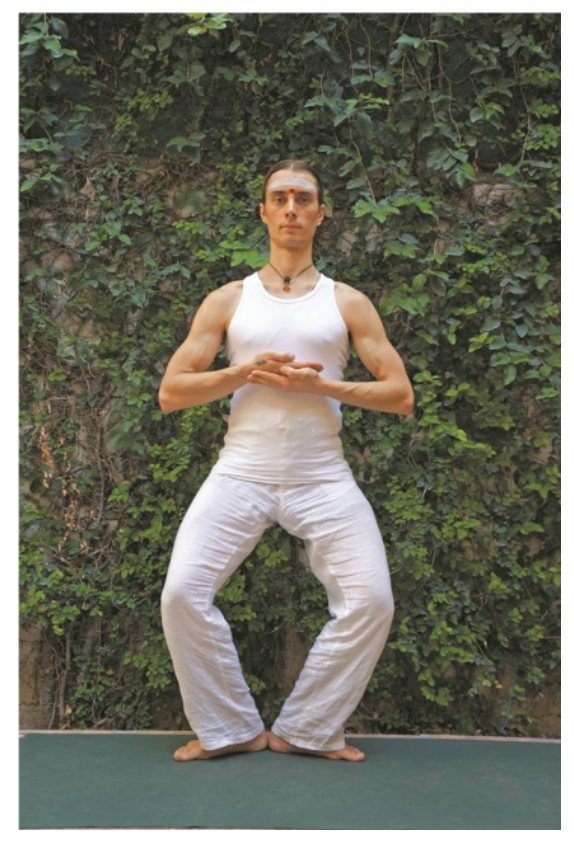
TECHNIQUE
- Your weight has to be on the thighs
- The legs have to be wide apart
- Hold the hands as shown (hold the hands in front of the Ananda Gandha – below the heart and above the navel)
IN 1ST KARANA OF SHIVA THANDAVAM, NEXT
2. – BHASTRIKAA KUMBHAKA
KUMBHAKA PADDHATI, VERSES:164 & 165
भस्त्रेव लोहकारस्य रेचपूरौ श्रमावधि ।
वेगेन स्तनयोरूर्ध्वं ततःपूरोऽर्कवर्त्मना ॥
जालन्धरं दृढं बध्वा कुम्भितं चन्द्रवर्त्मना ।
रेचयेद् भस्त्रिकाकुम्भः शरीराग्निविवर्द्धनः ॥
Bhastreva Lohakaarasya Rechapoorau Shramaavadhi |
Vegena Sthanayoroordhvam ThathahaPooro(a)rkavarthmanaa ||164||
Jaalandharam Dhrudam Badhvaa Kumbhitham Chandra-Varthmanaa |
Rechayeth-BhasthrikaaKumbhaha Shareeraagni-Vivarddhanaha ||165||
TRANSLATION
One should rapidly inhale and exhale similar to the bellows of a blacksmith till he becomes fatigued. Followed by this he should inhale through the right nostril and then having held the breath with the jaalandhara Bandha, he should exhale through the left nostril. This is Bhastrikaa Kumbhaka that increases bodily heat.
TECHNIQUE
- Rapidly inhale and exhale like the bellows of the black smith until you become fatigued
- Then inhale through the right nostril
- Press the chin on the chest so that the throat is locked
- Hold the breath as long as you can judiciously
- Relax the chin and exhale through left nostril
- Now stand straight
- Put your hands on your hip
- Now try to come back to the same posture
- Do this 3 times
NEXT
3. STANDING UDDEEYAANA BANDHA
GHERANDA SAMHITA, UPADESHA-3, VERSE: 10
॥ अथ उड्डीयान-बन्धः ॥
उदरे पश्चिमं तानं नाभेरुर्ध्वं तु कारयेत्।
उड्डानं कुरुते यस्मादविश्रान्तं महाखगः।
उड्डीयानं त्वसौ बन्धो मृत्यु-मातङ्ग-केसरी ॥
Udare pashchimam taanam Naabheroordhvam tu kaarayet | Uddaanam kurute yasmat Avishraantam mahaakhagaha | Uddeeyaanam tvasau bandhao Mrutyu-Maatanga-Kesaree || 3.10 ||
TRANSLATION One should contract the bowels above and below the navel so that the abdominal organs touch the back. The one who practices this uddeeyaana bandha continuously becomes a conqueror of death. The great bird (Kundalini) flies up in the Sushumna and flies there itself constantly.
TECHNIQUE
- Stand and Keep about half-a-metre gap between your feet
- Bend the knees slightly and rest your palms above the knees with the thumbs facing inwards and the fingers outwards.
- Keep the spine straight. Head should be up and eyes open
- Take a deep breath in and exhale completely, but do not be forceful.
- After exhaling, perform jalandhara bandha by moving the chin down to the chest and raising the shoulders.
- Pull the abdominal muscles inward so that the organs of the abdomen touch the back muscles
- Hold as long as you can.
- When you can’t hold anymore, Before inhaling, relax the stomach and abdomen, release jaalandhara bandha by raising the head, and stand straight.
- Then inhale through the nostrils slowly.
- Before repeating another round, breathe normally for a minute or two.
- Initially start with 3 times and gradually increase upto 10 times
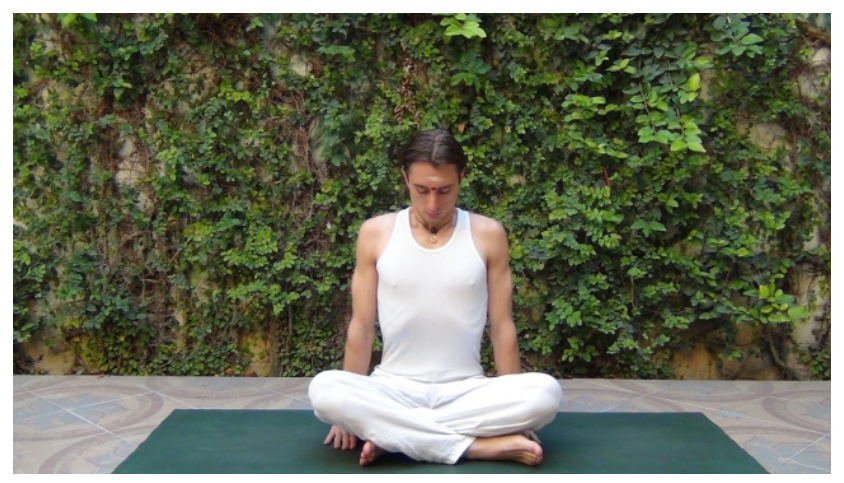
- Once you finished, please be seated
NEXT-IN SEATING POSITION
4. – TRISHOOLA KUMBHAKA
KUMBHAKA PADDHATHI, VERSE: 193
घोणा यां च मुखेनापि युगपत् पूरयेत् सदा ।
त्रिशूलिना त्रिशूलाख्यः कुम्भ उक्तस्त्रिशूलनुत् ॥
Ghonaabhyaam Cha Mukhenaapi YugapathPoorayethSadhaa | ThrishoolinaaTrishoolaakhyaha KumbhaUkthas-Trishoolanuth ||193||
TRANSLATION Always inhale through the nostrils and mouth together at a time. This is called the Trishoola Kumbhaka – the remover of triple sufferings – as explained by the Thrishooli Shiva.
TECHNIQUE
- Inhale through the nostrils and also through the mouth simultaneously
- Hold the breath as long as you can judiciously
- Now exhale through the nostrils slowly and relax
- Do this 7 times
IN SEATING POSITION, NEXT
5. - TRINETRA KUMBHAKA
KUMBHAKA PADDHATHI, VERSE: 192
सकृच्चन्द्रेण चापूर्य धार्यं सूर्येण पूरयेत् ।
नियम्य पूरयेन्नो यां धारयित्वा यथाविधि ॥
त्रिनेत्रकुम्भकः प्रोक्तः त्रिनेत्रेण त्रिसिद्धिदः ॥
SakruthChandrenaChaapoorya DhaaryaSooryenaPoorayeth | NiyamyaPoorayennobhyaam DhaarayithvaaYathaa-Vidhi || Thrinethra-KumbhakahaProkthaha ThrinethrenaThrisiddhidhaha ||
TRANSLATION Inhale through the left nostril and retain, inhale through the right nostril and retain and then inhale through both the nostrils, retain the breath (all these in one shot before exhalation). This is the Trinetra Kumbhaka – the giver of three siddhis – as explained by the three-eyed Shiva.
TECHNIQUE
- Inhale through the left nostril
- Hold the breath as long as you can judiciously
- Without exhalation, inhale through the right nostril
- Hold the breath as long as you can judiciously
- Again without exhaling, inhale through both the nostrils
- Hold the breath as long as you can judiciously
- Now exhale through both the nostrils slowly
- Do this 7 times
END OF KRIYA
Kriya Date
26-Feb-2012