CARE FOR EXCESSIVE SWEATING OF PALMS AND FEET
This text was machine-transcribed from the printed book and may contain errors. Select the words and choose “Report a mistake”.
Disease Description
Hyperhidrosis is the condition characterized by abnormally increased perspiration, in excess of that required for regulation of body temperature.
Hyperhidrosis can either be generalized or localized to specific parts of the body. Hands, feet, armpits, and the groin area are among the most active regions of perspiration due to the relatively high concentration of sweat glands; however, any part of the body may be affected.
Hyperhidrosis can also be classified depending by onset, congenital or acquired. Primary hyperhidrosis is found to start during adolescence or even before and seems to be inherited as an autosomal dominant genetic trait.
Primary hyperhidrosis must be distinguished from secondary hyperhidrosis, which can start at any point in life. The latter form may be due to a disorder of the thyroid or pituitary gland, diabetes mellitus, tumors, gout, menopause, certain drugs, or mercury poisoning. Hyperhidrosis may be also divided into palmoplantar (symptomatic sweating of primarily the hands or feet), gustatory and generalized hyperhidrosis.
STEPS TO BE FOLLOWED
- GARUDASANA
- SHEETHALI KUMBHAKA
- SEETHKARI KUMBHAKA
1. GARUDAASANA (version 1)
YOGAASANA MAALAA SACITRA, VERSE: 90
आसन कौ गुण घभमभश्र आदी दे बिष व्यापै नही ॥
Aasana Kau Guna sarpa Aadhee De Bisha Vyaapai Nahii ||90||
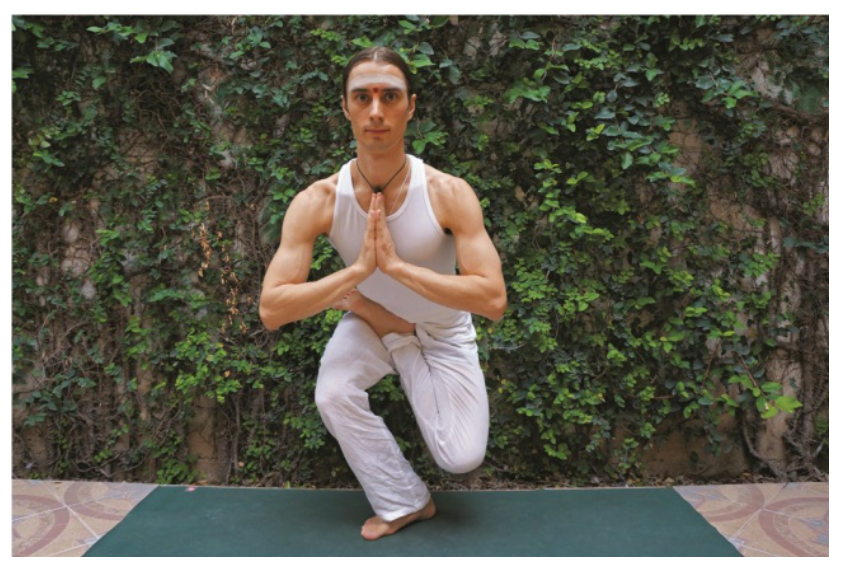
TRANSLATION-cum-TECHNIQUE
- Stand straight on the ground
- Balance yourself and place your left foot at the root of the left thigh
- Bend a little your right knee
- Bring the left knee close to the right ankle
- Fold the hands in prayer position and place it near the chest
- Settle in this posture for 30 seconds
IN GARUDASANA , NEXT-
2. SHEETHALEE KUMBHAKA
GHERANDA SAMHITA, UPADESHA 5, VERSES 73 & 74
जिह्वया वायुं आकृष्य उदरे पूरयेत् शनैः ।
क्षणं च कुम्भकं कृत्वा नाशाभ्यां रेचयेत् पुनः ॥
सर्वदा साधयेत् योगी शीतली कुम्भकं शुभम् ।
अजीनं कफ-पित्तं च नैव तस्य प्रजायते ॥
Jihvayaa Vaayum Aakrushya Udare Poorayet Shanaihi |
Kshanam Cha Kumbhakam Krutvaa Naasaabhyaam Rechayet Punaha || 5.73 || |
Sarvadaa Saadhayet Yogee Sheethalee-kumbhakam Shubham |
Ajeernam Kapha-Pittam Cha Naiva Tasya Prajaayathe || 5.74 ||
TRANSLATION Draw in the air through the mouth (with lips contracted and tongue thrown out), and fill the stomach slowly. Retain it there for a short time. Then exhale through both the nostrils. Let the Yogi always practice this Sheethalee Kumbhaka, giver of bliss; by so doing, he will be free from digestion, phlegm and bilious disorders.
TECHNIQUE
- Continue to sit in same asana
- Close the eyes and relax the whole body
- Extend the tongue outside the mouth and roll the sides of the tongue up so that it forms a tube
- Inhale slowly through the tongue and fill the abdomen slowly
- At the end of inhalation, roll the tongue in, close the mouth
- Retain it there for a short time
- Then exhale through both the nostrils
- Do this 21 minutes
IN GARUDASANA, NEXT
3. SEETHKAAREE PRAANAAYAAMA
HATHA PRADEEPIKAA, UPADESHA 4, VERSE 43
सीत्कां दद्यात् सदा वक्त्रे घ्राणेनैव विसर्जयेत् ।
एवमभ्यास योगेन कामदेवो द्वितीयकः ॥
Seethkaam dadyaath sadaa Vaktre Ghraanenaiva Visarjayet |
Evam Abhyaasa-Yogena Kaamadevo Dviteeyakaha ||4.43||
TRANSLATION By drawing the breath in through the mouth, make a hissing sound, without opening the mouth, and exhale through the nose. By practicing this, one becomes a second Kaamadevatha (god of love).
TECHNIQUE
- Stay in same asana
- Press the lower and upper teeth together and separate the lips as much as comfortable
- Breath in slowly through the gaps of the teeth
- Listen to the sound of the breath as the air is being drawn in
- Close the mouth at the end of the inhalation
- Exhale slowly through the nose
- Do this 21 times
END OF KRIYA