CHAOTIC BREATHING
This text was machine-transcribed from the printed book and may contain errors. Select the words and choose “Report a mistake”.
(Duration : 7 mins)
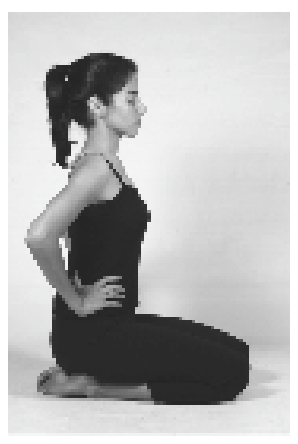
F or the first seven minutes sit in vajrasana (as shown in the picture) with eyes closed and hands on your hips and breathe chaotically. Inhale and exhale deeply and chaotically. Just focus on the breathing. Your entire being should become the breathing.
Normally in our body, the energy flows from the sahasrara chakra (crown center) to the muladhara chakra (root center). Vajrasana posture helps in the upward movement of energy.
Breath is the best place from where one can start any spiritual practice. There are different kinds of meditation techniques. Some focus on witnessing, while some focus on repeating a word or a mantra. But I can tell you that breath is the best place to begin any spiritual practice.
There are two types of systems in your body. One is voluntary and the other is involuntary. The movement of hands and legs is an example of voluntary action. When required you can move your hands and legs. But you cannot directly control the functioning of your brain, or the beating of your heart. Those are involuntary movements. But breathing is one system that is voluntary as well as involuntary. Even if you are not aware, the breathing mechanism continues to function. You don't stop breathing when you focus your attention on something else. That would be a calamity! Likewise, you can also control your breathing. The whole science of Pranayama emphasizes on control of breath. You can breathe deeply and slowly as and when required. You can hold your breath for long durations or even stop breathing for a few minutes. So breath is a link between your voluntary and involuntary systems.
But you can never stop breathing and die because then it would be a fight between your survival instinct and your will. And your survival instinct is much stronger than your will. In fact all involuntary movements in your body happen due to the survival instinct. You are living due to your very desire to live. Your very breathing happens due to the desire to live.
You might not have observed, but your quality of breathing changes depending on the state of mind. Your emotions have an impact on the breathing process. When you are in anxiety, your breathing changes. When you are angry, your breathing changes. When you are aroused sexually, your breathing changes. When you are in love, there is a qualitative change in your breathing. So your breathing is directly related to your emotions. It keeps changing as the state of the mind changes. When you are in tension, the normal advice given is to have a deep breath. And the moment you have a deep breath suddenly you feel light, more relaxed and the tension releases! Mind and breath are closely related. You can see that when you stop breathing, it becomes very difficult to think. Breath becomes the fuel for the mind. Actually in Sanskrit, we use the word prana. Prana does not directly mean breath. It means the energy that flows through breath. That energy itself is the life force.
In the Taitreya Upanishad, five sheaths (pancha koshas) are mentioned. The annamaya kosha (physical body sheath), pranamaya kosha (breath sheath), manomaya kosha (mind sheath), vijnanamaya kosha (intelligence sheath) and anandamaya kosha (bliss sheath). These sheaths are like the peels of an onion which cover the center, the self, the atman. The pranamaya kosha or the breath sheath is where all your desire memories are stored. So depending on your desires, your prana or breath gets modulated. Your breathing and your desires are tightly coupled. You might have seen that when you have too many desires, your breathing is very fast and heavy. When you have a few desires you breathe in a more relaxed way.
As the breath and the mind are inter-related, changing one automatically changes the other. We have already discussed how our emotions affect the breathing pattern. Likewise, if we were to control our breathing or bring about some change in our breathing pattern, it will have a direct impact on our emotions; our state of mind.
All our memories are stored in the muscles. I also strongly believe that if some part of the body is amputated, you would eventually lose the memory related to that part of the body. You could try this small
experiment: Try to remember some past incident in your life without remembering your form. It would be impossible! Your form is necessary for you to remember any incident in your life, because all your memories are stored in your form.
You have suppressed many emotions in your being and as a result you are not able to breathe normally. Your breath is shallow. When you breathe shallow, you never release these suppressed emotions and memories that are stored in your muscles. The breathing never touches each and every part of the body.
We always breathe in a fixed pattern. Our past samskaras, our past memories which are suppressed in our being, create a particular type of breathing pattern in our system. As a result we attract similar emotions and samskaras. Anything within our system has a survival instinct. So anything that is suppressed in our system creates favorable circumstances for it to stay and grow inside our system. If you have suppressed anger in your system, it will keep surfacing and create a breathing pattern for its survival. This is a vicious cycle. Your breathing is nothing but a cumulative effect of the past samskaras.
So Nithya Dhyaan begins with chaotic breathing. You have to breathe as deeply as possible and as chaotically as possible. Your entire being should become the breathing. Understand that breathing has to be deep. The chaotic breathing should not be shallow. The deep chaotic breathing will start releasing the tension in your muscles and body parts and in turn, all the engraved memories. Normally our muscles are always under stress. Chaotic breathing will loosen the muscles and start clearing the samskaras.
Each emotion within us gives rise to a particular breathing pattern. You might have seen that children breathe deeply and blissfully. They don't breath shallow. But as they grow, they get conditioned by society, by their pains, pleasures, guilts, beliefs, stress and other emotions, and the quality of the breathing changes totally. Now, if you have to shake this pattern, something that has been created due to the emotions suppressed in your system since so many years, you have to insert chaos. You have to create a turmoil! Inserting another pattern is not the solution. You have to create utter chaos in your system to dig out all the past impressions. So I don't recommend any rhythmic breathing pattern like pranayama, in this meditation. Just chaotic breathing should be done. This chaotic breathing will destroy all your past samskaras.
It is like shaking a tree with dead leaves. All the dead leaves will fall. Similarly chaotic breathing is like shaking your suppressed system. All the past engraved memories will be released.
Deep chaotic breathing also infuses tremendous oxygen and releases carbon dioxide from the body. It creates hyperventilation and as a result you feel more vibrant and fresh. By increased intake of oxygen in the blood, automatically all the body parts become alive and that creates more bio-energy in the body cells.
Normally we always feel ourselves as heavy dead mass. That is because our body is never alive. It is always under stress and tension. Anything that is tense can never be alive. If the body is made alive with increased flow of oxygen, you will start feeling light. Then you will start experiencing yourself as energy rather than matter. You feel heavy because of the engraved memories.
In fact in some Buddhist monasteries they use this concept of energy versus matter, as a technique to ordain people as monks in the monastery. After you are done with your spiritual disciplines, you are made to walk on grass. If you make a path (grass below your feet dies), then you are not initiated as a monk and more spiritual discipline is prescribed. A person with less samskaras will never make a path on the grass when he walks, because the burden of engraved memories is less and he always feels light within his system.
With increased oxygen and reduced carbon dioxide in chaotic breathing, you will make your suppressed system alive. The breathing should be so deep, intense and chaotic that your whole being should become the breathing. The bio-energy that is generated will melt your muscles and start clearing the samskaras, making you feel light, energetic and blissful. Thus we move on to the second step.
If you would like to know more techniques related to chaotic breathing, you can also practice the dukkaharana meditation technique which is taught in the Life Bliss Program (LBP) or Ananda Spurana Program (ASP).