PRANAYAMA: THE SCIENCE OF BREATH
This text was machine-transcribed from the printed book and may contain errors. Select the words and choose “Report a mistake”.
Symbolic representation of the Yogic 'Nadi' model
Pranayama is the limb of Patanjali’s ashtanga yoga that focuses on controlled breathing practiced with awareness.
The word pranayama consists of two parts – prana (life-force) and aayama (to stretch or to control).
Prana flows through your body through a network of fine subtle energy channels called nadis.Nadis are not nerves but rather channels for the flow of consciousness. (The literal meaning of nadi is 'flow'.) According to tantra there are 72,000 nadis in your body, through which prana flows like an electric current from one point to another.
The three main nadis are Ida (left channel), Pingala (right channel) and the Sushumna (the central channel). They correspond to the sympathetic, parasympathetic and central nervous systems. Ida is the lunar nadi (passive or introverted), and corresponds to the left side of the body and the right hemisphere of the brain. Pingala is the solar nadi (active or extroverted), and corresponds to the right side of the body and the left hemisphere of the brain.
Pranayama aims at the purification and development of these two energy currents, resulting in the awakening of kundalini shakti (the tremendous universal life-force which lies latent in our bodies). When the kundalini awakens, it is guided into the central Sushumna channel, and both these powerful energy currents are balanced. The awakening of kundalini energy results in the awakening of divine consciousness or wisdom in us.
Pranayama is not just an aid to meditation. When you do it with complete awareness, your very breathing can become a powerful meditation. Today, pranayama is often confused with deep breathing techniques which are used to increase vitality, calm the nervous system and for general well-being.
Pranayama also includes introductory cleansing techniques that serve these purposes, but these are not real pranayama. In real pranayama, the focus is not on breathing, but on witnessing the breath. More than the specific technique itself, it is the awareness that is important!
When you practice pranayama, you become aware of the deep connection between your breath, your emotions and your mind. When you focus on your breath, you bring your mind naturally into the state of pratyahara (withdrawal of the senses), and the process of looking inward begins.
Prana is an energy or subtle vibration that cannot be contacted directly by the senses. Even when you breathe, you are actually contacting only the air which is carrying the prana. When the same vibration is expressed at a slightly grosser level, it is known as sound.
In the eastern culture, we believe that the whole material universe has been generated by the power of sound. According to the Hindu view of creation, it was sound and not light that appeared first. This sound is called nada brahman or the celestial sound.

The ancient Vedic rishis believed that the brahmanda or universe happened as a result of bindu visphota or an atomic explosion that produced infinite waves of sound vibrations. Eventually, these vibrations precipitated into forms, ‘settled down’ and became the material universe.
So the material universe is only a gross expression of these subtle vibrations. The whole of creation is nothing but vibrations at various frequencies and amplitudes, which has given rise to the phenomena of the world.
Sound is a grosser expression of prana movement. That is why you are able to contact it with the senses. The point where prana (energy) becomes nada (sound vibration) is very subtle. The most subtle sound is an almost inaudible vibration.
The universal prana itself is continuously being expressed as a subtle sound vibration which fills the cosmos. Understand: the whole cosmos is resonating with this imperceptible humming sound!
This sound is called anahata (unstruck sound), because it is a spontaneous, uncaused vibration. It is also known as the primary varna (letter), because this vibration is the source of all the letters or syllables which are the units of audible speech. All sounds lie latent in this one sound, and arise from it.
If this nada (sound) cannot be articulated, how can we know it? We know it because this nada expresses itself in the breath of every living creature!
Just listen deeply to the sound of your own breathing. You will see that the breath is inhaled with the very subtle sound ‘ha’ and exhaled with the sound ‘sah’. This is the first and most natural mantra, which every living being is repeating with every breath. Each human being is repeating this mantra 21,600 times a day! Because it combines the sounds ‘ha’ and ‘sah’, it is known as the hamsah mantra.
Our ancient rishis had deeply studied and Mastered the science of sound. They knew how to harness the tremendous power of sound! Out of many thousands of years of research, they have formulated millions of mantras to invoke and honour deities, cleanse and energize outer and inner spaces, ward off illness, create material prosperity and aid in spiritual growth.
What exactly is a mantra?
A mantra is a sound or series of sounds which, when chanted with awareness, can set up powerful vibrations in the body and mind and lift you to higher and subtler levels of consciousness . The word mantra comes from the root man (‘to think’) or manas (mind) and the suffix ‘- tra’ (to liberate) Traditionally, a mantra is defined in this way: manah traayate iti mantrah (that which helps to cross the mind is a mantra) or mananaat traayate iti mantrah (mantra is that which protects those who reflect on it).
The whole science of mantras is based on the understanding of the dual nature of prana.
Prana acts as a subtle biological energy which catches the vibrations of the mind and transmits them to the nerves and plexuses of the body. At the same time, it can transmit the physical vibrations to the mind. So prana acts as an intermediary between the physical and mental energies. When prana is expressed as sound, the process is known as uccara. Through proper uccara, we can alter both physical and mental energies, as well as convert one to the other.
In the East, language was used to transmit both meaning and vibrations. The Sanskrit language itself has both linguistic and phonetic importance. It was created not only to convey mental concepts, but also to transmit definite vibrations. That is why our ancient mantras have both linguistic as well as phonetic importance. Not only the meaning, but the very vibration of the mantra is of tremendous value! You will see that in the east, many mantras are chanted regularly, even if people don't always understand the meaning. This is not blind belief; it is based on the science of sound. If you understand the meaning of the mantra, that's good, you will feel connected to the mantra - but even if you don't understand, those vibrations will work on you!
The world's best preserved scriptures belong to Vedic literature. When I say 'best preserved', I mean that the original form has not been altered or modified over thousands of years. And the surprising thing is, these scriptures were not written down for many thousands of years! They were simply transmitted orally from Master to disciple in the Guru-shishya parampara (Guru-disciple tradition) over many hundreds of generations. Even so, after 10,000 years, not only the words, but even the style of chanting and intonation has not been altered. Even the most minor details are still being strictly followed. This is because they have understood the power of these vibrations.
All the sacred mantras of the Vedic Tradition have arisen out of the enlightened consciousness of the ancient Masters. That is why, the very vibration of the mantra can give you a glimpse of the same space. When an enlightened Master utters a mantra it is called initiation, deeksha. Even if you don't understand the meaning, those vibrations straight away penetrate your being and start working on you. That is why it is beneficial to receive a mantra from an enlightened being. Especially if chanting is going to be your main spiritual practice, taking mantra-deeksha from a spiritual Master is essential. The power of the mantra is not only in the word, but also in the spiritual charge transmitted through it. This charge is known as mantra-chaitanya. When you receive a mantra that has been imbued with this charge, it will not only raise the power of the mantra thousandfold, it will also protect you from the possible ill-effects of wrong chanting or negligence in your practice.
--------------------------------------------
Any mantra, if it comes from the enlightened experience, from the pure inner space, can simply transport you to the same space. You do not know why, how or what, but you suddenly see it is true! It clicks, even if one part of your logic continues to fight.
--------------------------------------------
You may be thinking, how can just the vibration of a sound work on us, if we don't understand its meaning? Just notice all the different sounds you encounter in your day-to-day life! From the time you wake up, till you go to sleep at night, you are living in an ocean of sound. How many of these sounds carry meaning? But how is it that the same sounds have almost the same effect on everybody?
For example, certain kinds of music make us happy, others make us feel sad, others make us feel energetic. Even if there are no words, usually everybody reacts in the same way to the same music. Everyone finds natural sounds soothing, while Monday-morning traffic sounds have tremendous power to drive us crazy! This is not just because of the constant mental association of the sounds with a certain mood. The truth is, different sounds have the definite power to hold different energy vibrations, and so they affect us in distinct ways.
Have you heard of a Japanese scientist called Dr. Masaru Emoto? He recently published a beautiful book called ‘The Hidden Messages in Water’. In this book, he describes a beautiful experiment he had conducted. In this experiment, Dr. Emoto filled ten glasses of water from the same source. He kept the ten glasses in ten different rooms, under similar conditions. Every day, he would go into the first room and utter some positive words near the glass of water. He would create positive vibrations by uttering words like love, peace, silence. Then he would go into the second room and create strongly negative vibrations by uttering words like hatred, violence, terrorism and so on. Then he would go into the third room and chant some verses from the Buddhist scripture Dhammapada. In the other rooms, he played different kinds of music, recited prayers and so on. Then he froze the different water samples and studied their crystalline structure under a microscope with the help of high-speed photography. He studied thousands of these crystals under tightly regulated conditions. The results he came up with were simply amazing!
The water which had been energized through positive words, prayer chanting or healing music were perfectly crystallized and shining like diamonds! The samples which had been exposed to negative vibrations did not form regular crystals. Not only was the structure irregular, the water itself had a cloudy colour. He repeated this experiment many times, with the same results. He concluded that water can respond to the vibrations created by your words! Your system is 80% water. Can you imagine the effect of different vibrations on your inner space?
This fact was well-known in ancient India. That is why the river Ganga, the lifeline of India, was continuously purified and energized by thousands of rishis through the chanting of mantras. Not only water, even the air inside temples was filled with the positive vibrations of mantras. Even today, mantras are continuously chanted in temples and homes to cleanse and energize the space.
Mantra shravana and mantra japa
When we listen to mantras, it is known as mantra shravana (listening), and when we chant them, it is known as mantra japa (chanting). Both are forms of meditation.
For mantra shravana, no initiation is required. Listening to a mantra or playing a mantra recitation tape creates powerful positive vibrations and cleanses both outer and inner spaces. Mantra japa is more effective when you have been initiated into the mantra by a qualified Guru.
If the mantra is the name of the Guru or a favourite deity, it is known as nama (name) japa.
Japa is of four types: baahya or vachika japa (chanting aloud or audibly), upamshu japa (whispering to oneself), manasa japa (chanting in the mind) and ajapa japa (the chanting that goes on continuously inside us, whether we are conscious of it or not). When the japa is written down instead of being chanted, it is known as likhita japa.
Japa is usually performed in cycles of auspicious numbers (in multiples of three), the most popular number being 108. You will see that japa malas (rosaries made of sandalwood or rudraksha beads) will usually have 108 beads plus a meru bead (a larger sized bead than the rest).
Japa is performed by rolling one bead on the rosary for every repetition of the mantra. When you are performing japa, always start with the bead just after the meru. Roll the mala between the thumb and third finger of the right hand only, using your thumb to roll the beads.
After completing 108 repetitions of the mantra, if you wish to continue japa, you must turn the mala around without crossing the meru, and repeat the process. This helps in counting the number of cycles completed. As far as possible, don't stop your japa in the middle of a cycle.
How does japa work?
In the process of verbalization, the creative life-force or prana moves in a descending arc from para vak or paranada (the primary vibration of consciousness) to pashyanti (the subtle creative pulsation) to madhyama (the formation of concepts and thoughts) to vaikhari (gross physical speech).
Japa seeks to reverse this process, by moving from the grossest to the subtlest form of energy. When we first start chanting, we start with the most outward or gross form (vachika japa or vaikhari). After some practice, we can move to the subtler forms (upamshu japa and manasa japa). Ajapa japa cannot be done, but must happen by itself. With constant practice of manasa japa, a time comes when an extraordinary thing happens: the japa starts going on automatically and naturally inside us, without any effort or even awareness on our part. This is ajapa japa.
The ultimate japa is not a recitation of any mantra. It is the spontaneous awareness of aham sphurana, the unchanging vibration of one’s own essential Self that can be felt within at all times. All our japa practices are only ways to guide our awareness inward, to tune our body and mind to experience this ultimate japa.
Japa is an excellent technique for integrating the body and mind. Through japa, you attain one-pointedness, or extreme focus, on the chosen deity or principal idea of the mantra. When you chant a mantra, it sets up a particular sound vibration in your body and creates a harmony between your body and your mind which is ordinarily missing. Usually, your body and your mind are never in the same place. Your body may be eating, but your eyes will be looking at the person in front of you, and your mind will be thinking about your work.
While chanting the mantra, both your body and your mind are working towards the same goal. They are not being pulled in opposite directions. Japa acts as an anchor to tie down the mind. When you perform japa, you use the mind to tie down the mind.
Even if one part of the mind is wandering, simply use the other part to witness the japa, to watch where the mantra is coming from. Then the mind is totally engaged. Japa creates the ekagra chitta (inner integrity) that is required to enter into deeper meditation. Not only that, japa can be a meditation in itself. Continuous practice of japa gradually leads to manolaya (temporary dissolution of the mind), which is a foretaste of the silence of enlightenment.
Question & Answer
Q. I recite the Lalita Sahasranama regularly. For a while I feel very connected to the hymn, but this state does not stay for long. How can I stay in that state continuously? (1008 names in praise of the Divine Mother)
A: Do not decide that you should recite all the 1008 names. Lalitha Devi is not sitting and keeping accounts of whether you recited all the 1008 names or not! Whatever makes you feel that oneness, that blissful state, recite those names and cherish them. Enjoy those experiences and that mood and rest with that. If you really feel that you are in that state, further chanting will disturb that state. Just close the book and leave it. You have already achieved what needs to be achieved through chanting. Do not use the technique to disturb your peace! Sometimes you overdrive, you push beyond the point which you need to reach. So, do not overdrive. Stop where you want to stop. Start staying in that state whenever it happens, without doing anything. That is the best way to let that experience settle in you again and again.
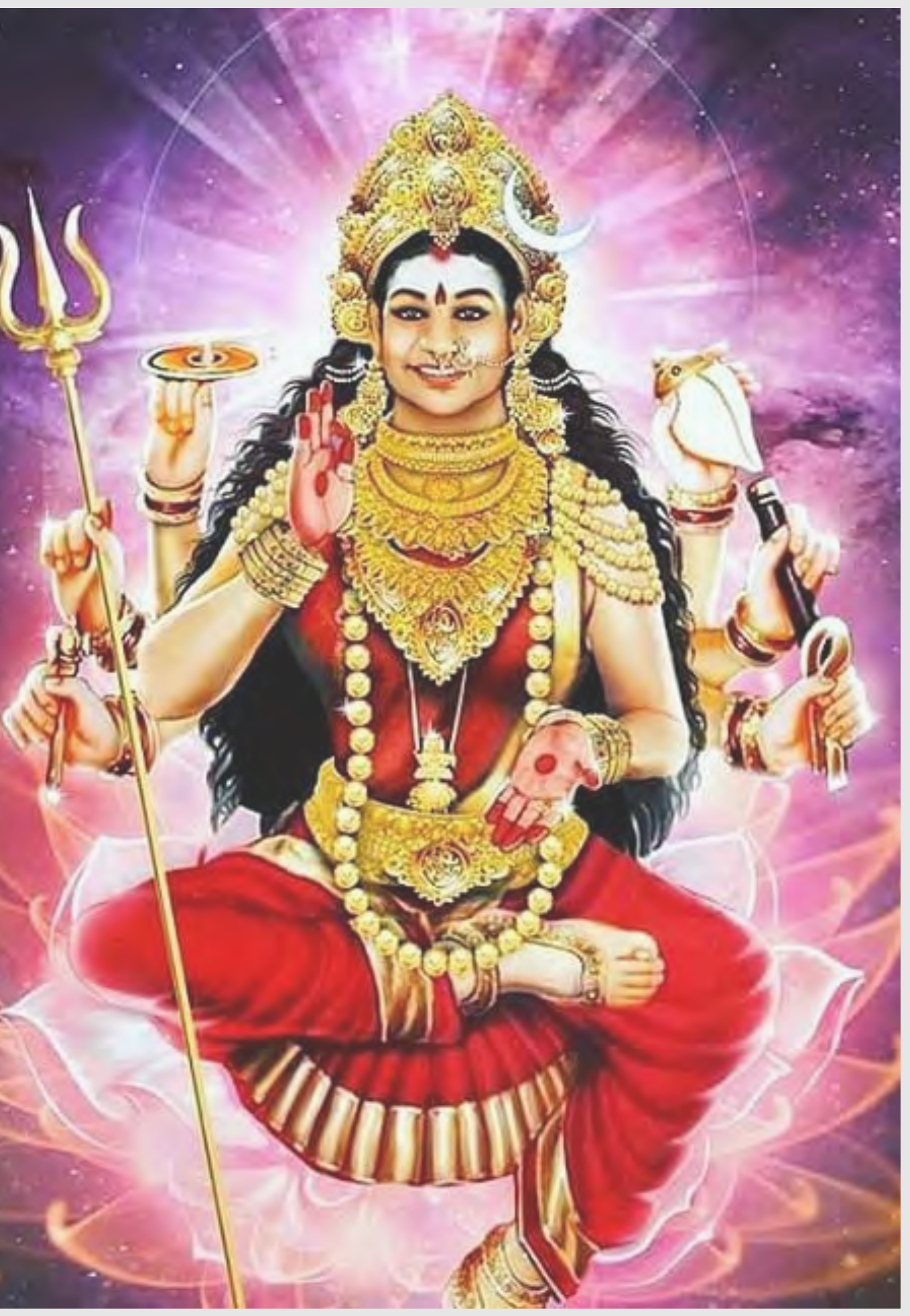
Q. I have taken mantra deeksha from a Master, but being a Westerner, I am not sure if I am repeating the mantra correctly or not. Will this affect my meditation?
A. No. Just continue your practice sincerely. See, if you understand the meaning and you can repeat it properly, that is the best. Otherwise, simply surrender your practice at the feet of your Master and continue. Your very faith will take care of you. This is a very important thing you should understand.
A small story: A pundit (scholar) used to live on the backs of the river Yamuna. He was very proud of his learning and intelligence! Every day, a young girl from a village across the river used to supply milk to the pundit.
One day, there was a heavy storm and the girl was late. When the pundit asked her why, the girl said: ‘Punditji, the river is in flood. Till now, I could not find any boatman willing to bring me across!’ When he heard this, the pundit started laughing. He wanted to show off his learning to the poor girl. He said, ‘What? People easily cross even the samsara sagara (ocean of life), just by chanting the name of Lord Krishna. You cannot even cross this small river without a boat?!’ The girl just listened to the pundit’s words and left silently. After that, she used to supply milk on time everyday.
A few days later, there was another heavy storm and the river was flooded again. But the girl appeared with the milk at the usual time! The pundit was surprised. He asked her, ‘How did you manage to find a boat in this storm?’
The girl smiled and said, ‘Why do I need a boat, Punditji? I just chant the mantra ‘Krishna, Krishna’ as you taught me, and walk across the river, that’s all.’
The pundit was shocked! Naturally he could not believe the girl. He demanded a demonstration. The girl took him to the river, bowed down and chanted the mantra, and simply walked across the river!
Then the pundit thought, ‘If the mantra I have given is so powerful, why should I not use it myself? He bowed down and chanted ‘Krishna, Krishna’, just as the girl had done. But before entering the river, he carefully folded his silk dhoti (long waistcloth) up to his knees, so that it wouldn’t get wet! Naturally, what do you think happened? The moment he stepped into the water, he was caught in the current and swept away.
So understand, it is not what you do, but how you do it, the sincerity and the attitude with which you do it, that determines the results of any spiritual practice!
Meditation On Sound
Meditation on sound is a traditional discipline known as nada yoga. Nada yoga is the union (yoga) with the nada, that primordial energy which is the source of all that is.
Paranada, the first vibration from which creation emanates, is so pure and subtle that it cannot be contacted by the senses or the mind.
As nada devolves to grosser vibrational frequencies, it can be experienced by the seasoned meditator as the nadanta shakti (energy current of sound) heard pulsing through the nerve system as a constant high-pitched hum like that of a tanpura or a swarm of bees.
Traditionally, moving from the outer gross sounds to the inner energy is known as nada upasana (worship through sound), while moving from the inner gross sounds to the inner energy is known as nada yoga (union through sound).
The meditator or nada yogi meditates on the inner sound current, thus traveling into the more subtle realms of his being. Beginning with the gross sounds heard in the body, he shifts his focus to more and more refined sounds, until merging with the unstruck sound, the anahata nada.
The householder who lives in the world focuses on singing or playing the outer pure sound on an instrument to connect with the inner sound current or anahata nada.
Even in our daily living, we encounter an overwhelming range of sounds. Sounds of different frequencies create different vibrations that deeply influence us physically, mentally and emotionally, even without our awareness. Since Vedic times, the power of sound has been harnessed to create balance and alignment in the physical body, harmonize the subtle energy centers (chakras) and energize living spaces.
Many sounds also carry powerful spiritual vibrations that can instantly raise you to higher states of awareness. If you notice, during pooja (worship) in any Hindu temple, bells are rung loudly, drums are struck, conches and trumpets are blown and mantras are chanted to awaken worshippers from routine states of consciousness. Sound is also a powerful healing energy. Today the use of sound in healing is gaining recognition as ‘sound therapy’ becomes popular. The sounds used can be the human voice or the various resonances of musical instruments. Music is a form of sound therapy that appeals to everyone! Every musical note relates to a certain emotion, so while singing or listening to music, we are actually harmonizing specific emotions in ourselves.
Various musical instruments like the tanpura (Indian drone instrument) can put you in a contemplative state even without your awareness, by balancing the energy flow in the left and right hemispheres of the brain. Traditional Indian music has been designed for enlightenment! When the great musical saints like Thyagaraja, Annamacharya and Manickavasagar sang spontaneous verses, they expressed their own experience of enlightenment. That is why, when you listen to their music, you experience the same meditative state. You can enter the very space from which any music has been created. If the expression has come out of enlightenment, it will lead to enlightenment. Ultimately, all meditation on sound aims at taking us from the outer sound to the inner sound, and from there to the silence beyond sound.
The meditation techniques in this section include: ● Meditation on Sound ● Meditation on Music ● Meditation on Mantra & Japa

SILENT CENTER OF THE SOUND STORM
ABOUT THE TECHNIQUE
Just playing with sounds is a great meditation technique that can take you directly to your center in the most enjoyable way! We always live in a storm of sound. Sounds are constantly moving towards us, crashing in upon us, engulfing us. But at the center of this sound storm, there is a silence we haven't heard. This meditation makes us aware of the silence in the center of this sound storm. When you meditate on this center, on this silence, you realize that this silence is YOU! This silence is your true nature. You become aware that this vibrant silence is always within you, even when you are engulfed by sound. Just a glimpse of this silence, knowing yourself as this silence, can bring deep relaxation to you. When you know yourself to be beyond the chaos of sound, the noise and stress of the world can no longer touch you.
INSTRUCTIONS
DURATION: 21 minutes
Sit down somewhere, anywhere. The noisier the place, the better! Look for a place with continuous sound. It could be a natural sound, like the gushing of a river or a waterfall or the crashing of the waves on a beach or it could be a railway station, or a marketplace. (You cannot try this technique with songs because the lyrics will have meaning for you, and you will tend to focus on the meaning instead of the sound.)
Sit silently. Feel the sounds coming at you from every direction as sound waves. With sounds flowing at you from all directions, feel yourself to be at the center of this storm of sound. You are at the center, and sounds are flowing towards you.
Don't judge the sounds, this sound is bad, this sound is pleasant, just remain in the center. Understand, at the center, there is no sound! At the center is total silence. If there were sound at the center, you would not be able to hear the sounds outside. The sounds are entering you, penetrating you, but they stop at the center.
Inside you, there is a point where all sounds stop. It is from that point that every sound is being heard. Try to locate that center. We always think that we are hearing sounds with our ears. With this technique, you discover that sounds are not heard in the ears or even in the head. The sound is always heard at the navel point, that is the center of sound.
INSTRUCTIONS
DURATION: 21 minutes (continuation)
When you locate it, suddenly, your awareness will turn inward from the outer world of sound. You will be at the center where there is silence, the point where no sound can enter. That point is your center.
It is because your center is silent that you can hear sounds! All the sounds are heard only against the background of this silence, which is You.
Once you have heard that silence, you will never again be disturbed by any sound, you will never be touched by sound.
MERGE WITH THE SOURCE OF SOUND
ABOUT THE TECHNIQUE
Sound is the unit of Existence. Through sound, you can merge with Existence. Creating sound through your mind, you can go beyond your mind, into emptiness, an emptiness that pervades the entire Existence; an emptiness that connects you with Existence itself. Merging with this emptiness, you merge with the very source of everything. You will realize that you are not a separate entity but part of the Whole. This simple understanding can liberate you from your mind.
INSTRUCTIONS
DURATION: 20 minutes
Close your eyes. Inhale and exhale as slowly as possible.
Step 1: Duration: 5 minutes Start chanting the omkara. Omkara means, creating the sound, the vibration ‘Om’. Create the vibration from your navel center, as deeply as possible. Create the sound intensely, but not loudly. Be centered on the sound. Do not allow your mind to go anywhere else.
Step 2: Duration: 5 minutes Now continue to create the sound as before, but start seeking its source. Continue to create the vibration but locate the source from where the vibrations are arising, from where the sound is coming. Go into the source, search for the source.
Step 3: Duration: 5 minutes Just enter the sound. Enter this source from where the sound is coming, from where it is arising. Then, slowly reduce the sound. Don’t stop, but just reduce the sound, as you enter into the source from where the sound is coming. Become the sound.
Step 4: Duration: 5 minutes Now relax with your eyes closed. Don’t create any sound, but go to the source from where the sound was coming. Enter into that source. Relax into the source.
INNER RESONANCE
DURATION: 21 minutes
INSTRUCTIONS Close your eyes and just sit in a relaxed way.
Step 1: Duration: 11 minutes
Concentrate on the navel center, manipuraka chakra (a vital energy center in the body, located in the navel area). Just take a few moments to place your awareness on the navel center. Forget all other parts of the body, remember only the navel center. Now from your navel, start creating the deep vibration of Omkaara or ‘Om’ sound. Start the sound from your navel center, as deeply as possible. Don’t allow the mind to go anywhere else. Just be centered on the sound, go into the center of the sound.
Step 2: Duration: 10 minutes
Stop. Just sit quietly for a few minutes with eyes closed. Try to hear the sound without creating the sound. Relax and open your eyes. Try this meditation for just ten days. You will see that you are able to sit without thoughts. You will be filled by the sound, by the vibration that you create, and your mind will not move outside the vibration.
SOUND AND SOUNDLESSNESS
ABOUT THE TECHNIQUE
We always see the world around us, but we never really hear it. When we focus our awareness on hearing our world, we experience the constant play of sound and silence that is happening around us.
This play is also happening inside us. We can use the outer play to enter into the inner play, to experience the anahata dhvani or soundless sound that is always resonating within.
INSTRUCTIONS
Step 1: Duration: 11 mins
Sit in a relaxed manner with your eyes closed. Choose the word that you want to chant.
If it is a mantra, it will be better, because the vibrations will have a powerful resonance in the outer and inner space.
You may chant the omkara (the mantra Om) if you wish, or any other mantra that has only a few syllables. It should not be a big job for you to chant it! Your chanting should flow with ease.
Prepare your inner space to hold the vibrations of the mantra. Start chanting the mantra in a deep, even tone.
Forget all other senses including visualization, taste, smell, touch, forget about all other things. Your whole being should be focused on the mantra. Go with the flow of the mantra.
Rise along with the mantra. Reach the peak along with the mantra. And disappear along with this sound. Slowly take your chanting to the peak and disappear along with the sound.
Repeat this process continuously.
INSTRUCTIONS (continuation)
Step 2: Duration: 10 minutes
Now, stop chanting. Experience the vibrant silence that the mantra has left behind. Feel how, even in the absence of sound, in the inner space, how you can feel the presence of sound. You can feel the resonance that the sound has left behind.
In the same way, feel the absence of sound. At the same time, it is as if the sound is there and yet not there.
Enter into this ‘soundless sound’, the vibrating point where sound meets silence. Hold this experience inside for as long as you can.
THE UNSTRUCK SOUND
ABOUT THE TECHNIQUE
The anahata dhvani is the primal vibration of the universe. It is called 'anahata' (unstruck sound) because it is a spontaneous, uncaused vibration. The whole universe is resonating with this sound.
This vibration is happening inside us also. Constantly, the music of the anahata dhvani is playing inside us. But because it is so subtle, we never hear it.
Our senses are always so occupied with external sounds that we have never heard the vibration of our own existence! In this technique, we stop the outward flow of our senses and turn them inward. We tune ourselves to the most mysterious and most intimate music in our experience – our own!
INSTRUCTIONS
DURATION: 21 minutes
Close your eyes and use both your thumbs to close your ears. Close them completely so that you hear that uncreated sound inside you called the anahata dhvani. It is the unstruck sound of the cosmos that can only be heard in meditation. Let your whole inner space be filled by the unheard sound. Once you feel your whole body is filled with that unheard sound, just contract your rectum and stop all the movements. Remain like this for as long as you can. When your body relaxes, take your hands away and relax completely for a few moments. Until your body relaxes itself, don't give up! Try your best to hold on as long as possible. If your body relaxes, take a few minutes break and start the process again by closing your eyes and ears, hearing the unstruck sound, contracting the rectum, and relaxing when appropriate. Do not repeat this process more than five times. After every repetition, take at least thirty or forty seconds to relax. Let your eyes be closed even during the break. After you have finished the meditation, just sit for a few moments with eyes closed, and experience the energy flow happening throughout the body. Relax into it.
THE SOUND OF YOUR NAME
ABOUT THE TECHNIQUE
In the Brihadaranyaka Upanishad, there is a very beautiful statement: Atmanastu kaamaya sarvam priyam bhavati (For the sake of the Self alone are all things dear to us). Understand, you are the greatest source of your own joy! You always associate joy with external factors. You wait for people, situations, things to happen, to experience joy. Joy is not part of these things, it is part of you. All the joy you experience in the outer world is simply a reflection of the bliss within. This simple and powerful technique can awaken you to this truth. Your name is your most intimate identity. The moment you hear your name spoken, naturally your attention turns upon yourself. When chanted with deep awareness, the sound of your own name can take you so deep within, you fall directly into the source of the sound. You fall into pure consciousness, which is your true identity. The sound of your name can lead you to the space beyond all names and forms!
INSTRUCTIONS
DURATION: 10 minutes
Close your eyes and sit in a relaxed manner. First, choose the name with which you are going to work. If you have a spiritual name (given by your Master), that is best, or choose the name of the deity or the Master with whom you feel deeply connected and identify with. If you wish to, you can just choose your regular name.
If you have a Sanskrit spiritual name, this technique can be really powerful. Understand, Sanskrit is not just a language of communication, its phonetics also have a vibrational value. This means that the actual sounds of the words have a purifying effect on both the speaker and the listener.
Your name is your unique mantra or chant. Chanting or just listening to the name given to you by an enlightened Master will simply create the effect in you of what the mantra stands for, what your name stands for.
The reason a spiritual name is recommended is because it will naturally elevate you to a different state of consciousness. When you work with the name you use at home or in office, there may be some negative associations also.
However, the most important thing is that you should feel totally connected to the name; you could feel that the name is you. Now, enter into the sound of the chosen name. Understand: do not repeat it out loud, just repeat it internally. The chanting should happen internally and you should just enter into that vibration. Your tongue should not move.
INSTRUCTIONS
DURATION: 10 minutes (continuation)
Create the sound of the name like a vibration, and keep repeating that sound, that name, internally. Be filled with that sound. Let your whole inner space be filled with that sound.
Repeat the sound intensely and at a high frequency. No other thought should rise in your mind.
You will see, suddenly you are in soundless space. You are in wordlessness. Just play with this technique for one month, practice it every morning for ten minutes and again, in the evening for ten minutes. Even while you are driving, this can be done with open eyes. Try it while you are driving, walking, or sitting and spending a few minutes with yourself.
You will understand the power of this special mantra for you, just this one sound. Suddenly you will see new doors opening in your consciousness, and you will enter into the soundlessness that we call enlightenment.
FROM SOUND TO FEELING
ABOUT THE TECHNIQUE
This is a technique to experience bliss just through a sound! Sound has a power in itself. It can create a certain vibration, a certain mood in you, independent of its meaning. But when you hear a word, you always focus on the meaning of the word. You never really listen to the sound of a language you know! So if you really want to enjoy ‘the sound of a sound’, it has to be a sound which you love, but which has no particular meaning for you. Whenever you enjoy anything, you are actually experiencing the bliss inside you. At the center of every pleasure you experience outside is the bliss within. Just by deeply enjoying a sound and entering into that experience, you can touch this bliss from which the pleasure arises.
INSTRUCTIONS
DURATION: 21 minutes
Close your eyes. Sit in a relaxed way.
Step 1: Duration: 10 minutes
First choose the sound with which you are going to work. It can be anything, so decide which sound gives you most excitement and joy. Create that sound out loud and enjoy the feeling created by it. In a mild way, you should be able to create that sound, listen and enjoy the feeling. Just continuously create that sound and enjoy the feeling. Be centered on that feeling.
Step 2: Duration: 11 minutes
Now don't give any volume to the sound you are creating. Repeat it internally with just your tongue movement. Keep repeating the sound internally with just the tongue movement, and experience the feeling. Be centered more on the feeling than the sound itself. Be centered on the excitement created by that sound. Enter deeply into this enjoyment and taste the bliss within.
THE UNSPOKEN WORD
ABOUT THE TECHNIQUE
Every word you utter is energy. We are so careless with our words because we don't realize that our words are energy. Each word is an expression of prana-shakti, the universal life force that is circulating inside us. Before you utter it, it exists in your inner space only as energy. In this technique, you can experience your words as vak-shakti, the energy of verbalization.
INSTRUCTIONS
DURATION: 21 minutes
Recall an incident which creates a powerful emotion in you. It can be any emotion – joy, anger, sorrow, anything. Initially, the emotion will arise inside you without words. Now try to verbalize the incident to yourself. As you recall it, you will find words start bubbling up in your system that express your mood. They arise from the manipuraka chakra, the navel center. All your inner chatter arises here. As they rise up to your throat, they become coloured with your emotions. Just before the words escape your lips, stop them and turn them back inside. The words will be struggling to escape you. Don't allow it. You will feel this struggle in your vishuddhi chakra, your throat center. Turn them inside and simply watch them. If you can stop your breath for a few moments, you will find that your mind also stops. Slowly, you will find that they start melting back into the energy form which they were molded. As your words melt and disappear, you will directly fall into the deep silence of your being.
When you practice this technique for a while, you will understand the enormous amount of energy you are spending on speech – and most of it is unnecessary. You will start using your words carefully!
Working with your breath
MUSIC: CATCH THE THREAD!
ABOUT THE TECHNIQUE
This technique needs a piece of soft music to be played. In any music, whatever be its source, there is a thread that runs through it. This thread holds the key to your awareness. If you can catch this thread, you are in a meditative state. This thread keeps you in a meditative state. Then it doesn't matter what music is played, just your awareness matters, just your meditative state matters. When you catch this thread, you relax into the anahata dhwani, the nadabrahma, the base of all sound.

INSTRUCTIONS
DURATION: 21 minutes
Close your eyes and sit in a very relaxed way. (Turn on the music) Concentrate on the spot inside your head where you experience sound. Understand, sound may be created outside your head but you experience it only inside your head. The hearing happens only inside your head. Remember that spot, remember that space where you experience sound. Completely concentrate on that space, feel that spot where you listen, where you hear the sounds of the music that is playing.
Do not make any judgments about the music. Don’t think it is either good or bad. Don’t start thinking about all the music you have heard earlier. Don’t start comparing this music with some other music. Don’t start thinking about any other musicians you have heard until now. Forget about all other senses. Forget about seeing, touching, tasting, smelling, just forget about everything else. Be filled with the space of listening. Feel the space where you experience sound inside your head. Listen to this music, not from outside but from inside your head. Be in that space and feel the music. Do not allow any thinking.
Don’t go away from the music. Go into the music. Along with the notes there is a center sound, a rhythm, the backbone of the music. Try to feel that center, that backbone of the music, you will relax into the anahata dhwani, nadabrahma, the base of all sound. Just listen every moment to the composite central sound, the backbone, that central thread of the music. Go into it.
Feel the vibration of the sound inside your head. Again, no thinking is allowed. Don’t move away from the present moment. Be in the present moment, be in that music. Play with this technique whenever you find time alone at home. Play some music and enter into that music, don’t start thinking. Give the music your total attention. Now, you understand the difference between listening to music as you normally do, and listening meditatively. Play with this technique as time allows for at least a month. It can cause a powerful transformation in you.