You Are Part of the Collective Consciousness
This text was machine-transcribed from the printed book and may contain errors. Select the words and choose “Report a mistake”.
We now move to a slightly more complex subject. It is about the relationship that we have with the world around us. Why do we see what we see? How do we see what we see? How do we fit into the scheme of Existence?
Matter, energy and beyond
What is this world made up of? Our five senses of sight, hearing, smell, taste and touch are our gateways to perceiving this world. They tell us that this world is made up of matter – objects in various forms, shapes, colors and qualities.
We see ourselves living in a three dimensional world fundamentally made up of the five basic elements - earth, water, fire, air and space. We see all the objects in this world undergoing change with time. They all undergo creation, sustenance and dissolution with the passage of time.
Classical physics tells us that matter is governed by the laws of physics like the three laws of motion, the law of gravity, the laws of fluid dynamics and so on. All objects are considered to be made up of molecules, which are made up of atoms, which in turn are made of three types of particles - protons, neutrons and electrons. We learned all these fundamental things in school.
But according to modern science, the world is not fundamentally made up of matter; the fundamental particles are not protons, neutrons and electrons. Modern science says matter itself is actually energy!
Albert Einstein’s famous equation, E=mc² (where E is energy, m is mass of the object and c is the speed of light) proves the equivalence of matter and energy. I was reading a very recent article, also published in the US Journal Science (http:// www.physorg.com/news146415074.html), on a research that proved Einstein’s equation. The fundamental particles in the nucleus themselves are considered to be made of smaller particles called quarks, which are bound by gluons. The surprising thing is the mass of gluons is zero and the mass of quarks is only five percent. The study says, the missing 95 percent comes from the energy of Matter is actually energy vibrating at various frequencies and manifesting itself in various forms.
the movements and interactions of quarks and gluons. So, energy and mass are equivalent.
This truth discovered by science a few decades ago, was declared by the Eastern rishisrishis in the UpanishadsUpanishads - the essence of the vedic knowledge. The very first line of the Isa Vasya UpanishadIsa Vasya Upanishad, written thousands of years ago, declares, Isa vasyam idam sarvam which means all that exists is energy!
Matter is vibrating energy
Matter is actually energy vibrating at various frequencies and manifesting itself in various forms. We are not able to see this vibration with our eyes because the frequencies of vibration are too high. It is just as when movement is too fast, the eye cannot perceive the moving objects as independent frames. The eye sees the objects merging into each other continuously.
In the same way, the vibration of energy cannot be perceived by the eye. It appears to be solid matter! Energy in gross form is matter. Matter in subtle form is energy. The body is the gross manifestation of the subtle mind. The mind is the subtle manifestation of the gross body. An important thing to be understood here is that the perception of the world varies from person to person because the functioning of the mind varies from person to person!
Even interactions between people are only energy interactions. For example, an atom that consists of a nucleus with a cloud of electrons around it can be compared to a football field. The nucleus is like a peanut in the center of a football field and the cloud of electrons is like the empty space in the field. Another comparison I came across is, if you were to remove all the space between all the atoms on planet earth, the remaining matter would come to just about the size of a sugar cube!
What we see as solid matter, as the football field in this example, is actually the electron clouds - huge empty spaces - interacting with each other. In the same way, our interactions and contact with other people and objects are also only interaction of energies. There is an exchange of energy that happens. You give some of your energy and you get energy from that person or object!
The world of infinite possibilities
Now, what is the origin of matter and energy? What is the origin of the body and mind? From where does the energy in all
Rishis - Seers of ancient India.
Upanishads – Texts from the vedic tradition of enlightened masters and disciples in ancient India.
Isa Vasya Upanishad - One of the major and oldest vedic scriptures.
objects arise? What then is the reality behind this perceived world? If we are not able to see reality as it exists through the senses, what is the nature of reality?
This question is asked in the Shiva Sutras, an ancient vedic scripture on the science of enlightenment. Shiva's\* consort Devi* asks Him, 'What is the nature of this wonder-filled universe?' As a response, Shiva delivers 112 enlightenment techniques which, when practiced, give the answer as a direct experience!
This question about reality leads us to a world beyond matter and energy, beyond the limitations of space and time. This is the world where all the possibilities exist as seed. It is the essence and the origin of thoughts, and it is the essence and origin of events in the material world.
In this world-beyond, ordinary logic does not exist. Cause and effect relationships do not exist. The happening of one event does not cause another event to happen, but it is correlated with the other event that happens. This correlation has no dependence on space and time. So what we call the seed is the ocean of infinite possibilities from which the waves of events arise.
This whole Existence and all its events happen as causeless auspiciousness, like waves arising in an ocean. Existence is an ocean of bliss and ecstasy. Out of the
Existence is an
ocean of bliss and
ecstasy.
causeless, overflowing ecstasy, the wave of Creation rises in the ocean of Existence! That is how things happen. The Divine, playing with its infinite manifestations in innumerable universes is called sustenance. Dropping from the play and relaxing into Itself is called dissolution. Dissolution is the settling back into the Absolute or Parabrahma* state. Then... for no logical reason, the play starts again...! This continues. What we see as results are the infinite happenings in the universe.
The real nature
We see this causeless and ecstatic play of Existence through our own individual perception! Our very perception collapses the beautiful happening into a localized reality. Each individual 'boils down' the beautiful happening into his own individual reality.
Someone asked me, 'I see this table here. All the people in this room see this same table. Then how can you say that this table is not a reality?' Please understand that what you see as this table here is not the same as what the other person sees! Each person in this room sees this table differently! That is the truth. That is what I am trying to explain here.
As long as the mind tries to perceive, what is perceived is not the ultimate reality. Only an infinite being can perceive Reality exactly
Shiva – Enlightened master.
Devi - Supreme goddess in Hinduism, Cosmic Mother.
Parabrahma - Supreme Being.
When we observe,
we observe
through our own
set of conditioning
or engrams.
as it is happening. He cannot explain it in words because words cannot describe what is beyond space and time. He can only tell you to wait for it to become your own experience! That is why Shiva answers not with philosophy but with techniques. He directly gives techniques for Devi to experience the Reality – the nature of the universe.
electron at the same time, because the very act of observing the location of the electron will change its momentum, and the very act of determining the momentum of the electron will change its location! This is what is known in science as the Heisenberg Uncertainty principle.
The particle-wave is both a particle and wave at the same time until the act of observation comes into play. This act of observation can now be connected with our act of observing the causeless happenings of Existence. When we observe, we observe through our own set of conditioning or what we call engrams which are preconceived and deeply engraved memories and conclusions. Each individual’s act of observation is colored by his own conditioning or engrams. Based upon that, he boils down the happening to suit his own experience of reality!
In the case of the particle-wave, the very act of observation ‘collapses’ the wave-particle to a particle or wave. This leads us to a deep understanding that both possibilities exist simultaneously, and it is the very act of observation that changes the possibility into a particular reality.
Let me give another scientific experiment that highlights how the very act of measuring distorts the beautiful reality. You may have heard of the double-slit experiment with light.
In this experiment, a beam of light is aimed at a barrier with two vertical slits. On the other side of the barrier is a photographic
Let me explain this concept based on the energy-matter idea. We saw that matter is actually energy. Classical physics said that the electron is a particle. However, quantum physics says that it is a wave. Actually, the electron exhibits the properties of both a particle and a wave in different situations. Physicists have now concluded that the electron has a dual nature as a ‘particle-wave’!
The act of observation collapses possibility into reality
Since the electron is a particle, what is the location of the electron? Since it is a wave, what is the momentum of the wave? The answers to these questions lead to a very surprising discovery that the particle-wave can be either a particle or a wave or even both at the same time. But you cannot determine both the location and the momentum of the
* Devi - Supreme goddess in Hinduism, Cosmic Mother. plate that is used to record the light as it falls on it after passing through the barrier. If only one slit is open, the pattern on the photographic plate is as expected, which is a single line of light aligned with the slit. If both the slits are open, we would expect two lines of light on the plate aligned with the slits, but what is observed are multiple lines of light and darkness in varying degrees. This is the principle of interference where light beams behave as waves that interfere with each other.
Now, if the light beam is slowed down enough so that instead of a stream of light particles or photons hitting the plate, each photon individually hits the plate, then there should be no interference and the plate should show a light pattern aligned with the slit. But, the resulting pattern still showed interference!
How is this possible? There is only this one photon, what can it be interfering with… other than itself? It was concluded that each photon not only goes through both the slits, but also simultaneously takes every possible path on the way to the target!
To see how this can occur, experiments were done to track the individual photon paths. But what happened was that the measurement in some way disrupted the paths of the photons. Whenever an attempt was made to observe, there were only two bright lines on the photographic plate aligned with the slits! If they didn’t attempt to measure, again the pattern became the multiple lines of light and darkness!
Understand, each photon moves simultaneously in a number of paths. But an effort to measure the paths causes it to collapse to a single path! In the same way, our very effort to perceive the infinite risings of the ocean of Existence causes it to appear as what our limited mind perceives!
The very act of
observation
changes the
possibility into a
particular reality.
Once a student asked a Zen master, ‘What is the path?’ The master replied, ‘Everyday life is the path.’ The student asked, ‘Can it be studied?’
The master said, ‘If you try to study, you will be far from it.’ The student asked, ‘If I do not study, how can I know it is the path?’
The master said, ‘The path does not belong to the perception world. Neither does it belong to the non-perception world. Perception is a delusion and non-perception is senseless. If you want to reach the true path beyond doubt, place yourself in the same freedom as the sky. You name it neither good nor not-good.’
Physiology of perception
Let us start with what really happens on a physical level when we perceive things.
When there is a perception of physical reality, the various parts of the brain show a change in neural activity as the neurons, which are the basic building blocks of the nervous system, fire in synchronicity. This results in the random visual patterns of light being perceived as specific shapes and forms. This is how the input from each of our senses is perceived, as an experience of particular sound, touch, smell, taste or sight.
If you now step back and look, you can see that before the observation or the perception, both the world as well as you, that is the seen and the seer, existed in a dynamic and chaotic state of activity. The act of perception changes that chaotic state into some sort of an order that becomes both, the seen in the outside world and the process of seeing in the seer (as the activity in the nervous system) at the same time. At the moment of seeing, the probability of what is seen collapses into a specific form.
In the Bhagavad Gita, Krishna, the lord and master, chooses to give Arjuna the experience of Krishna’s cosmic form. Until then, Arjuna had seen Krishna only as the six foot tall, handsome friend. But upon Arjuna’s request, and after Krishna sees that Arjuna is ready to receive the cosmic form experience, He decides to give it to him. Arjuna then sees Krishna as the manifestation of the entire cosmos – in all its seeming chaos.
He cries out, ‘O Lord! I can see all the gods and deities in Your body. I can see all the sages and divine serpents. O Lord of the Universe, I see many arms, stomachs, faces, eyes and your limitless form. O Universal Form, I cannot see your beginning, middle or end.’
Arjuna is unable to bear the experience because he loses his intellectual control over things! He begs for equilibrium, meaning he wants his mind to be under his intellectual control again. He wants to know the cause and effect of things and feel that they are in his control, because the experience rips him away from his perception of the cause-and-effect logic itself.
As long as cause and effect logic is under your control, you feel you are perceiving reality! Your ego is strong and steady. But the moment the logic is shaken, you feel tremendous fear. You feel you are just a drop in an ocean. What Arjuna sees is the absolute Reality, but he is afraid of that very Reality because it doesn’t conform to his logic. He begs to revert to the earlier state of perception through his five senses alone, through his own solid identity, his own solid ego.
Perception of space-time
Let us analyze what space is.
The 1D, 2D and 3D worlds
Take a basic element, a point, a one-
dimensional object. When a point traces
across a direction, it generates a line.
Bhagavad Gita – Ancient scripture delivered by enlightened master Krishna, and considered to be the essence of spiritual wisdom. Arjuna - Warrior prince and the third of the five brothers of the Pandava family in the great Indian epic Mahabharata. He was a disciple of enlightened master Krishna who received the wisdom in the Bhagavad Gita from Krishna.

Now, let us trace the motion of a line, a two-dimensional object. If it moves in the same direction as it is in, of course it will just continue to be a line. If it moves in a direction not

contained in it, it traces a surface or a plane.
Similarly, if a surface or a plane moves in a direction not contained in it, it will trace a

solid, a three-dimensional object.
So, a line is an infinite number of points. A surface is an infinite number of lines. A solid is infinite number of surfaces. Similarly, we can imagine a four dimensional space as an infinite number of three dimensional spaces.
Now, just as we built up these higher dimensions from the lower dimensions, we can also see the lower dimensions as parts or sections of a higher dimension space.
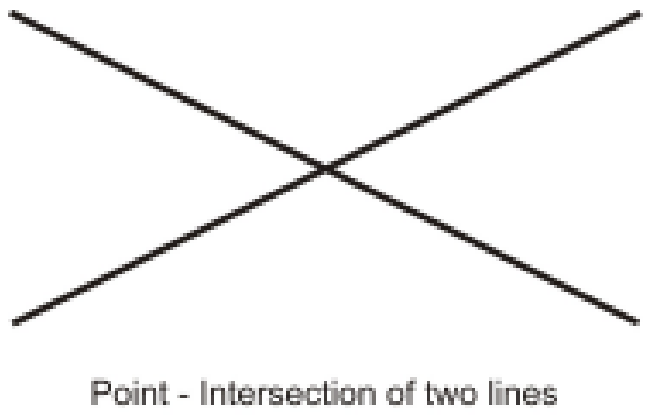
For example, a point is the intersection of two lines. So, a point is a section of a line.
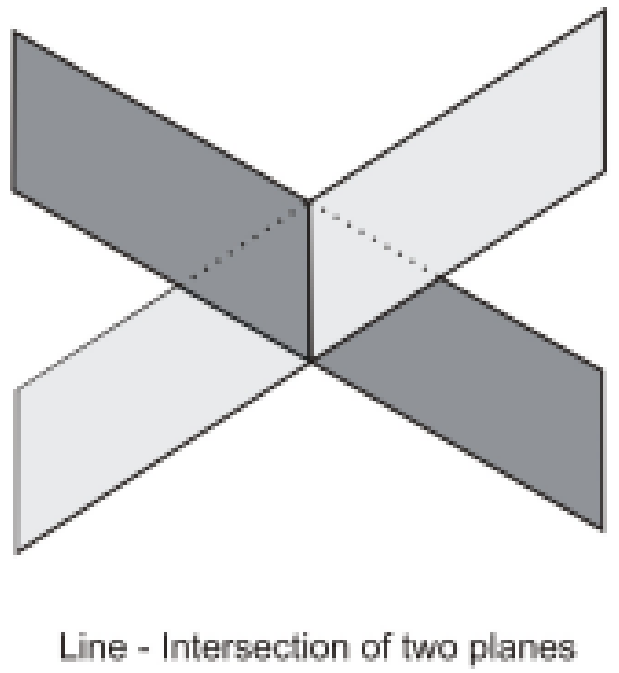
A line is a section of a surface. A surface is a section of a solid.
Extending this, we can say a solid is a section of a four-dimensional body. Our three dimensional space is a section of a four dimensional space. P.D.Ouspensky, in his book Tertium Organum, explains these very beautifully. He extends this to say that many separate three dimensional bodies, like humans
P.D.Ouspensky - Russian philosopher, mathematician and student of enlightened master George Gurdjieff. for instance, may actually be the sections or parts of one four dimensional body!
He explains this with a simple example. Suppose a horizontal plane intersects the top of a tree, parallel to the surface of the earth. Now, on this plane, the sections of branches seem to be all separate, not connected to each other. But, from the three dimensional space, we can see that these are all sections of branches of one single tree.
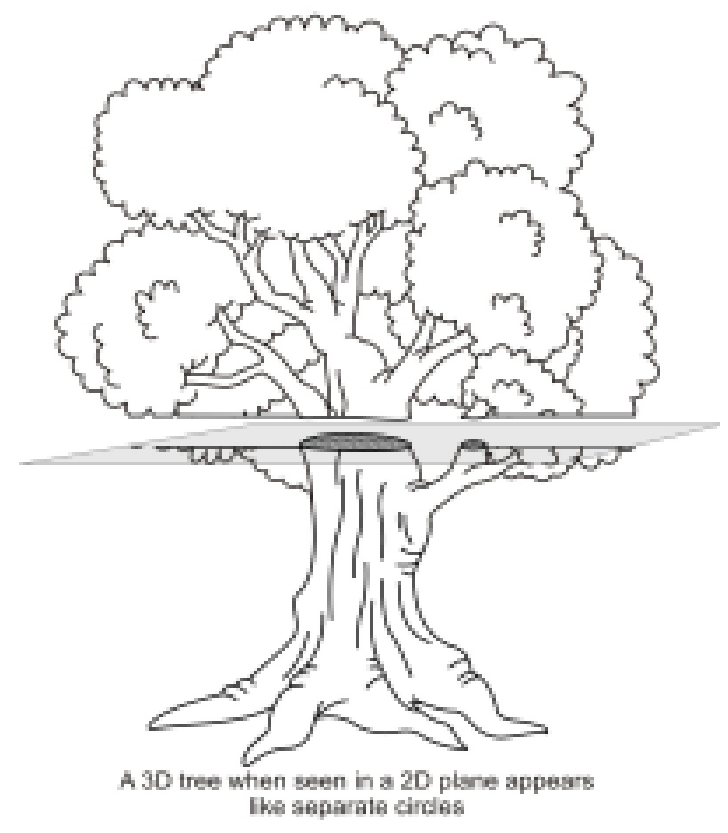
A 3D tree when seen in a 2D plane appears like separate circles