Karma – totality of conscious choices
This text was machine-transcribed from the printed book and may contain errors. Select the words and choose “Report a mistake”.
Your life is nothing but the totality of the conscious choices that you continuously make. Whether you want to or not, directly or indirectly, you are choosing everything. Someone else does not choose. It is you who chooses.
A small story:
An employee approached his boss, ‘Sir, my wife said I should ask you for a raise.’
The boss replied, ‘Oh, I will ask my wife tonight whether or not I should give you a raise!’
Understand, continuously it is your choice, your decision. You may think somebody else decides. But it is only you who is deciding.
A small example can make you understand the basic truth. If somebody criticizes you, you choose to get offended. If somebody praises you, you choose to get flattered. Because of your habit, you may choose it unconsciously. It is not someone else who chooses, it is you who choose. Because it has become your habit to think that someone else influences your decisions, you have forgotten that you are choosing.
Every time someone criticizes you, you choose to get upset. Every time someone praises you, you choose to get flattered. It is nobody else’s choice but your own. You can decide either way. When someone criticizes you, you can choose not to get offended and you can choose to remain calm and relaxed. It is just your choice to feel offended or not.
All your continuous choices every minute put together decide your life. If you don’t decide and if you allow incidents to decide your life you go into a mode of ‘paralysis’. Our lives as of now are nothing but paralysis. It is only when you decide to live your life without any outside events, situations or decisions being forced on you, you actually decide to live.
As long as you don’t understand life is your choice, your living is just paralysis.
Vasana, samskara and karma
There are three interrelated concepts, termed vasana, samskara\* and karma, in Sanskrit.
Vasana
Vasana is the seed of desire. For example, you are walking and you happen to see a dazzling necklace displayed outside a shop. A desire arises inside you to possess it. This is vasana.
Samskara
Samskara is the plant that grows when the seed of vasana sprouts. When you see that necklace again and again, the desire to possess it becomes stronger in you. When you feed the desire to possess the necklace, it is like supplying water and nutrition to the seed of vasana.
The corruption that happens to the inner space is what I call samskara or engraved memories. They are the memories that go and sit in your inner space and pull you to go through the same experience repeatedly. They pull you to do the same kind of actions repeatedly, pull you to run through the same kind of thought patterns, even if you don't want to. Those memories are what I call samskaras.
Any samskara that is operating in your conscious or unconscious layer is nothing but a hindrance to the fulfillment of your life. There is no such thing as good or bad samskara. No samskara is good. An inner space filled with samskaras is hell. An inner space without samskaras is heaven. Do not try to classify samskaras as good or bad.
A samskara by itself, by its very nature, is negative. By its very nature samskara is depressive. Anything done out of samskaras will reduce everything to boring emptiness. Anything that happens with a deep understanding, just out of your pure inner space, always adds value to you. Anything done out of samskaras adds more and more bondage to you.
From our young age we collect so many different samskaras in so many ways. We accumulate them and also reproduce them. Samskaras do reproduce themselves even without any further action from our part.
Samskaras get strengthened in different ways. There are some samskaras that get strengthened only by action, when you repeat the action. There are some samskaras that get strengthened just by receiving information with regard to them, when you receive input from the world about them. There are some other samskaras that need neither action nor information, just remembrance is enough, and they get strengthened!
We collect these different levels of samskaras, engraved memories, and store them in our system and expand them.
Samskara - Engrams or deeply engraved memories.
Karma
Finally when driven by the desire you execute the action and it becomes karma. The power of desire drives you into finally buying the necklace. That is the action – the karma.
Anything half done leaves a samskara (engraved memory) in your being. Anything not lived fully leaves an imprint or samskara in your being, which time and again pulls you, attracts you to travel the same path and fulfill it.
The cause of addiction is also related to samskaras. In my own experience of having worked with millions of people personally, at least a few thousand cases of addiction have been healed by meditation. The basic truth about addiction is that you have lived your life vaguely, not fully or with the whole being. Unfulfilled desires create a samskara in you pulling you back to fulfill the desire by re-experiencing the same desire again and again.
Any emotion lived intensely simply liberates you of that emotion - be it anger, fear, desire to eat or attachment to any object or person. You are liberated fully of anything when you live it fully. If a person keeps going back to a problem time and again, it only means that he or she has not lived out the problem fully.
When we live, half our mind is somewhere else. Patanjali* says beautifully, ‘The more the quantity, the less the quality.’ The moment the quality of enjoyment of any object inc-reases, its quantity decreases in direct pro-portion, of its own accord. Therefore, it is the quality that needs to be increased.
Any emotion lived
intensely simply
liberates you of
that emotion - be it
anger, fear, desire
to eat or
attachment to any
object or person.
Life is not a brief candle. It is a bright shining torch. Make it burn as brightly as possible in your life.
Three types of karma
There are three types of karma - agamya, prarabdha* and sanchita.
Sanchita karma is like a bank, a reserve bank. Understand, this may not be the first time you have taken a body and come to planet earth. You may have taken millions of bodies before! In those millions of bodies, whatever thoughts you had, whatever you spoke, whatever you did, all those unfulfilled experiences have become your engrams – engraved memories. Put together, they are like a bank called sanchita karma. When I say ‘bank’, it is not a collection or saving, it is debt! You will have to pay back all the loans!
The next type of karma is prarabdha* karma. Prarabdha* means this: from the sanchita bank of karma you take some karma out of which you create your present body.
Patanjali - A sage of ancient India and author of Yoga Sutras, which is considered the foundation of the system of yoga.
Prarabdha - Mindset and desires that we bring into this world when we are born.
Prarabdha is just a
small bit of the
accumulated
sanchita karma
account that you
have brought into
this life.
You then decide to enjoy and exhaust all those karmas that you brought with you through that body. So prarabdha is just a small bit of the accumulated sanchita karma account that you have brought into this life. You have planned to enjoy or exhaust these through this body of yours.
The third type of karma is the worst. It is the agamya karma, the karma that you start collecting after coming down to planet earth, because of fresh thoughts, words and deeds.
Anybody who lands on planet earth has to exhaust his prarabdha karma before he dies. For example, let us say you have 1000 karmas in your sanchita bank. Out of these 1000 karmas, suppose you take only ten karmas with you as your prarabdha karma when you take up your body saying, ‘Let me finish these ten karmas this time.’ However, after coming down, instead of exhausting your own prarabdha karmas, you start watching others and collecting karma based on their desires. These are desires that you have borrowed from others around you. Because of these borrowed desires, you create certain thoughts, words and actions.
For example, if you see someone more beautiful than you, your thoughts multiply due to comparison and jealousy. You create karma based on thoughts. Sometimes you talk ill of others, without knowing any of the related facts. When you do this, you accumulate karma based on words.
The way out of the daily irritation - living your prarabdha karma
Let me explain the three types of karma from a different angle.
You see, if you take all the possibilities that you are aware of and that are available to you in the cosmos, we call that as agamya. There are all kinds of possibilities. You can become a fish, you can become a snake, you can become a man, or you can become a god. All these are possibilities. We call that as agamya.
There are also other possibilities that are available to you. These are not only within the field of your awareness like the things that you know such as fish, monkey, dog, donkey and man, but also many other possibilities that are unknown to you. Those we call sanchita, the whole range of known and unknown possibilities.
The whole is sanchita and the possibilities that lie in front of you are agamya. You then decide to play only with certain boundaries of these possibilities when you come into this body. That is what we call prarabdha. See when you came down, you decided to play inside certain boundaries. That boundary is what we can call prarabdha.
Moving the
physical body out
of fear or greed is
what I call living
your life based on
agamya.
After coming here you see many possibilities before you that you try to accumulate, that you try to acquire. Those possibilities can be called as agamya.
This prarabdha that you brought with you has the intelligence to run your life.
One big difficulty is that you see too many agamya, too many possibilities in front of you. Because of that, your trust over your prarabdha or your own preselected possibilities reduces. You think your prarabdha may not be that powerful to run your life because of the agamya, the possibilities, which are in front of your eyes.
Let me tell you this. Trusting prarabdha is powerful. Fulfilling your prarabdha will take away one very negative aspect of your life - the continuous irritation. The constant irritation that you carry from morning till night is the gift of agamya.
From morning till night, from the moment you come out of your bed till the moment you fall asleep, you feel a constant irritation. We just need somebody to make some mistake and we jump on them! We are just waiting. Anybody who comes in our presence will have our ‘blessing’! That constant irritation is because we are centered on agamya.
If our energy, our inner space is centered on prarabdha, we will not be carrying the constant irritation that we carry now. It is not that we will not be working or relating with the possibilities. It is not that we will stop working, no! We will continue to work but our base will be our prarabdha.
You see, the mood of constantly rejecting everything, constantly being irritated, happens because of our agamya, because of the possibilities we see around us. We are running behind the choices, the possibilities, the agamya. But we forget that the prarabdha is very intelligent, very powerful.
In the whole world, there are only two kinds of people, people whose inner space is centered on agamya and people whose inner space is centered on prarabdha, that’s all. People whose inner space is centered on prarabdha live their life in restful awareness.
The mind that is based on agamya will be inspired only by fear or greed. You can see this when you wake up. You will come out of your dream state only if you have a desire or if you are caught by some fear. For example, you may get inspired to wake up because you wish to send your child to school so that she gets a good education and has a bright future. Or you may get up out of fear of getting late for office because you are afraid of losing your job.
Moving the physical body out of fear or greed is what I call living your life based on agamya.
The way out of the cycle of karma
All your actions are invariably driven by greed or fear and therefore end up being superficial actions, adding to your karma.
In this way, you end up collecting more karmas. By the time you go back, what will happen? Your ‘karma bank balance’ would have increased by the number of your agamya karma!
Say you came down with ten karmas, you did not exhaust these ten karmas with which you came, but you collected 200 more!
What will happen the next time you take the body? Your sanchita is now 1000 added to the 200 new agamya karmas you collected now. You now have 200 karmas more than in your last birth. Again you take ten out of that collection and come down with another body. But you only collect more and go back. This becomes a vicious circle. This is what we call janma marana chakra, life-and-death cycle, continuously taking a body and dying, again and again.
Instead, while you are living, if somebody gives you the knowledge that you are not just the body or the mind and it is karma that is influencing you, then the influence of that karma over you will begin to come down. You will then start exhausting the prarabdha karma that you came down with.
Let us say you brought ten prarabdha karmas with you when you took this body and came down. Suppose in these ten prarabdha
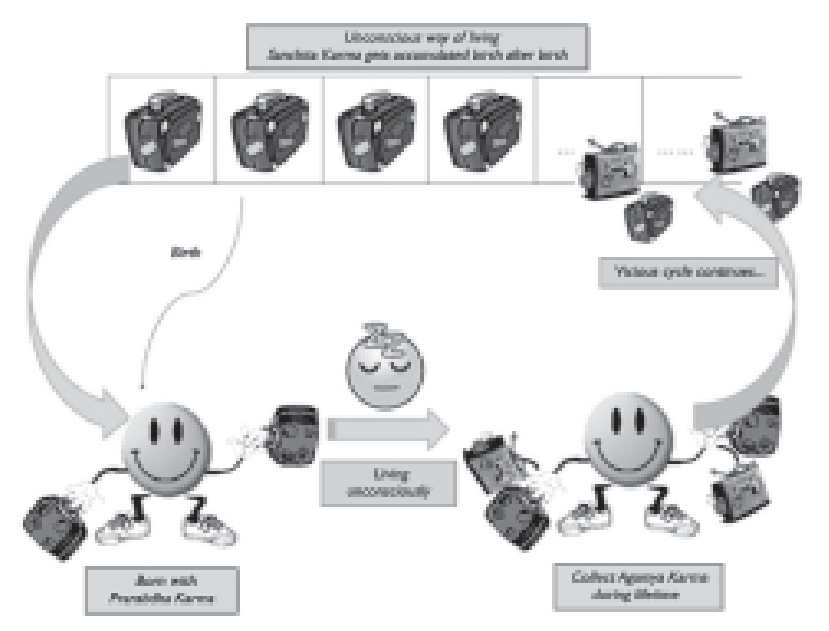
karmas, you have three samskaras or three engrams that have the power to put you into depression. If you continue to obey those engrams and fall into depression, they will not remain just three, but will probably become ten. The additional seven karmas are the agamya karmas. If instead of exhausting your prarabdha you decide to remain with them, you collect agamya.
If on the other hand, whenever these three engrams put you in depression you have learned some technique to come out of the
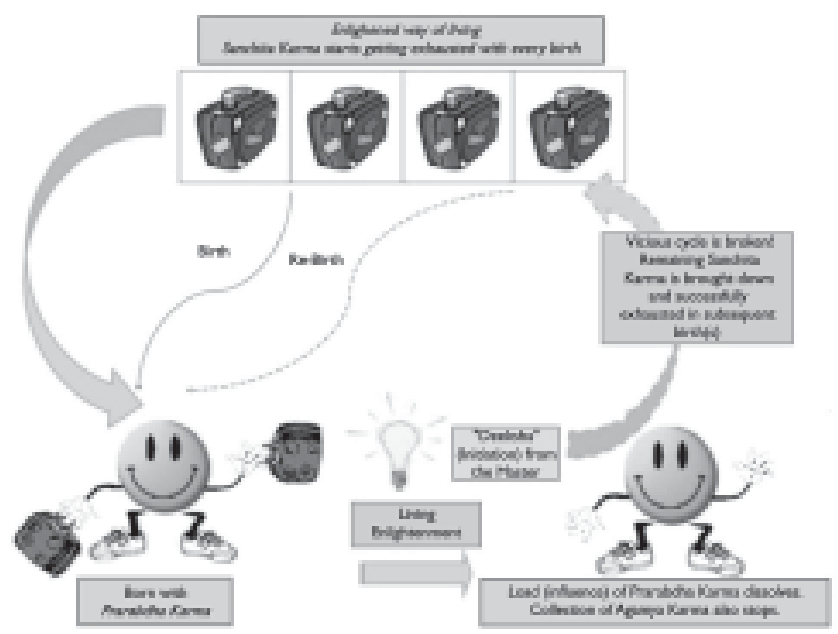
depression, then these three will start losing their power over you. So, over time, of the ten karmas, three will leave you. Whenever you reduce the influence of prarabdha on yourself, not only will the prarabdha get burnt, but the chances of accumulating new karma, the agamya karma, will also come down.
You stop collecting agamya when the prarabdha loses its influence over you. When the influence of these ten prarabdha engrams over you stops, the agamya collection will also stop because it is these ten engrams that are responsible for the collection of further engrams or karma.
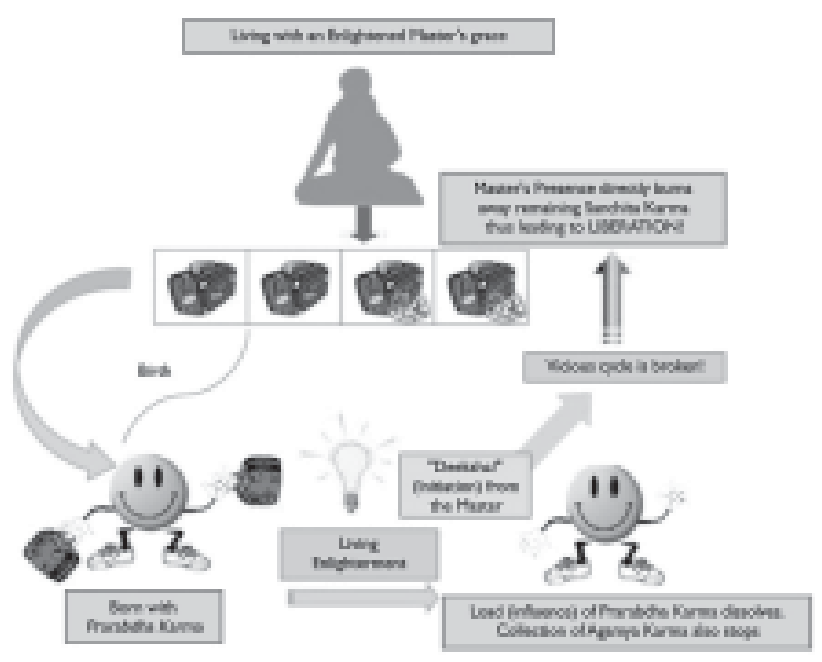
Now let us come to the sanchita karma. Understand, you can't do anything directly with your sanchita karma bank. For sanchita
to burn out, only Guru Krupa, grace of the master, will work. Only the master's grace can do anything to burn out your sanchita.
Only intention matters
A beautiful story from the devotional vedic scripture Bhagavatam1:
Krishna declared, 'If I am true brahmachari4 (celibate), then let the Yamuna² part and let us go across.'
The Yamuna² parted.
Outwardly, it may seem that Krishna was with the girls like other ordinary men. But Krishna was beyond the body-mind. His actions did not carry the intention of an ordinary man. It is the intention of any act that matters, not the act itself.
Intention is the baggage, the karma, not the action. If action creates intention, it becomes the baggage. Pure action with no end objective is not karma.
Bhagavatam - The foremost epic of Hindu religion describing the incarnations of Vishnu, especially his incarnation as
Krishna. It was written by Vyasa, who was also the author of the itihasa or epic Mahabharata
Yamuna - A holy Indian river associated with enlightened master Krishna.
Gopis - Women who tended cows who were devotees of enlightened master Krishna.
Brahmachari - A vedic student, usually referring to a young celibate monk.
Action without intention is living enlightenment. Master's presence affects the intention
See, whatever you are doing in the presence of the master, you are doing for the master. You know it is in no way going to build your name or fame. So, the action happens without intention. There is no intention. The intention is the master's. The action is yours. Intention is in the being of the person who has no intentions!
You see, the total sanchita karma can be yours or mine. Mine is divine play. Yours is suffering. When it started, your total sanchita karma also started as a divine play. But, after gathering more and more gathered agamya karma, it became dirty.
Because I have no karma, when you flow with me you will also act without intention. Action without intention is living enlightenment.
Action without intention is free from karma
If a person has committed ten murders, the quantity of murders will not be recorded. But the intensity of the murderer will be recorded. It is the quality, the mindset, and the attitude, that carries the karmic burden.
That is why Krishna says again and again in the Bhagavad Gita that intention is much more important than action. That is the message of the whole Gita. He says, 'When you are without intention I will take care.'
Action does not get recorded. Only intention gets recorded.
The Mahabharata\* tells us the beautiful story of a courtesan and a monk.
There was a monk who lived across a courtesan's house. He used to keep a count of the men coming to her house and used to imagine all kinds of things about her lifestyle. The woman spent all her free time praying to Krishna to redeem her from her miserable life.
One day, they both died at the same time. Both reached the court of Yama\*, the god of death. Yama* looked at the record of their lives and gave the decision: the monk should go to hell and the woman should go to heaven. The monk was shocked and started protesting, 'I lived such a pious life while she lived such an immoral life! How can I be sent to hell and she to heaven!'
Yama* replied, 'In my court of judgment, your actions are of no value, only your intent matters. You wore a monk's robes and lived a good life outwardly but your inner space was filled with lust. So in the outer world, your body is now being buried with honor but you have to suffer hell. The woman's heart was forever with Krishna even while her body was
Mahabharata - The Hindu itihasa or epic whose central characters are the five Pandava princes, their hundred Kaurava
cousins and enlightened master Krishna.
Yama - Hindu god of death and justice.
sold to men. So her body doesn't have anybody to even do the last rites but she is going to heaven.'
It is the intention and attitude that counts.
An enlightened being, an incarnation, is one with Existence. An enlightened being can only operate in tune with Existence. He can never be out of tune. The actions of an enlightened master can never be without awareness and compassion.
Since we do not have the consciousness or awareness, we cannot justify our actions by saying they are similar to those of an enlightened being. Be very clear, the action may look similar outwardly but the intention, the inner space, the attitude, is completely different.
A beautiful story from the life of Adi Shankara:
Once while Shankara was wandering with his disciples, he suddenly felt thirsty. They were in the middle of nowhere. They traveled further and finally came across one shop. Shankara went up to the man in the shop and asked for some water to drink. The man said, 'I am sorry but I have nothing to offer you except liquor. That is all I have.'
Shankara replied, 'Alright, please give me some.' He drank a glass of liquor and thanked the man. The disciples were shocked to see their master drink liquor! The thirsty disciples decided to follow the master and they all drank liquor to their heart's content.
When they resumed the journey, Shankara continued to walk normally but the disciples under the effect of liquor were not even able to keep the next step properly. They went up further and after some distance, came across an iron forge.
Shankara went upto the man who was pouring molten iron into the cast. He asked him for a glass of water. The man apologized saying he didn't have any water to offer. Shankara said, 'Alright. Please give me the molten iron then.'
The man and Shankara's disciples were all shocked. The man gave Shankara the hot molten iron which he just poured into his mouth as if it was water!
He then turned around to his disciples and said, 'You may also drink now.' The disciples stood with their heads lowered. Shankara then explained, 'Do not follow what I do. Follow what I say. Otherwise, you just choose to follow what your mind tells you.'
An enlightened
being has no
personal interest
because his
identity is
dissolved in the
identity of the
whole universe.
Understand, the very plane on which enlightened beings exist is different from the normal human plane of existence. So they do not need to and cannot do things according to usual logic. Their intention is what is important,
- Adi Shankara – Enlightened master which cannot be explained in terms of ordinary logic.
An enlightened being has no personal interest because he has no individual identity – his identity is dissolved in the identity of the whole universe.
Intention and action
If the depth of the intention is more and of the action is less, the person is lazy or in tamas1.
If the depth of intention and of the action is the same, the person is in restless action or rajas2.
If there is no intention but only the action, he is in purposeless action or sattva3.
That is why Krishna says in the Bhagavad Gita, ‘Fight, O Arjuna4.’ It is not the act of ‘killing’ that will be recorded but the intention that will be recorded. The intention of Arjuna⁴ is the intention of Krishna, who is a being with no intentions as He is one with the Cosmos!
When you act in tune with the Cosmos, the whole Cosmos blesses you. You attract all kinds of positive coincidences around you. That is why when people contribute even a little to the cause of such a person they are showered in abundance from all corners.
The power of daily intention
We have seven layers or seven bodies of energy, which are physical, pranic5, mental, etheric, causal, pleasure and nirvanic6. Please understand, in the causal layer our gathered or agamya karma is completely available for us. See, in the causal body, you may have the skills to play cricket, golf and tennis. But if you get up from deep sleep with a strong will or intention to play cricket, then you will also bring from the causal body the intelligence to play cricket. You will be naturally led into the situations, the atmosphere and the intelligence for it. If you go to sleep at night with a strong intention to play golf and you wake up in the morning with the strong intention to play golf, then you will bring with you that intelligence to play golf.
The causal layer is an exchange place. It is like monetary exchange. In the causal layer you can exchange anything. When you go to the causal layer the karma of this birth itself can be changed if you have that strong intention every day. This is true freedom.
Tamas - One of the three gunas or attributes of nature. Attribute of inaction.
Rajas - One of the three gunas or attributes of nature. Attribute of aggression.
Sattva - One of the three gunas or attributes of nature. Attribute of passive action.
Arjuna - Warrior prince and the third of the five brothers of the Pandava family in the great Indian epic Mahabharata.
He was a disciple of enlightened master Krishna who received the wisdom in the Bhagavad Gita from Krishna.
Pranic - Related to prana or life energy.
Nirvanic - Connected to nirvana. The nirvanic layer is the seventh and final energy layer in our body mind.
Strong intention has the capacity to change the gathered agamya karma and the prarabdha karma of this birth. It cannot change the total sanchita karma. Sanchita karma can only be changed by the grace of the master – one who is without karmas.