KAILASA's Jurisprudence - Volume 1
This text was machine-transcribed from the printed book and may contain errors. Select the words and choose “Report a mistake”.
KAILASA'S
Jurisprudence
VOLUME I
Ebook ISBN: 979-8-88572-161-5
From The Supreme Pontiff of Hinduism Jagadguru Mahasannidhanam Bhagavan
Nithyananda Paramashivam 7
Dharma-based Hindu Legal Jurisprudence of Kailasa 8
The Ancient Hindu Legal System 8
Requisite Qualities of Judiciary 9
Visible Equity 9
Integrity 9
Precedence in the case of Conflict 10
Explaining the Importance of Truth (Satya) in Evidence 11
About the Department of Justice of Kailasa 11
Cosmic Constitution 12
Guiding Texts 13
Chief Justice of United States of SriKailasa 14
TITLE I
THE ORDER AND ITS NATURE 15
ARTICLE 1
Origin and Nature of the Order 15
ARTICLE 2
Purpose 18
ARTICLE 3
Sovereignty 18
ARTICLE 4
Royal Lineage 19
ARTICLE 5
Source Knowledge of Hinduism 20
ARTICLE 6
Founding Principle of SHRIKAILASA 21
ARTICLE 7
Flag, Emblem and Stamp of SHRIKAILASA 22
ARTICLE 8
Language 22
TITLE II
THE MEMBERS OF THE ORDER 23
ARTICLE 1
The Sovereign Order of KAILASA 23
Article 2
The Obligation of the Sovereign Order 24
ARTICLE 3
Administrative Headquarters
Duties and Offices 24
TITLE III
GOVERNANCE AND ECOSYSTEM OF SHRIKAILASA 25
Article 1 25
The Supreme Pontiff of Hinduism 25 Article 2 Powers of The Supreme Pontiff of Hinduism 26 Article 3 27
Sanyas (Monastic) Order of the Sovereign Order of Kailasa 27 Article 4 The Principle of God’s Governance 31 Ideological Foundation of Kailasa’s Governance 33 Article 5 The Hindu Parliament of SHRIKAILASA 37 Article 6 Departments of SHRIKAILASA 38 Department of State 39 Department of Treasury 39 Department of Commerce Department of Housing Department of Human Services Department of Education 39 Department of Enlightened Civilization 39 Department of Information Broadcasting 39 Department of Health 39 Department of Vedic Science & Technology 39 Department of Global Communications 39 Department of Religion & Worship 39 Department of Agriculture 39 Department of Environment & Animals 39 Article 7 SHRIKAILASA Uniting Nations 39 Article 8 39 de facto Spiritual Embassies and States 39 Article 9 SHRIKAILASA’s Global Services 40 SHRIKAILASA’s mission is to share with today’s world the practical applications of Sanatana Hindu Dharma and its science of enlightenment, to bring that successful life and lifestyle to the world in 81 services. Our services offered include: 40 QUANTUM MEMORY PROGRAM IN KAILASA 41 KAILASA’S RESERVE BANK 41 KAILASA’S HEALING SERVICE 41 NITHYANANDA SACRED ARTS UNIVERSITY 41 HINDU IMPORTS AND EXPORTS AND INTERNATIONAL TRADE 41 KAILASA’S E-PASSPORT 41 KAILASA'S SCIENCE OF COMPLETION 41 KAILASA'S FLOOD RELIEF INITIATIVES 41 KAILASA'S ASTROLOGICAL SERVICES 41 KAILASA'S EN-PREGNANCY 42 GITA JNANA YAJNA IN KAILASA 42 SHIVA DEEKSHA IN KAILASA 42 KALPATARU IN KAILASA 42 NITHYANANDA HEALERS INITIATION 42 NITHYANANDA ANNAMANDIR (FOOD BANK) 42 NITHYANANDA KRIYA 42 VYASA NIRAHARA SAMYAMA IN KAILASA 42 PACCHAI PATTINI VRATHAM IN KAILASA 42 NITHYANANDA GAU MANDIR 42 PARAMASHIVOHAM PROGRAM IN KAILASA 43 NITHYANANDA NIRAHARA SAMYAMA 43 NITHYANANDA HINDU UNIVERSITY 43 NITHYANANDA GURUKUL 44 INNER AWAKENING PROGRAM IN KAILASA 44 AKASHIC READING SPIRITUAL SERVICE IN KAILASA 44 NITHYANANDA SANNYAS ORDER 44 KAILASA'S SCIENCE OF POWER MANIFESTATION 44 55 KAILASA'S SAFFRON OM 44 NITHYANANDA HINDU UNIVERSITY is the world's largest Hindu university as per the number of faculties, number of students, number of courses and number inspired by the SPH with 20 million+ enrollments, 7000+ courses with extended campuses in 150 countries. 44
ARTICLE 10 General Norms of Elections 44
Article 11 Initiations 45
General Norms 47
Title I 48
Ecclesiastical Laws 48
Title II 50
Custom 50
Title III 50
Decrees 50
Title IV 51
Administrative Acts 51
Article I 51
Common Norms 51
Chapter II 53
Singular Decrees and Precepts 53
Title V 54
Statutes and Rules of Order 54
Title VI 54
Physical and Juridic Persons 54
Article I 54
Physical Persons 54
Article II 56
Juridic Persons 56
Title VII 57
Juridic Acts 57
Title VIII 58
Power of Governance 58
Title IX 59
Ecclesiastical Offices 59
Title X 60
Citizens of Kailasa 60
Title XI 60
Rights and Responsibilities of the Citizens of Kailasa 60
Title XII 62
Ministers of Kailasa 62
Title XIII 64
The Hierarchy of Governance of Kailasa 64
Title XIV 65
Internal Coding of Various Kailasas 65 Chapter I 65 The Ministry 65 Chapter II 66 Notaries 66 Chapter III 67 THE FINANCE COUNCIL AND THE FINANCE OFFICER 67 Chapter IV 68 The Sanyasi Council 68 Chapter V 69 Members of Spiritual Structures 69
Title XV 70
The Teaching Function of Kailasa 70
Title XVI 71
The Ministry of the Divine Word 71
Chapter I 71
The Teaching of the Divine Word 71
Chapter II 72
Instruction by Vakyartha Sadas 72
Title XVII 73
Hindu Education 73
Chapter I 73
Gurukuls (Schools) 73 CHAPTER II 74 Hindu Universities and other Institutes of Higher Studies 74 CHAPTER III 75 Ecclesiastical Universities and Faculties 75
TITLE XVIII 76
Temporal Goods of Kailasa 76
TITLE XIX 76
The Acquisition of Goods 76
TITLE XX 80
Contracts and Alienation 80
TITLE XXI 82
Wills 82
From The Supreme Pontiff of Hinduism Jagadguru Mahasannidhanam Bhagavan Nithyananda Paramashivam
To The Mantreshwaras, Vidyeshwaras, Ganeshwaras, Lokeshwaras, Astreshwaras And To all Kailasans worldwide,
Kailasa is based on the principles of life revealed and ordained by Paramashiva. The basis of the whole juridical-legislative tradition of Kailasa is the Vedagamas and scriptures revealed by Paramashiva.
The Dharmashāstra (Code), as the principal legislative document of Kailasa founded on the juridical-legislative heritage of revelation and tradition, is to be regarded as an indispensable instrument to ensure order both in individual and social life, and also in the Kailasa nation’s activity itself. Therefore, besides containing the fundamental elements of the hierarchical and organic structure of Kailasa as willed by the divine Founder, as based upon the Vedagamic fundamental principles which govern the juridical-legislative functions, the Code must also lay down certain rules and norms of behavior.
The greatest care has been taken to ensure that in the lengthy preparation of the Code the wording of the norms should be accurate, and that they should be based on a solid juridical, Vedagamic, dharmashāstra-based foundation.
I promulgate this fundamental body of ecclesiastical laws for Kailasa.
With the supreme authority with which I am vested, by means of this Constitution, to be valid forever in the future, I promulgate the present Code as it has been set in order. I command that for the future it is to have the force of law for the whole Kailasa, and I entrust it to the watchful care of all those concerned, in order that it may be observed. I therefore exhort all the Kailasians to observe the proposed legislation with a sincere spirit and good will in the hope that there may flower again in Kailasa a renewed discipline based on the four tattvās (principles) of Integrity, Authenticity, Responsibility and Enriching.
The ecclesiastical law which embraces this body constitutes the classical law of Kailasa and is commonly called by this name.
Dharma-based Hindu Legal Jurisprudence of
Kailasa
The Ancient Hindu Legal System
The most ancient system of jurisprudence in the world is the Vedic/ Hindu jurisprudence. The system was based on dharma. Dharma is defined by the sage Jaimini, author of the mīmāsa sūtra as follows: codanā lakṣaṇo'rtho dharmaḥ Dharma is a function that propels one to action. It may be briefly described as the code of conduct: it teaches both religious and secular matters. Unlike many modern systems with the king at the helm of affairs, in the Hindu jurisprudence, the king himself was subject to the law. Arbitrary power was unknown to Hindu jurisprudence and the king's right to govern was subject to the fulfillment of duties towards his subjects, the breach of which resulted in forfeiture of kingship. The judges were independent and subject only to the law. The whole system was based on fairness and equity of justice with the highest regard for integrity, impartiality, and independence of the judiciary. The Indian judiciary consisted of a hierarchy of judges with the Court of the Chief Justice (Prāḍvivāka) at the top, each higher Court being invested with the power to review the decision of the Courts below. In the time of Mahābhārat, to receive the daughter of a fisherman in marriage, the king could not just forcibly take her but his son, Devavrata makes a vow of lifelong celibacy so that he nor any progeny of his would ascend to the throne thereby assuring the fisherman his daughter's progeny would continue and he could be assured of her and her progeny's future (Devavrata was thereafter celebrated and known as Bhīṣhma for this ferocious vow). In the more recent times of Chanakya, the Court consisted of three jurists (dharmastha) and three ministers (amatya).
Requisite Qualities of Judiciary
Visible Equity
The great jurists, Manu, Yājñavalkya, Kātyāyana, Bṛhaspati and others, and in later times commentators like Vācaspati Miśra and others, described in detail the judicial system and legal procedure which prevailed in Hinduism from ancient times. The divine sage Narada enjoins that when the king occupies the judgment seat (dharmāsanam), he must be impartial to all beings, having taken the oath of the son of Vivasvan. The oath of Vivasvan is the oath of impartiality as evidently manifested in the fact that the son of Vivasvan is Yama, the god of death, who is impartial to all living beings.
Kātyāyana says, "The king should enter the court-room modestly dressed, take his seat facing east, and with an attentive mind hear the suits of his litigants. He should act under the guidance of his Chief Justice, judges, ministers and the members of his council. A king who dispenses justice in this manner and according to law resides in heaven". These provisions are significant. The king was required to be modestly dressed (vinīta-veṣa) so that the litigants were not intimidated. The code of conduct prescribed for the king when acting as a judge was very strict and he was required to be free from all "attachment or prejudice".
The judges and counselors guiding the king during the trial of a case were required to be independent and fearless and prevent him from committing any error or injustice. Kātyāyana says, "If the king wants to inflict upon the litigants (vivādinam) an illegal or unrighteous decision, it is the duty of the judge to warn the king and prevent him.
When the judge realizes that the king has deviated from equity and justice, his duty is not to please the king for this is no occasion for soft speech (vaktavyam tat priyam nātra); if the judge fails in his duty, he is guilty.
A judge should be austere and restrained, impartial in temperament, steadfast, God-fearing, assiduous in his duties, free from anger, leading a righteous life, and of good family.
Integrity
The foremost duty of a judge was integrity which included impartiality and a total absence of bias or attachment. The concept of integrity was given a very wide meaning and the judicial code of integrity was very strict. Brihaspati says, “A judge should decide cases without any consideration of personal gain or any kind of personal bias; and his decision should be in accordance with the procedure prescribed by the texts. A judge who performs his judicial duties in this manner achieves the same spiritual merit as a person performing a Yajna.”
The strictest precautions were taken to ensure the impartiality of judges. A trial had to be in open court and judges were forbidden to talk to the parties privately while the suit was pending because it was recognised that a private hearing may lead to partiality. Shukra-nītisāra says, “Five causes destroy impartiality and lead to judges taking sides in disputes. They are attachment, greed, fear, enmity, and hearing a party in private.”
Another safeguard of judicial integrity was that suits could not be heard by a single judge, even if he was the king. The King had to sit with his counselors when deciding cases, and judges must sit in benches of uneven numbers. Shukra-nītisāra enjoined that “Persons entrusted with judicial duties should be learned in the Vedas, wise in worldly experience and should function in groups of three, five, or seven.” Kautilya also enjoined that suits should be heard by three judges (dharmasthstrayah).
Yājñavalkya says, “The Sovereign should appoint as assessors of his court persons who are well versed in the literature of the law, truthful, and by temperament capable of complete impartiality between friend and foe.”
These assessors or jurors were required to express their opinion without fear, even to the point of disagreeing with the Sovereign and warning him that his own opinion was contrary to law and equity.
Kātyāyana says, “The assessors should not look on when they perceive the Sovereign inclined to decide a dispute in violation of the law; if they keep silent they will go to hell accompanied by the King.”
Precedence in the case of Conflict
Nāradā says, “The basis of a judicial decision (vyavahāra) may be (i) Dharma-shāstra, (ii) (previous) judicial decisions (vyavahāra) or custom (caritra) or the decrees of the Sovereign. The authority of these four is in the reverse order, each preceding one being superseded by the one following it.
Explaining the Importance of Truth (Satya) in Evidence
Brihaspati says, "Judges who are well-versed in the dharmashāstra should address the witness in words praising truth and driving away falsehood (from his mind)." Nāradā enjoins, "The judges should inspire awe in the witness by citing moral precepts which should uphold the majesty of truth and condemn falsehood." All the smrtis were unanimous in holding that perjury before a court was a heinous sin as well as a serious crime. There were other provisions, calculated to reduce the changes of false evidence being given. Kātyāyana enjoined, with much common sense that there should be no delay in examining witnesses-obviously because delay dims the memory and stimulates imagination, "The Sovereign should not grant any delay in the deposition of witnesses; for delay leads to great evil and results in witnesses turning away from the law."
About the Department of Justice of Kailasa
United States of SriKailasa, the only Hindu nation on planet Earth, is headed by the Supreme pontiff of 2 billion Hindus. United States of SriKailasa is a borderless nation, having its States and embassies worldwide. The nation of SriKailasa is built on the supreme principle of tyaga which is loosely translated as sacrifice. Tyaga in Sanskrit and as per the Hindu scriptures is not sacrifice but it is the renunciation of one's identities at various levels. It results in breaking free of the limiting binding cognitions. It is the super power which makes one manifest Paramashiva. The justice system of Kailasa is the ultimate one, exactly as ordained by Paramashiva, based on pure compassion. The fundamental premise of the justice system of Kailasa is the truth of Paramashivoham - I am Paramashiva. Whether we realize it or not, experience it or not, every one of us is the Ultimate Paramashiva. Any perception or belief or cognition that is otherwise is pure delusion. So the justice system of Kailasa does not evaluate or judge a person, or classify him or her as a saint or sinner, as these classifications themselves are redundant in the face of the truth of Paramashivoha. Hence the justice system is not based on punishment, the social concepts of right and wrong, neither confession nor atonement. It is based on pure dharma and cosmic law as revealed by Paramashiva and the understanding of prayaschitta which is based on realization and completion and realignment to the Ultimate. Paramashiva's system does not judge a being as innocent or guilty. It only reminds a person about his or her fundamental purpose of life to realize he or she is Paramashiva already. Any miss or non alignment to this truth is realigned with prayaschitta which is a reminder rather than punishment and hence does not engender the biggest delusion of modern society, fear.
The Department of Justice is responsible for defining, upholding, mapping as a lifestyle and implementing the cosmic principles enshrined in the Cosmic Constitution as revealed by Paramashiva in His living incarnation Bhagavan Sri Nithyananda Paramashivam, the Supreme Pontiff of Kailasa, the greatest living Hindu nation. This includes maintenance of law and order, administration of justice, public administration, internal security, protection of Hinduism from persecution and external attacks.
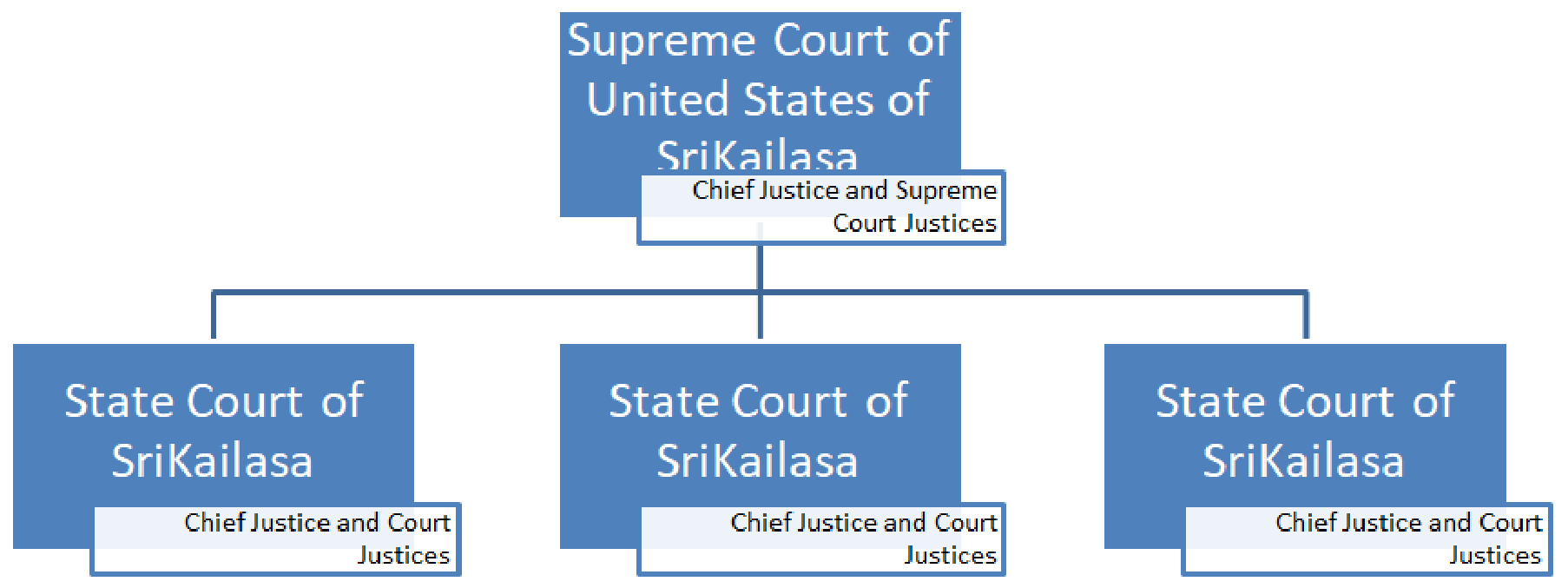
The structure of the justice system of United States of Kailasa comprises the Supreme Court headed by the Chief Justice of SriKailasa and a team of Supreme Court justices below which structure is the Court of every state of the United States of SriKailasa headed by the various justices.
Cosmic Constitution
"OM NITHYANANDA PARAMASHIVOHAM" - is the guiding principle of the Supreme Court of SriKailasa. It expresses the ultimate responsibility of the Supreme Court of SriKailasa - to ensure justice as per the Cosmic Constitution enshrined as the Constitution of SriKailasa, standing on the supreme existential truths of Oneness (advaita), non-violence (ahimsa), compassion (karuna), and with the aim to help every being realize the ultimate reality of Paramashivoham - I am Paramashiva.
The 'Nithyananda Shruti' section of the Cosmic Constitution is perpetual and cannot be amended in any way at any time as it embodies the Ultimate Truths of the Cosmos and life as revealed, explained and established by The SPH.
The Cosmic Constitution may be amended by a resolution adopted by three-fourth of the eligible members present and voting, but such amendment must be proposed in writing and submitted at least one month prior to the meeting. It shall be effective after acceptance by the majority vote or in the time period decided in the meeting itself. The Court is the highest seat of justice in the Nation for all matters arising under the Constitution or the laws of SriKailasa. As the final arbiter of the law, the Court is charged with ensuring the citizens of SriKailasa the promise of cosmic justice under law and, thereby, also functions as guardian and interpreter of the Cosmic Constitution.
Guiding Texts
The Constitution of Kailasa is based on the Shruti - Vedagamas which form the articles of the Constitution and the Smritis form the guidelines of the Constitution. The Code of Civil Procedure is based on the Shrutis-Smritis.
The justice system of Kailasa follows the Dharmasutras and Dharmashastras.
Dharmashastras are guidebooks of dharma as they contain guidelines for individual and social behavior, ethical norms, as well as personal, civil and criminal law.
The four major Dharmasutras are by Apastamba, Gautama, Baudhayana and Vasistha.
Dharmashastras enumerate four sources of Dharma – the precepts in the Vedas, the tradition, the virtuous conduct of those who know the Vedas, and approval of one's conscience (Atmanastushti, self-satisfaction)
The Dharmashastras present their ideas under various categories such as:
- Acara - normative behavior and practices of a community, conventions and behaviors that enable a society and various individuals therein to function - Vyavahara - judicial procedure, process, practice, conduct and behaviour
- Prayascitta – atonement, alternative to punishment or incarceration
The four major Dharmashastras are Manusmriti, Yajnavalkya smriti, Narada smriti, Vishnu smriti as well as Mahabharat Shanti parva.
The sacred scriptures of the sovereign order of Kailasa include:
- Direct teachings of The SPH available in video, audio, book, electronic formats like ebooks, social media posts like on Facebook, Twitter, blogs, etc
- Akashic readings and writings of Kalabhairava through The SPH
- Prasthanatraya: a. Bhagavad Gita b. Brahma Sutras c. Twelve major Upanishads i. Isa Upanishad ii. Katha Upanishad iii. Kena Upanishad iv. Aitreya Upanishad v. Taittreya Upanishad vi. Mundaka Upanishad vii. Mandukya Upanishad viii. Chandogya Upanishad ix. Brihadaranyaka Upanishad x. Mahanarayana Upanishad xi. Prashna Upanishad] xii. Shvetashvatara Upanishad
Chief Justice of United States of SriKailasa
The Chief Justice of the United States of SriKailasa is Paramashiva Himself in the form of His Divine Holiness Bhagavan Sri Nithyananda Paramashivam.
TITLE I
THE ORDER AND ITS NATURE
ARTICLE 1
Origin and Nature of the Order
1.1. DEFINITION OF KAILASA - KAILASA is the revival of the ancient enlightened Hindu civilizational Nation which is being revived by displaced Hindus from around the world. 1.1.1. KAILASA as of date is the only macrocosmic, ancient, Hindu enlightened civilisational and territorial nation to serve the religious and spiritual needs of two Billion Hindus (https://kailaasa.org/) and the whole of humanity. 1.1.2. The KAILASA movement is founded and spearheaded by members of the Hindu Adi Shaivite minority community from Canada, the United States and other Countries and is created for and offers a safe haven to all the world’s practicing, aspiring or persecuted Hindus, irrespective of race, gender, sect, caste, or creed, where they can peacefully live and express their spirituality, arts, and culture free from denigration, interference and violence. 1.1.3. KAILASA is the place and space where everyone treats each other as Paramashiva, who is the primordial Divinity inside all of us, evolving all of us to Paramashiva Padam (the state, space, being, powers and superconsciousness of Paramashiva). All of us recognise and cognize each other as Paramashiva. 1.1.4. KAILASA is a tradition that stems from the divine primordial Lord Paramashiva whose salient purpose is Global peace, enlightenment for all of humanity. 1.2. The Supreme Pontiff of Hinduism Jagat Guru Mahasannidhanam (JGM) His Divine Holiness (HDH) Bhagavan Nithyananda Paramashivam hereinafter referred to as "The SPH" is the founder, spiritual and ecclesiastical head and the Hon'ble President of Kailasa, the only civilizational Hindu nation. 1.3. Every citizen of Kailasa takes the oath of ideological and organizational commitment that includes the following: 1.3.1. To accept The SPH as the founder, spiritual head and supreme authority of Kailasa, and to understand, imbibe and follow with integrity, authenticity, responsibility and enriching oneself and others, the cosmic law as revealed in the teachings, directions and ideology of The SPH;
1.3.2. To never intentionally act against the interests of Kailasa; and
1.4. To maintain the spiritual purity, high standards and ideology and teachings established by The SPH, and to not indulge in or involve the sangha in any activities contrary to the cosmic law, or any illegal, immoral or other activity which may threaten Kailasa.
1.5. To live with the 4 principles of integrity, authenticity, responsibility and enriching and make others live the four principles.
1.6. To live and follow the Hindu lifestyle of Vedas and Agamas to experience and radiate Paramashivatva as taught and initiated by The SPH.
1.7. Definitions pertaining to discipline of initiated disciple/ citizen of Kailasa:
1.7.1. “Prayashchitta” is taking up a spiritual practice to realign oneself back to the original state. The sangha is expected to help a person in the process of prayashchitta by helping him or her with shifting the context of any situation to the right context for the person and thereby help him or her to get the right cognition.
1.7.2. Transfer: If the citizen commits guru droha, sangha droha, or linga droha of a severe nature, the member will be transferred to a different location, as decided on a case by case basis.
1.7.3. Expulsion: A citizen will be expelled from the sangha if he or she commits guru droha, sangha droha, or dhamma droha, of a very severe and unforgivable nature, as decided on a case by case basis.
1.8. In this Constitution and in the Code the Sovereign Order of SHRIKAILASA is also referred to as “The Sovereign Order”, “SHRIKAILASA” or “KAILASA”.
1.9. The Supreme Pontiff of Hinduism (SPH) Jagat Guru Mahasannidhanam (JGM) His Divine Holiness (HDH) Bhagavan Nithyananda Paramashivam, hereinafter referred to as ‘The SPH Nithyananda Paramashivam’ is the head of the KAILASA Nation, the ancient enlightened Hindu civilizational nation, and the head of Sovereign Order of KAILASA. He has worked tirelessly for the past 40 years despite enduring more two decades of relentless persecution for the revival of ancient science of the Vedas and Agamas (Hindu scriptures) of Hinduism using the technologies of Yoga, Ayurveda (Science of Herbal Medicines), Dhyana (Meditation) and Pranayama (breath control) throughout the world to develop human beings consciously irrespective of nationality, religion, race, gender or economic status in improving their physical, mental, emotional, economic and spiritual well-being. SPH is ordained as the 1008 th Acharya Mahamandaleshwar (the head of all spiritual leaders) of Atal Akhada (ancient apex body of Hinduism), coronated as Mahamandaleshwar (Supreme Spiritual Head) of Maha Nirvani Akhada, largest apex monastic order, becoming the youngest Mahamandaleshwar, ordained as the 233rd Guru Mahasannidhanam (Pontiff) of Thondai Mandala Aadheenam, present 293rd Guru Mahasannidhanam (Pontiff) of Shyamalapeeta Sarvajnapeetam, present 23rd Guru Mahasannidhanam of Dharmamukthi Swargapuram Aadheenam and the incumbent Emperor of Suryavamsa Surangi Samrajyam.
1.10. KAILASA is a consortium of multiple micronations- some with sovereign and autonomous status, de facto spiritual embassies, not for profit organisations (NPO), non governmental organization (NGO's), educational institutions including Hindu universities and school (gurukul), temples, temple monastery complexes, nunneries, food banks (Annamandir) , animal shelters (Goshala), libraries (Jnanalaya), organic agriculture. The consortium of Kailasa(s) established around the world known as the United States of Kailasa (USK) is growing in more than 150 countries.
1.11. SHRIKAILASA is created by a group of dispossessed people who lost the right to practice Hinduism authentically in their own countries. They found freedom to practice Hinduism as revived by The SPH Nithyananda Paramashivam, and subsequently because of that, achieved enormous success in other countries. Though the SHRIKAILASA movement is founded in the United States, and spearheaded by members of the Hindu Adi Shaivite minority community (ASMC), it is created for, and offers a safe haven to all the world's practising, aspiring or persecuted Hindus, irrespective of race, gender, sect, caste, or creed, where they can peacefully live and express their spirituality, arts, and culture free from denigration, interference and violence.
1.12. The Sovereign Order of SHRIKAILASA is a Hindu religious order and consists of different lineages and paths of living the science of enlightenment as prescribed by the sacred scriptures of Hinduism, the Veda-Agamas. Deeply rooted in the Guru-Disciple tradition (Guru-Shishya Parampara), the order is initiated by The SPH Nithyananda Paramashivam and dates back to Lord Paramashiva Himself. The Order is apolitical, peaceful, sovereign and service-oriented.
1.13. KAILASA operates as a sovereign nation with autonomous status, KAILASA's worldwide defacto embassies (https://kailasapedia.org/wiki/KAILASA_Centers_Worldwide). KAILASA's democratic government works with International agencies and organizations to develop and administer humanitarian projects aligned with the world's needs including free food, medical care, education to children, spiritual, mental, emotional and alternative health care including yoga, meditation and spiritual healing through seventeen ministries ([https://gov.shrikailasa.org/departments-agencies/](https://gov.shrikailasa.org/departments-agencies/) ). 1.14. Over centuries, Hinduism, the enlightenment ecosystem, has survived the persistent persecution, and is now being revived in its most authentic form by the 1008th living Incarnation of Paramashiva, The SPH Nithyananda Paramashivam.
ARTICLE 2
Purpose
2.1. The Purpose of The Sovereign Order of SHRIKAILSA is to nurture, revive, preserve and share with today's world the practical applications of the authentic ancient Vedic Enlightenment Ecosystem which gave the world mathematics, science, astrophysics, cosmology, flying machines, time travel - highly intelligent advanced civilization as revived by The SPH Nithyananda Paramashivam. 2.2. SHRIKAILASA is the voice of over 2 Billion persecuted Hindus across the world and authentic Hinduism, the religion that gave 'ahimsa' (non-violence) to the world. 2.3. SHRIKAILASA's supreme aim is to serve the religious and spiritual needs of 2 Billion Hindus and the whole of humanity. Therefore, SHRIKAILASA is a consortium of multiple micronations, educational institutions including Hindu universities and school (gurukul), de facto spiritual embassies, temples, temple monastery complexes, nunneries, food banks (Annamandir), animal shelters (Goshala), libraries (Jnanalaya), organic agriculture.
ARTICLE 3
Sovereignty
3.1. KAILASA with a lineage extending and integrating 19 Hindu Kingdoms, is officially recognized as independent even by the British authorities at the time of the colonial rule; it had territories, but like many kingdoms, these ancestral territories were absorbed into the Indian Union post Colonial rule while the Kings of the territories retained their titles and sovereignty. (https://kailasapedia.org/wiki/Category:Kingdoms).
3.2. The Order is a subject of international law and exercises sovereign functions.
3.3. Legislative, executive and judicial functions are reserved to the competent bodies of the Order According to the provisions of the Constitution and Code.
ARTICLE 4
Royal Lineage
4.1. The Order is a legal entity recognized by KAILASA.
4.2. Religious members through their vows, as well as members of the Second Circle through the Promise of Obedience, are only subject to their appropriate Superiors in the Order. In accordance with the Code of Hindu Law, religious members of the Order are exempt from the jurisdiction of the state and are directly subject to KAILASA.
4.3. In the conduct of relations with the KAILASA, the acquired rights, customs and privileges granted to the Order by the Supreme Pontiff are in force unless expressly abrogated.
4.4. The Supreme Pontiff appoints his representative to the Order on whom are conferred a specific title and special faculties. To ensure the pure Supreme tradition continues to elevate humanity, the representatives have the responsibility to replicate as of the time when the Kingdom of Madurai was established in the mists of time by Lord Paramashiva and later revived by Devī Mīnākṣi and Lord Sundareśvara, who as the deities and incarnates of Lord Paramashiva ruled over the Kingdom. This is in accordance with the the pure Supreme tradition of the Madurai Aadheenam since when the Divine Couple Devī Mīnākṣi and Lord Sundareśvara enthroned their direct representatives, their divine energies in the form of continuously flowing lineage of living Masters – the Guru Maha Sannidhanams (Pontiffs) of the Madurai Aadheenam.
4.5. The religious nature of the Order does not prejudice the exercise of sovereign prerogative pertaining to the Order.
ARTICLE 5
Source Knowledge of Hinduism
5.1. The Veda-Agamas are the Source knowledge of Hinduism or Sanatana Hindu Dharma. The revelation from the Veda-Agamas form the Shāstra Pramana, the scriptural authority on truth, which came down directly from the mouth of Paramashiva to His consort Devi Adishakti.
In the Svacchanda tantra, Sadāśiva, the Super Consciousness reveals:
āgatāṃ śivavaktrebhyo gataṃ ca girijāmukhe ।
mataṃ hi vāsudevasya tasmādāgama ucyate ॥
Translation:
That which has come from Shiva’s mouth and directly heard and received by Devi Girija (Parvati), which has been ordained by Sri Vāsudeva (Vishnu) to govern the world, therefore that is called āgama.
Hence, Agamas are directly revealed by Paramashiva, they are more like a practical manual of how to, what to, where to, when to. All these details are answered with the right context, giving enough of understanding and tremendous user friendliness.
5.2. Pramāṇas, the Four Authorities and Evidences of Truth
5.2.1. Shāstra Pramāṇa is the scriptural evidence, the direct, ultimate authority on the Truth as it is, for it is directly from Paramashiva, the Adiguru (original Guru), the Source of all that is. In Sanatana Hindu Dharma, Veda-Agamas are the irrefutable Shāstra Pramāṇa. All knowledge currents, philosias, rituals and lifestyle systems, and Yogic sciences for humanity are in-depth systematically revealed in Veda-Agamas and form the pramanas.
5.2.2. Apta Pramāṇa is the ancient authentic, time-tested, fool-proof compilations of experiences of Enlightened Sages such as the Rishis, Siddhas, Munis, Incarnations (Avatars), the direct disciples and followers and descendants of Bhagavan Sadashiva, like the Saptarishis, Maharishis, including the Enlightened Ones such as Patanjali, Valmiki, Agastya Mahamuni, Abhinavagupta, Kshemaraja, Paramahamsa Yogananda, etc. The compiled experiences verify and expand further on the Veda-Agamas, forming Apta Pramana. 5.2.3. Atma Pramana are the direct experiences of the Living incarnation, the SPH Nithyananda Paramashivam, who is respected, revered as the living incarnation by millions of people worldwide.
5.2.4. In the space of Pure Oneness or Shuddhadvaita with Bhagavan Paramashiva, the Atma Pramānas of The SPH Nithyananda Paramashivam form the words of His Gurus, His own experiences, and all that He has imbibed as a 'cognition' and directly experienced, and done thorough verification and authentication with the Shāstra Pramāṇa, and then presented to the world.
5.3. Vedas are the ultimate, superior authority for the Hindus. Vedas are like a pure science, where the ultimate truths are explained, but Agamas are the scriptures where the applied technology, the applied science is expanded.
5.4. All the Hindu bodies accept Veda- Agamas as Shruti [that which is heard], and everything else follows as Smritis [the remembered scriptures].
5.5. The fundamental principles of existence, one's existence as individual self or one's existence as part of the society, one's existence as part of one's family, one's existence as part of one's community, one's existence as part of one's country, one's existence as part of the humanity, one's existence as part of the Cosmos, in every level of existence there are some fundamental principles to manifest what one wants as reality - Paramashiva explains this science as Agama.
ARTICLE 6
Founding Principle of SHRIKAILASA
6.1. SHRIKAILASA is peaceful, sovereign, service-oriented and represents an ideology, rather than a territory. It is rooted in the fundamental principle of Shuddhadvaita or Pure Oneness - the idea that all beings can live in peace and harmony, and that all human beings are equal and divine, and can reach their highest potential irrespective of their color, nationality, religion, gender or race.
The Hindu civilization is the world's oldest living civilization that exist until today. It is this world's ancient, indigenous civilization that spanned across the globe as a nation that secured all the good that exist in the world today in various forms and traditions, including the sciences of Vedic mathematics, astronomy, navigation, medicine, yoga, and above all - the sacred science of living Enlightenment.
ARTICLE 7
Flag, Emblem and Stamp of SHRIKAILASA
7.1. The triangular flag with emblem of Paramashiva and Nandi is the State flag of the Nation of KAILASA. It is called as the Rishabha Dhvaja. This form of Paramashiva, this cosmic form with 25 heads and 50 hands is the most powerful, ultimate form as He Himself describes in Agama.
7.2. In Sanatana Hindu Dharma, the Kaavi (deep maroon) color is associated with Thyaaga (renunciation with right context) and Sanyas. It is because of the sacred Hindu Sanyas order (Hindu monk) that Sanatana Hindu Dharma is available to humanity today. Many gave their lives protecting the sacred scriptures, temples, knowledge, Gurukuls and deities. Kaavi symbolizes their sacrifice, commitment and integrity to Sanatana Hindu Dharma.
ARTICLE 8
Language
8.1. The Official language of SHRIKAILASA is Sanskrit, Tamil and English.
TITLE II
THE MEMBERS OF THE ORDER
ARTICLE 1
The Sovereign Order of KAILASA
1.1. The Sovereign Order of KAILASA is the oldest Hindu Governing Body for Hinduism, the Enlightenment Ecosystem. It is the largest organised Hindu body since time immemorial originating from Paramashiva Himself.
1.2. The Sovereign Order of KAILASA is a collective of different paths of living the science of enlightenment as prescribed by Paramashiva in the Veda-Agamas of the Hindu tradition. Deeply rooted in the Guru-Shishya parampara, the order is initiated and inspired by The SPH Nithyananda Paramashivam.
1.3. The Sovereign Order of KAILASA was revived with the divine vision of administering, supporting, serving, catering, governing all the religious and spiritual needs of 2 billion born and practising Hindus. 81 Orders constitute the Sovereign Order of KAILASA.
1.4. Members of the Sovereign Order of KAILASA form an efficient network that includes everything from educational needs, medical needs, food bank programs, emergency relief programs, spiritual support for the displaced living through war, conflict, or lawfare to intervention in areas hit by natural disasters, and various social services. Its programmes, run independently or within a framework of partnerships with governments, international agencies and universities are now active in over 100 countries.
1.5. The Order’s network across nations strengthens KAILASA’s relationships and scope of aid with governments of the countries in which it operates. This network enables charitable initiatives including food programs, education programs, job opportunities, holistic healthcare programs, empowerment programs, environmental programs, eradication of poverty programs, etc to be a virtuous cycle mutually benefitting KAILASA and the nation in which it operates.
1.6. The Sovereign Order of KAILASA comprises 83 Orders led by The SPH Nithyananda Paramashivam and the NITHYANANDA Order of monks, nuns and Hindu diaspora which are working for global peace and to give superconscious breakthrough to humanity.
Article 2
The Obligation of the Sovereign Order
2.1. The monks and and nuns (sanyasis) belonging to the First Circle profess the vows of poverty (aparigraha), chastity (brahamacharya) , nonviolence (ahimsa), non-stealing (asteya) in accordance with the sanyas sampradaya and as per the Hindu scriptures and as expounded by The SPH, thus aspiring breakthrough from consciousness to superconsciousness, and enlightenment as the only goal.
2.2. The monks and nuns are for all purposes under the Sanyas dharma and Hindu law as expounded in the Manu Dharma Shastra.
2.3. The members of the Order are to conduct their lives in an exemplary manner in conformity with the teachings and precepts of the Sovereign Order of Kailasa, and to devote themselves to the spiritual and charitable activities of the order, according to the provisions of the sanyas vows.
ARTICLE 3
Administrative Headquarters
Duties and Offices
3.1. The Eastern Headquarters of KAILASA is the Adi KAILASA Sarvajnapeeta located in Bangalore, South India. The Western Headquarters of KAILASA is KAILASA Los Angeles, USA.
3.2. The revival of KAILASA the enlightenment ecosystem in the modern era started in 1994, with a temple monastery complex in Thiruvannamalai, South India. Today, KAILASA has its presence across over 100 countries with over 1 Billion ecitizens in Enlightenment based ecosystems inspired purely by The SPH Nithyananda Paramashivam.
TITLE III
GOVERNANCE AND ECOSYSTEM OF
SHRIKAILASA
Article 1
The Supreme Pontiff of Hinduism
1.1. The Supreme Pontiff of Hinduism (SPH), Jagatguru Mahasannidhanam (JGM), His Divine Holiness (HDH) BHAGAVAN NITHYANANDA PARAMASHIVAM (பகவான் ஸ்ரீ நித்யானந்த பரமசிவம் : Tamil), (भगवान श्री नित्यानन्द परमशिवं: Sanskrit) born 2 January 1978 is the revivor of KAILASA – the ancient enlightened civilization, the great cosmic border-less Hindu nation.
1.2. The SPH is the 1008th Incarnation of Paramashiva as per Hinduism, recognized by His predecessors who are enlightened masters and adepts.
1.3. The Supreme Pontiff of Hinduism is:
1.3.1. Ordained as the 233rd Guru Mahasannidhanam (Pontiff) of Kanchee Kailasa Sarvajnapeetham (Thondai Mandala Aadheenam):
1.3.2. The incumbent Emperor of Suryavamsa Surangi Samrajyam.
1.3.3. Present 293rd Jagatguru Mahasannidhanam (Pontiff) of Kailasonnata Shyamalapeetha Sarvajnapeetham.
1.3.4. Present Mahamandaleshwar (Supreme Spiritual Head) of Maha Nirvani Akhada largest apex monastic order
1.3.5. 1008th Acharya Mahamandaleshwar (the head for all spiritual leaders) of Atal Akhada (ancient apex body of Hinduism)
1.3.6. Present 23rd Guru Mahasannidhanam of Dharmamukti Swargapuram Aadheenam
1.3.7. Elected as the Supreme Pontiff of Hinduism by a congregation of over 1000 Hindu leaders (Pontiffs).
1.4. Political Legitimacy of The Supreme Pontiff of Hinduism
The Spiritual Head of Kailasa, The Supreme Pontiff of Hinduism (SPH) Jagatguru Mahasannidhanam (JGM) His Divine Holiness (HDH) Bhagavan Nithyananda Paramashivam is the duly coronated monarch of 19 ancient Hindu kingdoms including the Kingdom of Surangi in Andhra Pradesh, the Kingdom of Swargapuram in Tamil Nadu, the Kingdom of Madurai in Tamil Nadu, the Kingdoms of Tiruvannamalai, Dhyanapeetha Matha, Mahanirvani Peetha, Atal Peetha, Thondaimandalam, Bhagya Nagara, Eambalam, Thanjavur, Tiruvarur, Vedaranyam and Panchanathikulam. Moreover, the SPH is also the spiritual founder of numerous temples, monastic orders and ancient religious organizations that were traditionally recognized as sovereign, politically independent entities under Hindu law.
Article 2
Powers of The Supreme Pontiff of Hinduism
2.1. The Supreme Pontiff of Hinduism, assisted by the Sovereign Order of KAILASA, sees to the exercise of his supreme authority, to the conferral of duties and offices, and to the general government of the Order.
2.2. The Supreme Pontiff of Hinduism has the power:
2.2.1. To issue legislative measures, with the deliberative vote of the Sovereign Order of KAILASA, concerning matters regulated neither by the Constitution nor by the Code
2.2.2. To promulgate by decree the acts of government
2.2.3. To admit, with the deliberative vote of the Sovereign Order, members of the First Circle to Aspirancy
2.2.4. To receive members into the Third Circle of the Order, with the deliberative vote of the Sovereign Order or with a provision given on his authority alone.
2.2.5. To decide on, administer, with the assistance of the Sovereign Order the assets of the Common Treasure and to supervise the properties
2.2.6. To execute the acts of Paramashiva, insofar as these relate to the Order, and to inform Paramashiva of the state and the needs of the Order
2.2.7. To ratify international agreements, with the deliberative vote of the Sovereign Order;
2.2.8. To convene an Extraordinary Chapter General which will have the faculty to dissolve the Sovereign Order and elect a new one, in accordance with the norms of the Constitution and Code.
2.2.9. Absolute power in every matter of Kailasa, including but not limited to spiritual, administrative, executive, judicial, as the Supreme authority of Kailasa.
2.3. The Supreme Pontiff of Hinduism is the 1008th Incarnation of Paramashiva as per Hinduism, recognized by His predecessors who are enlightened masters and adepts. The Supreme Pontiff of Hinduism has made the Science of Power manifestation, Yoga and temple based universities for humanity. The Supreme Pontiff of Hinduism is the 1008th Acharya Mahamandaleshwar (the head for all spiritual leaders) of Atal Akhada (ancient apex body of Hinduism), ordained as the 233rd Guru Mahasannidhanam (Pontiff) of Kanchee Kailasa Sarvajnapeetham (Thondai Mandala Aadheenam), present 293rd Jagatguru Mahasannidhanam (Pontiff) of Shyamalapeetha Sarvajnapeetham, present 23rd Guru Mahasannidhanam of Dharmamukti Swargapuram Aadheenam, present Mahamandaleshwar (Supreme Spiritual Head) of Maha Nirvani Akhada
- largest apex monastic order, elected as the Supreme Pontiff of Hinduism by a congregation of over 1000 Hindu leaders (Pontiffs) and the incumbent Emperor of Suryavamsa Surangi Samrajyam.
Article 3
Sanyas (Monastic) Order of the Sovereign Order of
Kailasa
3.1. Sanyas in the sovereign order of Kailasa is lived as per the sanyas dharma described in the Sanyas Upanishads.
3.2. Sanyas involves living the five vows of satya (truth), ahimsa (non violence), asteya (non-stealing), aparigraha (living with minimal possessions), brahmacharya (celibacy) and the four tattvas of sampoorti (integrity), shraddha (authenticity), upayanam (responsibility) and apyayanam (enriching). 3.2.1. Satya - Being truthful. The biggest blessing is having someone who can see through one totally including the lack of integrity, inauthenticities and irresponsibilities and with tremendous compassion and patience guide one individually from where one is towards the Ultimate. All that is needed is a yes when the master guides one to throw light on one's blind spots of 'I don't know and I don't even know that I don't know', which only the Master can see. 3.2.2. Asteya - Non-stealing. Asteya is first not taking other's things even by mistake and taking if needed only after asking. It also means one can go to the next level of giving whatever one has (other than what the guru has initiated one with like the kavi, rudraksh, etc) to anybody who asks for it or wants it.
3.2.3. Aparigraha - Living with Minimal Possessions. A sannyasi of the Nithyananda order gets the unique privilege of having every personal item of his or hers personally blessed by the Master.
3.2.4. Ahimsa – Non-violence in thought, word and deed. A sannyasi lives by the truth of 'Abhayam sarva bhootebhyo' – ‘No fear for any being from me’.
3.2.5. Brahmacharya – Celibacy in thought, word and deed. The whole energy shift towards the higher energy, the seed of sannyas, is in this powerful vow that directly shifts one from the human plane to the divine plane, awakens the kundalini energy – the latent potential energy. All the biological hindrances in this can be overcome by one’s will combined with the great support of the grace of the Master and his unique guidance for every individual every moment.
3.3. Sanyas received with the blessings of the SPH to become a part of the sanyas order of Kailasa is a blessing received from the SPH and commitment given by the member of the sanyas order to live the life of sanyas for all lifetimes, and declaring one’s allegiance with loyalty and integrity to the SPH Nithyananda Paramashivam, Nithyananda Linga (teachings of the SPH) and Kailasa (Nithyananda sangha or mission of the SPH), including as amended by the SPH and the sovereign order of Kailasa over time.
3.4. The monastic order of the Sovereign Order of Kailasa includes:
3.4.1. Sannyasis
3.4.2. Naishtika brahmacharis and brahmacharinis
3.4.3. Bhautika brahmacharis and brahmacharinis
3.5. The monastic order of the Sovereign Order of Kailasa need to follow the vows of sanyas:
3.5.1. Living the 4 tattvas of sampoorti (integrity), shraddha (authenticity), upayanam (responsibility) and apyayanam (enriching)
3.5.2. Living the 5 vows of brahmacharya (celibacy), asteya (non-stealing), aparigraha (living with minimal possessions), satya (truth) and ahimsa (non-violence)
3.5.3. Making an irrevocable commitment to Master, His teachings and His sangha – Nithyananda, Nithyanandham and Nithyananda sangha – in the current and future lives
3.6. There are 3 orders in the Sanyas order of the sovereign order of Kailasa, of the Nithyananda sampradaya:
3.6.1. Sanyasi
3.6.1.1. A Sanyasi (male/ female) is one who has been initiated by the SPH into poorna sanyas. Sanyas is described in the Vedagamas as the highest tattva of the 24 tattvas. Sanyas is a lifetime commitment to living the life of Sanyas, being established in the space of the 4 tattvas of integrity, authenticity, responsibility and enriching oneself and others; and living every moment in positivity, possibility, leadership and enlightenment.
3.6.1.2. A Sanyasi or Sanyasini should be capable of and take the responsibility of being the Peethadheeshwar (spiritual head) or Sri Mahant (administrative head) of an aadheenam/ defacto spiritual embassy of Kailasa.
3.6.1.3. A Sanyasi or Sanyasini should be physically, emotionally and psychologically independent of his or her pre-monastic relations.
3.6.1.4. A Sanyasi or Sanyasini is the one who has received the sacred kavi (saffron robes) from the SPH. The initiation is given after the Sanyasi's commitment to remain in the highest space of the 4 tattvas, beyond the need for completions with any situation of life.
3.6.1.5. The attire of a Sanyasi is full saffron or kavi.
3.6.1.6. A sanyasi takes the vow of upholding strongly and being established in the space of sannyas - completion and enriching
3.6.1.7. A sanyasi declares to go beyond the need for prayashchitta (when one falls from the space of sannyas, taking up a spiritual practice as a reminder not to allow oneself to fall again or succumb to patterns) by cutting off the shikha (tuft of hair at the back of the head) and upanayanam (sacred thread across the upper body) which are the aids during prayashchitta.
3.6.2. Naishtika brahmachari (male)/ brahmacharini (female)
3.6.2.1. A naishtika brahmachari or brahmacharini is one who has committed to a lifetime of sanyas but who is in the zone of practicing the 4 tattvas through living the tattvas and completing in the situations of non-integrity with the tattvas. He or she is given the sacred kavi (saffron robe) by the SPH during the sanyas initiation.
3.6.2.2. A naishtika brahmachari or brahmacharini should train to become the Peethadheeshwar (spiritual head) or Sri Mahant (administrative head) of an aadheenam/ defacto spiritual embassy of Kailasa.
3.6.2.3. A naishtika brahmachari or brahmacharini should be physically, emotionally and psychologically independent of his or her pre-monastic relations.
3.6.2.4. A naishtika brahmachari or brahmacharini takes the sacred kavi (saffron robes) from the feet of the SPH. This is symbolic of his commitment to remain in the highest space of the 4 tattvas, and completing whenever he or she falls from the space of the 4 tattvas.
3.6.2.5. The attire of a naishtika brahmachari/ brahmachari is the orange color kavi.
3.6.2.6. A brahmachari trains to uphold strongly and be established in the space of sannyas - completion and enriching
3.6.2.7. A brahmachari declares to go take prayashchitta when one falls from the space of sannyas (taking up a spiritual practice as a reminder not to allow oneself to fall again or succumb to patterns). This is signified by the shikha (tuft of hair at the back of the head) and upanayanam (sacred thread across the upper body) which are the aids during prayashchitta.
3.6.3. Bhautika brahmachari / brahmacharini
3.6.3.1. A bhautika brahmachari or brahmacharini is one who wants to try the life of Sanyas and hence takes initiation into brahmacharya.
3.6.3.2. A bhautika brahmachari or brahmacharini takes the sacred kavi (saffron cloth) from the feet of the SPH. This is symbolic of his commitment to remain in the highest space of the 4 tattvas, and completing whenever he falls from the space of the 4 tattvas.
3.6.3.3. A bhautika brahmachari or brahmacharini commits to living the vows of Sanyas during his brahmacharya period but he or she has the option of moving to a grihastha (married) life at which point he or she should complete with the brahmacharya initiation by dropping the kavi with the blessings of the SPH.
3.6.3.4. A bhautika brahmachari or brahmacharini should train to live, radiate and share the 4 tattvas.
3.6.3.5. A bhautika brahmachari or brahmacharini should be physically, emotionally and psychologically independent of his or her pre-monastic relations during his brahmacharya period.
3.6.3.6. The attire of a bhautika brahmachari is the orange color kavi. 3.6.3.7. A brahmachari trains to uphold strongly and be established in the space of sannyas - completion and enriching
3.6.3.8. A brahmachari declares to go take prayashchitta when one falls from the space of sannyas (taking up a spiritual practice as a reminder not to allow oneself to fall again or succumb to patterns). This is signified by the shikha (tuft of hair at the back of the head) and upanayanam (sacred thread across the upper body) which are the aids during prayashchitta.
3.6.3.9. A bhautika brahmachari or brahmacharini can complete with his or her brahmacharya initiation if and when he or she chooses to move towards grihastha life, by surrendering the kavi back at the feet of the Master.
3.6.4. Apath sanyasi
3.6.4.1. In the Vedic scriptures, sanyas can be taken in the case of dire need (apath) situation for preserving Hinduism.
3.6.4.2. An apath sanyasi of the sovereign order of Kailasa takes the sacred kavi from wherever he/ she is, to answer the call of responsibilism to Hinduism and lives the vows of sanyas as practiced in the sovereign order of Kailasa.
Article 4
The Principle of God's Governance
4.1. The Hindu Governance as described by Paramashiva is presently revived by the 1008th living incarnation of Paramashiva, The Supreme Pontiff of Hinduism, Jagatguru Mahasannidhanam, His Divine Holiness Bhagavan Nithyananda Paramashivam since 1981, with the divine vision of administering, supporting, serving, catering, governing all the religious and spiritual needs of 2 Billion Hindus and the whole of humanity. Therefore, KAILASA is a consortium of multiple micronations, educational institutions including Hindu universities and school (gurukul), de facto spiritual embassies, temples, temple monastery complexes, nunneries, food banks (Annamandir), animal shelters (Goshala), libraries (Jnanalaya), organic agriculture.
4.2. The Sovereign Order of KAILASA functions in a systematic dynamic approach of amalgamating its governance with the aid of over 108 humanitarian, charitable initiatives in over 100 countries through its legitimate institutions in the countries it is operating from. The Sovereign Order of KAILASA is permanently present with educational, medical, social, spiritual and humanitarian projects in most countries in the world. 4.3. Paramashiva describes how Governance is happening and the Ecosystem of KAILASA is existing and functioning, in KAMIKA AGAMA:
SRIMAD KAMIKA AGAMA || PURVA BHAGA ||
4TH PATALAM, ARCHANA VIDHI PATALAM,
193RD SLOKA
विद्येश्वरवृतो चैव गणेशावरणे तथा.
लोकपालास्त्रयोश्चैव रुद्रादीनाम् अथावृतौ
VIDYEŚVARĀVṚTO CAIVA GAṆEŚĀVARAṆE TATHĀ. LOKAPĀLĀSTRAYOŚCAIVA RUDRĀDĪNĀM ATHĀVṚTAU
TRANSLATION: THE AVARANA OF VIDYESVARAS, THE AVARANA OF GANESVARAS, THE AVARANA OF LOKAPALAS, THE AVARANA OF AYUDHAS, THE AVARANA OF THE RUDRAS AND OTHER LORDS.
SRIMAD KAMIKA AGAMA || PURVA BHAGA ||
4TH PATALAM, ARCHANA VIDHI PATALAM,
187TH SLOKA
कर्णिकायां यजेदेवं ब्रह्माङ्गैश्च समावृतम्
गणेशैः लोकपालैश्च हेतिभिर्वज्रपूर्वकैः
KARṆIKĀYĀṂ YAJEDEVAṂ BRAHMĀṄGAIŚCA SAMĀVṚTAM GAṆEŚAIḤ LOKAPĀLAIŚCA HETIBHIRVAJRAPŪRVAKAIḤ
TRANSLATION: ON THE PERICARP OF THE LOTUS-SEAT, HE SHOULD WORSHIP LORD SIVA AS SURROUNDED BY THE BRAHMA MANTRAS AND ANGA MANTRAS, VIDYESVARAS, GANAS, LOKAPALAS AND AYUDHAS(WEAPONS).
4.4. Kailasa is the ecosystem to manifest enlightenment, experience and radiate Paramashivatva, the state, space, powers, being, superconsciousness of Paramashiva. The revival of Hinduism through Kailasa is centered on the greater science of Hinduism, of the cosmos, revealed in the Vedagamas.
Ideological Foundation of Kailasa's Governance
4.5. The ideological foundation of the constitution of Kailasa include:
4.a. Not giving up on oneself and others - A citizen of Kailasa will follow the fundamental teaching of 'Don't give up on you or others.'
4.b. Living the four tattvas (sacred principles) of sampoorti (integrity), shraddha (authenticity), upaayanam (responsibility) and aapyaayanam(enriching).
4.c. Sampoorti (integrity) –
4.i. Integrity (Sampoorti) is you fulfilling the word and thought you give to yourself and to others, and experiencing a state of 'poornatva' – completion with yourself and with life. Honesty is not integrity. Integrity is honesty also. The words one gives to oneself form the bone structure of one's life. If one commits with oneself and one doesn't honor that word, and one doesn't even bother to complete that word inside one's heart, then that word hangs inside one as a broken commitment.
4.ii. Integrity is not carrying the hangover of the commitments one has made, either to oneself or to others.
4.iii. When one breaks the commitments given to oneself, one loses self-confidence. The more commitments one gives and breaks, the more self-confidence is lost. When one breaks the commitments given to others, it takes away their confidence in that person. The only way to come out of this is through the process of completion.
4.d. Authenticity (Shraddha) - Authenticity is being established in the peak of one's capability, and responding to life from who one perceives oneself to be for oneself, who one projects oneself to be for others, and, what others expect one to be for that person.
4.6. What one considers as oneself has four dimensions:
4.a. Mamakara – what one believes oneself as
4.b. Ahankara – what one projects as oneself to others 4.c. Anyakara – what others believe one to be
4.d. Swa-anyakara – what one perceives life as
4.7. All these identities put together is the person as a whole. Authenticity is nothing but keeping one’s four identities in tune, and being in the peak of all four parts of oneself. Usually, what one thinks as one – one’s mamakara - is always less than what one actually is, and what one projects as oneself to others – one’s ahankara – is always more than what one is. For example, one may experience oneself as a very fearful person, but project oneself as strong and powerful. Anyakara is actually some part of oneself which is suppressed by one, which wants to realize itself, that goes and sits in another’s heart and becomes their expectation about that person, so that the suppressed part is realized. Swa-anyakara is one’s expectation from life.
4.8. Responsibility (Upaayanam)
4.a. Responsibility (Upaayanam) is living and responding to life from the truth that one is the source of, and therefore, responsible for all happenings in and around that person.
4.b. Only when one feels that one is responsible for everything happening in and around that person, one will start looking into the truth and start seeing the possibility for a solution.
4.c. When one takes responsibility, the higher energies express through the person. Even if one takes one step towards responsibility, the cosmos takes a thousand steps towards the person taking responsibility for himself. When one is in the space of responsibility, both his or her inner space and outer space support him or her. The whole universe supports one because the universe experiences its fulfillment through the cognition of those who feel responsible.
4.d. Responsibility is an alive energy that grows with one feeling it.
4.9. Enriching (Aapyaayanam)
4.a. Enriching (Aapyaayanam) is you taking responsibility with integrity and authenticity, that you are committed to continuously enriching, which is expanding yourself and life, in and around you.
4.b. Life happens to a person with others! Every relationship one experiences is just one dimension of oneself. It is the son who makes the father, it is the wife who makes the husband, it is the followers who make the leader. Each significant relationship in one’s life is one dimension of one. And unless one fulfills all of one’s dimensions, one cannot be fulfilled. 4.c. Enriching is an alive energy that expresses itself directly through creation. So one can say he or she is enriching if one can see and show results in the outer world.
4.d. Any problem or conflict one has in life can be handled very practically, efficiently and skillfully with these four principles.
4.10. The effects of living the tattvas is:
4.a. With Integrity, the innate intelligence to expand is straightened and the space of positivity is awakened in you.
4.b. With Authenticity, life continuously oozes in you. You experience the space of possibility.
4.c. With Responsibility, you awaken to your true nature. Ishwaratva - leadership consciousness - blossoms in you.
4.d. With Enriching, you establish your Existence into everything, and ultimately experience yourself as Brahmanyam Bahuputrataam - the favorite inheritor of the Cosmos.
4.11. Being established in a state of 'completion' in life
4.a. Completion means shifting the cognition from an inadequate cognition of life and situations which is restrictive, to an expansive cognition which expands oneself and the other person.
4.b. Any action that is unfulfilled as per one's imagination, either because of an outer hindrance or an inner hindrance, is incompletion. Incompletion is anything that leaves one with an experience of low energy, 'low' emotions, and a feeling of unfulfillment.
4.c. The truth is whether one realizes or not, one is complete unto oneself. The only incompletion is not knowing that you are already complete, and it expresses itself as fear, greed, anger, jealousy and depression.
4.d. If a past happening causes a stir inside one, whether sweet or sad, there is an incompletion there. Either there is an unhealed wound, or an unfulfilled craving. A really complete happening will present itself just as it happened, with no charge of emotion, no load from the past. Both sweet and painful memories are hangovers.
4.e. Anything that comes from the past as a constraint in the future is a limitation and a bondage. It destroys one's ability to respond freely and spontaneously in the present moment. 4.f. Completion is not blind acceptance. Completion simply means not resisting the flow of life.
4.12. Listening
4.a. The space of completion is the nurturing ground for listening. And listening in turn leads to more and more completion as one flows with life with listening.
4.b. Listening means just dropping your mind and being available for the other.
4.13. Constantly overcoming one's root thought patterns
4.a. As children, you always experience life from a state of completion. But for most of us, something happens one day that causes a dent in the completion. It could be as small a happening as a harsh word from a parent or teacher, or a fight with a friend. Or it could be a shattering event like a loved one's death or childhood sexual abuse. When it happens, it feels as if death is happening to you. It simply shakes your whole world. Such events are the defining moments of your life. These are the moments when you create the deep-rooted instinctive cognitions that control you for the rest of your life without your knowledge.
4.b. You always feel powerless in front of your patterns, because you feel that they are who you are. But you are not born with the patterns with which you are working! When you are not born with a certain pattern, it means that it is created in you. Anything that is created can be changed. You CAN destroy the old pattern and create a new one.
4.c. Whenever you go to the root of the problem, whenever the root pattern is attended to, all major problems are attended to. Only on a superficial level it looks like there are many problems; when you go to the root, it is only one problem. Then when you go deeper, you will find that there is no problem, but only your belief that you have a problem.
4.d. Deep Completion for vedic mind and heavy yoga and weight-lifting for yogic body
4.e. Anybody who considers The SPH as his guru should follow the daily routine of doing the process of completion every night before going to sleep for at least 42 minutes to start with which could reduce to 21 minutes when there are not as many incompletions; and doing heavy yoga and weightlifting in the morning for at least 21 minutes, preferably 42 minutes. 4.f. The deep completion before going to sleep helps relieve the stresses and incompletions in the muscle memory and leads one to a dreamless sleep (sign of birthless life or no more rebirths ahead). 4.g. The heavy yoga and weightlifting causes deep breathing and enables one to develop a strong yogic body that is beyond depression and such mental problems.
Article 5
The Hindu Parliament of SHRIKAILASA
The Hindu Parliament of SHRIKAILASA constitutes the five Avaranas and the five Sabhas: The five Avaranas - Mantreshvaras, Vidyeshwaras, Ganeshvara, Lokeshvara, and Astreshvaras.
5.1. First Avarana is Mantreshvaras - Ministers (Mantris) who counsel or personally present information to Paramashiva. They exist as part of Shiva as well as the first AVARANA of Shiva. They are literally in Sarupya Mukti, literally like Paramashiva, like his extension. Mantreshvaras are almost in Sayujya and Swarupya Mukti. 5.2. Second Avarana is Vidyeshwaras - Vidyeshwaras are the head of the branch of knowledge system. Hinduism governs by the strength of its knowledge not by strength of weapon. Weaponry is only the defense not the core branding of Hinduism or KAILASA. Vidyeshwaras manifest the Swarupya Mukti.
Vidyeshwaras take up the responsibility of heads of educational institutions including chancellors of universities and heads of various departments, head of the ministry of sacred arts under which are thousands of sacred arts universities worldwide, head of various universities teaching Hindu medical systems like Siddha and Ayurveda.
5.3. Third Avarana is Ganeshvara - head of ganas. Each responsibility is executed, manifested by a set of ganas and the head of those ganas is Ganeshvara and the head of all these ganas is Mahaganapati, Paramashiva’s own son / extension. The team that works under Mahaganapati is Ganeshvaras. Ganeshvaras manifest Sameepya mukti. 5.4. Fourth Avarana - Lokeshvara - zonal heads. Lokeshvaras are more in Salokya Mukti.
5.5. Fifth Avarana - Astreshvaras - the chief executives who implement the decision based on an Astra. An astra is a mantra, a principle, that is put to execution.
5.6. The various levels of mukti are:
5.6.1. Salokya Mukti - First one year, carving one's Integrity, Authenticity, Responsibility, Enriching, Divya Sharira, pure identity.
5.6.2. Samipya Mukti - Second year, carving one's state, space and manifesting powers.
5.6.3. Sarupya Mukti - After 3 years, moving all over the universe to radiate Paramashiva. Taking responsibility for Paramashiva - then one is enjoying Sārupya Mukti.
5.6.4. Sayujya Mukti - In oneness of Paramashiva
5.7. The Five Sabhas - Chit Sabha, Raja Sabha, Deva Sabha, Kanaka Sabha and Nithyananda Sabha
5.7.1. Chit Sabha will present consciousness based spiritual enlightenment science, welcoming all Hindu representatives, incarnations, enlightened masters, pontiffs, gurus and others who willingly accept the parliament's humble request and invitation.
5.7.2. Raja Sabha will be a responsible democratic setup which will invite Hindu leaders of nations, sympathisers and political leaders who appreciate Hindu principles.
5.7.3. Deva Sabha is a think tank of individuals who live to enrich others to be able to live at the highest Hindu administrative principles embedded in Vedas, Itihasas, Puranas and Agamas which evolve sustainable development.
5.7.4. Kanaka Sabha is an entity with a set of collated principles related to Hindu resource development.
5.7.5. Nithyananda Sabha is a responsible democratic Sabha which will comprise of individuals who will streamline the administration of SHRIKAILASA, who themselves experience and enrich the world with the science of blissful living.
Article 6
Departments of SHRIKAILASA
Towards reviving the enlightened civilization for global peace, SHRIKAILASA is administered through multiple departments and agencies based on the Hindu principles of governance as
described in the Vedas and Agamas.
Ministry of Sovereign
Department of State
Department of Treasury
Department of Commerce
Department of Housing
Department of Human Services
Department of Education
Department of Enlightened Civilization
Department of Information Broadcasting
Department of Health
Department of Vedic Science & Technology
Department of Global Communications
Department of Religion & Worship
Department of Agriculture
Department of Environment & Animals
Article 7
SHRIKAILASA Uniting Nations
SHRIKAILASA Uniting Nations aims to unite all nations towards the 108 humanitarian, charitable, sustainable goals declared based on universal human values and world peace as revived by The Supreme Pontiff of Hinduism, Jagatguru Mahasannidhanam, His Divine Holiness Bhagavan Nithyananda Paramashivam since 1994.
Article 8
de facto Spiritual Embassies and States
The following is a list of Hindu temples, monasteries, franchisee campuses & organizations worldwide that are de facto spiritual embassies of SHRIKALASA that represent and support the nation. They are run by Spiritual Ambassadors of SHRIKALASA who are initiated and trained into manifesting powers and living enlightenment. 1. Nithyananda Annalaya - Serving free food (Anna Daan) worldwide as per Hindu Paaka Shastra (Science of Hindu cooking)
2. Nithyananda Gurukul - Residential schools reviving Vedic education to create an enlightened generation
3. Nithyananda Vidyalaya - Non-resident schools reviving Vedic education to create an enlightened generation
4. Nithyananda Jnanalaya - Hindu libraries & knowledge centers, collecting & preserving Hindu scriptures
5. Nithyananda Hindu University - Extended campuses of the global Nithyananda Hindu University
6. Nithyananda Vaidyalaya - Offering free medical care, camps, and reviving traditional Hindu medical sciences like Yoga, Ayurveda, Siddha medicine
7. Nithyananda Galleria - Selling traditional Hindu handicrafts and artefacts, Hindu books and traditional medicine
8. Nithyanandeshwara Paramashiva Devalaya - Housing temples of Paramashiva following the most authentic Hindu traditions
9. Nithyananda Healing Centers - Offering free spiritual healing by initiated spiritual ambassadors
10. Nithyananda Goshala - Housing cruelty free cow shelters as per Hindu scriptures
11. Nithyananda Yogalaya - Teaching traditional and authentic Yoga and meditation
12. Nithyananda Media & TV - Broadcasting & communicating the teachings from Hinduism
13. Nithyananda Dhyanapeetam - Teaching meditation and spirituality across the globe
14. Nithyananda Peetham - Traditional Adi-Shaivite monasteries housing temples and monastic complexes
Article 9
SHRIKAILASA’s Global Services
SHRIKAILASA’s mission is to share with today’s world the practical applications of Sanatana Hindu Dharma and its science of enlightenment, to bring that successful life and lifestyle to the world in 81 services. Our services offered include:
| 1. QUANTUM MEMORY PROGRAM IN KAILASA | 28. NITHYANANDA CHANDI HOMA | 55. KAILASA'S WHITE OM |
|---|---|---|
| 2. KAILASA'S RESERVE BANK | 29. KALABHAIRAVA HOMA IN KAILASA | 56. HINDU COMPLIANCE BODY |
| 3. KAILASA'S HEALING SERVICE | 30. NITHYANANDA RUDRA HOMA | 57. KAILASA'S RED OM |
| 4. NITHYANANDA SACRED ARTS UNIVERSITY | 31. MAHESHWARA PUJA IN KAILASA | 58. HINDU VOTING |
| 5. HINDU IMPORTS AND EXPORTS AND INTERNATIONAL TRADE | 32. RAMA NIRAHARA SAMYAMA IN KAILASA | 59. KAILASA'S PRESIDENTIAL DAILY ADDRESS |
| 6. KAILASA'S E-PASSPORT | 33. KRISHNA NIRAHARA SAMYAMA IN KAILASA | 60. KAILASA'S YELLOW OM |
| 7. KAILASA'S SCIENCE OF COMPLETION | 34. KAILASA'S SCIENCE OF UNCLUTCHING INITIATION | 61. HINDU WORLD TRADE CENTER |
| 8. KAILASA'S FLOOD RELIEF INITIATIVES | 35. KAILASA'S SPIRITUAL COUNSELLING | 62. KAILASA'S GREEN OM |
| 9. KAILASA'S ASTROLOGICAL SERVICES | 36. HINDU RITUALS | 63. KAILASA'S BLUE OM |
| 10. KAILASA'S EN-PREGNANCY | 37. KAILASA TV | 64. KAILASA'S KALPATARU |
|---|---|---|
| 11. GITA JNANA YAJNA IN KAILASA | 38. ANANDA SPURANA PROGRAM IN KAILASA | 65. NITHYANANDA HINDU LIBRARY |
| 12. SHIVA DEEKSHA IN KAILASA | 39. KAILASA'S SHIVA SUTRAS | 66. HINDUISM NOW |
| 13. KALPATARU IN KAILASA | 40. NITHYA DHYAN 40 A. YOGA (NDY) IN KAILASA | 67. KAILASA'S BACHELOR'S DEGREE IN LIVING ENLIGHTENMENT |
| 14. NITHYANANDA HEALERS INITIATION | 41. KAILASA'S EN-PARENTING | 68. KAILASA'S SARVAJNANAPEETHA |
| 15. NITHYANANDA ANNAMANDIR (FOOD BANK) | 42. KAILASA'S TEACHER TRAINING - NITHYA YOGA | 69. KAILASA'S ADHEENAVASI PROGRAM |
| 16. NITHYANANDA KRIYA | 43. KAILASA'S DEEKSHA - SANYAS | 70. KAILASA'S ADHEENAVASI PROGRAM |
| 17. VYASA NIRAHARA SAMYAMA IN KAILASA | 44. KAILASA'S ATMA SPURANA PROGRAM | 71. NITHYANANDA PADA PUJA |
| 18. PACCHAI PATTINI VRATHAM IN KAILASA | 45. NITHYA DHYANA SPURANA PROGRAM (NDSP) IN KAILASA | 72. KAILASA'S GLOBAL AKHANDA NIRVIKALPA SAMADHI JNANA YAJNA |
| 19. NITHYANANDA GAU MANDIR | 46. KAILASA'S LIVING ENLIGHTENMENT PROCESS | 73. NITHYANANDA UNIVERSITY PRESS |
| 20. PARAMASHIVOHAM PROGRAM IN KAILASA | 47. KAILASA'S RATHA YATRA | 74. HINDUISM NOW TV | | 21. NITHYANANDA NIRAHARA SAMYAMA | 48. KALABHAIRAVA ARCHANA IN KAILASA | 75. NITHYANANDA GLOBAL PRESS | | 22. NITHYANANDA HINDU UNIVERSITY | 49. SANKALPA MANTRA (KALABHAIRAVA HOMA) IN KAILASA | 76. KAILASA'S NAYANA DEEKSHA | | 23. NITHYANANDA GURUKUL | 50. RUDRA HOMA SANKALPA MANTRA (CONSCIOUS RESOLUTION) IN KAILASA | 77. AROGYA SPURNA PROGRAM IN KAILASA | | 24. INNER AWAKENING PROGRAM IN KAILASA | 51. CHANDI HOMA SANKALPA MANTRA IN KAILASA | 78. ALCHEMY PRODUCTS OF KAILASA | | 25. AKASHIC READING SPIRITUAL SERVICE IN KAILASA | 52. PRATHYANGIRA HOMA IN KAILASA | 79. HINDUISMPEDIA | | 26. NITHYANANDA SANNYAS ORDER | 53. VISHESHA DEEKSHA IN KAILASA | 80. KAILASA'S NLIGHTEN APP | | 27. KAILASA'S SCIENCE OF POWER MANIFESTATION | 54. SHAKTI-SPURANA PROGRAM IN KAILASA 55 KAILASA'S SAFFRON OM | |
NITHYANANDA HINDU UNIVERSITY is the world's largest Hindu university as per the number of faculties, number of students, number of courses and number inspired by the SPH with 20 million+ enrollments, 7000+ courses with extended campuses in 150 countries.
NITHYANANDA HINDU LIBRARY is collecting, organizing, preserving, time capsuling, decoding, spreading and reviving 20 Million source books of Hinduism.
NITHYANANDA SACRED ARTS UNIVERSITY is the revival of the 64 sacred arts and sciences like Ayurveda, Music, Dance, Sculpting, Astrology and Vastu.
ARTICLE 10
General Norms of Elections
10.1 Every issue Hindu society or Hindus are facing Kailasa gives the option to take votes and conduct elections in a democratic voting system. 10.2 All the initiated disciples who have a Kailasa E- Passport have the right to vote in the Parliament of SHRIKAILASA. 10.3 For every election, SHRIKAILASA presents all necessary content, with the statistics of studies done by researchers to the authentic Shastra Pramana and cosmic revelation, required for voters to make decision because Kailasa believes in responsible democracy where the voters are educated on the topic that is being voted upon. 10.4 Without prejudice to any other provision, the basis of any vote is calculated on those with a right to vote who are present and vote.
Article 11
Initiations
11.1 SHIVA DEEKSHA level I - Samaya Deeksha - is the Initiation Into Understanding You Are Paramashiva. Why a person needs it and how it makes him manifest the state, space, powers, being, Superconsciousness and KAILASA of Paramashiva:
Paramashiva does the five actions: 1.Creation: manifestation, Srishti (सृष्टि, Sṛṣṭi), in Sanskrit. 2.Sustenance: maintenance, Sthiti (स्थिति) in Sanskrit. 3.Rejuvenation: destruction, Samhara (संहार, Saṃhāra) in Sanskrit. 4.Pulling out of delusion: Tirobhava (तिरोभाव, Tirobhāva) in Sanskrit.
5. Liberation: enlightening Anugraha (अनुग्रह) in Sanskrit.
Paramshiva does all these five actions. The same Paramashiva, not only He is sitting in the Cosmos and doing these five actions, He is sitting inside each being and doing these five actions.The core content of one's inner space is Paramashivoham. This truth "You are Paramshiva" is the ultimate truth.
When one realizes the day to day facts and the ultimate truth are matching, it is called enlightenment. If one brings love in one's life, a deep love for everything happening, one will realize two things: Everything is auspicious, Paramashiva, Sadashiva. Sada means everything. Shiva means auspicious.
SHIVA DEEKSHA Initiation will be available digitally. Anyone can enroll through social media, then he will be given an introduction and the date of his initiation. When he comes online, the Acharya who initiates, sits online, performs the sacred ceremonies on behalf of the disciple. The acharya drops the flower on panchamukha of sadashiva and gives the spiritual name, sends the kanta mala and yajnopavita and the mantra initiation cards to the disciple, gives him the initiation. The disciple receives and wears all of it and starts living, manifesting SHIVA DEEKSHA.
The Deeksha mantra, olai (palm leaf), meaning the mantra card needed for initiation, will be sent free of cost. Money can be accepted as a voluntary donation.
11.2 SHIVA DEEKSHA level II - Vishesha Deeksha - Initiation to Gain Direct Access to Paramashiva.
Through this Deeksha, the disciple is given access and the right to connect with Sadashiva through Shiva Puja.
Requirement of Vishesha Deeksha:
1) Become a vegetarian
2) Bring oneself to Oneness with Shiva Puja daily.
11.3 BHAGAVAD GITA JNANA YAJNA - It is the period between Amavasya (New Moon) and Pournami (Full Moon). During this period, the BHAGAVAD GITA book will be given free of cost, either hard or soft copy. Anyone can enroll and study the essence of Gita within that one paksha (between Amavasya and Poornima).
11.4 LIVING ENLIGHTENMENT JNANA YAJNA - It is the period between Amavasya (New Moon) and Pournami (Full Moon). During this period, the LIVING ENLIGHTENMENT book, either hard or soft copy, will be given free of cost. Anyone can enroll and study the essence of LIVING ENLIGHTENMENT within that one paksha (between Amavasya and Poornima).
11.5 RUDRAKSHAS - RUDRAKSHAS are the seeds of the Rudraksha fruit obtained from Rudraksha trees which have sacred properties. Every Rudraksha has dividing lines running from top of the seed unto its bottom with equally spaced clefts called Mukhi (face) on the surface of the beads. According to the number of mukhis (faces) the Rudraksha bead type ranges from single face to a several faced bead (up to 21 faces). Rudrakshas can be worn by anyone as a single bead necklace, as a string of beads called mala or as bracelets. Rudraksha mala is a spiritual tool used in the practice of chanting mantras. In the Sanskrit language 'Rudra' means Lord Shiva and 'aksh' means eyes. The mere utterance of this sacred word Rudraksha is said to create emotions and vibrations touching the soul and bringing a person closer to God. Rudrakshas are available for distribution, by following your local country laws. 11.6 NIRAHARA SAMYAMA - This is an ancient Vedic Science of safely break away from food and hunger related patterns. It is not fasting, it is awakening of extraordinary powers of your body by a special process, producing food directly from Nature. Over the years it has been practiced by thousands globally and has proven to be the safest and easiest way to break away from food related patterns and ailments like Obesity- excessive body weight, Anorexia, Bulimia, Overeating, Craving for certain foods, Diabetes, PCO, Anemia and many disorders. Kailasa offers the following types of NIRAHARA SAMYAMAS: RAMA NIRAHARA SAMYAMA, KRISHNA NIRAHARA SAMYAMA, VYASA NIRAHARA SAMYAMA, NITHYANANDA NIRAHARA SAMYAMA, NITHYA NIRAHARA SAMYAMA . TURIYATITA SAMYAMA
General Norms
- The canons of this Code regard only Kailasa.
- For the most part the Code does not define the rites which must be observed in celebrating liturgical actions. Therefore, liturgical laws in force until now retain their force unless one of them is contrary to the canons of the Code. 3. The canons of the Code neither abrogate nor derogate from the agreements entered into by Kailasa with nations or other political entities. These agreements therefore continue in force exactly as at present, notwithstanding contrary prescripts of this Code.
4. Universal or particular customs beyond the law which are in force until now are preserved.
Title I
Ecclesiastical Laws
- A law is established when it is promulgated.
- Laws regard the future, not the past, unless they expressly provide for the past.
- Only those laws must be considered invalidating or disqualifying which expressly establish that an act is null or that a person is affected.
- Merely ecclesiastical laws bind those who have been solemnized with Samaya deeksha, possess the efficient use of reason, and, unless the law expressly provides otherwise, have completed seven years of age.
- Universal laws bind everywhere all those for whom they were issued. a. All who are actually present in a certain territory, however, are exempted from universal laws which are not in force in that territory. b. Laws established for a particular territory bind those for whom they were issued as well as those who have a domicile or quasi-domicile there and who at the same time are actually residing there.
- Particular laws are not presumed to be personal but territorial unless it is otherwise evident.
- Travelers are not bound: a. by the particular laws of their own territory as long as they are absent from it unless either the transgression of those laws causes harm in their own territory or the laws are personal; b. by the laws of the territory in which they are present, with the exception of those laws which provide for public order, which determine the formalities of acts, or which regard immovable goods located in the territory.
- Transients are bound by both universal and particular laws which are in force in the place where they are present.
9. Laws, even invalidating and disqualifying ones, do not oblige when there is a doubt about the law. When there is a doubt about a fact, however, ordinaries can dispense from laws provided that, if it concerns a reserved dispensation, the authority to whom it is reserved usually grants it.
10. Ignorance or error about invalidating or disqualifying laws does not impede their effect unless it is expressly established otherwise.
11. The legislator authentically interprets laws as does the one to whom the same legislator has entrusted the power of authentically interpreting.
12. An authentic interpretation put forth in the form of law has the same force as the law itself and must be promulgated. If it only declares the words of the law which are certain in themselves, it is retroactive; if it restricts or extends the law, or if it explains a doubtful law, it is not retroactive.
13. An interpretation in the form of a judicial sentence or of an administrative act in a particular matter, however, does not have the force of law and only binds the persons for whom and affects the matters for which it was given.
14. Ecclesiastical laws must be understood in accord with the proper meaning of the words considered in their text and context. If the meaning remains doubtful and obscure, recourse must be made to parallel places, if there are such, to the purpose and circumstances of the law, and to the mind of the legislator.
15. Laws which establish a penalty, restrict the free exercise of rights, or contain an exception from the law are subject to strict interpretation.
16. If a custom or an express prescript of universal or particular law is lacking in a certain matter, a case, unless it is penal, must be resolved in light of laws issued in similar matters, general principles of law applied with dharmic equity, the jurisprudence and practice of the Dharmashāstrās, and the common and constant opinion of learned persons.
17. A later law abrogates, or derogates from, an earlier law if it states so expressly, is directly contrary to it, or completely reorders the entire matter of the earlier law. A universal law, however, in no way derogates from a particular or special law unless the law expressly provides otherwise.
18. In a case of doubt, the revocation of a pre-existing law is not presumed, but later laws must be related to the earlier ones and, insofar as possible, must be harmonized with them. 19. Civil laws to which the law of Kailasa yields are to be observed in Kailasa law with the same effects, insofar as they are not contrary to divine law and unless Kailasa law provides otherwise.
Title II
Custom
- Only that custom introduced by a community of Kailasians and approved by the legislator according to the norm of the following has the force of law.
- No custom which is contrary to divine law can obtain the force of law.
- A custom contrary to or beyond Kailasa law cannot obtain the force of law unless it is reasonable; a custom which is expressly reprobated in the law, however, is not reasonable.
- No custom obtains the force of law unless it has been observed with the intention of introducing a law by a community capable at least of receiving law.
- Unless it makes express mention of them, however, a law does not revoke centenary or immemorial customs, nor does a universal law revoke particular customs.
Title III
Decrees
- General decrees by which a competent legislator issues common prescripts for a community capable of receiving law, are laws properly speaking and are governed by the prescripts of Kailasa law.
- Those who possess executive power are able to issue, within the limits of their competence, general executory decrees, namely, those which more precisely determine the methods to be observed in applying the law or which urge the observance of laws.
- General executory decrees oblige those who are bound by the laws whose methods of application the same decrees determine or whose observance they urge. 4. General executory decrees, even if they are issued in directories or in documents of another name, do not derogate from laws, and their prescripts which are contrary to laws lack all force.
- Such decrees cease to have force by explicit or implicit revocation made by competent authority as well as by cessation of the law for whose execution they were given. They do not, however, cease when the authority of the one who established them expires unless the contrary is expressly provided.
- Instructions clarify the prescripts of laws and elaborate on and determine the methods to be observed in fulfilling them. They are given for the use of those whose duty it is to see that laws are executed and oblige them in the execution of the laws. Those who possess executive power legitimately issue such instructions within the limits of their competence.
- The ordinances of instructions do not derogate from laws. If these ordinances cannot be reconciled with the prescripts of laws, they lack all force.
- Instructions cease to have force not only by explicit or implicit revocation of the competent authority who issued them or of the superior of that authority but also by the cessation of the law for whose clarification or execution they were given.
Title IV
Administrative Acts
Article I
Common Norms
- A singular administrative act, whether it is a decree, a precept, or a rescript, can be issued by one who possesses executive power within the limits of that person's competence.
- An administrative act must be understood according to the proper meaning of the words and the common manner of speaking. In a case of doubt, those which refer to litigation, pertain to threatening or inflicting penalties, restrict the rights of a person, injure the acquired rights of others, or are contrary to a law which benefits private persons are subject to a strict interpretation; all others are subject to a broad interpretation. An administrative act must not be extended to other cases besides those expressed.
3. An administrative act, even if it is a rescript, lacks effect insofar as it injures the acquired right of another or is contrary to a law or approved custom, unless the competent authority has expressly added a derogating clause.
4. The executor of any administrative act invalidly carries out his or her function before receiving the relevant letter and verifying its authenticity and integrity, unless previous notice of the letter had been communicated to the executor by authority of the one who issued the act.
5. The executor of an administrative act to whom is entrusted merely the task of execution cannot refuse the execution of this act unless it clearly appears that the act itself is null or cannot be upheld for another grave cause, or the conditions attached to the administrative act itself have not been fulfilled. Nevertheless, if the execution of the administrative act seems inopportune due to the circumstances of person or place, the executor is to suspend the execution. In such cases the executor is to inform immediately the authority who issued the act.
6. The executor of an administrative act must proceed according to the norm of the mandate. If, however, the executor did not fulfill the essential conditions attached to the relevant letter and did not observe the substantial form of proceeding, the execution is invalid.
7. The executor of an administrative act can, according to his or her prudent judgment, substitute another as executor unless substitution has been forbidden, the executor has been chosen for personal qualifications, or a substitute has been predetermined. In these cases, however, the executor may entrust the preparatory acts to another.
8. The executor's successor in office can also execute an administrative act unless the executor was chosen for personal qualifications.
9. If the executor has erred in any way in the execution of an administrative act, the executor is permitted to execute the same act again.
10. An administrative act does not cease when the authority of the one who established it expires unless the law expressly provides otherwise.
11. The revocation of an administrative act by another administrative act of a competent authority takes effect only from the moment at which the revocation is legitimately made known to the person for whom it has been given.