Addiction
This text was machine-transcribed from the printed book and may contain errors. Select the words and choose “Report a mistake”.
❖ Addiction to anything is an unconscious or mechanical process. It is not just addiction to drinks or tobacco. It is addiction to even religion. People who pray unconsciously and mechanically, following a routine, will find it very hard if they miss even one day's prayer. For them it is an addiction and so it causes anxiety when missed. Just as an alcoholic who misses his evening drink starts trembling in insecurity, the mechanically religious person will feel a big void if he misses his routine prayer.
The key is to understand the difference between doing things with awareness and doing things mechanically and out of fear or greed. When you do things with awareness, it will never put you under any sort of bondage. It will not bind you in space and time. You will be a master. Doing things mechanically and out of fear or greed will bind you and cause misery to you. You will be a slave.
Daily Awareness Practice

❖ To drop an addiction, flood it with awareness; it will transform in the right way. Remember, never think that you need to drop an addiction. Anything that you resist will persist. You simply need to transform it by deep awareness, that's all. When you understand the language of transformation, you are on the right track, you are on the path of openness. Every time you drink, drink with complete awareness. That means, every time you drink, drink consciously, slowly, watching every movement of yours, tasting every drop of the drink, watching the reaction of your body to it. Make it a process filled with acute awareness. If you do this every time you decide to drink, you do not have to drop the habit, the habit will drop you forever.
........................................................................... Gibberish Meditation Manipuraka Shuddhi Kriya (Total Duration: 30 minutes)
The Manipuraka Shuddhi Kriya is a meditation technique taken from ancient Christianity. Known as 'glassalolia', the technique was further adapted by the Sufis as 'gibberish'. This technique will empty you of your deeply engraved negative mental patterns and worries. It will clear all your suppressed emotions of anger and worry. Once you do this technique, you will feel very light in the manipuraka region - the navel area, the area of your worries and complex mental patterns. After doing this meditation, it is up to you to stop gathering new worries and loading your manipuraka all over again.
There is no good garbage and bad garbage. Garbage is garbage. The mind is like a dustbin. There is no classification called good thoughts and bad thoughts. Whether good or bad, thoughts are garbage. Words are garbage. The mind has to be emptied of the overflowing words. These words are the ones that irritate us, they are like blisters in our inner space. Words and thoughts will never allow us to relax even on a vacation. Gibberish is a technique where you will empty all this garbage.
Instructions:
This technique should be done on an empty stomach, or at least 2 hours after a major meal; otherwise you might throw up.
❖ Step 1 (Duration: 20 minutes)
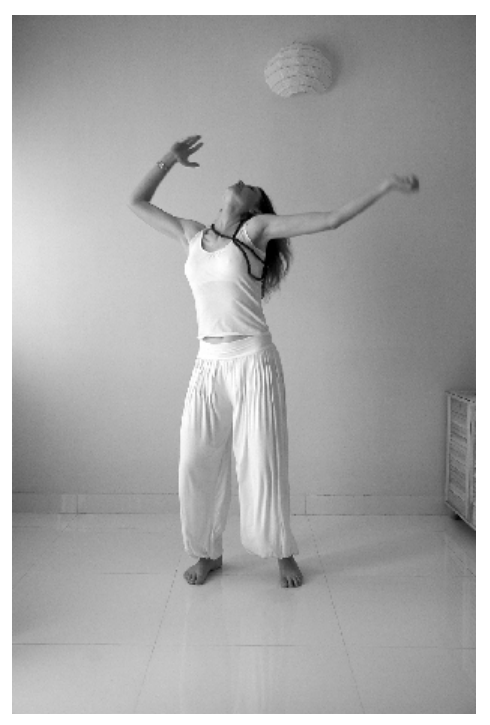
a. Stand with your eyes closed. Go deep into your manipuraka and feel how heavy the area feels. It is filled with all your worries. Focus on your manipuraka chakra for a minute. Just try to feel all the pent up anger and worry inside you due to various reasons.
b. Now, just start making nonsensical sounds from the navel area, as loudly as you can. Do not use words to shout. If you use words, only familiar and recent emotions will surface and also words will give rise to only more words without actually working on the emotions behind them.
c. Shout absolute gibberish. Only this will open out the unconscious in you. Only this will open out the deeply hidden emotions. Wave your hands, shout, scream. If tears flow, let them flow.
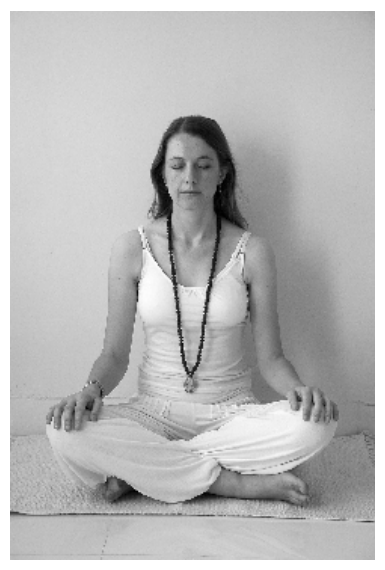
d. Do it with all your might, to vomit out all your negative feelings. Recall the painful incidents. Visualize the persons involved and feel the emotions involved in those incidents. Bring out all the emotions. Become completely immersed in them. Be aware of nothing else.
❖ Step 2 (-Duration: 10 minutes)
With your eyes closed, sit down in silence. Just be a witness to your thoughts. Feel the lightness in your manipuraka area. You will find that it is so light and blissful. Your whole being will be so light and free.
IN A NUTSHELL
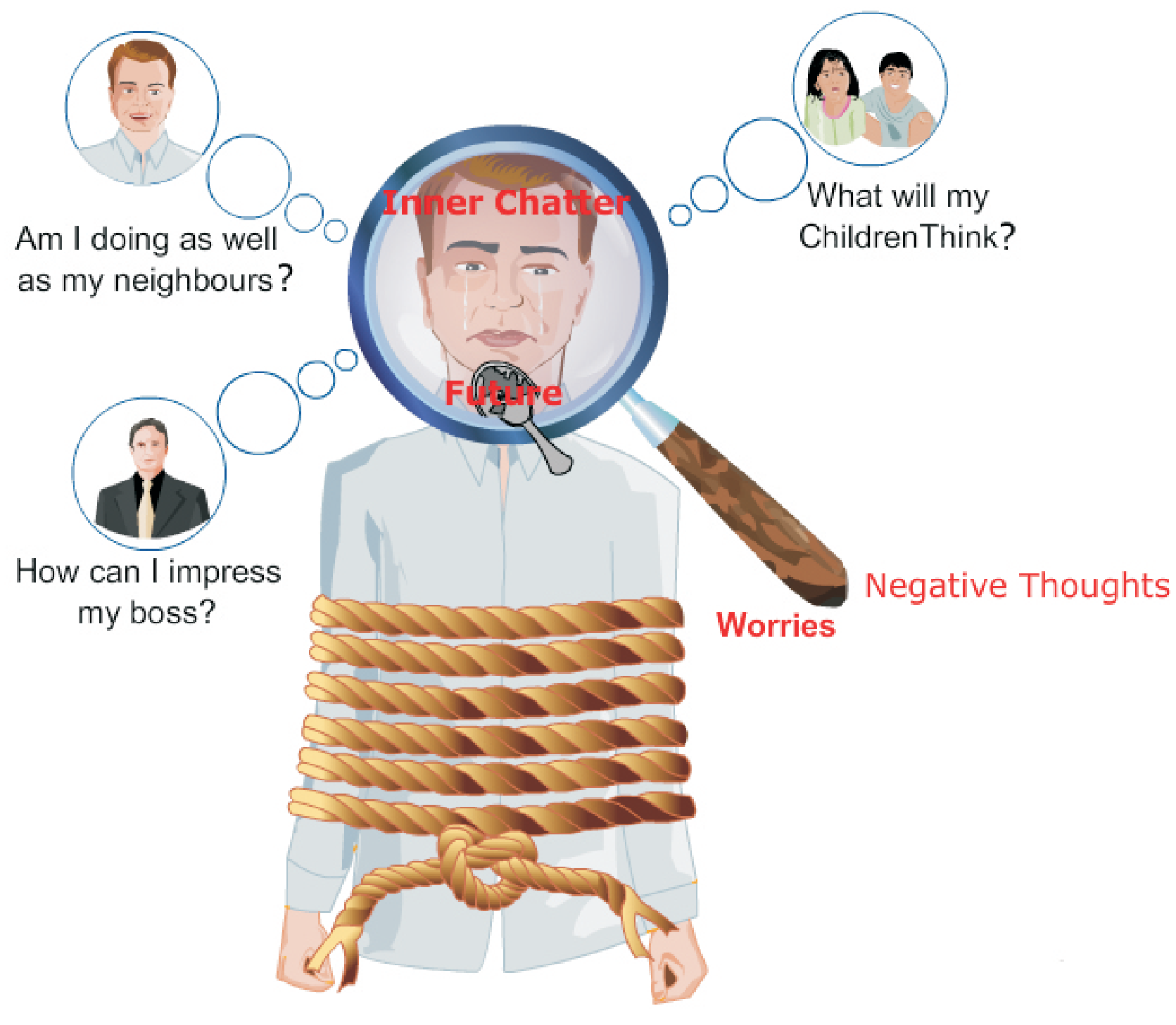
The manipuraka chakra is located at the navel. It is the seat of worries and is blocked by constant worrying. It flowers when we stop worrying about our worries!
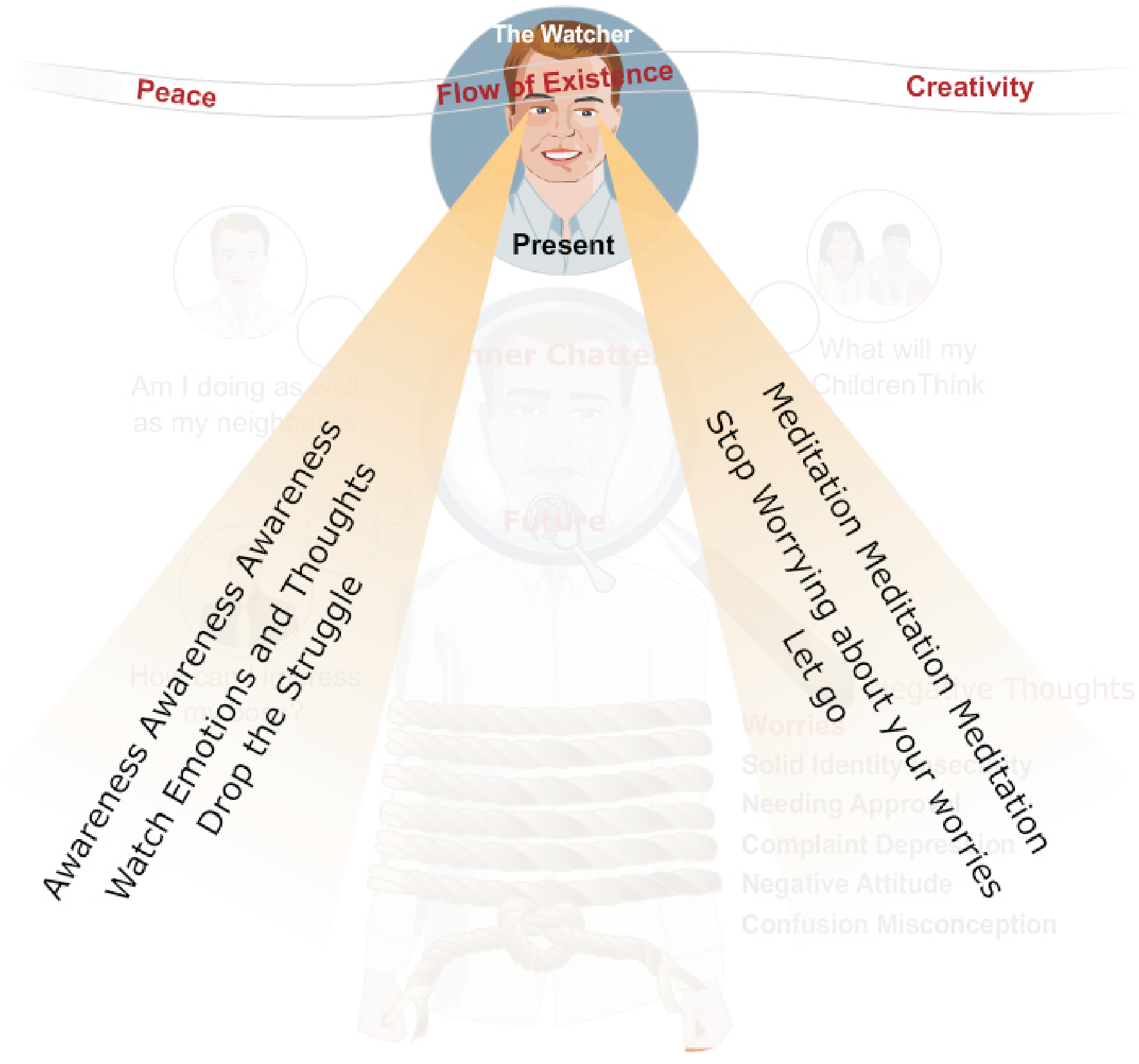
The diagram alongside shows a man who is 'tied up' with his worries. This is depicted as a rope tied around the manipuraka chakra. The worries become 'food for the mind', shown as bits of garbage on a spoon. The worries are magnified by the mind (shown as a magnifying glass) and become constant negative chatter in the mind. Worries are always about the future and as we
Am I doing as well as my neighbours?
Inner Chatter
Future
What will my Children Think?
How can I impress my boss?
Worries
Negative Thoughts are creative by nature, the worries ensure that we will create a future which will not be fulfilling for us.
We have become so wedded to our worries that if we have nothing to worry about, we become agitated and even feel that life has no purpose or value. We feel that we have nothing to live for. This is what is meant by 'worrying about the worries'.
How can we stop worrying about the worries? The key lies in becoming aware of our inner chatter and the illogical workings of the mind. Meditation is the key to developing this awareness. As we start to create a distance from the inner chatter, by becoming 'the watcher', we can merely observe. As we observe the chatter we will stop taking it seriously, and begin to become aware of the flow of existence, and the possibility of living with intuition as our guide, instead of the logic of the mind. In this way, we will begin to live in peace, instead of constant anxiety. Life will begin to flow instead of being a struggle.
In the second diagram alongside, the man at the top of the picture is 'the watcher'. Through meditation and developing awareness, he has started to merely observe the play of thoughts and emotions running through his mind. He is no longer under the control of the mind and its illogical decision-making processes. He is free from his worries because he is no longer worrying about them. He knows that it is futile to try to control the mind or to resist worries and that the key is to merely stand back and become the observer.