Intensity is a war with yourself
This text was machine-transcribed from the printed book and may contain errors. Select the words and choose “Report a mistake”.
May 23, 2012
Intensity means fighting with your own patterns. If you are fighting with your own patterns, you are being intense. If you are fighting with others patterns, it means you are in-tension, not intense!
Fighting with your patterns is intensity; fighting with others patterns is tension.
Come on, it is time we fight with our patterns, our inner enemies.
Everybody comes and tells me, I have transformed so much. Why don't you tell the other person also to transform? Everybody knows what their own patterns are, but nobody wants to fight with their own patterns. Everybody wants to fight with others' patterns!
You have enough enemies inside, so why don't you fight with your patterns? Look at your own patterns instead of others' patterns. Identify and break your own patterns.
But you say - No, no, no, no! He is not fighting with his patterns, so I have to fight with his patterns! So you fight with his patterns and he fights with your patterns!
War means you fighting with others' patterns; peace means you fighting with your own patterns. You fighting with your own patterns is peace. You fighting with others' patterns is war! That's all!
Now, wherever conflicts are there, you guys decide if you want to be in war or peace.
Process to identify your major patterns
1. Think of a recent conflict or a time when you felt powerless, felt your energy was down or felt depressed or felt fear, anger. Visualize it vividly as if it is happening now, relive the situation. Recall what was said, how you felt, everything you can visualize of that event.
2. Identify three things in the conflict:
- Mamakara – what you think you are inside at that moment. It is the image you carry for yourself; what you feel as you at that moment. e.g. I am a loser, I always let my parents down. * Ahankara – What you project to others as you - the way you react, the body language, the actions, and the statements you gave about yourself to others at that time e.g. I project friendliness even when I feel I am a loser.
- Swa-anyakara – what you cognize as Life at those moments. What is it that you felt life was for you at that moment e.g. Life is humiliating me, because people were laughing at me at that time.
When you identify these three statements, you will see that they have been there inside you during many situations in your life before.
These statements are only the branches; they are only the sign of the pattern existing deep inside. The root is hidden from your own view due to your current cognition. But we can start with cutting off the branches.
3. Do the process of self-completion – swapoornatva kriya.
The purpose of self-completion is to make yourself whole or complete. When you are complete, you will feel a lightness, feel the heaviness lift, feel energized, feel your inner space expanding. When you are incomplete or not whole, you will not have life energy, and you will feel powerless, upset, lifeless, low energy.
Have a medium-sized mirror in which you can see your face comfortably. You are going to have a conversation with yourself!
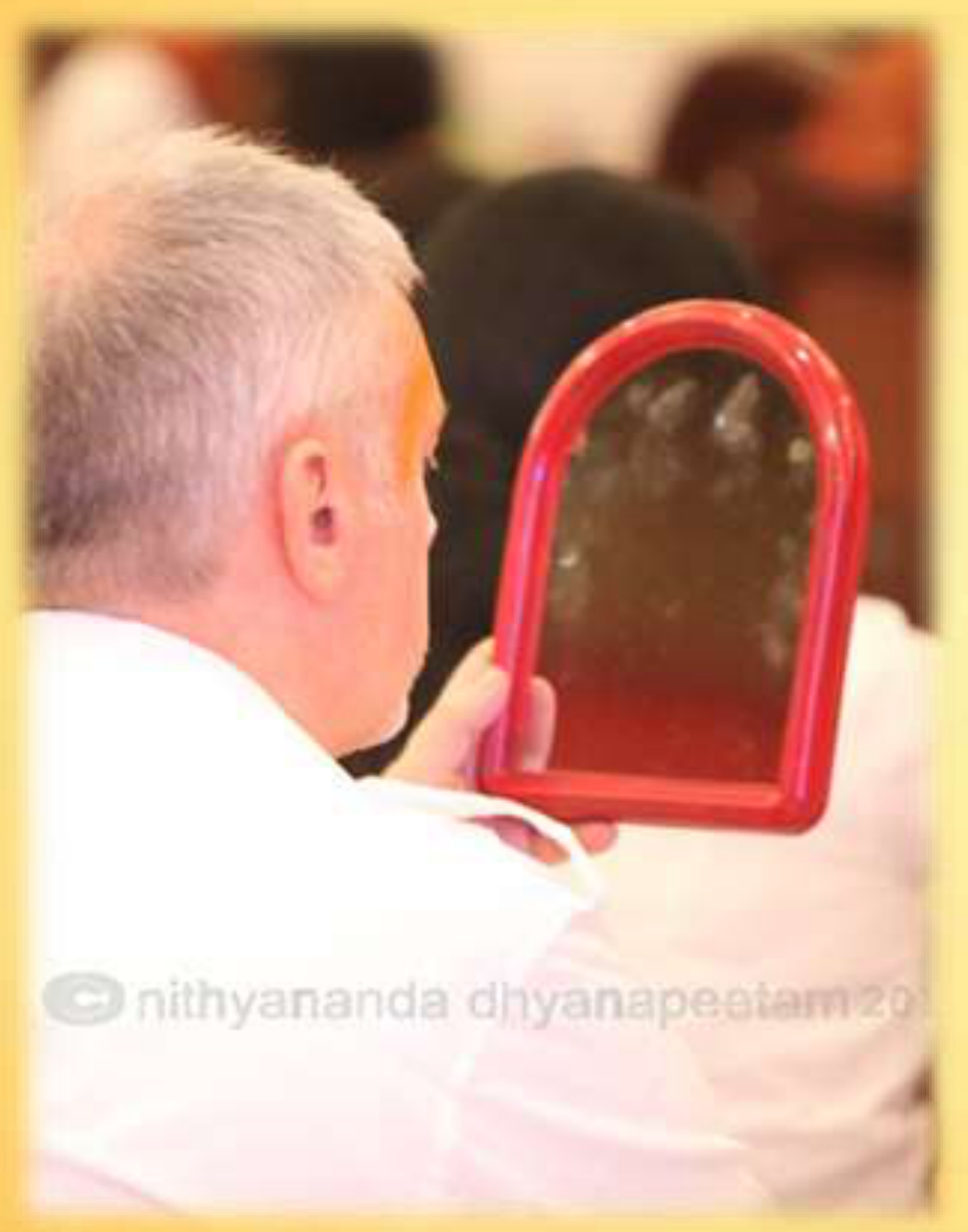
With the mirror in front of you, sit in a relaxed way and cognize that you committed for completion to happen. The complete part of you is holding the mirror. The incomplete person is the image in the mirror.
Look at the image in the mirror and bring up the situation again. Listen intently to what the incomplete person in the mirror has to say to you about the conflict. Keep listening till there is nothing else the incomplete person has to say.
Now, as the complete person, say to the incomplete person in the mirror that you heard what had been said, and that the incomplete person was functioning from a cognition that was created in the past, and that it is not the cognition you now have as a complete person.
Say to your mirror-image that you are functioning from this new cognition, and that you will not be functioning from the old cognition you had at that time. Heal the incomplete person in the mirror completely. Tears may come; laughter may come; allow both to happen.
8. On completion, you will feel a lightness, an expansion or a deep feeling of relief or a sigh. You may have sudden clarity about other past events, which are based on the same pattern you were dealing with during the completion process.
9. Repeat the same process for any other major pattern you want to complete.