'Press Council of India' Report : Paid news
This text was machine-transcribed from the printed book and may contain errors. Select the words and choose “Report a mistake”.
undermining democracy
The Press Council of India is a statutory body in India that governs the conduct of the print media. It is one of the most important bodies that sustain democracy, as it has supreme power in regard to the media to ensure that freedom of speech is maintained. It is also empowered to hold hearings on receipt of complaints and take suitable action where appropriate.
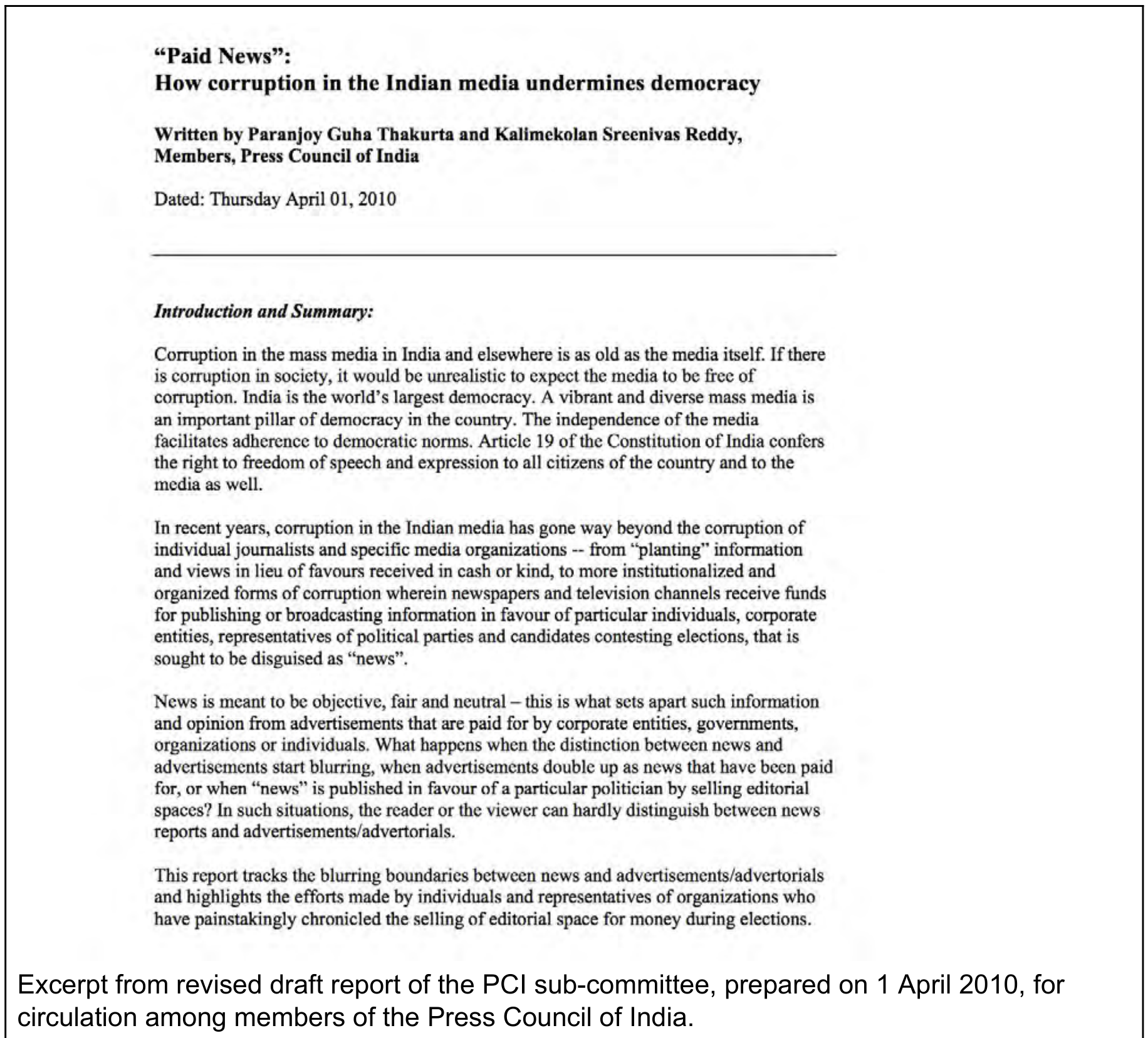
“Paid News”: How corruption in the Indian media undermines democracy
Written by Paranjoy Guha Thakurta and Kalimekolan Sreenivas Reddy, Members, Press Council of India
Dated: Thursday April 01, 2010
Introduction and Summary:
Corruption in the mass media in India and elsewhere is as old as the media itself. If there is corruption in society, it would be unrealistic to expect the media to be free of corruption. India is the world's largest democracy. A vibrant and diverse mass media is an important pillar of democracy in the country. The independence of the media facilitates adherence to democratic norms. Article 19 of the Constitution of India confers the right to freedom of speech and expression to all citizens of the country and to the media as well.
In recent years, corruption in the Indian media has gone way beyond the corruption of individual journalists and specific media organizations -- from “planting” information and views in lieu of favours received in cash or kind, to more institutionalized and organized forms of corruption wherein newspapers and television channels receive funds for publishing or broadcasting information in favour of particular individuals, corporate entities, representatives of political parties and candidates contesting elections, that is sought to be disguised as “news”.
News is meant to be objective, fair and neutral – this is what sets apart such information and opinion from advertisements that are paid for by corporate entities, governments, organizations or individuals. What happens when the distinction between news and advertisements start blurring, when advertisements double up as news that have been paid for, or when “news” is published in favour of a particular politician by selling editorial spaces? In such situations, the reader or the viewer can hardly distinguish between news reports and advertisements/advertorials.
This report tracks the blurring boundaries between news and advertisements/advertorials and highlights the efforts made by individuals and representatives of organizations who have painstakingly chronicled the selling of editorial space for money during elections.
Excerpt from revised draft report of the PCI sub-committee, prepared on 1 April 2010, for circulation among members of the Press Council of India. http://www.indiatogether.org/uploads/document/document_upload/2146/PCIsc-intro.pdf