JPC on Radia tapes?
This text was machine-transcribed from the printed book and may contain errors. Select the words and choose “Report a mistake”.
[Figure: Author icon]
The Congress on Monday continued to feign deafness as Opposition voices demanding a joint parliamentary committee (JPC) probe into the 2G spectrum scam grew louder.
The Opposition not only rejected the government's offer of entrusting the scam probe to Parliament's public accounts committee ( PAC) but also demanded that the ambit of the JPC investigation be extended to include a probe into the Nira Radia tapes to ascertain the media's role in the controversy.
The tapes had exposed the role of some mediapersons in influencing the decision to appoint A. Raja as telecom minister.
The Centre had said the PAC would be assisted by a five-member multidisciplinary action panel drawn from various investigating agencies such as the Enforcement Directorate (ED) and the Central Bureau of Investigation (CBI). But the Opposition contended that a PAC will not have the same powers as a JPC.
"The 2G spectrum scam involved all institutions of the state as well as the media. It is no longer an audit issue," leader of the Opposition in the Lok Sabha Sushma Swaraj said. Her Rajya Sabha counterpart Arun Jaitley agreed with Swaraj and added: "As the tapes have exposed, corporate lobbyists decide who should be the minister and what should be the allocation of portfolios? The national policy on telecom was tailored to suit some people. The telecom ministry was reserved for one party and, within that party, one person.
[Read more: 10-https://www.indiatoday.in/india/north/story/jpc-on-radia-tapes-86005-2010-11-23]
Media blackout and reactions in social media: The news gained prominence following sustained pressure on social networking sites Twitter[21]and Facebook[23] against an attempted blackout orchestrated by many prominent Indian TV channels and newspapers.
| 24 November 2010: DNA - #barkhagate: Protests in 140 characters leave no space for gray areas | | :--- | | Barkha Dutt has spent the last few days replying to tweets expressing loss of faith in her and demanding answers for her involvement in the recent expose wherein she offered to facilitate a meeting between DMK's Kanimozhi and Union health minister Ghulam Nabi Azad on the behest of lobbyist Niira Radia. | | Dutt's active presence on Twitter has ensured that all ire is directed straight at her; she cannot dodge any of it. Search for #barkhagate, and you sense that Twitter users and bloggers are baying for her blood. But, her reply to each tweet is calm. Like this one, "Ethics should be measured by coverage of issues. | | Diplomatic friendliness to get information from a source is very different. To get news one speaks to all kinds of people, dirty or clean, if they are a source of real time updates. That is not a crime." |
Shubho Sengupta, head of digital media at Rediffusion Y&R, says that #barkhagate is not going to affect her in the long-run. “I think Barkha is handling the issue very intelligently and she should continue the discussions. But most tweets are very impulsive rants or attacks against her; they aren’t asking the right questions.”
Veteran media critic V Gangadhar says, “For long, the Letters to the Editor was the only section where you could complain about an erroneous report, or give feedback. Social media has ensured criticism happens on public fora.” Which is why, since the last few years, the growing adoption of new media — blogs, citizen journalism websites and Twitter — is a crucial phase in the history of journalism, when the media’s reputation of having the final word is being challenged.
“The blackout of reporting on the scandal by some newspapers and news channels was the biggest reason that angered social media users,” says Santosh Desai, CEO, Future Brands.
But there is also criticism of the kind of debate that new media is generating. Gangadhar describes it as ‘very right-wing, unbalanced and extreme’. Desai says that people must put every issue in context. “#barkhagate hasn’t grasped that or crafted it like a debate, rather it is more of a personalised attack.”
[http://www.dnaindia.com/india/report-barkhagate-protests-in-140-characters-leave-no-s pace-for-gray-areas-1471128]
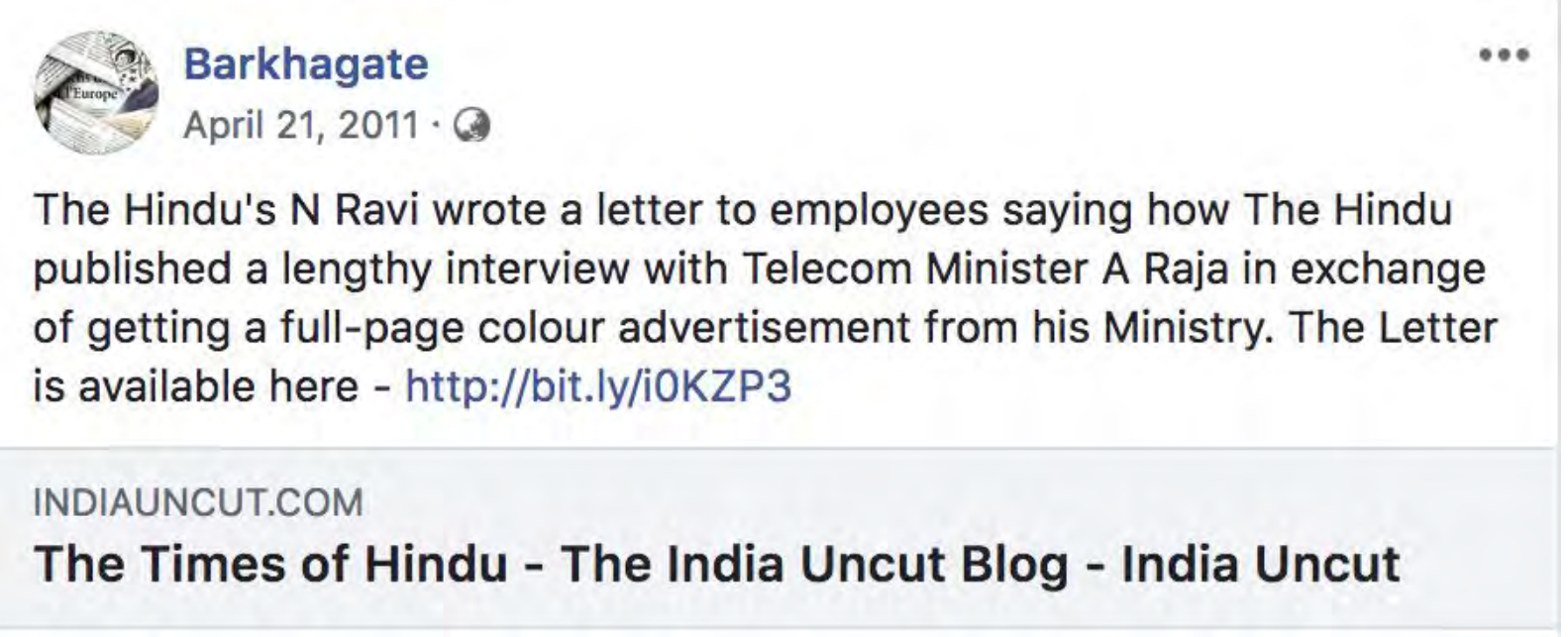
23 https://www.facebook.com/indiamediawatch/
Journalists mentioned in the Radia tapes
- Barkha Dutt, Group editor, English news, New Delhi Television(NDTV), NDTV also has a Hindi news channel NDTV India
- M.K. Venu, then Opinion Editor, The Economic Times. Outlook weekly published unconditional apology for naming M.K.Venu on its cover.
- Prabhu Chawla, the then editor of India Today magazine
- Shankar Aiyar, then with India Today Group
- Vir Sanghvi, HT advisory editorial director
- Casual conversations with Radia of Editors of The Times of India, The Economic Times and The Hindu Business line also figured in the tapes published by Outlook magazine.