Destruction of the indigenous superior education system
This text was machine-transcribed from the printed book and may contain errors. Select the words and choose “Report a mistake”.
Macaulay’s English Education Act, 1835 To Zachary Macaulay, 12 October 1836
Our English schools are flourishing wonderfully. We find it difficult, indeed at some places impossible, to provide instruction for all who want it. At the single town of Hoogley fourteen hundred boys are learning English. The effect of this education on the Hindoos is prodigious. No Hindoo who has received an English education ever continues to be sincerely attached to his religion. Some continue to profess it as a matter of policy. But many profess themselves pure Deists, and some embrace Christianity……. It is my firm belief that, if our plans of education are followed up, there will not be a single idolater among the respectable classes in Bengal thirty years hence. And this will be effected without any efforts to proselytise, without the smallest interference with religious liberty, merely by the natural operation of knowledge and reflection. I heartily rejoice in this prospect....
Letter To Zachary Macaulay, 12 October 1836
My dear Father,
- Our English schools are flourishing wonderfully.
- The effect of this education on the Hindoos is prodigious.
- No Hindoo who has received an English education ever continues to be sincerely attached to his religion.
- if our plans of education are followed up, there will not be a single idolater among the respectable classes in Bengal thirty years hence.
- And this will be effected without any efforts to proselytise, without the smallest interference with religious liberty, merely by the natural operation of knowledge and reglection. I heartily rejoice in this prospect....
http://www.columbia.edu/itc/mealac/pritchett/00generallinks/macaulay/txt_letters_later.html
Without a doubt, native education decayed and illiteracy increased during the Christian British rule.
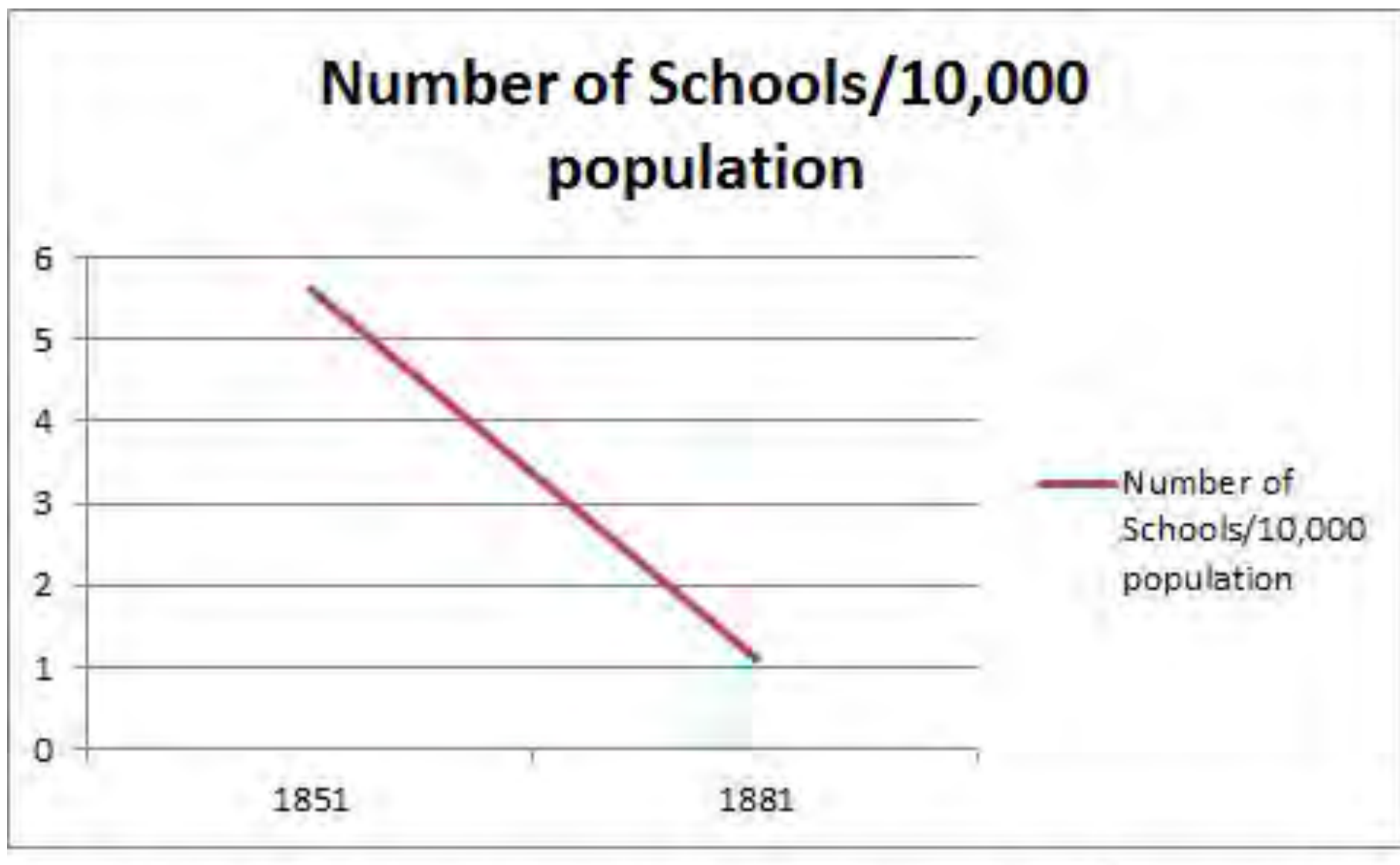
According to Sir Henry Lawrence, there was one school for every 1783 inhabitants of the most backward division of the Punjab at the time of annexation. But thirty years later in 1881, 'there is one school of whatever sort, to every 9,028 inhabitants', according to the President of the Educational Commission.
According to Sir Henry Lawrence, there was one school for every 1783 inhabitants of the most backward division of the Punjab at the time of annexation. But thirty years later in 1881, 'there is one school of whatever sort, to every 9,028 inhabitants', according to the President of the Educational Commission. William Adam estimated that there was 11% literacy in the Thana of Nattore during 1830s. A century later the British considered this an accomplishment in many parts of India!