An attempt of silent assassination in the Mysore Prison
This text was machine-transcribed from the printed book and may contain errors. Select the words and choose “Report a mistake”.
During the Mysore detainment, a silent assassination was contrived to poison His food. A person who worked in the prison, supported His Divine Holiness, horrified at this daylight murder sent in a note - ‘Please do not eat, food is poisoned.’ That night, His Divine Holiness left the plate at the corner of the cell, and saw a rat eating the food and dying, proving that the food was indeed poisoned.
What are Sections 107 and 151 of Code of Criminal Procedure slapped on His Divine Holiness?
The extremity of persecution and brutal attacks done on His Divine Holiness, can be understood by observing the circumstances, the judicial laws and the foul play of the STATE POLICE.
Section 107 deals with ‘Security for keeping the peace in other cases’ and purports the power of the Executive Magistrate who has received information that a person is likely to commit breach of peace or disturb public tranquility in any way, and is of opinion that there is sufficient ground for proceeding, he may require such person to show cause why he should not be ordered to execute a bond with or without sureties for keeping the peace for such period, not exceeding one year.
Section 107 does not vest any power in the hands of the police to arrest.
Section 151 of Cr.P.C. deals with 'Arrest to prevent the commission of cognizable offences. According to this: (1) A police officer knowing of a design to commit any cognizable offence may arrest, without orders from a Magistrate and without a warrant, the person so designing, if it appears to such officer that the commission of the offence cannot be otherwise prevented'. (2) directs that 'No person arrested under sub-section (1) shall be detained in custody for a period exceeding 24 hours from the time of his arrest unless his further detention is required or authorized under any other provisions of this Code or of any other law for the time being in force'.
Abuse of the Powers under Sections 107, 151
- Historically, preventive arrest was notoriously used in India during the British rule under the Bengal Regulation— III of 1818 (the Bengal State Prisoners Regulation) which empowered the government to detain or arrest anybody on mere suspicion.
- Sections 107 and 151 is to avert the commission of an undesirable offence and not punish for a certain crime committed.
- For instance, the arrest of Anna Hazare on August 2011 under Sections 107 and 151 was unconstitutional, against democratic principles and similar to the situation during National Emergency, by the retired IPS Officer- Kiran Bedi.
- Section 107 is a preventive section and not punitive, hence there is no strong and legal grounds for incarcerating a person unless there has been an in-depth scrutiny of facts. In the case of
His Divine Holiness, there was no scrutiny of facts by District Magistrate, it was straight unlawful use of Section 107 Cr Pc.
CRIMES OF THE STATE POLICE IN EXECUTING IPC 107, 151
In an unheard-of absurd move, instead of arresting the perpetrators, the State Police and the District Magistrate slapped an “unauthorised” case of ‘preventive measure to protect law and order’ and ordered the arrest of His Divine Holiness, who had done no offence and had not breached any peace, AND IN REALITY WAS THE VICTIM IN THE WHOLE ISSUE!
- Most notorious complaint: Section 107, 151 of Code of Criminal Procedure of Indian Penal Code was registered by the District Magistrate against His Divine Holiness. The district magistrate is part of the executive wing of the government and not the judiciary.
- Violation of Constitutional Law: Section 151 states, “No person arrested shall be detained in custody for a period exceeding 24 hours from the time of his arrest”. His Divine Holiness was illegally remanded for SEVEN DAYS by the DM.
- As per the Judicial Law, the Section 107, 151 need many pre-requisite sections to be satisfied before these sections can be registered by the DM. The Sections clearly state that an individual can be apprehended only when there is sufficient grounds to suspect that he is a threat to public peace or safety. It was proven on 25th February 2013, that there were no sufficient grounds in the complaint as there was no offense done.
- On 25th February 2013, the High Court of Karnataka (in the case of Sri Nithyananda Swamiji vs District Magistrate) quashed the complaint citing it was: CONTRARY TO LAW AND UNAUTHORIZED AS PER THE LAW. Following are the excerpts from the ORDER OF THE HIGH COURT.
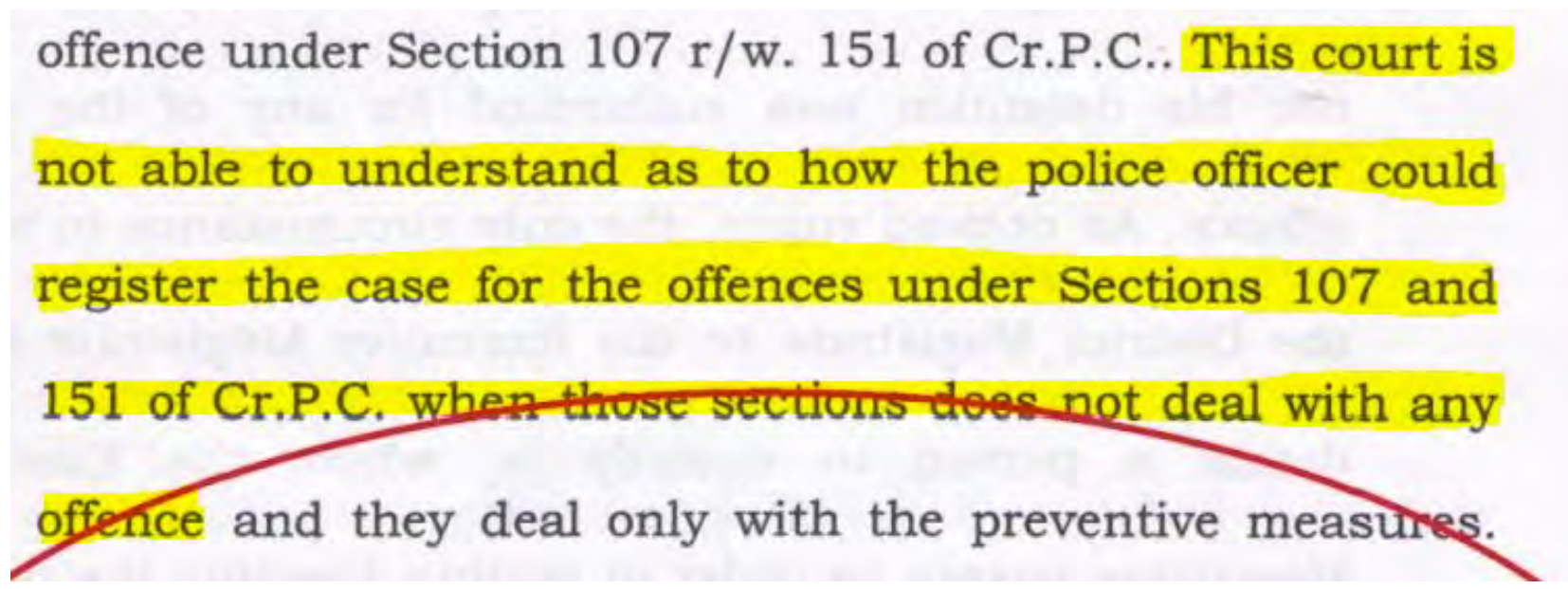
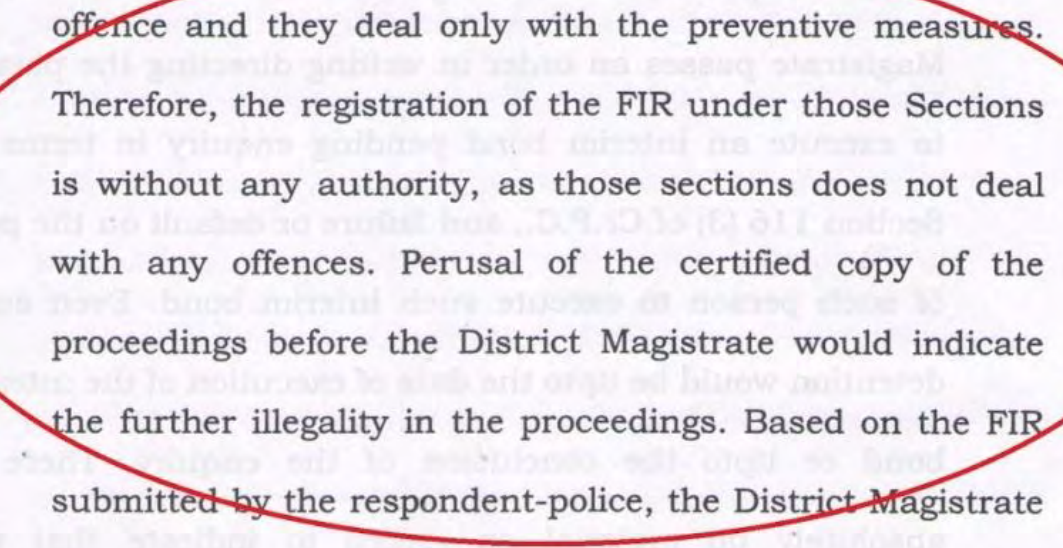
- DM HAD NO AUTHORITY FOR REGISTERING THE FIR, NO OFFENCE EXISTED: "Perusal of the FIR indicates that the respondent-police had registered the case for the offence under Section 107 r/w. 151 of Cr.P.C. This court is not able to understand as to how the police officer could register the case for the offences under Sections 107 and 151 of Cr.P.C. when those sections do not deal with any offence and they deal only with the preventive measures. Therefore, the registration of the FIR under those Sections is without any authority, as those sections do not deal with any offences."
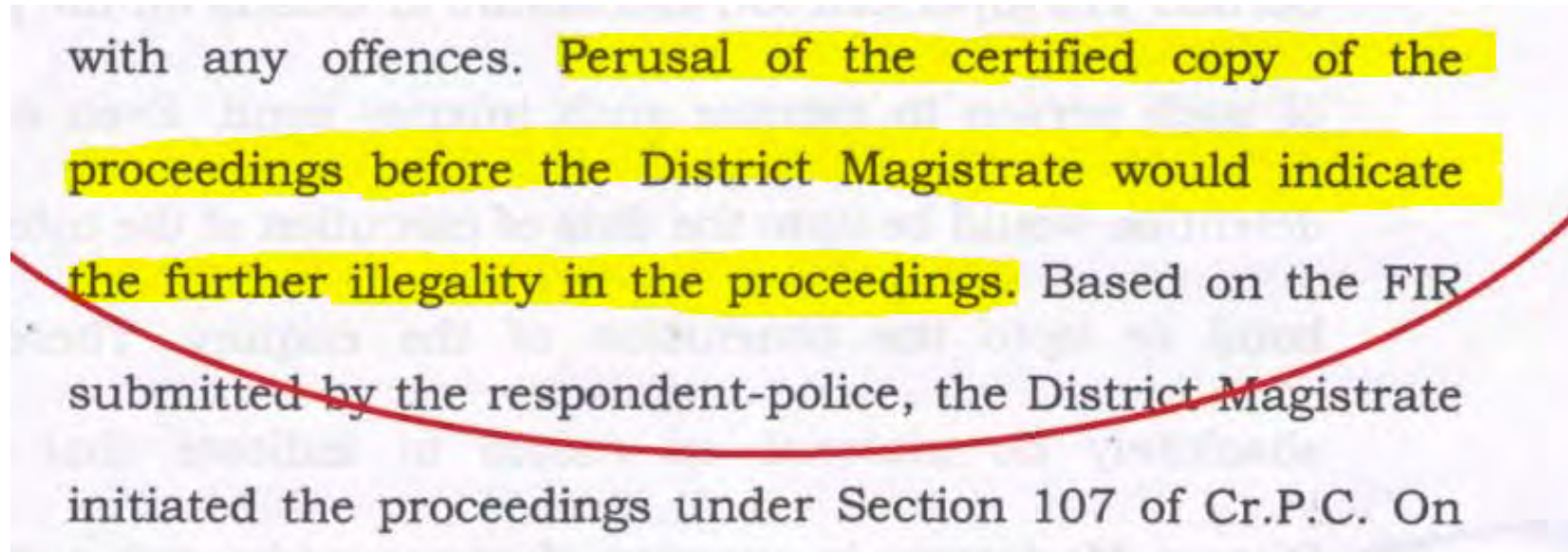
- PROCEEDINGS WERE ILLEGAL BY THE DM: "Perusal of the certified copy of the proceedings before the District Magistrate would indicate the further illegality in the proceedings."
- ILLEGAL DETENTION: "The petitioner (His Divine Holiness) was arrested and produced before the District Magistrate and the District Magistrate remanded the petitioner to the judicial custody for a period of seven days."
- DM HAD NO POWER TO REMAND HIS DIVINE HOLINESS AS HIS DETENTION WAS NOT REQUIRED AND THERE WAS NO OFFENCE:
- "Reading of Sections 107, 111, 116 and 151 of Cr.P.C., does not indicate any power on the part of the executive magistrate to remand the petitioner to judicial custody, since it is not shown that his detention was required in any other case nor his detention was authorized for any of the other offence. Therefore, the remand of the petitioner to judicial custody was without authority of law. The entire proceedings before the District Magistrate, Ramanagara, initiated under Section 107 of Cr.P.C. and various orders passed therein are contrary to law and without any jurisdiction. Therefore, the FIR as well as the further proceedings taken thereon are required to be quashed." 7
under sub-section (1) shall be detained in custody for a period exceeding 24 hours from the time of his arrest unless his further detention is required or authorized under any other provisions of this Code or of any other law for the time being in force'.
11) Perusal of the FIR in the case on hand indicates that the respondent-police had registered the case for the offence under Section 107 r/w. 151 of Cr.P.C.. This court is not able to understand as to how the police officer could register the case for the offences under Sections 107 and 151 of Cr.P.C. when those sections does not deal with any offence and they deal only with the preventive measures. Therefore, the registration of the FIR under those Sections is without any authority, as those sections does not deal with any offences. Perusal of the certified copy of the proceedings before the District Magistrate would indicate the further illegality in the proceedings. Based on the FIR submitted by the respondent-police, the District Magistrate initiated the proceedings under Section 107 of Cr.P.C. On
8
the very same day, the petitioner was arrested and produced before the District Magistrate and the District Magistrate remanded the petitioner to the judicial custody for a period of seven days. As noticed supra, reading of Sections 107, 111, 116 and 151 of Cr.P.C., does not indicate any power on the part of the executive magistrate to remand the petitioner to judicial custody, since it is not shown that his detention was required in any other case nor his detention was authorized for any of the other offence. As noticed supra, the only circumstance in which the District Magistrate or the Executive Magistrate could detain a person in custody is, where the Executive Magistrate passes an order in writing directing the person to execute an interim bond pending enquiry in terms of Section 116 (3) of Cr.P.C., and failure or default on the part of such person to execute such interim bond. Even such detention would be upto the date of execution of the interim bond or upto the conclusion of the enquiry. There is absolutely no material on record to indicate that the District Magistrate in exercise of power under sub-section (3) of Section 116 of Cr.P.C. directed the petitioner to
execute an interim bond pending enquiry. Therefore, there
was no compulsion on the part of petitioner to execute
interim bond. Therefore, the District Magistrate had no
authority to remand the petitioner to judicial custody, as
such, the remand of the petitioner to judicial custody was
without authority of law. The order dated 14.06.2012
passed by the District Magistrate directing the petitioner to
execute a bond for a sum of Rs.1,00,000/- with two
sureties for the like-sum to be in force for a period of one
year, without holding any enquiry as required under
Section 116, is contrary to law and without jurisdiction.
There also appears to be no preliminary order as required
by Section 111 of Cr.P.C. Therefore, the entire proceedings
before the District Magistrate, Ramanagara, initiated under
Section 107 of Cr.P.C. and various orders passed therein
are contrary to law and without any jurisdiction. Therefore,
the FIR as well as the further proceedings taken thereon
are required to be quashed.