अथ चतुर्थोऽध्यायः
This text was machine-transcribed from the printed book and may contain errors. Select the words and choose “Report a mistake”.
ज्ञानकर्मसंन्यासयोगः
Jñānakarmasannyāsa Yogaḥ
श्री भगवानुवाच ।
इमं विवस्वते योगं प्रोक्तवानहमव्ययम् ।
विवस्वान्मनवे प्राह मनुरिक्ष्वाकवेऽब्रवीत् ॥ ४.१
śrībhagavānuvāca
imaṁ vivasvate yogaṁ proktavānaham avyayaṁ ।
vivasvānmanave prāha manurikṣvākave'bravīt ॥ 4.1
4.1 Bhagavān says: ‘I taught the sun god, Vivasvān, the imperishable science of yoga and Vivasvān taught Manu, the father of mankind and Manu in turn taught Ikṣvāku.’
एवं परम्पराप्राप्तमिमं राजर्षयो विदुः ।
स कालेनेह महता योगो नष्टः परन्तप ॥ ४.२
evaṁ paraṁparāprāptamimaṁ rājarṣayo viduḥ ।
sa kāleneha mahatā yogo naṣṭaḥ parantapa ॥ 4.2
4.2 The supreme science was thus received through the chain of master-disciple succession and the saintly kings understood it in that way. In the course of time, the succession was broken and therefore the science as it was, appears to have been lost.
स एवायं मया तेऽद्य योगः प्रोक्तः पुरातनः ।
भक्तोऽसि मे सखा चेति रहस्यं ह्येतदुत्तमम् ॥ ४.३
sa evāyaṁ mayā te'dya yogaḥ proktaḥ purātanaḥ ।
bhakto 'si me sakhā ceti rahasyaṁ hyetaduttamam ॥ 4.3
4.3 That ancient science of Enlightenment, or entering into eternal bliss, is today taught by me to you because you are my devotee as well as my friend. You will certainly understand the supreme mystery of this science.
अर्जुन उवाच ।
अपरं भवतो जन्म परं जन्म विवस्वतः ।
कथमेतद्विजानीयां त्वमादौ प्रोक्तवानिति ॥ ४.४
arjuna uvāca aparaṁ bhavato janma paraṁ janma vivasvataḥ / kathametad vijānīyāṁ tvamādau proktavāniti // 4.4
4.4 Arjuna says: ‘Oh Kṛṣṇa, you are younger to the sun god Vivasvān by birth. How am I to understand that in the begin-ning you instructed this science to him?’
श्री भगवानुवाच
बहूनि मे व्यतीतानि जन्मानि तव चार्जुन ।
तान्यहं वेद सर्वाणि न त्वं वेत्थ परन्तप ॥ ४.५
śrībhagavānuvāca bahuni me vyatītāni janmāni tava cārjuna / tānyahaṁ veda sarvāṇi na tvaṁ vettha parantapa // 4.5
4.5 Bhagavān says: Many many births both you and I have passed. I can remember all of them, but you cannot, O Parantapa!
अजोऽपि सन्नव्ययात्मा भूतानामीश्वरोऽपि सन् ।
प्रकृतिं स्वामधिष्ठाय संभवाम्यात्ममायया ॥ ४.६
ajo ’pi sannavyayātmā bhūtānām īśvaro ’pi san / prakṛtiṁ svāmadhiṣṭhāya saṁbhavāmyātmamāyayā // 4.6
4.6 Although I am unborn, imperishable and the lord of all living entities, by ruling my nature I reappear by my own māyā.
यदा यदा हि धर्मस्य ग्लानिर्भवति भारत ।
अभ्युत्थानमधर्मस्य तदात्मानं सृजाम्यहम् ॥ ४.७
yadā yadā hi dharmasya glānirbhavati bhārata / abhyutthānam adharmasya tad ātmānaṁ sṛjāmyaham // 4.7 4.7 Whenever positive consciousness declines, when collective negativity rises, O Bhārat, again and again, at these times, I happen Myself.
परित्राणाय साधूनां विनाशाय च दुष्कृताम् ।
धर्मसंस्थापनार्थाय संभवामि युगे युगे ॥ ४.८
paritrāṇāya sādhūnāṁ vināśāya ca duṣkṛtām |
dharma-saṁsthāpanārthāya saṁbhavāmi yuge-yuge || 4.8
4.8 To protect the pious and to annihilate the wicked, to re-establish righteousness I Myself appear, age after age.
जन्म कर्म च मे दिव्यमेवं यो वेत्ति तत्त्वतः ।
त्यक्त्वा देहं पुर्नजन्म नैति मामेति सोऽर्जुन ॥ ४.९
janma karma ca me divyamevaṁ yo vetti tattvataḥ |
tyaktvā dehaṁ punarjanma naiti māmeti so'rjuna || 4.9
4.9 One who knows or experiences My divine appearance and activities does not take birth again in this material world after leaving the body but attains Me, O Arjuna.
वीतरागभयक्रोधा मन्मया मामुपाश्रिताः ।
बहवो ज्ञानतपसा पूता मद्भावमागताः ॥ ४.१०
vītarāgabhayakrodhā manmayā māmupāśritāḥ |
bahavo jñānatapasā pūtā madbhāvamāgatāḥ || 4.10
4.10 Being freed from attachment, fear and anger, being filled with me and by taking refuge in me, many beings in the past have become sanctified by the knowledge of me and have realized me.
ये यथा मां प्रपद्यन्ते तांस्तथैव भजाम्यहम् ।
मम वर्त्मानुवर्तन्ते मनुष्याः पार्थ सर्वशः ॥ ४.११
ye yathā māṁ prapadyante tāṁstathaiva bhajāmyaham |
mama vartmānuvartante manuṣyāḥ pārtha sarvaśaḥ || 4.11
4.11 I reward everyone, I show Myself to all people, according to the manner in which they surrender unto me, in the manner that they are devoted to me, O Pārtha!
काङ्क्षन्तः कर्मणां सिद्धिं यजन्त इह देवताः ।
क्षिप्रं हि मानुषे लोके सिद्धिर्भवति कर्मजा ॥ ४.१२
kāṅkṣantaḥ karmaṇāṁ siddhiṁ yajanta iha devatāḥ |
kṣipraṁ hi mānuṣe loke siddhirbhavati karmajā || 4.12
4.12 Men in this world desire success from activities and therefore they worship the gods. Men get instant results from active work in this world.
चातुर्वर्ण्यं मया सृष्टं गुणकर्मविभागशः।
तस्य कर्तारमपि मां विद्ध्यकर्तारमव्ययम् ॥ ४.१३
cāturvarṇyaṁ mayā sṛṣṭaṁ guṇakarma vibhāgaśaḥ |
tasya kartāram api māṁ viddhyakartāramavyayam || 4.13
4.13 Depending upon the distribution of the three attributes or guṇas and action, I have created the four castes. Yet, I am to be known as the non-doer, the unchangeable.
न मां कर्माणि लिम्पन्ति न मे कर्मफले स्पृहा ।
इति मां योऽभिजानाति कर्मभिर्न स बध्यते ॥ ४.१४
na māṁ karmāṇi limpanti na me karmaphale spṛhā |
iti māṁ yo'bhijānāti karmabhirna sa badhyate || 4.14
4.14 I am not affected by any work; nor do I long for the outcome of such work. One who understands this truth about me also does not get caught in the bondage of work.
एवं ज्ञात्वा कृतं कर्म पूर्वैरपि मुमुक्षुभिः ।
कुरु कर्मैव तस्मात्त्वं पूर्वैः पूर्वतरं कृतम् ॥ ४.१५
evaṁ jñātvā kṛtaṁ karma pūrvairapi mumukṣubhiḥ |
kuru karmaiva tasmāttvaṁ pūrvaiḥ pūrvataraṁ kṛtam || 4.15
4.15 All the wise and liberated souls of ancient times have acted with this understanding and thus attained liberation. Just as the ancients did, perform your duty with this understanding.
किं कर्म किमकर्मेति कवयोऽप्यत्र मोहिताः ।
तत्ते कर्म प्रवक्ष्यामि यज्ज्ञात्वा मोक्ष्यसेऽशुभात् ॥ ४.१६
kiṁ karma kimakarmeti kavayo'pyatra mohitāḥ |
tat te karma pravakṣyāmi yaj jñātvā mokṣyase'śubhāt || 4.16
4.16 What is action and what is inaction, even the wise are con-fused. Let me explain to you what action is, knowing which you shall be liberated from all ills.
कर्मणो ह्यपि बोद्धव्यं बोद्धव्यं च विकर्मणः ।
अकर्मणश्च बोद्धव्यं गहना कर्मणो गतिः ॥ ४.१७
karmaṇo hyapi boddhavyaṁ boddhavyaṁ ca vikarmaṇaḥ |
akarmaṇaśca boddhavyaṁ gahanā karmaṇo gatiḥ || 4.17
4.17 The complexities of action are very difficult to understand. Understand fully the nature of proper action by understanding the nature of wrong action and inaction.
कर्मण्यकर्म यः पश्येदकर्मणि च कर्म यः ।
स बुद्धिमान्मनुष्येषु स युक्तः कृत्स्नकर्मकृत् ॥ ४.१८
karmaṇyakarma yaḥ paśyedakarmaṇi ca karma yaḥ |
sa buddhimān manuṣyeṣu sa yuktaḥ kṛtsnakarmakṛt || 4.18
4.18 He who sees inaction in action and action in inaction, is wise and a yogi, Even if engaged in all activities.
यस्य सर्वे समारम्भाः कामसङ्कल्पवर्जिताः ।
ज्ञानाग्निदग्धकर्माणं तमाहुः पण्डितं बुधाः ॥ ४.१९
yasya sarve samārambhāḥ kāmasaṅkalpavarjitāḥ |
jñānāgnidagdhakarmāṇaṁ tam āhuḥ paṇḍitaṁ budhāḥ || 4.19
4.19 He who is determined and devoid of all desires for sense gratification, he is of perfect knowledge. The sages declare such a person wise whose actions are burnt by the fire of knowledge.
त्यक्त्वा कर्मफलासङ्गं नित्यतृप्तो निराश्रयः ।
कर्मण्यभिप्रवृत्तोऽपि नैव किञ्चित्करोति सः ॥ ४.२०
tyaktvā karmaphalāsaṅgaṁ nityatṛpto nirāśrayaḥ |
karmaṇyabhipravṛtto'pi naiva kiñcitkaroti saḥ || 4.20
4.20 Having given up all attachment to the results of his action, always satisfied and independent, the wise man does not act, though he is engaged in all kinds of action.
निराशीर्यतचित्तात्मा त्यक्तसर्वपरिग्रहः ।
शारीरं केवलं कर्म कुर्वन्नाप्नोति किल्बिषम् ॥ ४.२१
nirāśī ryatacittātmā tyaktasarvaparigrahaḥ l śārīraṁ kevalaṁ karma kurvannāpnoti kilbiṣam ll 4.21
4.21 The person who acts without desire for the result; with his consciousness controlling the mind, giving up all sense of ownership over his possessions and body and only working, incurs no sin.
यदृच्छालाभसन्तुष्टो द्वन्द्वातीतो विमत्सरः ।
समः सिद्धावसिद्धौ च कृत्वापि न निबध्यते ॥ ४.२२
yadṛcchālābhasantuṣṭo dvandvātī to vimatsaraḥ l samaḥ siddhāvasiddhau ca kṛtvāpi na nibadhyate ll 4.22
4.22 He who is satisfied with profit which comes of its own accord and who has gone beyond duality, who is free from envy, who is in equanimity both in success and failure, such a person though doing action, is never affected.
गतसङ्गस्य मुक्तस्य ज्ञानावस्थितचेतसः ।
यज्ञायाचरतः कर्म समग्रं प्रविलीयते ॥ ४.२३
gatasaṅgasya muktasya jñānāvasthitacetasaḥ l yajñāyācarataḥ karma samagraṁ pravilī yate ll 4.23
4.23 The work of a liberated man who is unattached to the modes of material nature and who is fully centered in the ul-timate knowledge, who works totally for the sake of sacrifice, merges entirely into the knowledge.
ब्रह्मार्पणं ब्रह्महविर्ब्रह्माग्नौ ब्रह्मणा हुतम् ।
ब्रह्मैव तेन गन्तव्यं ब्रह्मकर्मसमाधिना ॥ ४.२४
brahmārpaṇaṁ brahmahavir brahmāgnau brahmaṇā hutam l brahmaiva tena gantavyaṁ brahmakarmasamādhinā ll 4.24 4.24 The offering, the offered butter to the supreme in the fire of the supreme is offered by the supreme. Certainly, the supreme can be reached by him who is absorbed completely in action.
दैवमेवापरे यज्ञं योगिनः पर्युपासते ।
ब्रह्माग्नावपरे यज्ञं यज्ञेनैवोपजुह्वति ॥ ४.२५
daivamevāpare yajñaṁ yoginaḥ paryupāsate | brahmāgnāvapare yajñaṁ yajñenaivopajuhvati || 4.25
4.25 Some yogis worship the gods by offering various sacrifices to them, While others worship by offering sacrifices in the fire of the supreme.
श्रोत्रादीनीन्द्रियाण्यन्ये संयमाग्निषु जुह्वति ।
शब्दादीन्विषयानन्य इन्द्रियाग्निषु जुह्वति ॥ ४.२६
śrotrādī nīndriyāṇyanye saṁyamāgniṣu juhvati | śabdādī nviṣayānanya indriyāgniṣu juhvati || 4.26
4.26 Some sacrifice the hearing process and other senses in the fire of equanimity and others offer as sacrifice the objects of the senses, such as sound in the fire of the sacrifice.
सर्वाणीन्द्रियकर्माणि प्राणकर्माणि चापरे ।
आत्मसंयमयोगाग्नौ जुह्वति ज्ञानदीपिते ॥ ४.२७
sarvāṇīndriyakarmāṇi prāṇakarmāṇi cāpare | ātmasaṁyamayogāgnau juhvati jñānadī pite || 4.27
4.27 One who is interested in knowledge offers all the actions due to the senses, including the action of taking in the life breath into the fire of Yoga and is engaged in the yoga of the equanimity of the mind.
द्रव्ययज्ञास्तपोयज्ञा योगयज्ञास्तथापरे ।
स्वाध्यायज्ञानयज्ञाश्च यतयः संशितव्रताः ॥ ४.२८
dravyayajñāstapoyajñā yogayajñāstathāpare | svādhyāyajñānayajñāśca yatayaḥ saṁśitavratāḥ || 4.28
4.28 There is the sacrifice of material wealth, sacrifice through penance, sacrific through yoga and other sacrifices while there is sacrifice through self-study and through strict vows.
अपाने जुह्वति प्राणं प्राणेऽपानं तथापरे ।
प्राणापानगती रुद्ध्वा प्राणायामपरायणाः ॥ ४.२९
apāne juhvati prāṇaṁ prāṇe ’pānaṁ tathāpare |
prāṇāpānagatī ruddhvā prāṇāyāmaparāyaṇāḥ || 4.29
4.29 There are others who sacrifice the life energy in the form of incoming breath and outgoing breath, thus checking the movement of the incoming and outgoing breaths and con-trolling the breath.
अपरे नियताहाराः प्राणान्प्राणेषु जुह्वति ।
सर्वेऽप्येते यज्ञविदो यज्ञक्षपितकल्मषाः ॥ ४.३०
apare niyatāhārāḥ prāṇānprāṇeṣu juhvati |
sarve’pyete yajñavido yajñakṣapitakalmaṣāḥ || 4.30
4.30 There are others who sacrifice through controlled eating and offering the outgoing breath, life energy. All these people know the meaning of sacrifice and are purified of sin or karma.
यज्ञशिष्टामृतभुजो यान्ति ब्रह्म सनातनम् ।
नायं लोकोऽस्त्ययज्ञस्य कुतोऽन्यः कुरुसत्तम ॥ ४.३१
yajñaśiṣṭāmṛtabhujo yānti brahma sanātanam |
nāyaṁ loko’styayajñasya kuto’nyaḥ kurusattama || 4.31
4.31 Having tasted the nectar of the results of such sacrifices, they go to the supreme eternal consciousness. This world is not for those who have not sacrificed. How can the other be, Arjuna?
एवं बहुविधा यज्ञा वितता ब्रह्मणो मुखे ।
कर्मजान्विद्धि तान्सर्वानेवं ज्ञात्वा विमोक्ष्यसे ॥ ४.३२
evaṁ bahuvidhā yajñā vitatā brahmaṇo mukhe |
karmajānviddhi tānsarvānevaṁ jñātvā vimokṣyase || 4.32
4.32 Thus, there are many kinds of sacrifices born of work mentioned in the Vedas. Thus, knowing these, one will be liberated.
श्रेयान्द्रव्यमयाद्यज्ञाज्ज्ञानयज्ञः परंतप ।
सर्वं कर्माखिलं पार्थ ज्ञाने परिसमाप्यते ॥ ४.३३
śreyān-dravya-mayād yajñāj jñāna-yajñaḥ parantapa |
sarvaṁ karmā'khilaṁ pārtha jñāne parisamāpyate || 4.33
4.33 O Parantapa (conqueror of foes), the sacrifice of wisdom is superior to the sacrifice of material wealth. After all, all activities totally end in wisdom.
तद्विद्धि प्रणिपातेन परिप्रश्नेन सेवया ।
उपदेक्ष्यन्ति ते ज्ञानं ज्ञानिनस्तत्त्वदर्शिनः ॥ ४.३४
tadviddhi praṇipātena paripraśnena sevayā |
upadekṣyanti te jñānaṁ jñāninastattvadarśinaḥ || 4.34
4.34 Understand these truths by approaching a spiritual Master, by asking him your questions, by offering service. The enlightened person can initiate the wisdom unto you because he has seen the Truth
यज्ज्ञात्वा न पुनर्मोहमेवं यास्यसि पाण्डव ।
येन भूतान्यशेषेण द्रक्ष्यस्यात्मन्यथो मयि ॥ ४.३५
yajjñātvā na punar mohaṁ evaṁ yāsyasi pāṇḍava |
yena bhūtāny aśeṣeṇa drakṣyasy ātmanyatho mayi || 4.35
4.35 O Pāṇḍava, knowing this you will never suffer from desire or illusion, you will know that all living beings are in the supreme, in Me.
अपि चेदसि पापेभ्यः सर्वेभ्यः पापकृत्तमः ।
सर्वं ज्ञानप्लवेनैव वृजिनं संतरिष्यसि ॥ ४.३६
api cedasi pāpebhyaḥ sarvebhyaḥ pāpakṛttamaḥ |
sarvaṁ jñānaplavenaiva vṛjinaṁ santariṣyasi || 4.36
4.36 Even if you are the most sinful of all sinners, you will certainly cross completely the ocean of miseries through the boat of knowledge.
यथैधांसि समिद्धोऽग्निर्भस्मसात्कुरुतेऽर्जुन ।
ज्ञानाग्निः सर्वकर्माणि भस्मसात्कुरुते तथा ॥ ४.३७
yathaidhāṁsi samiddho'gnir bhasmasātkurute'rjuna |
jñānāgniḥ sarvakarmāṇi bhasmasātkurute tathā || 4.37
4.37 Just as a blazing fire turns firewood to ashes, O Arjuna, so does the fire of wisdom burn to ashes all actions, all your karma.
न हि ज्ञानेन सदृशं पवित्रमिह विद्यते ।
तत्स्वयं योगसंसिद्धः कालेनात्मनि विन्दति ॥ ४.३८
na hi jñānena sadṛśaṁ pavitramiha vidyate |
tatsvayaṁ yogasaṁsiddhaḥ kālenātmani vindati || 4.38
4.38 Truly, in this world, there is nothing as pure as wisdom. One who has matured to know this enjoys in himself in due course of time.
श्रद्धावाँल्लभते ज्ञानं तत्परः संयतेन्द्रियः ।
ज्ञानं लब्ध्वा परां शान्तिमचिरेणाधिगच्छति ॥ ४.३९
śraddhāvāllabhate jñānaṁ tatparaḥ saṁyatendriyaḥ |
jñānaṁ labdhvā parāṁ śāntimacireṇādhigacchati || 4.39
4.39 A person with śraddhā (courageous faith) achieves wisdom and has control over the senses. Achieving wisdom, without delay, he attains supreme peace.
अज्ञश्चाश्रद्दधानश्च संशयात्मा विनश्यति ।
नायं लोकोऽस्ति न परो न सुखं संशयात्मनः ॥ ४.४०
ajñaś cāśraddadhānaś ca saṁśayātmā vinaśyati |
nāyaṁ loko 'sti na paro na sukhaṁ saṁśayātmanaḥ || 4.40
4.40 Those who have no wisdom and faith, who always have doubts, are destroyed. There is no happiness in this world or the next.
योगसंन्यस्तकर्माणं ज्ञानसंछिन्नसंशयम् ।
आत्मवन्तं न कर्माणि निबध्नन्ति धनञ्जय ॥ ४.४१
yoga-sannyasta-karmāṇaṁ jñānas-aṁchinna-saṁśayaṁ |
ātmavantaṁ na karmāṇi nibadhnanti dhañanjaya || 4.41
4.41 O Dhanañjaya (winner of riches), one who has renounced the fruits of his actions, whose doubts are destroyed, who is well-situated in the Self, is not bound by his actions.
तस्मादज्ञानसंम्भूतं हृत्स्थं ज्ञानासिनात्मनः ।
छित्त्वैनं संशयं योगमातिष्ठोत्तिष्ठ भारत ॥ ४.४२
tasmād ajñāna sambhūtaṁ hṛtsthaṁ jñānāsinātmanaḥ ।
chittvainaṁ saṁśayaṁ yogam ātiṣṭhottiṣṭha bhārata ॥ 4.42
4.42 O descendant of Bhārata, therefore, stand up, be situated in yoga. Armed with the sword of knowledge; cut the doubt born of ignorance that exists in your heart.
इति श्रीमद्भगवद्गीतासूपनिषत्सु ब्रह्मविद्यायां योगशास्त्रे
श्रीकृष्णार्जुनसंवादे ज्ञानकर्मसंन्यासयोगो नाम चतुर्थोऽध्यायः ॥
iti śrī mad bhagavadgītāsūpaniṣatsu brahmavidyāyāṁ
yogaśāstre śrī kṛṣṇārjuna saṁvāde jñānakarmasannyāsa yogo nāma
caturtho'dhyāyaḥ ॥
In the Upaniṣad of Śrīmad Bhagavad Gītā, the scripture of yoga dealing with Brahmavidyā Yogaśāstra, the science of Brahman, in the form of Śrī Kṛṣṇārjuna saṁvād, dialogue between Śrī Kṛṣṇa-Arjuna, this is fourth chapter named, Jñānakarmasannyāsa Yogaḥ, ‘The Yoga of Action in Knowledge and Renunciation.’
,
I Taught This Science To Sun (4.1-1.3)
Kṛṣṇa is just thirty-two years old when He makes this statement! But He says, 'I gave this imperishable knowledge to Sūrya, the Sun god—imaṁ vivasvate yogaṁ proktavān aham avyayam (4.1).’
With logic, you cannot understand this statement. Next, He says: The supreme science, this yoga as it was, appears to have been lost in course of time. The truth is not new. It is eternal; neither new nor old. Eternal means it is there forever, beyond time and space. This yoga is imperish-able as Kṛṣṇa declares, avyayam. Anything created out of the space of completion stands eternally. Completion is eternal, Nitya.
The science of Karma Yogaḥ is being explained further in this chapter, Jñāna-karma-sannyāsa Yogaḥ. If you allow these words to penetrate you, then straightaway they can give you the first glimpse of Enlightenment.
Five thousand years ago, Kṛṣṇa said, ‘I gave this science to Sūrya, the Sun god and the Sun god, Vivasvān instructed Manu, the father of mankind, who passed this wisdom onto Ikṣvāku. Here, Kṛṣṇa gives the succession, the Master-disciple lineage. ‘In course of time, the science of yoga was lost, sa kāleneha mahatāyogo naṣṭaḥ parantapa’, He says.
Learn Only from a Living Enlightened Master
Understand why this yoga was lost? When a disciple is not in the space of completion, not ready to listen, naturally the technique becomes a ritual.
‘In course of time, the science was lost.’ Kṛṣṇa uses a beautiful phrase, ‘the supreme science was taught by Me, imaṁ vivasvate yogaṁ and the supreme science was received through lineage, evaṁ paramparā prāptam.’ Even a single unenlightened disciple is enough to destroy the whole science. One who creates a spiritual movement, creates it only out of the energy of Enriching with Enlightenment, from his love and compas-sion. Our Vedic Masters transmitted the truths through the oral tradition. The disciple sits in Upaniṣad at the feet of the Master.
Upaniṣad means sitting with the Master. Upaniṣad is nothing but a Master, who gets into a space, and lets the disciples sit around and mirror his neuron activity in their brains. Upaniṣad is the best way to transmit the experiential expression of the great tattvas. This is how Bhagavān Kṛṣṇa transmits Bhagavad Gītā to the Sun god, Vivasvān and now to Arjuna. That is why our Upaniṣads insist upon going to a Living Enlightened Master, if you want the ultimate experience. All our books are only manuals. Vedas are the only books, courageous enough to declare that they cannot give you Enlightenment.
Here Kṛṣṇa uses the words, ‘rājarṣayo viduḥ’, meaning, this science is given to kingly saints, to kings and Enlightened Masters, not just to any saint. Only they can preserve the science as it is. Only a rich man who has seen the outer world, enjoyed the material wealth, can realize its empti-ness and enter the inner world. Only a king can enter into Enlightenment, because he knows there is nothing in the outer space that can fulfill him.
BECAUSE YOU ARE MY DEVOTEE AND FRIEND
Kṛṣṇa says: ‘I am telling you this very ancient science of the ultimate Enlightenment, Yoga and being My devotee, my friend, you will under-stand the supreme mystery of this science.’
The person who does not have feeling connection with Kṛṣṇa, cannot receive the ultimate truth. You can’t talk to God through logic. Here, the qualification to receive the truth is devotion. He says that You are my own, bhakto’si me sakhā ceti rahasyaṁ hy etad uttamam (4.3). Sakhā means friend.
So, now let us enter into the science as it is revealed by Śrī Kṛṣṇa. Just sit with a complete, open, relaxed being in the space of listening. Let us meditate on Śrī Kṛṣṇa, the greatest Enlightened Master, JagadGuru. Let us pray to Him to allow His words to penetrate our being. Let Him reside in our inner space and enlighten our Consciousness.
I MYSELF APPEAR AGE AFTER AGE (4.4-4.8)
Kṛṣṇa starts His message as a response to Arjuna’s question. Arjuna asks, ‘The Sun god is so much senior to you. How am I to understand that in the beginning you instructed this science to him?' Arjuna and Kṛṣṇa are almost of the same age. Suddenly, Kṛṣṇa says He gave this science to the Sun god thousands of years ago! So now, it is very difficult for Arjuna to believe Kṛṣṇa's words.
For the first time Kṛṣṇa declares His Divinity! Gītā is delivered to only one person. To express the truth, the quality of the person is important, not the quantity. Now, the disciple is ready. So Kṛṣṇa opens up.
Kṛṣṇa declares so clearly, 'I am unborn, ajopi. I never take birth. I am Parabrahma, the ultimate energy. 'I am God, bhūtānām īsvaro'pi san. You can always relate with Me. I am unborn and I never die.' I am the Lord of all living entities—ajo'pi sann avyayātmā bhūtānām īsvaro'pi san (4.6).
I still happen in every millennium in my original form. Using My māyā, I assume the body and incarnate Myself, sambhavāmy ātma-māyayā.' He happens on the planet Earth again and again in so many forms to enrich the whole humanity. Humans are in the clutch-es of māyā or illusion due to which they take birth. But Kṛṣṇa has māyā itself under His control and takes birth on His own wish! But again and again we miss Him. We are all conquerors of Buddha, Kṛṣṇa, Rāmakṛṣṇa, Ramaṇa Maharṣi. That is why again and again He has to happen on planet Earth to lift us, to enrich us with Enlightenment.
KṚṢṆA PROMISES TO HAPPEN AGAIN AND AGAIN
The next two verses are the essence of not only the whole Gītā but all the spiritual scriptures. Here He declares:
yadā yadā hi dharmasya glānir bhavati bhārata |
abhyutthānam adharmasya tadātmānaṁ sṛjāmyaham || 4.7
paritrāṇāya sadhūnāṁ vināśāya ca duṣkṛtām |
dharma saṁsthāpanārthāya sambhavāmi yuge yuge || 4.8
Whenever there is a decline in consciousness, whenever the collec-tive unconsciousness increases, to establish the dharma, cosmic law or righteousness of the eternal consciousness, the science of eternal bliss, dharma saṁsthāpanārthāya, I Myself appear, age after age, sambhavāmi yuge yuge.
Kṛṣṇa declares, ‘I come down again and again, to set right the wrong.’ He keeps the generation of enlightened Masters open for the future, the possibility, the science of enlightenment open for the future generations on planet Earth. Only a courageous being, a complete Incarnation like Kṛṣṇa can declare this truth; sambhavāmi yuge yuge.
This verse is a promise; it is deliverance to all of humanity. This one single idea, when understood, can straightaway make you enlightened. There is a cycle of positivity and negativity, up and down, over time. Dharma, righteousness is restored eventually. This is Kṛṣṇa’s promise.
TO KNOW ME IS TO BE LIBERATED (4.9-4.12)
A very strange statement. Kṛṣṇa says, ‘One who understands the nature of My appearance and activities will be liberated from this birth and death cycle.’ He says, ‘Understand my transcendental nature of birthlessness and deathlessness. and you will also achieve the same transcendental nature.’ If you understand that I don’t take the body, you will not take the body either. If you understand I am liberated, you will realize that you are also liberated.’ How can it be?
He says, bhūtānām īśvaro’pi—I am the Lord of all living beings! A mere cowherd boy from Brindavan says this! Kṛṣṇa lived such an ecstatic, spontaneous life, it is not easy to realize who He is! Kṛṣṇa is revealing His truth to all of us. When He says, ‘I am God, I am the Ultimate,’ He shows us the possibility, ‘When I can achieve, why can’t you? It is like a seed is always afraid of rupturing to become a tree. But the tree tells the seed, ‘Unless you open, I cannot happen.’ It is necessary to give courage to the seed. Same way, Kṛṣṇa gives the courage of authenticity to us, ‘You can also can experience the Truth and become God, like Me.
THE SECRET OF BIRTH AND DEATH
Kṛṣṇa is giving the ultimate teaching.
janma karma ca me divyam evaṁ yo vetti tattvataḥ /
tvaktvā dehaṁ punar janma naiti mām eti so ‘rjuna // 4.9
It means: if you understand the secret of My birth and death, you will be liberated from birth and death, Arjuna. How? Let us see the secret of the birth and death of Kṛṣṇa.
Now, just as Kṛṣṇa made the statement, now I am making the same statement to you all again. I am going to speak on something beyond logic. It is pure experience. Before speaking, I take an oath: With integrity and authenticity, whatever I speak is the truth.
Whenever the ultimate truth is uttered, something beyond our logic is uttered, we never receive it completely. If you can, receive it.
The moment the physical body dies and relaxes, that very moment the soul leaves the body. At that time, what you perceived as the highest pleasure in your life surfaces, and you decide your next birth based on that desire. Nobody else decides your birth. It is simply you who chooses. It is clearly the conscious decision of your soul.
The whole secret is this. Ordinary man takes birth based on fear and greed. That is why his whole life is driven by fear and greed. Enlightened Masters, Incarnations assume the body out of love and compassion. That is why Kṛṣṇa beautifully says, ‘ātma māyayā, because of My own energy, I take birth. Out of My love and compassion, I land on this planet Earth.’
The next question is: How can we be liberated by knowing this truth? Understand, when I say the words ‘birth or death’, I don’t mean just dying at the end of life. I mean, every night’s sleep is your birth and death. Every night when you go to sleep, you die! When you come back in the morning, you take birth one more time. That moment, when you take the body matters. These are basic, subtle, mysterious secrets of altering the whole consciousness.
INCARNATION HAPPENS OUT OF LOVE AND COMPASSION
An Incarnation assumes the body out of love and compassion. He comes back every morning just to pour His compassion out to the whole world. If you alter your thoughts at the time of waking up, you will alter your whole consciousness.
When you get up, let the first thought be of love and compas-sion. Get up only to express your life in bliss. Don’t think Life is your birthright. Birth itself is not your right; it is a pure gift. So every day is a blessing. When you get up, assume the body with this gratitude to the Divine. The quality of your whole consciousness will change.
Here I am giving you the straight technique to become Kṛṣṇa, an Incarnation. If you assume the body out of greed or fear, you are a man. If you assume the body out of love and compassion, you are an Incarnation, you are Divine. Kṛṣṇa gives us a technique to attain Him, to experience janma karma ca me divyam (4.9). If we are able to live, free from the attachments, then we can be absorbed in Him, and attain Him. Kṛṣṇa gives a technique to cut these kārmic bonds and realize the reality.
Kṛṣṇa offers a way to be in His space of completion. He says, ‘Be drowned in Me, man-mayā mām upāśritaḥ; you will have no an-ger, no fear. In this manner, you can be purified and realize Me, pūtā mad-bhavām āgatāḥ (4.10).’ He gives the assurance that having followed this path, many have achieved Realization. He is not saying, ‘if you do this, maybe something good will happen.’ No! ‘Do it, you will achieve! Many people have done so and have realized Me, bahavo jñāna tapasā (4.10).’ Completion directly liberates you from the karmas; completion di-rectly leads you to experience the truth, the reality of life!
Here, Kṛṣṇa reaffirms what He has promised earlier, that—He will take care of the need of every one of His devotee. Only the most compassionate being who cares and loves all, will make this statement.
BE UNAFFECTED BY ACTION (4.13-4.16)
Now we come to the community system. Kṛṣṇa says, ‘I have created the four communites as per the distribution of the three guṇas or attributes.’ Guṇa means ‘attribute’ or ‘quality’ that we are born with. There are three basic guṇas: satva or purity, rajas or ac-tivity and tamas or inactivity. Listen, Kṛṣṇa uses the words, ‘the distribution of the three guṇas.’ He does not say, ‘depending upon birth.’ He says, ‘Based on the guṇa, I decide his varṇa, his community’ The varṇa system was four-fold. Brāhmaṇas, the scholars and priests. Kṣatriyas, the soldiers and kings. Vaiṣyas, the business community. Śudras, the workers.
Kṛṣṇa states that only the one who transcends these three guṇas can reach His state, the higher levels of consciousness. To reach Kṛṣṇa one has to be a triguṇa rahita, beyond the three guṇas. Then, one becomes a non-doer, no-attribute person.
ACTION IN INACTION AND INACTION IN ACTION (4. 17-4.20)
Here, Kṛṣṇa says that the person who sees inaction in action and action in inaction has attained Completion, karmaṇy akarma yaḥ paśyed akarmaṇi ca karma yaḥ (4.18).
When you see that it is not the ‘I’ in you that is doing the activ-ities, but the senses following their nature, then you have attained Completion. So naturally, you are liberated and you can do actions beautifully without expecting any result. That is what Kṛṣṇa means by action, karmaṇi and inaction, akarmaṇi. You cannot be inactive by nature. You can be seemingly active and busy, but totally useless. The real Self in you is eternal, unchanging. The Self in you, in me, is all the same. When everything is you, where is the question of jealousy, fear or greed? Everything is you. Enjoy this world in its many forms, without getting caught in attachment.
Kṛṣṇa says here: Be involved completely in the action yet be detached, independent and satisfied within. Then you can function spontaneously, flowing with Existence. Every single thing you do is an act of joy, because you are complete in yourself.
YOUR INNER SPACE IS CONNECTED TO THE UNIVERSE (4.21-4.25)
Create the space of completion. Complete with your patterns! There is no shortcut; this is the shortest cut! Complete and create the space of integrity and authenticity.
The inner space you carry is such a powerful space! It is hiranyagarbha, the space where the planets get created or destroyed. You may be an individual, but your inner space is not individual; it is well-connected with the whole Universe. This is what I call the ‘collective consciousness.’ So, anything you decide in your inner space becomes a reality in the Cosmos, in Life.
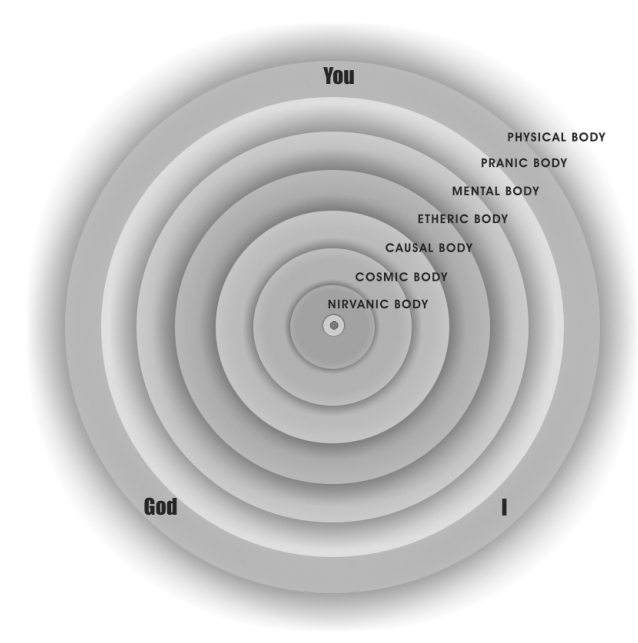
The next truth: Your body is not just one body. There are seven layers or bodies. The first layer is the physical body. The second, prāṇic body. These energy layers can be represented as concentric circles, with the physical layer as outermost circle and the seventh layer, nirvan- ic body as innermost layer. At the physical layer, you, God and I are at three different points in the outer- most circle. As you go deeper, these three entities finally merge into one at the innermost nirvāṇic layer, the ultimate consciousness, where God, you and I are one.
Once you realize that you are a part of the collective conscious-ness, you go beyond pain, suffering, and diseases. As long as you are individually conscious, you will be continuously suffering.
With collective consciousness you unify, but with individual consciousness you cut things into pieces. At the spiritual level, when you understand you are deeply connected to the whole Universe, you start really Living Advaita, the space of oneness and open many dimensions of your being. See, just with this body you can think, enrich and enjoy so much. If you disappear into the collective consciousness, you will experience so many possibilities.
THE ESSENCE OF LIFE IS 'ENRICHING'
The purpose of life is to enrich Life with Completion; to enrich others and yourself with Completion. The person who realizes the purposelessness of life can have the strength to enrich himself and others, only he can go beyond duality and surpass envy, only he can be satisfied in any action with whatever profit comes, what Kṛṣṇa calls—yadṛcchā lābha santuṣṭo dvandvātīto vimatsaraḥ (4.22). When you realize this, you relax into the space of completion, unaffected by success or failure, although doing actions, as Kṛṣṇa says beautifully, ‘samaḥ siddhāv asid- dhau ca kṛtvāpi na nibadhyate (4.22)’.
Kṛṣṇa says here, ‘One who works for the sake of enriching sacrifice, merges into the knowledge, yajñāyācarataḥ karma samagraṁ pravilīyate (4.23).’ Enrich just for the sake of enriching.
KNOW SACRIFICE AND BE PURIFIED (4.26-4.32)
In these verses, Kṛṣṇa talks about many forms of sacrifices—of material wealth, yoga, penance—a combination of material, physical, mental and spiritual sacrifices. ‘Sacrifice’, it is not just the act of giving, but the attitude of giving. The true meaning of sacrifice lies in the space from which it is done. When you offer something you cannot afford to give, it is a true enriching sacrifice. When one sacrifices whatever is dear or difficult to give away, he enters a completely different plane of sacrifice, of true non-attachment, leading to liberation.
EXPERIENCE BY SURRENDERING TO A MASTER (4.33-4.36)
Sacrificing knowledge is far more difficult than sacrificing wealth. Kṛṣṇa advises the seeker to sacrifice one’s knowledge and one’s intellect at His feet, at the feet of the Master, to experience the ultimate Truth. Beautifully He says, ‘tad viddhi praṇipātena paripraśnena sevayā (4.34).’ A Master is one who has experienced the Truth and who can simply transfer his experience of Truth to you. He communes with you. A teacher is one who imparts knowledge through communication.
Masters have no vested interest, no karma to exhaust. A Master does not differentiate between good and bad, merit or sin as the society does. Here, Kṛṣṇa says beautifully, ‘Even if you are the most sinful of all sinners—sarvebhyaḥ pāpa-kṛt-tamaḥ, you will certainly cross the ocean of miseries with the boat of knowledge—sarvaṁ jñāna-plavenaiva vṛjinaṁ santariṣyasi (4.36).’
ŚRADDHA ENRICHES YOU WITH JÑĀNA, KNOWLEDGE (4.37-4.42)
What a beautiful verse, ‘śraddhāvān labhate jñānaṁ, the one established in authenticity is enriched with knowledge.’ Actually,
śraddha means faith plus the courage of authenticity to live to your highest possibility. Kṛṣṇa declares the power of authenticity here, ‘śraddhāvān labhate jñānaṁ (4.39)–Only the authentic one is enriched with knowledge.’ When you have the knowledge and courage of authenticity to live the teachings, then you can achieve the ultimate knowledge, the knowledge of Enlightenment.
With śraddha, authenticity, you conquer your senses, and direct your mind towards the truth. The state of fear can be born in you only when you are inauthentic. Only a man living authenticity, is a liberated one enriched with the ultimate knowledge, śraddhāvān labhate jñānaṁ (4.39).
Kṛṣṇa says that there is no happiness for those who always have self-doubts, who doubts the Self, either in this world or the next. Self-doubt destroys you—saṁśayātmā vinaśyati and the one who has the self-doubt is never happy anywhere—na sukhaṁ śaṁsayātmanaḥ (4.40).
First, understand what self-doubt is! When you convince others with your strong outer image (what you project to others) and your inner image (what you feel as you) starts questioning you, that is self-doubt; where root of unhappiness grows, na sukhaṁ śaṁsayātmanaḥ (4.40). Listen. In any field if you carry self-doubt, you will continue to be power-less. In any field if you complete with your self-doubt, you are educated. Education is nothing but completing with self-doubts.
Arjuna is not ready to surrender to Kṛṣṇa completely. He doesn’t know that much deeper self-doubts need to be completed, through the experience of the Truth. That is why Kṛṣṇa gives over 700 verses to first convince him that ‘he does not know.’ When Arjuna finally gives up saying ‘I don’t know’ then Kṛṣṇa reveals Himself!
So, let the divine Parabrahma Kṛṣṇa guide us all to the right energy, to the right path of knowledge and the right experience. Let Him shower eternal bliss, Nityānanda.
CHAPTER
5
Sannyāsa Yogaḥ
LIVE ALL YOUR POSSIBILITIES
SEEKING MORE AND MORE DOES NOT
LEAD TO HAPPINESS. IT LEADS TO
DEPRESSION. THEN WHAT LEADS TO
HAPPINESS THAT IS ETERNAL?.