Items for doing Guru Pūjā
This text was machine-transcribed from the printed book and may contain errors. Select the words and choose “Report a mistake”.
We offer Guru pūjā to either the feet of the Master or to the Guru pādukās - sandals of the Guru.
Items needed for pūjā:
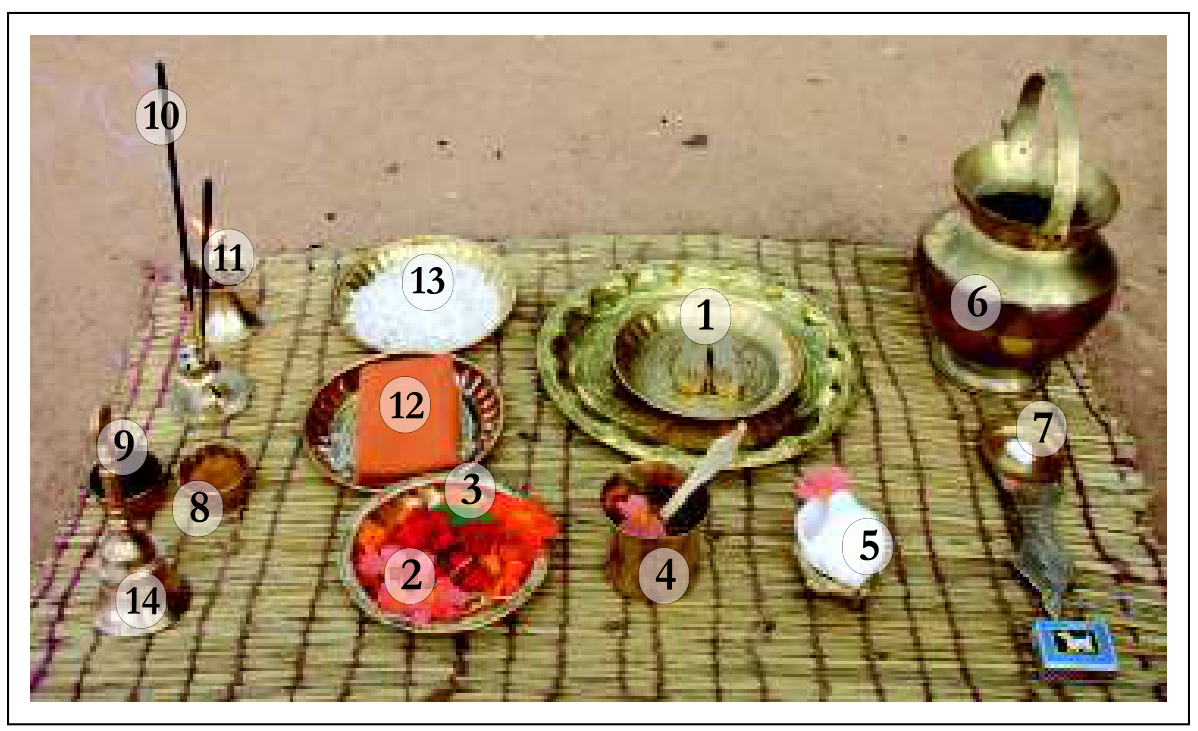
1 - Guru pādukā - sandals symbolizing the feet of the Guru on a plate 2 - Flowers (a handful) on a plate 3 - A bilva leaf (You could offer water if bilva leaf is not available) 4 - Pañcapātra and Uddharaṇi - small water cup with a spoon (kośa kośi can also be used. It is a fish-shaped vessel) 5 - Conch 6 - Kamaṇḍalu - small holy water jug You can use the uddharaṇi in place of the Kamaṇḍalu 7 - Camphor on camphor plate 8 - Sandal Paste 9 - Kuṁkum - vermillion - powder 10 - Two incense sticks 11 - Oil lamp and match box 12 - Small piece of saffron cloth 13 - Food for offering (any fresh / dry fruits, nuts, fresh cooked food.) 14 - Bell
GURU DHYAAN
(Meditating upon the Guru to invoke Him)
नित्यानन्दं परमसुखदं केवलं ज्ञानमूर्तिं
द्वन्द्वातीतं गग्नसदृशं तत्त्वमस्यादि लक्ष्यम् ।
एकं नित्यं विमलमचलं सर्वधीसाक्षिभूतं
भावातीतं त्रिगुणरहितं सद्गुरुं तं नमामि ॥
nityānandaṁ paramasukhadaṁ kevalaṁ jñānamūrtiṁ
dvandvātītaṁ gaganasadṛśaṁ tattvamasyādi lakṣyam |
ekaṁ nityaṁ vimalaṁ acalaṁ sarvadhī-sākṣi-bhūtaṁ
bhāvātītaṁ triguṇarahitaṁ sadguruṁ taṁ namāmi ||
Invoke the presence of the Guru:
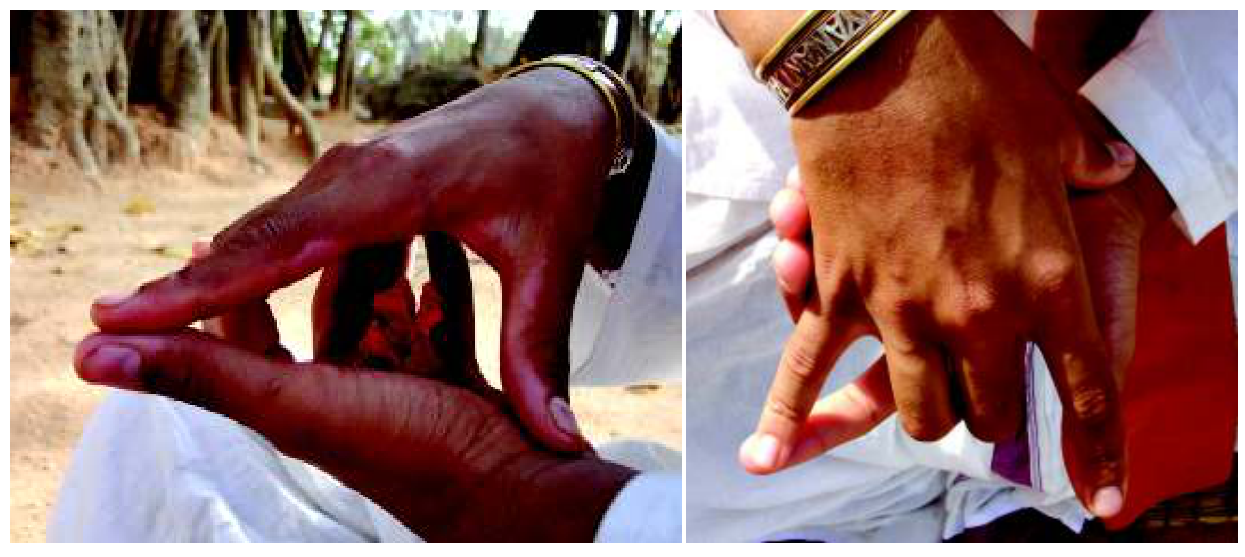
Visualise your inner space to be a seat at your heart chakra. Take a flower in your hand, hold it with kūrma mudra, close your eyes, meditate on the Master and chant the mantra. Kūrma means tortoise. This mudra signifies your inner space. The tortoise has the power to go into concentration within one second. It can withdraw its five senses at once! This symbolically represents pulling all your senses inside in a moment. You just take your whole mind within you like a withdrawing tortoise. Just stop the wandering of the mind and start chanting.
Explanation:
Salutation to the inner Guru which is the state of Eternal Bliss; ultimate ease; the space of pure knowledge
The inner Guru that is beyond all dualities, is expansive like the infinite sky, can be intuited with the Mahāvākya as 'That art Thou'
The Only one – eternally pure, unwavering, the witnessing Self and innate intelligence in all beings
That is the state beyond the play of emotions and the state wherein one transcends the three states of satva (tranquility), rajas (activity) and tamas (dullness) and becomes the Master deftly handling the states.
nityānandaṁ: Eternal Bliss, or the state of expressing the Truth or Existence or bliss every moment.
paramasukhadaṁ: Ordinary sukha or happiness, comes from doing something. Paramasukhadaṁ is supreme happiness which happens continuously with no reason. It brings with it the ability to remain utterly relaxed in action and inaction.
kevalaṁ: Established in aloneness
jñānamūrtiṁ: Pure knowledge, expression of enlightenment, embodiment of knowledge. Whatever He does radiates knowledge. He is the manifestation and complete expression of energy and wisdom in the human body.
dvandvātītaṁ: Beyond duality. For Him, there is no rich or poor, happiness or sorrow. He is beyond all opposite or dual emotions. His inner space is always blissful.
gaganasadṛśaṁ: All pervading, pure like the sky, filled with animate and inanimate things, with whatever you know and don't know, with whatever you can perceive and not perceive.
tattvamasyādi lakṣyam: Again and again, the Sadguru makes you realize that He and you are one and the same. He is the embodiment, the goal; you are That, the ātman Brahman. He enables you to experience and express that understanding. His very presence will remind you that you are That and that He is that lakṣya or goal, He is that embodiment and you are Him. Again and again through His body language, He indicates: you are That.
There are three levels of progress in all of us: the first is understanding, the second is feeling and the ultimate is experiencing. Understanding is intellectual, feeling is emotional, and experiencing is what happens at the being level.
To be with the Master, it is a basic necessity to have intellectual understanding. When you don't have the intellectual understanding, and the flood of devotion happens, all relationships disappear; you will be frightened; your whole will shrink in fear.
In Bhāgavatam, the popular Hindu epic, Śiṣupāla started claiming himself as enlightened, having girl friends and calling them gopīs Somebody asked Vyāsa, the author of Bhāgavatam, 'Whatever Kṛṣṇa is doing, Śiṣupāla is also doing. Why do you call his actions as immoral and Kṛṣṇa's actions as madhura bhāva - a relationship where one sees the other as a beloved - and rāsa līlā - Divine play?'
Vyāsa replied, 'The gopīs deeply know Kṛṣṇa is God. Their whole relationship is based on enlightenment. They are His disciples. They are around Him to realize the experience of the Divine. But in Śiṣupāla's case it is not so.'
An intellectual base transforms the quality of the relationship. The gopīs are clear about what they are doing and with whom they are playing. They have a clear base of intellectual understanding.
If there is no understanding, if we are not intellectually convinced, we would not be here. The moment it becomes a feeling, we will simply fall into the experience. But many times, we struggle between understanding and feeling.
At this point, we need something called smaraṇa – remembrance; remembering the Truth. Injecting the Truth in ourselves will remind us of the Ultimate Truth again and again. Whenever we have vested interests, nothing solid happens; this is the truth. If it becomes a deep feeling, then straightaway it becomes pure experience.
The word lakṣya has a deep meaning; it means ‘goal’, the needle which is continuously pointing towards the goal, like a compass. Tattvamasi is the vedic mahāvākya (great declaration) which means ‘Thou art That’.
There was a disciple who asked his Master, ‘Master, please give me knowledge.’ The Master in response recited the whole Vedas. The disciple could not grasp anything of what he recited. He said, ‘Master, please simplify and tell me’. The Master now recited the whole Upaniṣad. The disciple again said, ‘This is also too much. Please teach me the gist of it.’ The Master now recited the entire Bhagavad Gīta. The disciple said, ‘No, no! This is too much. Please teach me the simple way.’ The Master then recited the Brahmasūtra! The disciple could not take it anymore. He said, ‘Please Master, give me just the essence.’ Then the Master uttered only one word: Tattvamasi - you are That. This mahāvākya - great declaration - is the essence of all spiritual Truths.
There are five mahāvākyas given by the ṛṣis - ancient scientists of the inner world. They are:
Tattvamasi
Aham Brahmāsmi
Prajñānam Brahma
Ayam Ātmā Brahma
Sarvam khalvidam Brahma
Aham Brahmāsmi : I am Brahman. Brahman is what resides in us as ‘I’ consciousness. We usually associate ourselves with the body and mind. Each one of us thinks: I am the body and mind. If we eliminate ‘body’ and ‘mind’ in this sentence, whatever is remaining is Brahman. What resides in you as ‘I’ is consciousness, brahman, gnana, atman, whatever you may call it. Continuously, we repeat to ourselves: we are body and mind. We continuously believe: I am that, I am this. But if you eliminate ‘that’ and ‘this’, and just stop at ‘I am’, it becomes pure consciousness. We are just as we are. We fall back into consciousness. We become enlightened, liberated.
Ayamātmā Brahma : Whatever is my ātman is Brahman. Ayamātmā means ‘my ātma’; whatever we feel as the soul; the very life itself is Brahman.
Prajñānam Brahma : This implies consciousness; what is there as ‘I’ feeling is also Brahman or God. Prajña means the ‘I’ feeling.
The Master is the embodiment of these four mahāvākyas.
The moment you start feeling this way, it means that the experience has started happening, and you don’t need a signboard. When you don’t even have an intellectual understanding, you don’t need a Master as yet. Let us say you are traveling from Seattle to LA. When you are in Seattle, you don’t need an LA signboard. The moment you enter into the suburbs of LA, that is when you have start having emotional experience also, then too you don’t need a signboard! But in the gap, while you are traveling, you need signboards. You need signboards to show the way. If you have intellectual understanding but it has not become emotional experience, in that gap, you need sign boards. The lakṣya or goal, which reminds you of your real state, which reminds you that you are That, is the presence of the Master.
Again and again, He will remind you; He will not let you forget. His very presence will remind you. His very presence shows us how He is: living like a flower among us. The very presence of the Master is to remind you to come up to His level. The very presence of the Master is a compass needle that shows the path.
The word lakṣya has got three meanings: the goal, the needle (the need in idle time!) and third that He is the embodiment of the Truth. His walking, sitting, living - everything reminds us of enlightenment.
Ekaṁ nityaṁ : The Master is eternal, with neither beginning nor end.
vimalaṁ : Beyond the state of being pure or impure; no impurity can touch Him.
acalaṁ: Steady. He is like an immovable mountain.
sarvadhī-sākṣi-bhūtaṁ: The witnessing self and innate intelligence. All of us have the delusion that we will live forever. We don't really believe that we are going to die; the understanding of impermanence of life is superficial. Have we really been shaken by death? Never! Even if we see death on the road, we never stop to think that one day we are also going to die.
Whenever we fall back into pure consciousness, we feel a deep assurance of the Eternal. But we falsely associate this feeling of permanence or nitya mood with the body and mind. There is no partition between pure consciousness - pure energy, and the body and mind - pure matter. The quality of pure consciousness is that which knows, 'I will be forever'. The quality of body and mind is that it will perish.
We attribute this quality of pure consciousness to the body and mind and that is the mistake. If we realize that the body and mind will perish one day, then we will be in this consciousness forever, eternally. Or if we know that pure consciousness is eternal, we naturally will not be caught in the body and mind. The quality of the energy is confused with the quality of matter. Now in every one of us, the quality of pure consciousness is present; it never dies. That is eternal consciousness, eternal bliss, nitya ānanda. We are the pure witnessing consciousness in all the elements. This is what the Master, who is the embodiment of pure consciousness, reminds us.
bhāvātītaṁ: Beyond the emotional states. You cannot place the Master in any single frame. He is most unpredictable. The moment you predict the Master, you lose Him; you are lost. You will be caught in His reflection. You are no more a disciple. Arguing with the Master doesn't refer only to the outside; all our related inner chatter is also included. All our inner chatter is arguing with Existence that is reality. If we have total acceptance, we will not have inner chatter. If we have inner chatter, it means that we don't have acceptance; it may be a verbal argument or silent argument, it's all the same. The Master is beyond comprehension, beyond imagination.
triguṇarahitaṁ: One who is beyond the 3 basic qualities of satva - pure intelligence, rajas - dynamic activity, and tamas - dullness. The Master is not married to any of the three guṇas. He just moves with and beyond all three. None of them touches Him and He is not attached to any of them. He simply plays with all three of them. When He displays tamas, He refrains from activity. When He displays rajas, He exhibits his dynamism and does multi-tasking. When He displays satva, He radiates pure intelligence.
sadguruṁ taṁ: There are many Gurus: our mother, our father, our teachers etc., but the Sadguru is the one who removes all darkness of māyā or illusion. He is the only one who can do it. namāmi: Mā means mine, āmi means I. Mine and I, I offer at Your feet.
Why do we need to offer the concept of mine? It has been proven that children start developing 'I' consciousness when they know what is their's (mine). Only based on your ownership, you start developing 'I'. Based on the notion of mine, you develop 'I'. The moment mine is taken away, 'I' will be shaken. Try to snatch a toy from a child; he will be shaken. He will start crying, because for him, that is his very being. Children build their I-consciousness based on their concept of mine.
We have built our consciousness based on what we have. That is why we surrender.
Here, in this pūjā, there is no giving because there is nobody who is taking. There is only offering; you only offer, you surrender everything to Him. You are offering whatever you think is yours and you. From your birth, your personality is based on mine; on that which is our property or what we think as ours. When the mine is taken away, we are shaken inside, and feel our whole being is taken away. It will never be taken; it's the attitude that matters. Only a man who has surrendered 'mine' and 'I' can utter this śloka: Oh Sadguru! I offer 'mine' and 'I' at your lotus feet.
You don't need any meditation if you remember the meaning of this mantra throughout the day. You will simply know that an intelligent, supreme energy is there. That's all. Nothing more is needed.