If Saturn is your Planet
This text was machine-transcribed from the printed book and may contain errors. Select the words and choose “Report a mistake”.
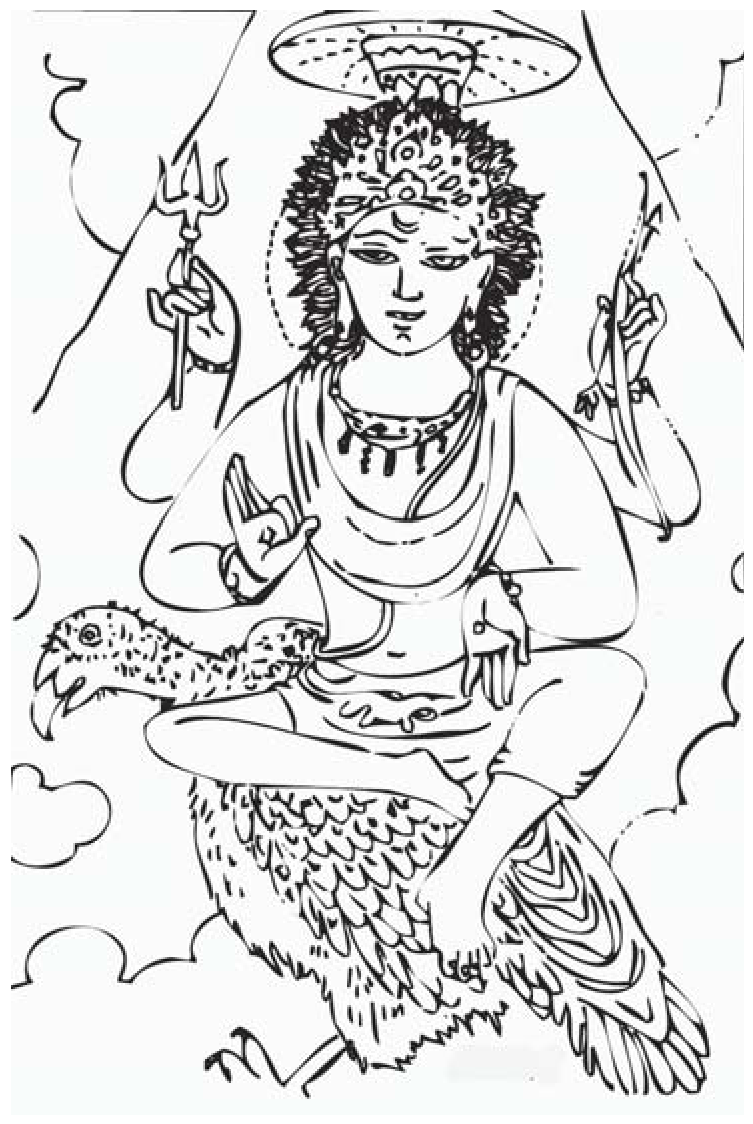
‘I worship Saturn, dark blue in color, who is born before the God of death, the son of the Sun and shadow.’
- Veda Vyāsa
Dynamic: How we take responsibility, how we focus and discipline our lives
Key Words: Focus, Longevity, control, discipline, patience, endurance, philosophical disposition, temperament, education
Signs: Aquarius/Capricorn
Color: Black, deep blue
Gender: Masculine
Cakra: Ājñā, Mūlādhāra
Temperament: Tamas (inertia)
Governing deity: Lord Brahma and Yama (the Lord of Death)
Saturn in Vedic Scriptures
On the insistence of Śiva, Pārvati fasted for a year to propitiate Viṣṇu so that he would grant her a son. Lord Viṣṇu, after the completion of the sacrifice, announced that he would incarnate himself as her son in every eon. Accordingly, Viṣṇu was born to Pārvati as a charming infant.
This event was celebrated with great enthusiasm and all the gods were invited to take a look at the baby.
However Śani (Saturn), the son of Sūrya, hesitated to look at the baby since he was cursed with the gaze of destruction. Pārvati insisted that he look at the baby, which Śani did.
Immediately the infant’s head fell off and flew to Goloka. Seeing Śiva and Pārvati grief-stricken, Viṣṇu mounted on Garuda, his divine eagle, and rushed to the banks of the Pushpa-Bhadra River, from where he brought back the head of a young elephant.
The head of the elephant was joined with the headless body of Pārvati’s son, thus reviving him. The infant was named Gaṇeśa and all the gods blessed Gaṇeśa and wished Him power and prosperity.
Tendencies of Saturn in Aquarius
‘Saturn has an emaciated and long physique, tawny eyes, big teeth, and is vata in temperament. He is indolent, lame and has coarse hair.’
- Bṛhat Parāśara Hora Śāstra
Symbol: The Water bearer
Element: Air
Ruling Planet: Saturn /Śani
Ayurvedic constitution: Vata
Healing stone: Amethyst
The Sanskrit name for aquarius is Kuṁbha, which means 'a pitcher'. Kuṁbha also relates to Kuṁbhaja, meaning 'born of a pitcher', a name for sage Agastya, one of the great Vedic seers. Its significance holds a deep spiritual meaning.
Aquarius denotes radical transformation involving the purification of the accumulated saṁskāra, giving a new spiritual direction to life. The impact of such an inflow of cosmic life-force can be experienced as a challenge in day-to-day life. The native strives to integrate himself, but is followed by multiple blessings, which enable him to Live Enlightenment.
Under the impact of Aquarius, the individual is subjected to fluctuating moods, which are overcome with spiritual practices.
Aquarius-born are naturally self-sacrificing. They have the capacity to surrender themselves completely to the Divine. They are eager to work for the good of a community or for the world. They can be totally devoted to a cause or in whatever they put their faith, be it a social group, spiritual group, or also a more illicit organization. For that, they have to develop discrimination and go towards what brings inner bliss, what liberates them in all senses. They can also denigrate themselves and do things which degrade their consciousness and create guilt and self-blame.
They may be artists, original thinkers, different from others, sometimes involved in different undefined activities. Their charisma radiates upon small groups. They are not upfront people, nor born leaders, but they can be excellent therapists, gifted of a rare intuition.
Aquarius Nakṣatras: Dhaniṣṭa, Śatabhiṣa, Pūrvabhadrapada
Tendencies of a Dhaniṣṭa-born
Dhaniṣṭa is also known as 'the Star of Symphony'. Its symbol is a drum and a tabla (a small drum); both instruments symbolize richness and sound. In a sense, Dhaniṣṭa deepens the impulse of Śravaṇa's influence to perceive the truth, and makes it more practical. Such a person will combine the balance of the meditator and the energy of the warrior.
Many seers are born under this nakṣatra, and its extreme energy can bring difficulties into ordinary people's life. Dhaniṣṭa's life can lead to great spiritual attainment, as well as the opposite.
Born under Dhaniṣṭa, your approach to life is very practical; you are of good behavior and kind hearted. You dislike expressing your disagreement with others till the last moment. But once you are angry, you are determined to crush your opponent.
You have excellent insight; you are attentive and can perceive the truth behind names and forms. It can make you to feel close to humanity at large and be of compassionate nature. You are also adventurous, having a free spirit, and you definitely have spiritual warrior’s quality.
On the other side, you may as well be overly turned towards the outer world. Your seeking for security leads you to overwork to acquire things for better comfort. This attitude may lead you to too much ambition or jealousy of others’ success. You can become rude, or even revengeful and fail to value people around you.
Patience and perseverance should be maintained in all trials of life.
Historian, musicians, poets, doctors and surgeons, property management, engineers, miners, scientist, research, charitably involved people can be found under this nakṣatra’s energy.
Tendencies of a Śatabhiṣa-born
Śatabhiṣa is known as the ‘veiling star’. This nakṣatra is all about healing the human condition physically and spiritually. It is associated with the divine nectar of immortality, and gives skills for the healing arts.
Born under this star, you may have encountered a radically changing experience in your life: an experience which changed your destiny for better or worse. Such a crisis could bring you revitalization and new options in life.
You are very simple, living a straightforward life. You can possess tremendous energy and courage. But secretive in nature, you want to keep certain aspects of yourself hidden to others. More than others, you need solitude to contemplate upon your life. A need for meditation is essential here.
You have a tendency to be depressed, feel restrained and constricted in life. Many different emotions come out of this, difficult to formulate, bringing apathy or a sarcastic tone the native. You may meet obstructions, which are nothing other than opportunities for you to expand your true nature, to seek what is your path, to discover why you came on earth.
Harsh speech, rough, and prone to chronic disease, you should really do yoga. You can excel in professions such as astronomy, physics, healing, writing, secretarial work, engineering and electrical engineering.
Tendencies of a Pūrvabhadrapada-Born
Pūrvabhadrapada symbol is a double-faced man. This nakṣatra contributes to the raising of our spiritual aspiration in life. It is also a transformational energy where one can learn to give up the ego and live enlightenment.
Born under Pūrvabhadrapada, you will be intelligent, sensitive, expert in art, and inclined to take risks. Your personality is so charming that you can get out of any troublesome situation.
You are adaptable and extend your hand only once you are sure that your kindness will be appreciated and used for the purpose that you envision. For charity matters, you have a practical approach.
You have a strong practical need to fix your effort on a vision, an ideal for the future. This nakṣatra grants a universal stripe to a person. Your independence and self-reliance make you original in many ways: in your thoughts, in your inventions, and your skills. You are never just an ordinary person and are pretty unconventional.
But you may have unnecessary anger and anxiety. You can use harsh words at times and cynicism. You should think about starting meditating, as you need to learn to handle your response to stress. Your wavering mind needs to be calmed and brought back to constructive activities.
You may show interests in astrology, research, statistics, administration work, business planning. You may also be attracted to an ascetic and yogic style of life.