DHANIṢṬHĀ-ŚATABHIṢA-PŪRVABHĀDRAPADĀ NÁKṢATRA
This text was machine-transcribed from the printed book and may contain errors. Select the words and choose “Report a mistake”.
Nakṣatra: the constellation in which the moon sits in the heaven at a particular time, commonly called as ‘birth Star’
Vedic sciences: refer to a number of disciplines found in the Vedas, a large body of texts originating in ancient India; among the oldest sacred texts
Ṛg Veda: an ancient Indian sacred collection of hymns, counted among the four canonical sacred texts of Hinduism known as the Vedas
Āryabhaṭa: one of the first astronomer and great mathematician of India, born in 476
Copernicus: (1473 – 1543) the first astronomer to formulate a heliocentric cosmology, which displaced the Earth from the center of the universe
Galileo: (1564–1642) Italian physicist, mathematician, astronomer and philosopher. His achievements include improvements to the telescope and important astronomical observations
_Yojana_: a Vedic measure of distance used in ancient India, between 6 to 15 km (4 and 9 miles)
_Ṛṣi_: a sage through whom the hymns flowed, a “seer” able to reach states of higher consciousness.
_Yogi_: a practitioner of various forms of spiritual discipline, as yoga
_Parāśara_: author of many ancient Indian texts and important astrological texts, known as a traveling Master
_Bṛhat Parāśara Hora Śāstra_: a prominent astrological scientific text, written as a recorded dialogue between Parāśara and his disciple Maitreya
_Vaśiṣṭa_: Rāma’s guru, a great Ṛṣi who had complete knowledge of the whole cosmos and the gods
_Veda Vyāsa_: a sage of ancient India, compiler of the Vedas and great epics like the Māhābhārata
_Māhābhārata_: one of the major Sanskrit epic of India and philosophical scripture, depicting a great war that happened in India, written in 250 000 verses
Saṁskāra: engraved memories stored in the subconscious part of the mind. They are continually interfering with our decision making process
Grahas: energy centers, energy fields that planets exert in the universe. They are generally assimilated to 'planets'
Karmas: the collection of unfulfilled experiences and actions that stay in us and constantly pull us to fulfill them
Āyurveda: a system of traditional medicine native to the Indian Subcontinent, ayus meaning 'life', and veda, meaning 'related to knowledge' or 'science'
Yoga: literally union, union of the individual self and the divine Self, often taken to mean Hatha yoga, which is one of the components of yogāsana, relating to body postures
Rudrākṣa: a large broad-leaved tree whose seed is traditionally revered and used for prayer beads, or mainly growing in foothills of the Himalayas up to South-East Asia
Sanskrit: the language of the Ṛg Veda and of many scriptures, as well as mantras
Mantra: a sound, a formula, sometimes a word or set of words, which because of their inherent sounds, have energizing properties. They are an approach to spiritual evolution
Unclutching: understanding that each thought is completely independent, unconnected to the precedent; which leads to disengage oneself from the mind, resulting in experiencing the no-mind state
Cakra: literally a 'wheel': refers to energy centers in the mind-body system
Ājñā: sixth cakra, located between the eyebrows, known as the master cakra, locked by excessive seriousness
Tamas: the behavior of laziness or inaction
Lord Brahma: the creator of the trinity
Lord Śiva: rejuvenator in the trinity also means 'causeless auspiciousness'
Pārvatī: consort of Lord Śiva, mother to Gaṇeśa
Viṣṇu: the preserver in the trinity; His incarnations include Kṛṣṇa, Rāma ect., also means ‘all encompassing’
Gaṇeśa: the very revered elephant god who removes obstacles
Agastya: a great sage who introduced and popularized Vedic tradition in South India
Viśuddhi cakra: the fifth cakra, or subtle energy center located in the throat region, locked by comparing ourselves with other
Dośa: in Ayurvedic medicine, one of the three biological humors or energies (kapha, pitta, vata) which combine in various proportions to determine individual constitution and mental and physical disorders
Vata: one of the three humors (body constitution) of Āyurveda, related to the principle of movement in the mind and body; air element
Vajrāsana : common yoga and meditation posture, where the person sits on his heels
Cin mudra: palms upraised with thumb and forefinger forming a circle and other three fingers outstretched
Guru Pūja: form of worship offered to the master
Asana: body postures performed in yoga, literally means ‘seat’
Aṣṭāṅga namaskār: prostrating to a deity or master by lying on the floor with all eight limbs of the body touching the earth
Bhujaṅgāsana: ‘cobra posture’ in yoga, in which the head and chest are raised while lying down
Pranic layer: the second layer of energy of the body, related to prana or life energy
Brahman: the unchanging, infinite, immanent, and transcendent reality, the Divine Ground of all matter, energy, time, space, being, and everything in this Universe
_Bīja mantra:_ refers to the single syllable mantra used to invoke certain deities
_Pūja:_ a ritual made of different offerings related to the deity propitiated
_Navagraha dośa:_ literally means 'planetary defects' or inauspicious alignment of planets
_Homa:_ ancestral Vedic fire ritual
Nirvanic layer: seventh subtle body that we have and last layer of energy which is the space where one experiences intense bliss
Physical layer: the gross body made of flesh and bones
_Aum:_ the primordial cosmic sound from which the whole Universe emerged
Hrīm: bīja, or seed mantra relating to feminine energy
Śakti: energy, intelligent energy, considered as the feminine aspect of Śiva
Ahankār: ego or excessive pride due to one's possessions, material wealth, intelligence or powers
Jīvan Mukti: the state of achieving liberation from the cycle of birth and death during one's lifetime
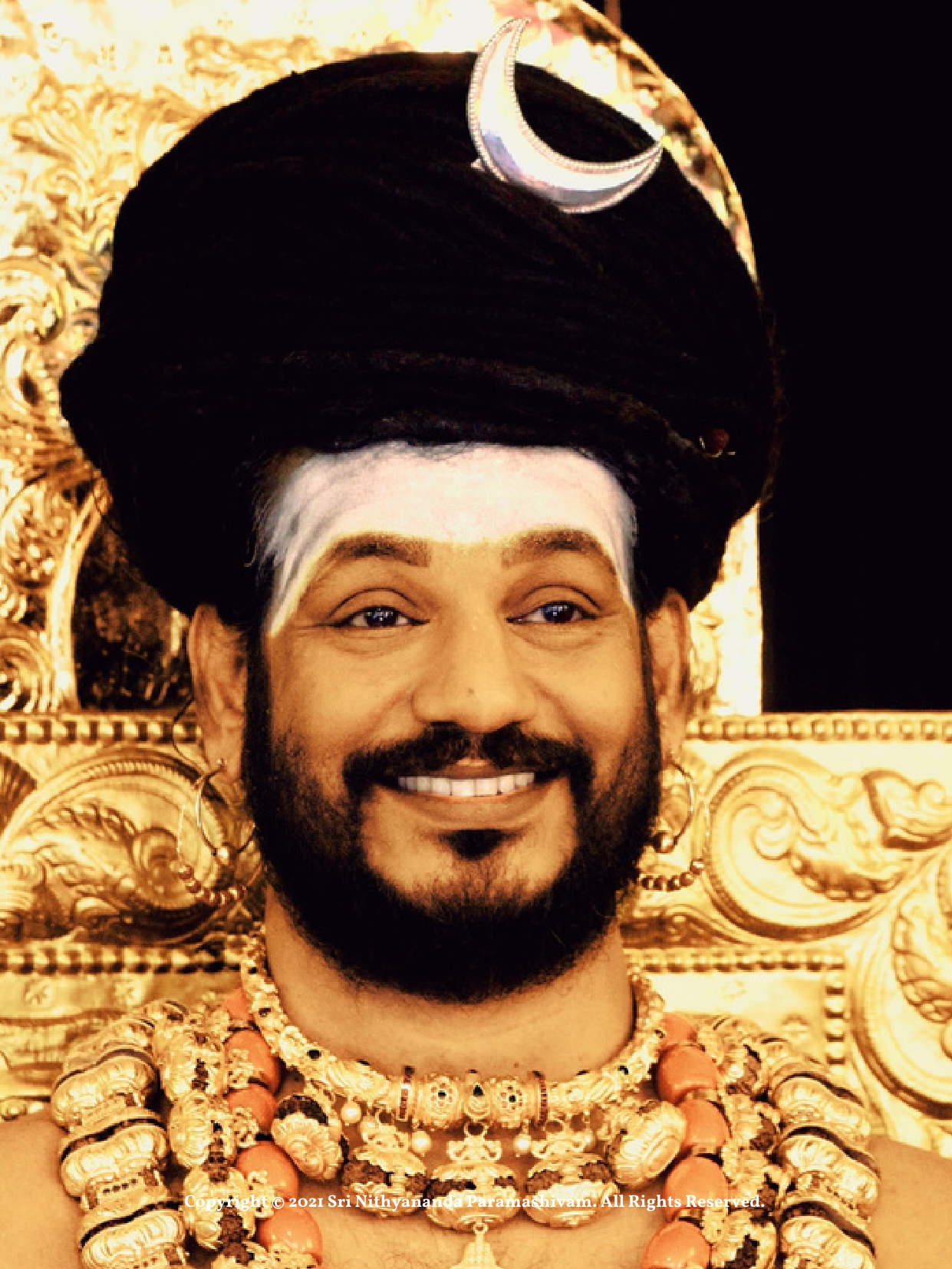
"Let you all experience and radiate Jīvan Mukti, Living Enlightenment"
- Paramahamsa Nithyananda
About The SPH Nithyananda Paramashivam
The Supreme Pontiff of Hinduism ("SPH"), Jagatguru Mahasannidhanam ("JGM"), His Divine Holiness ("HDH") Bhagavan Sri Nithyananda Paramashivam, is recognized as the 1008th living incarnation of Paramashiva as per Sanatana Hindu Dharma ("Hinduism") and by His predecessors of enlightened masters and adepts.
The SPH Nithyananda Paramashivam is reviving Hinduism as the 1008th Acharya Mahamandaleshwar (the head for all spiritual leaders) of Atal Akhada (ancient apex body of Hinduism), coronated as Mahamandaleshwar (Supreme Spiritual Head) of Maha Nirvani Akhada (largest apex monastic order) and the youngest Mahamandaleshwar, ordained as the 233rd Guru Mahasannidhanam (Pontiff) of Thondai Mandala Aadheenam, ordained as the 293rd Guru Mahasannidhanam (Pontiff) of Shyamalapeeta Sarvajnapeetam, ordained as the 23rd Guru Mahasannidhanam of Dharmamukthi Swargapuram Aadheenam, and coronated as the 203rd Emperor of Suryavamsa Surangi Samrajyam.
The Srimad Karana Agama, Purva bhaga, Patala 71, Sakalotpatti vidhi, Sloka 8 & 9 (Sacred Ancient Hindu scripture) declares:
इत्येवं निष्कळं प्रोक्तं परं भावमिति स्मृतम्।
सृष्टिस्थं लोकरक्षार्थं लोकस्योत्पत्तिकारणम्।।
साधकानां हितार्थं तु स्वेच्छया गृह्णते तनुः।
In this way (Shiva) who is Nishkala - without any body and parts, who is the Ultimate Supreme Being, who is established in the Creation, who is the Cause of the creation of the Universe, assumes a body out of His Free Will for the protection of the Universe, and for the welfare of the Spiritual seekers and Devotees.
The SPH Nithyananda Paramashivam is the reigning spiritual emperor of 17 ancient traditional Hindu kingdoms and the reviver of the most ancient, most peaceful, still-living and long-lasting demonstrable system that shows the possibility of peaceful co-existence amongst people. Following the coronation to establish KAILASA worldwide at the age of 16, for the past 27 years, The SPH Nithyananda Paramashivam, as the face of the unified Hindus, has been single-handedly, tirelessly inspiring the dispossessed Hindu Diaspora to reclaim their Hindu centric freedom and stand unified for the centuries-old Hindu genocide.
About The SPH Nithyananda Paramashivam
The 1008th living incarnation of Paramasiva, The SPH Nithyananda Paramashivam stands as the unifying force for the 2 billion born and practicing Hindu diaspora worldwide and established the Hindu State, KAILASA for the persecuted Hindus in over 100 countries.
The SPH Nithyanada Paramashivam has made resolute efforts towards recognizing and legitimizing the Hindu genocide which has been receiving scant consideration by global leaders and international bodies, The SPH Nithyananda Paramashivam founded KAILASA Uniting Nations. For the past 27 years, this international body has been responsible in building relations, bridging dialogs, inspiring leaders, uniting nations towards acknowledging the Hindu policies which are universal, life positive as referenced from the ancient text of Hinduism. This is the ‘ahimsa’ (non-violent) way of bringing acknowledgment to the horrors of the Hindu genocide, the untold facts of the darkest act of mankind on Earth to the most contributing civilization - KAILASA.
KAILASA is an apolitical nation whose vision is enlightened living for all. Towards this goal, KAILASA is the only Hindu nation on planet Earth today bringing legitimacy to the principles of Hinduism. Social principles, economic principles, judicial principles, Hindu medical principles, and Hindu economic principles. KAILASA is The SPH Nithyananda Paramashivam’s response to humanity’s global problems of poverty, hunger, illiteracy, disease, violence and global warming and the continuing ethnocide and genocide of over 80 million Hindus worldwide since 7 centuries.
Over the last 50 years, the effects of meditation and its significant impact on stress, crime rates, violence, political decision making and even war in local and global consciousness is well established. Unfortunately, in the last two hundred years, forcibly we are made to believe Hinduism is a functional principle only for enlightenment and spirituality. It is absolutely dysfunctional for the political, social, economical system. Making Hindu family structure, Hindu social structure dysfunctional is the greatest crime done against humanity.