LESSON: 3
This text was machine-transcribed from the printed book and may contain errors. Select the words and choose “Report a mistake”.
Introduction: Introduce about needs and wants
Goals: To understand the difference between 'wants' and 'needs' and the two categories of people who experience life.
Click: When we believe life has a purpose we will miss life
About the topic: 'wants' and 'needs' are very different, and its important to be able to differentiate between them.
In this whole world, there are 2 kinds of people, 1 kind experiences life once in a while, and the other category experiences life continuously.
Whenever you think you are feeling joy, you are experiencing life! That is why you feel so alive, as if everything is beautiful! You are in tune with that 'ever living presence'.
The desire to experience is what drives us to get out of bed in the morning. In order to live and be connected and have a positive experience with the universe.
When we get things that we 'need', we are happy, but when we just desire and 'want' things, we are not satisfied when we get them.
Every desire which drives us is nothing but the desire to experience that ever living presence. We sometimes have so many desires, but there is a difference between out true desires, and our “borrowed” desires.
Borrowed” desires are called 'wants' and our true desires are our 'needs'.
When our desires are our own true desires, when they reflect our real needs, when they depress themselves in our inner energy we don't feel any desperation about trying to achieve them.
Wants are not our true desire; we just want something especially because others have it and even after getting what we want we won't be happy. We will see somebody else and borrow another want from them.


Assessment: • What are the differences between 'wants' and 'needs'? • What are wants? • What are needs? • What are the 2 categories of people? • How can we experience life? How can we be in tune with our 'ever living presence'? • Will we be satisfied if we receive things we do not need? • If we had all the toys in the world, would that make us happy? • What are important things in life? • What are things that matter?
Activity of the day: Make a list of desires, their needs and wants. Then they meditate on these desires or discuss them in groups.
At the end of the meditation or discussion they have to recollect from memory their list of desires. What they can recollect is usually a fraction of what they have written
Art of the Day: Your home
Evaluation:
After you've discussed the topic, ask them questions to make them think about true desires and things that really matter in life.
Conclusion: When we focus our attention on things that matter, life becomes sweeter and more special. We need to value life and get in touch with our true nature.
[Figure: DESIRE]
Art of the Day - Your home
Materials needed: Paper, Pencil or Sketch.
Procedure: Encourage each child to draw a picture about their home, their house and some representational picture of their home. Encourage each child to draw in the picture what all needs and wants they want in their house.
DESIRE
LESSON: 4
Introduction: Introduce about the Seven layers of Pyramid
Goals: To understand and realize that some things we need, and some things we only desire. Looking within will help us to find bliss.
Click: Bliss is being satisfied.
About the Topic:
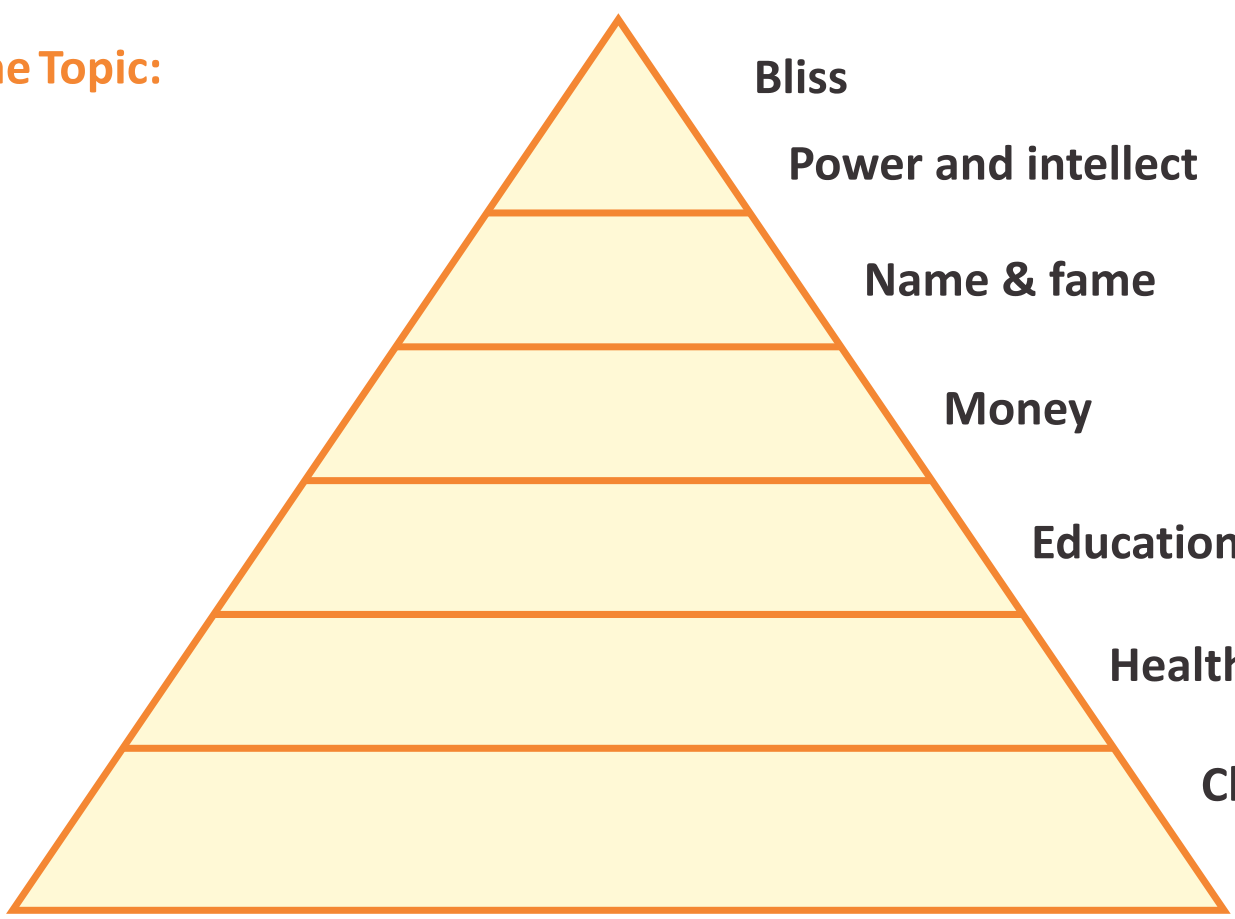
There are seven layers in the pyramid leading up to bliss. We are going to explore the different levels and decide where we are and discuss how to go into bliss. These energy centre or layers in the pyramid correspond with the seven centers of energy in the Vedic system. Each Centre represents an emotional state as well as a state of the desire. As we fulfill the needs of each Centre, we move up in energy till we reach a state of fulfillment. This is also known as self-actualization (Marlow's hierarchy of needs.)
Instead of starting at the bottom of the pyramid and trying gradually go up and in life, we can turn our focus inward and experience our true state, which is bliss. When we are in bliss, top of the pyramid, all our true desires will be fulfilled, everything in the pyramid automatically comes to us.
[Figure: DESIRE]
Bliss is experiencing, being happy, being satisfied. We always go from down to top because we listen to ego. When we are with our self, not trying to prove, when we listen to our heart, we can come from top to bottom.
When you have oneness and compassion we can achieve bliss.
Changing the object is never a solution. Changing the attitude is the solution.
By understanding ourselves, we will understand the world.
Assessment: To go through the seven layers and understand what they mean and why we need or want them.
● What are food and medicine? Are they need / want?
● Do we need clothing and shelter?
● Is education a need? Why do we need to study?
● In what ways does education help us in our lives?
● What is the difference between needing and wanting money?
● Do we need millions of rupees? Or only want?
● Does money make us happy?
● Can we buy love or friends with money?
● What good things can we do with money?
● What is name and fame? What does that mean?
● Doesn't everyone want to be special and important?
● Will it make us happy if we are famous?
● What is intellect?
● Does being very intellectual make us happy?
● If we knew everything and had all the answers and were so smart, would that lead us into bliss?
● What is bliss?
● What does that word bliss mean to you?

Activity of the day: Craft make a pyramid of desire
Art of the Day: Mirror image
Evaluation: Ø From the seven layered pyramid, which ones are needs? Ø Which are wants? Ø What is most important thing to remember?
Conclusion: Bliss is found within. This is the zone where we flow free of stress. This is the zone of inner realization. This is the zone where you know that you are one with the universal energy.
[Figure: DESIRE]
Activity - Make a pyramid of desire
Materials needed: Paper, Pencil (or) Sketch (or) Pencil, Chart paper.
Procedure: Explain to the child about the pyramid of desire. Encourage each child to cut a triangular shape in the chart with safety scissors and ask them to divide the triangle and write the components of the pyramid of desire.
Art of the Day: Mirror image
Materials needed: Paper, Sketch (or) Pencil, Mirror picture or object.
Procedure: Keep a picture or object in front of the mirror and ask each child to see the image in the mirror and draw the picture on the paper with pencil or sketch. Explain to the children we see our friends, relatives and mirror their desires as our desires