LIVING INTENSELY IN THE PRESENT
This text was machine-transcribed from the printed book and may contain errors. Select the words and choose “Report a mistake”.
Fortunately, by your very nature, you can have only one thought at a time. The moment a new thought comes inside your system, it means that the old thought has lost its power or influence over you. If the new thought has entered you, it means
One important truth you should know is that even if you want, even if you try consciously, you cannot possess or hold onto your suffering for long.
Even if you try to hold it, you cannot hold your suffering because continu-ously, your thought that creates suffering is also replaced by newer thoughts! In fact, to hold onto suffering will require a lot of effort on your part because thoughts are continuously flowing.
Be very clear, your power to bring on a new thought itself proves you have the power to drop the old thought. The problem is, instead of just watching the new thoughts flowing through you, you try to bring back old thoughts into your system. It is like picking up your trashed emails and bringing them back to the inbox. Is there any need to bring back trashed emails? No! If you constantly look to bring back the old thoughts, you will create only suffering.
Understand that if you nurture the fact that any suffering can be replaced by a stream of fresh thoughts then that becomes reality for you. And there is no suffering. If you are nurturing the thought, ‘No, however much I allow replacing, the suffering comes back,’ you will make that into reality. If you mother the thought that the suffering is going to come back, it will come back. If you mother the thought that it is going to go away, it will go away.
All you need to understand is that if even once you can replace a thought in your inner space without returning to the previous thought, you will get the confidence, ‘I have replaced it once. I can do it again.’ Then you can tell your-self, ‘If the old thought comes back ten times, let me replace it ten times!’ that’s all. Soon you will see the old thought will stop coming back.
There is a very beautiful incident in Buddha’s life:
Buddha says, ‘Whenever I said in meditation, ‘I am going to get up after a few hours’, I never became enlightened. Once I decided, ‘If I am not going to become enlightened, I am not going to get up from this seat. Let this body dry up in this very place. Until I become enlightened, I am not going to move.’ Buddha says that the moment he created that strong clarity, the authentic sankalpa – vow, the next second, he became enlightened!
When you sit down to replace your suffering and think, ‘Today I will replace it ten times. If it comes back the eleventh time, I can try again tomorrow,’ then nothing will happen. No transformation will take place for you. Decide very clearly, ‘Until it stops coming, I am going to replace the negative thoughts.’ That is what I call courage.
Suppose there is a person sitting in front of you who you think is an enemy. Suddenly if you notice that his head is separate, his legs are separate and his hands are separate, would you even feel like fighting with him? No! He is not even worth fighting! He doesn't even have a solid existence, as you imagined him to have. So what is there to fight?
In the same way, only when you imagine you have a huge problem in front of you, that a big person is in front of you, you start fighting and getting into more trouble. Your depression is not the huge enemy that you think it is. It is just like the person with disjointed body parts. It is you who joined the parts and gave it life. Your fighting with depression is the root cause of your depression.
In Ramayana there is a beautiful story. Whoever stands in front of the monkey king Vali and fights with him, loses half of his power to him. In the same way, whoever stands in front of the thought shaft and starts fighting with that shaft, half of their power will go away to that shaft.
The moment you unclutch from the shaft, you experience the neutral space, and inner healing starts. The moment inner healing starts, physically also you are healed.
Do not try to renounce your depression, because by your very nature it is getting renounced, flowing away from you. By your very nature just as joy disap-pears from your mind, depression also disappears from your mind. The moment you try to eliminate the depression, you will extend it and give it more life.
See, if you have a deep depression, will you stop going to the office? No! You may carry the depression in your mind but your body moves. You work. You may not be that productive or efficient. But your body still moves.
Instead of 'living depression', I am saying, 'live unclutched'.
When we live in depression, we don't have all these questions, 'If I am depressed, how can my body move?' We don't have such questions. The depres-sion becomes part of our life. In the beginning you may have questions, 'How can I live unclutched? How will I even move my body?' Understand that the constant remembrance of unclutching does not interfere with your mind or body movements. It only removes the depression because it lets the depression thoughts rise and fall without clutching to them.
SOLUTION FOR ADDICTION
What is addiction? It is a behavior or action that if you don't do it, you will feel terrible that you are missing something. But, if you do it you won't feel any joy, it When you are in that space of irresponsibility or defeatist attitude, mentally you are very active but physically you are tired. When you are unclutched, phys-ically you are active and alive, but mentally you are silent.
You see, 33% of the body is sattva, pure silence. 33% of the body is rajas, restless-ness and 33% of the body is tamas, deep sleep, laziness. Right now the first fear that happens in you is if you unclutch, you may become tamasic, a lazy person.
Unclutch. That 33% of your laziness will quickly be exhausted. It will disappear from your system within a few days. Then you will automatically start working from your innate intelligence. You don't have to be driven by fear and greed to live your day-to-day life.
I am not saying you should stop thinking completely. I am only saying, when you are unclutched, whatever thoughts have to happen will happen automatically. Initially when you are unclutched you will feel as if no thoughts are happening. Later you will understand, even after unclutching, whenever thinking is necessary, the mind is clutched. Whenever thinking is not necessary, the mind is unclutched. Your mind is being used as an instrument, not as a master.
We can live purely from inspiration. But the problem is, we are never given that confidence. We are never given the courage that we can live simply by inspiration. Sometimes you can see that for no reason you radiate excitement; for no reason you radiate intelligence. That is what I call inspiration. It may last only for a few moments, but you need to realize that those few moments can become a way of life for you. If we remain unclutched, then continuous inspi-ration will happen in our lives. Unclutching directly kindles the energy of the being. This energy is the energy of inspiration, the energy of unclutching.
ARE ‘YOU’ NEEDED TO RUN YOUR LIFE?
Understand one important thing, we have an automatic intelligence that can run our lives, that can take care of our day-to-day responsibilities. Not only can it run our lives, it can maintain, extend, and expand our lives as well.
But society conditions you from a young age. You are taught that you cannot run without planning, without fear or greed. Your self-respect is taken away from you. You are made to lose trust that you can lead your life spontaneously, without fear or greed. That is why constantly you try to infuse greed or fear into yourself. You try to use fear and greed as fuel to make your life run, to make your life alive.
Be very clear, you cannot run your life based on fear and greed. If you are driven by fear and greed, you will carry a constant irritation in you. From morning until night, from the moment you wake up until the moment you go to sleep, you will carry a constant irritation in you. You just wait for a reason to explode. Just one small touch is enough, and you are ready to jump on the other person. He does not even need to make any mistake; just coming in front of you is enough to trigger you! This happens because of the strain of running your life through fear and greed.
If you just relax, the automatic intelligence of Existence will run your life beautifully for you. Your actions will be automatically propelled by the energy of Existence.
UNCLUTCHING – A SELF-PURIFYING AND EVOLUTIONARY TECHNIQUE
Ashtavakra says,
You who have been bitten by the great black serpent of egoism 'I am the doer'
Drink the nectar of the faith, 'I am not the doer' and be happy.
Ashtavakra gives this technique to the king and seeker, Janaka. Please understand that simply thinking that 'I am not the doer' or having faith that 'I am not the doer' will not liberate you directly. This technique by itself will not liberate you. It will just make you tired! You are not able to remember that you are not the doer continuously without a break. The moment you understand that you are not able to remember 'I am not the doer' all the time, you will be completely frustrated and you will just drop the mind. The moment you drop the mind, the truth that you are not the doer will simply become reality! That is the technique suggested here.
This is a very simple understanding of unclutching. All you need to do is remember to unclutch whenever you start giving meaning to old thoughts or whenever you connect with old thoughts and allow them to bother you.
Do not create, maintain or destroy any thought. If you don't do any of these three things, you are the Supreme Self, Parabrahma!
Unclutching is like a self-purifying method. For any technique to be self-purifying and liberating, the moment you become subtle, the technique should also become subtle, by itself. Unclutching is one such technique.
The technique that does not become subtle by itself stays in the gross level. If it is not able to kill itself, if the technique is not able to commit suicide, it will kill you! The beauty with the technique of unclutching is that it will become subtler and subtler by itself as you become subtler. Finally, it will dissolve. From the Whole came the Whole. If you remove the Whole from the Whole, only the Whole remains. By very nature we seek the Wholeness. By very nature we seek fulfillment in anything we do.
Whether it is eating, drinking, jumping, reading, talking, sleeping, or medi-tating, in any activity that we engage, our being yearns to completely experience the activity and be fully involved in it. Are we fully conscious of every action we engage in? Are we aware every moment of our life?
A small story:
A man was travelling by cab to the airport. The cab driver was driving very fast even around corners and sharp turns. The passenger was getting terrified with his driving.
Finally, the cab driver seeing the terrified passenger, said, 'Why don't you do what I do when I take turns? Just shut your eyes!'
When you are not completely aware and involved in the action you are engaged in, your being remains unfulfilled in that experience. The unfulfilled experience remains inside you and keeps pulling you to do the action again with intensity to fulfill it. This is karma.
Karma is the collection of unfulfilled experiences that stay in us and constantly pull us to fulfill them.
Anything that we do and experience intensely and deeply will always leave our system. It will liberate us. Any experience that we did not go through completely, through which we did not have complete fulfillment, that did not get our full energy, attention and awareness, remains inside us as karma.
Even though we carry some karma, basically we are complete fulfillment, Wholeness. So any karma that has not been fulfilled cannot rest inside us for too long. It will try its best to fulfill itself. It will drive us again and again to go through the same activity so that it can be fulfilled. Any desire, any experi-ence, which has not become complete in our system, will remain as karma and push us again and again to make us go through the same experience until it is fulfilled.
We think, speak and do things without clarity, without fulfillment and with deep ignorance. All these thoughts, words and actions collectively contribute towards our karmic baggage because none of them gives rise to fulfillment in us. When they do not give rise to fulfillment our karma pushes us to somehow fulfill them.
Our own thoughts, words and deeds become our karma and drive us to reach fulfillment in some way.
THE PRESENT IS THE TOTALITY OF ALL PAST DECISIONS
Understand clearly that now you are reading this book because of all your past decisions. You decided to pay attention to the book on display. You decided to buy it. You decided to sit down and read this book now. The totality of all these decisions contributes to your sitting here.
The totality of all these past decisions is your present moment. Now, applying the same logic, the totality of your present decisions will be your future.
This is the essence of karma theory: the totality of all your past is the present, and the totality of your present is your future.
The totality of all your past is the present. The totality of your present will be your future. The problem is that we make most of our decisions uncon-sciously. We take thousands of decisions unconsciously. That is the reason why we are not able to connect the cause with the effect.
Flood more awareness, more intelligence into your thinking system. Flood more awareness, more consciousness into your decision-making system.
In any given moment, the future is predestined but conditionally. It will be a certain future according to all the totality of events till that time – this is the predestined future. But it is conditional. There is an important factor that can and will change it – your consciousness, your will.
A small story:
Once, two brothers met a sage who was known to be able to look into the future. The brothers paid their respect to the sage and asked him if he could tell them about their future. The hermit advised them, 'It may not be good for you to know your future. Besides, your future can change later even if I tell you now.'
The brothers insisted on knowing their future. The sage looked at the elder brother and said, 'You will become a king in a year.' Looking at the younger brother, he said, 'You are destined to die in the hands of a murderer in a year's time.' The brothers started walking back home. The elder brother was overjoyed while the younger one was depressed.
Now the elder brother started creating his fantasy world dreaming of becoming a king. The younger brother, who was destined to have less than a year to live, started spending his time in spiritual activities. He used his time to serve everyone and soon came out of his depression. then become a karma mukta, liberated from karma. As of now you are a karma bandha, bonded to karma because you have not lived your past completely.
For example, your childhood always seems golden. It is the golden past. You may feel your life in college was great, but when you were actually in college, you didn't really feel that way. Why? Because your suffering has become much more now and in comparison, the past seems very nice! Now you attribute joy to your past and if given a chance you want to repeat it. When you lived through it, did you actually experience it? No!
If you can relax in the present moment, at zero TPS, for at least 11 kshanas, you will penetrate the time shaft. If you can stay in zero TPS for 21 kshanas, you will penetrate the time shaft and can alter the future. This is in your hands.
All meditation techniques are ways to bring down your TPS so that you can penetrate the time shaft.
It is important to understand the concept of kshana. There is no equivalent for this word in the English language. So, let me explain to you what kshana means. Kshana is a measure of time. It is not a second or a minute as many people believe.
The gap between two thoughts is one kshana. We are used to thinking of time in an absolute sense. But a kshana is absolutely relative! The thoughts of every person and the rate at which they come in a person are dependent on that person. Kshana varies from person to person.
If a person is restless and gets too many thoughts in a span of one second, his kshana is shorter because the gap between two thoughts is less.
If a person is calm and collected like a meditator is, he gets fewer thoughts in a given span of time. His kshana is longer because the gap between two thoughts is more.
Your life is nothing but the totality of the conscious choices that you continuously make. Whether you want to or not, directly or indirectly, you are choosing everything. Someone else does not choose. It is you who chooses.
Understand, continuously it is your choice, your decision. You may think somebody else decides. But it is only you who is deciding.
A small example can make you understand the basic truth. If somebody criti-cizes you, you choose to get offended. If somebody praises you, you choose to get flat-tered. Because of your habit, you may choose it unconsciously. It is not someone else who chooses, it is you who choose. Because it has become your habit to think that someone else influences your decisions, you have forgotten that you are choosing.
Every time someone criticizes you, you choose to get upset. Every time someone praises you, you choose to get flattered. It is nobody else's choice but adds more and more bondage to you.
From our young age we collect so many different samskaras in so many ways. We accumulate them and also reproduce them. Samskaras do reproduce themselves even without any further action from our part.
Samskaras get strengthened in different ways. There are some samskaras that get strengthened only by action, when you repeat the action. There are some samskaras that get strengthened just by receiving information with regard to them, when you receive input from the world about them. There are some other samskaras that need neither action nor information, just remembrance is enough, and they get strengthened!
We collect these different levels of samskaras, engraved memories, and store them in our system and expand them.
KARMA
Finally when driven by the desire you execute the action and it becomes karma. The power of desire drives you into finally buying the necklace. That is the action – the karma.
Anything half done leaves a samskara (engraved memory) in your being. Anything not lived fully leaves an imprint or samskara in your being, which time and again pulls you, attracts you to travel the same path and fulfill it.
The cause of addiction is also related to samskaras. In my own experience of having worked with millions of people personally, at least a few thousand cases of addiction have been healed by meditation. The basic truth about addiction is that you have lived your life vaguely, not fully or with the whole being. Unful-filled desires create a samskara in you pulling you back to fulfill the desire by re-experiencing the same desire again and again.
Any emotion lived intensely simply liberates you of that emotion – be it anger, fear, desire to eat or attachment to any object or person. You are liberated fully of anything when you live it fully. If a person keeps going back to a problem time and again, it only means that he or she has not lived out the problem fully.
When we live, half our mind is somewhere else. Patanjali says beautifully, ‘The more the quantity, the less the quality.’ The moment the quality of enjoy-ment of any object increases, its quantity decreases in direct proportion, of its own accord. Therefore, it is the quality that needs to be increased.
Life is not a brief candle. It is a bright shining torch. Make it burn as brightly as possible in your life. bilities. You can become a fish, you can become a snake, you can become a man, or you can become a god. All these are possibilities. We call that as agamya.
There are also other possibilities that are available to you. These are not only within the field of your awareness like the things that you know such as fish, monkey, dog, donkey and man, but also many other possibilities that are unknown to you. Those we call sanchita, the whole range of known and unknown possibilities.
The whole is sanchita and the possibilities that lie in front of you are agamya. You then decide to play only with certain boundaries of these possibilities when you come into this body. That is what we call prarabdha. See when you came down, you decided to play inside certain boundaries. That boundary is what we can call prarabdha.
After coming here you see many possibilities before you that you try to accu-mulate, that you try to acquire. Those possibilities can be called as agamya.
This prarabdha that you brought with you has the intelligence to run your life.
One big difficulty is that you see too many agamya, too many possibilities in front of you. Because of that, your trust over your prarabdha or your own prese-lected possibilities reduces. You think your prarabdha may not be that powerful to run your life because of the agamya, the possibilities, which are in front of your eyes.
Let me tell you this. Trusting prarabdha is powerful. Fulfilling your prar- abdha will take away one very negative aspect of your life – the continuous irritation. The constant irritation that you carry from morning till night is the gift of agamya.
From morning till night, from the moment you come out of your bed till the moment you fall asleep, you feel a constant irritation. We just need somebody to make some mistake and we jump on them! We are just waiting. Anybody who comes in our presence will have our 'blessing'! That constant irritation is because we are centered on agamya.
If our energy, our inner space is centered on prarabdha, we will not be carrying the constant irritation that we carry now. It is not that we will not be working or relating with the possibilities. It is not that we will stop working, no! We will continue to work but our base will be our prarabdha.
You see, the mood of constantly rejecting everything, constantly being irritated, happens because of our agamya, because of the possibilities we see around us. We are running behind the choices, the possibilities, the agamya. But we forget that the prarabdha is very intelligent, very powerful.
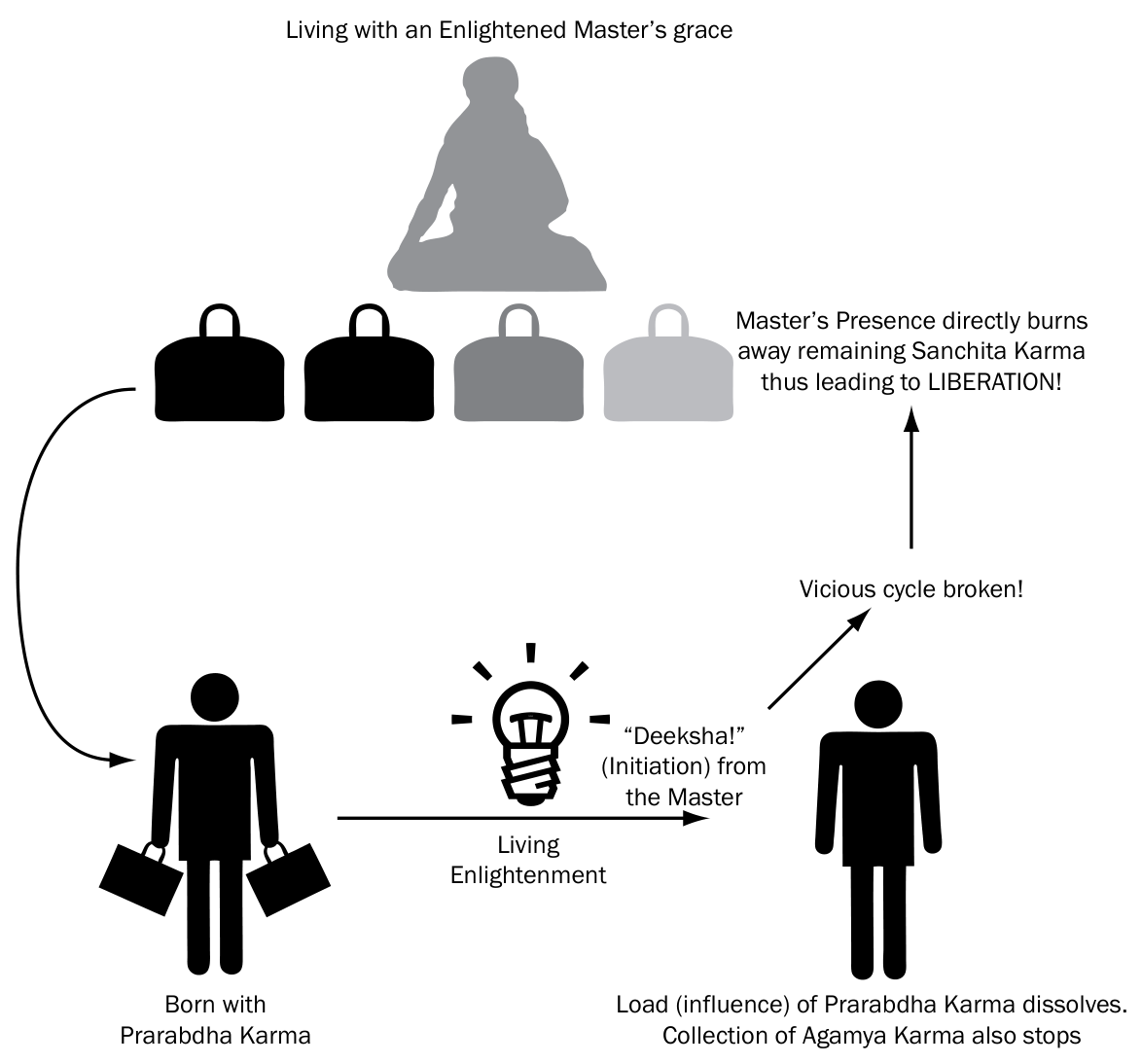
If on the other hand, whenever these three engrams put you in depression you have learned some technique to come out of the depression, then these three will start losing their power over you. So, over time, of the ten karmas, three will leave you. Whenever you reduce the influence of prarabdha on your-self, not only will the prarabdha get burnt, but the chances of accumulating new karma, the agamya karma, will also come down.
You stop collecting agamya when the prarabdha loses its influence over you. When the influence of these ten prarabdha engrams over you stops, the agamya collection will also stop because it is these ten engrams that are responsible for the collection of further engrams or karma.
Now let us come to the sanchita karma. Understand, you can't do anything directly with your sanchita karma bank. For sanchita to burn out, only Guru Krupa, grace of the master, will work. Only the master's grace can do anything to burn out your sanchita.
A beautiful story from the devotional vedic scripture Bhagavatam:
Krishna reached the banks of river Yamuna with the gopis, his milkmaid friends. They wanted to cross the river but there was no way to cross.
Krishna declared, 'If I am true brahmachari (celibate), then let the Yamuna part and let us go across.'
The Yamuna parted.
Outwardly, it may seem that Krishna was with the girls like other ordinary men. But Krishna was beyond the body-mind. His actions did not carry the intention of an ordinary man. It is the intention of any act that matters, not the act itself.
Intention is the baggage, the karma, not the action. If action creates inten-tion, it becomes the baggage. Pure action with no end objective is not karma.
See, whatever you are doing in the presence of the master, you are doing for the master. You know it is in no way going to build your name or fame. So, the action happens without intention. There is no intention. The intention is the master's. The action is yours. Intention is in the being of the person who has no intentions!
You see, the total sanchita karma can be yours or mine. Mine is divine play. Yours is suffering. When it started, your total sanchita karma also started as a divine play. But, after gathering more and more gathered agamya karma, it became dirty.
Because I have no karma, when you flow with me you will also act without intention. Action without intention is living enlightenment.
ACTION WITHOUT INTENTION IS FREE FROM KARMA
If a person has committed ten murders, the quantity of murders will not be recorded. But the intensity of the murderer will be recorded. It is the quality, the mindset, and the attitude, that carries the karmic burden.
That is why Krishna says again and again in the Bhagavad Gita that inten-tion is much more important than action. That is the message of the whole Gita. He says, 'When you are without intention I will take care.'
Action does not get recorded. Only intention gets recorded.
The Mahabharata tells us the beautiful story of a courtesan and a monk.
There was a monk who lived across a courtesan's house. He used to keep a count of the men coming to her house and used to imagine all kinds of things about
Shankara went upto the man who was pouring molten iron into the cast. He asked him for a glass of water. The man apologized saying he didn't have any water to offer. Shankara said, 'Alright. Please give me the molten iron then.'
The man and Shankara 's disciples were all shocked. The man gave Shankara the hot molten iron which he just poured into his mouth as if it was water!
He then turned around to his disciples and said, 'You may also drink now.' The disciples stood with their heads lowered. Shankara then explained, 'Do not follow what I do. Follow what I say. Otherwise, you just choose to follow what your mind tells you.'
Understand, the very plane on which enlightened beings exist is different from the normal human plane of existence. So they do not need to and cannot do things according to usual logic. Their intention is what is important, which cannot be explained in terms of ordinary logic.
An enlightened being has no personal interest because he has no individual identity – his identity is dissolved in the identity of the whole universe.
If the depth of the intention is more and of the action is less, the person is lazy or in tamas.
If the depth of intention and of the action is the same, the person is in rest-less action or rajas.
If there is no intention but only the action, he is in purposeless action or sattva.
That is why Krishna says in the Bhagavad Gita, ‘Fight, O Arjuna.’ It is not the act of ‘killing’ that will be recorded but the intention that will be recorded. The intention of Arjuna is the intention of Krishna, who is a being with no intentions as He is one with the Cosmos!
When you act in tune with the Cosmos, the whole Cosmos blesses you. You attract all kinds of positive coincidences around you. That is why when people contribute even a little to the cause of such a person they are showered in abundance from all corners.