Leadership is a State, Not a Status
This text was machine-transcribed from the printed book and may contain errors. Select the words and choose “Report a mistake”.
A true leader is a person who
is ready to take responsibility
consciously, who is not constantly
dependent on the past memory.
When we become responsible for others, we no longer are focused on us. We move towards serving other people. Serving other people is leader-ship. Pandering to one’s own needs without a care about others is absence of leadership.
There are so many books these days about leadership and how it is an impor-tant part of making an organization successful. There are so many so-called leadership gurus who teach and train people in organizations to ‘develop’ lead-ership. Yet when we look at all organizations, whether they are doing business to make a profit, or in government service or in the area of social services, true leaders are rare.
If you look at any organization you will find that less than 1% tends to become the so-called leaders in the organization. If you look at business organi-zations, we can say that there are probably only 1% of these organizations that can claim to be true leaders in their fields who are excelling in all areas of their business – making a profit, delivering good products and services, providing service to society, providing satisfaction to their employees, etc.
So we can say, true leaders are actually 1% of the 1% of successful business organizations. It means just 0.01% of the overall working population actually has true leadership qualities in them! We can say the same about organizations in other fields. This is what I mean when I say true leaders are rare.
Let us now try and understand why this is the case. For this, we need to understand:
In most organizations, those who have become leaders have achieved the status of the leader. They may not have necessarily achieved the state of the leader. What do I mean by this? To understand this, first let us understand the key ingredients that make a successful leader.
A small story:
There was once a great war between two countries. The war had been going on for some time and the soldiers were starting to feel tired of the long battle.
On a hot afternoon, a man in civilian clothes was riding past a small group of tired soldiers digging a huge pit. The group leader was shouting orders and threatening punishment if the work was not completed within the hour.
The man riding the horse stopped and asked, ‘Sir, why are you only shouting orders? Why can't you help them yourself?’ asked the stranger on horseback.
The group leader looked at him and replied, ‘What do you mean? I am the leader. The men do as I tell them.’ He then added, ‘If you feel so strongly about helping them, you are welcome to do so yourself!’
The man got down from his horse and started walking up to the soldiers at work. The group leader was simply shocked! The man took up the tools and started helping the soldiers and worked with them till the job was finished!
Before leaving the man congratulated the soldiers for their work, and approached the group leader.
He said, ‘The next time your status prevents you from supporting your people, you should inform your higher authorities, and I will provide a more permanent solution.’
The group leader was now completely surprised. Only now he looked closely at the man, and realized that the man was the army general!
We now need to ask ourselves how many so-called leaders in organizations exhibit the qualities of the group leader. And how many people do you know who exhibit the qualities of the army general?
Regardless of the status in an organization, you will agree that the majority of the so-called leaders exhibit the qualities of the group leader. They achieve the status of the leader but not the state of the leader.
There are very few people who are ready to really help get the work done.
A true leader is a person who is ready to take responsibility consciously, who is ready to handle life consciously, who is not constantly dependent on the past or his memory. If you are dependent on your memory, if you are dependent on the past to take decisions, please be very clear, you will be a follower. You cannot be a leader.
Responding spontaneously to situations is what I call responsibility.
A responsible leader is a person who is able to respond spontaneously to situations, who is fresh and continuously keeps himself alive, who is not caught in the past.
Let me try to give you a small diagram on how the mind works, how the state of a leader is achieved, how leader consciousness happens in us. Let us understand how the mind works – how we receive data, process it and make decisions.
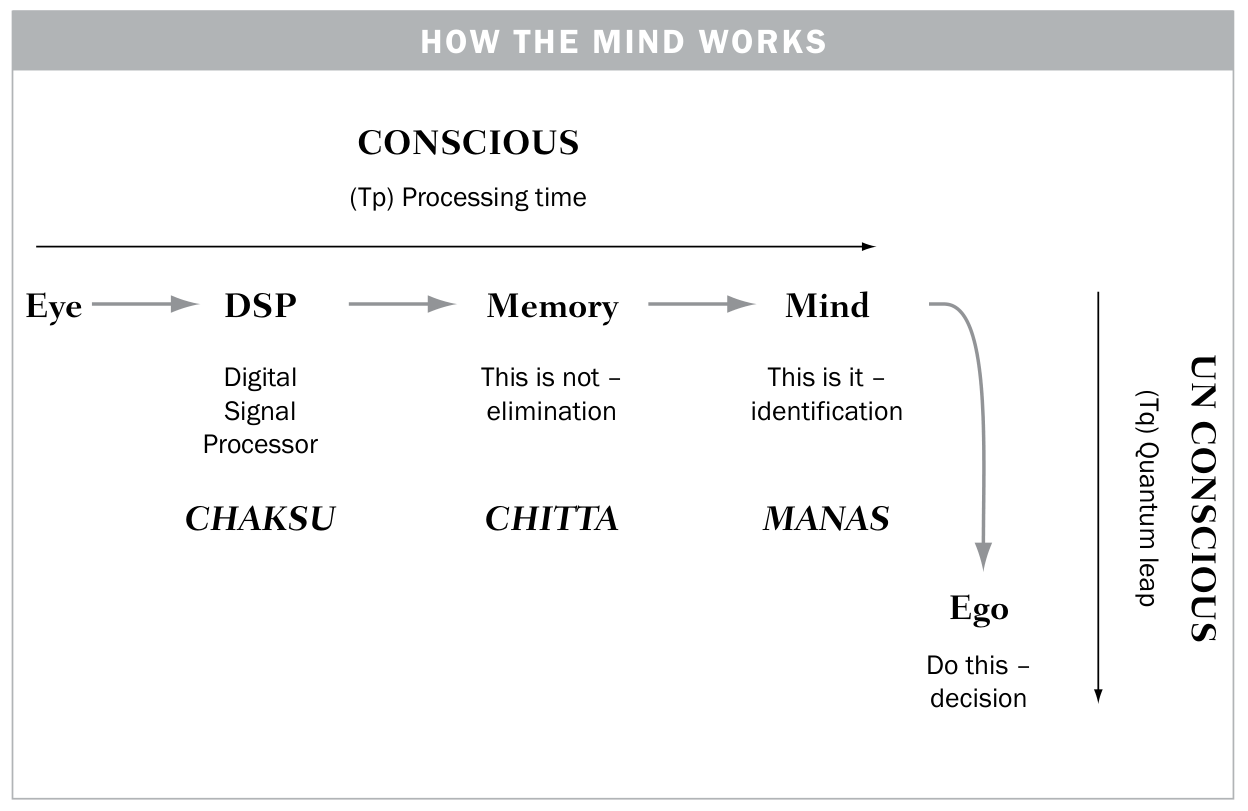
For example, you are seeing something through your eye. Of course, you receive information through all the five senses – eyes, ears, nose, tongue and touch. For now, let us take the example of the eye. When you see with your eyes, immediately the file goes to a space called the chakshu, it is just like a Digital Signal Processor (DSP). Whatever you are seeing through the eye is converted to a bio-signal, just like a digital signal file. This file moves to a space called chitta in Sanskrit which is just like memory in a computer. Here the process of identification starts. For example, you are now seeing this book – the whole file goes to the DSP, chakshu, and the whole file is converted into a bio-signal file, and then it moves to chitta, memory.
The memory starts analyzing – ‘This is not a stone, this is not a tree, this is not an animal …’ The elimination process happens in the memory. This process of elimination happens in the memory. Next, the identification, ‘This is a book,’ happens in the mind or manas. In the mind, you start identifying, ‘This is a book,’ ‘It is a book on spirituality,’ ‘It is written by an enlightened being.’
After identification, the file then moves to a space which I call ‘ego’, the decision-making center. In the ego you start thinking, ‘In what way am I connected to this situation?’ If your past experiences with similar books were good, you decide to continue to read. If your past experiences were not good, if you felt ‘Oh, this is not worth it, I felt very bored last time’, or ‘I read similar books but did not feel any benefit,’ if you feel negative you will decide not to continue reading. The ego decides based on your past experiences. This is the way your mind functions.
Now, the important thing which you need to understand is, the decision is taken unconsciously. If the process happens in a straightforward way, you will not have any problem and things will go very smoothly in your life. Everything will be clear and straight!
But this process does not always happen in a straightforward way. Some-times things start happening in an unconscious way. For example, if you were hurt or disturbed by something that was said in a similar book you read before, the moment you see this book, unconsciously that memory will be awakened.
You see, in your life, if you are hurt or disturbed in a particular place, or by a particular situation, or by a person wearing a particular colored dress, the next time when you go to that place, or the next time you see another person wearing the same colored dress, you will go through the same low mood even if you know logically that the place or that person has nothing to do with your past experi-ences. You will have that same memory again in your mind. You will again have that same experience. This is what I call ‘samskaras’ or ‘engraved memories’.
These engraved memories distort or disturb your decision-making capacity. You see, if the whole process of the mind map I just described happens consciously, then it is a straightforward and logical process. But due to the unconscious mind, a lot of times, the process is not straightforward. As I described earlier, we tend to get biased based on our experiences we have had with a particular person or a particular situation. This is the space where poli-tics happens! This is the space where things move illogically. This is the space where the past memories or engrams will be sitting and you do not even know what decision you are making! Again and again, your mind will say, 'When I suffered and struggled so much, why not them!' You will just reproduce your old mental set up on others. This can be a very de-motivating factor in organizations.
PRODUCTIVITY
So much has been written and said about productivity in organizations. Produc-tivity has become the mantra in organizations for the last two or three decades. As a result of invention of computers and new communications technologies such as the internet and cell phone, the world has become a much smaller place. While there has been an increase in productivity in companies, it has often come at a huge price on the health (physical and mental) and well being of the employees. Let us now start to understand what is productivity and how productivity can be enhanced without the side effects of stress.
In simple terms, productivity can be measured as:
Productivity = Output / Input
The measure of output may be certain number of tasks completed by a partic-ular individual or team or revenue in the case of a manufacturing company. The measure of input may include the number of hours worked on a particular project, manufacturing costs etc.
Billions of dollars are spent by companies globally to enhance human produc-tivity. Most of these efforts are centered on providing new skills specific to training in a particular area of the organization's focus or improving technology such as use of computers, internet or other forms of media and communications. Some compa-nies also invest in developing 'softer skills' such as interpersonal skills, team-building skills, etc. But most of these trainings tend to address the conscious mind - actions, behaviors and perceptions that are just on the surface. But over 90% of our emotions and behaviors reside deep under the surface of our mind. This is what the psycho-analyst, Sigmund Freud, calls the unconscious mind.
If we look at the mind, there are thoughts and perceptions which are accu-mulated in our mind at a conscious level. But there are deeper memories and stored knowledge that we use to help us solve problems. Then there is a whole range of emotions and experiences that are embedded in the unconscious level. This is where the samskaras or engraved memories reside.
Most corporate training programs focus on the conscious mind to impart knowledge or particular skills. But actually it is as though we are sitting on leading corporate leaders and Nobel Laureates on this subject where they have shared amazing evidences of improved innovation and intuitive skills developed as a result of becoming free of samskaras.
So we can now elaborate on the equation to describe productivity. We can restate the equation as follows:
Productivity = Output/Input
Input = (Intellect + Technical Skills + Samskaras)
As you know, we live with our mind 24 hours a day, 365 days a year. For most people, the mind is constantly running, analyzing, passing judgment on indi-viduals, having various emotions and responding to situations, all of which is dependent on the level of samskaras that may be 'haunting' us.
Without the load of these samskaras, you will find that your innate intellect and the skills you have developed through your education, training or life expe-riences will directly be used in delivering the output instead of being knocked around by your mind. You will see the productivity simply shoots up!
This is an area that has mostly not been looked at by companies and organi-zations. But there are simple tools and techniques from the Eastern mystics who have developed techniques to cleanse the mind of these samskaras.
Sometimes people ask me, 'If we are free of samskaras, will we stop thinking? Will we become lazy and complacent?' I tell you, it is actually the opposite. Please refer again to the experiment I gave you a while back on jotting down your thoughts on a piece of paper for fifteen minutes. If the mind is free from the effects of samskaras, you will see a quantum jump in intelligence and you will be creative and a whole new zone of intelligence will emerge. You will see that all of a sudden you will be able to develop skills of intuition and innovation that emerge from your being.
Understand, this is not a mystical zone you are going to enter into. Be very clear, the skills of intuition reside in all of us. They have been clouded by the impact of samskaras. Let me now describe how a mind-body system that is free from samskaras will improve intuition and innovation.