Innocence Regained Opens Many Doors to Life
This text was machine-transcribed from the printed book and may contain errors. Select the words and choose “Report a mistake”.
Innocence knows the beauty of purposelessness.
It may seem strange to speak of innocence after talking about intensity, but in the truest sense, you cannot be intense in anything you do unless you are innocent of other agenda. The innocence I speak of may not be what your own dictionary defines as innocence. What I speak about is the innocence of a child. A child is intense about anything that it does. Adults have lost that power, but it can be regained.
Innocence means purity of the inner space, not being affected by the thoughts or the engraved memories. Let you be very clear, even if you are not expressing your emotions like anger, greed and lust, if they are present in your inner space, you are not as yet a total and innocent person. Socially you may be pure, that's all. On the other hand if you express your anger, lust and greed but nothing touches your inner space and you live like an innocent child, then be very clear, you are a pure being.
You can see children get angry. Children are greedy also. They build their personality mostly on greed. That is why they are so aware and conscious of 'mine' attitude. Try to take away a toy from a child. The child will behave as if his life is taken away. He will scream and shout. This is because his whole personality is built upon 'mine' attitude. Children have greed and anger, but you cannot call them impure. This is because whatever you may think as impurity does not affect their inner space. They will sit and play with their toys and after a few hours they will throw them and go away. They don't carry anything in them. Their inner space is beautiful and pure.
Satyakama tells him how he had understood the Truth through animals and birds and requests the master to teach him the Truth in his own words.
The master says, 'You already know the Truth,' and blesses him.
The story says that just by being, just by listening to what nature has to say, Satyakama established himself in the Truth. He became enlightened.
Total innocence leads to enlightenment. Satyakama asks the master for enlightenment and the master asks him to multiply cows! Many of you will ask, what do cows have to do with enlighten-ment? Fortunately Satyakama was not so intellectual. Fortunately he did not receive formal intellectual education. So he did not ask this question! He was simple, innocent and humble, ready for the transformation to happen. He had no logic to use.
Understand, unless you are without logic, or tired of logic, you cannot be ready for the transformation. Logic cannot help you understand even your own life. Logic cannot help you look even into your own mind. How can it help you change?
People ask me, 'Swamiji, why are you against logic?' I am not against logic. I am only telling you that all your suffering is because of logic without intelligence. Your logic creates so much politics inside you from morning till evening.
What is politics? It is nothing but differing opinions on the same subject, is it not? Now watch your mind. It says one thing in the morning and a different thing in the evening on the same subject. This creates the dilemma in your mind. Your mind itself is such dilemma.
People say that in all spiritual organizations there is so much politics. I ask them, 'What do you mean?' There is politics inside the very persons who make this statement! To create politics, you don't even need two people. One person is more than enough. One single person with logic is enough because in the morning his logic will say something and in the evening it will say something else! And naturally the fight between you and you is politics! Am I right? Then why are you making the statement that even spiritual organizations have politics?
If you place the decisions that you make in the morning and the decisions that you make in the evening together in front of you, you will see a politician sitting inside you!
Logic does not allow you to be simple and innocent. It does not allow the transformation to happen easily. Logic has to be overcome for the transforma-If your being is like that, in this moment the transformation can happen. Just in this moment the transmission of light can happen.
REMAIN EMPTY
The word upanishad means ‘sitting at the feet of the master’. In ancient India, there was the gurukul tradition of masters and disciples. Children were left with the master at the age of seven and they grew up centering beautifully in their consciousness. Masters are living embodiments of the scriptural truths. Their thoughts, words and deeds stem from the ultimate Truth. Disciples pick up the truth just by living around them.
Swami Sri Yukteshwar Giri, an enlightened master from India says, ‘Sitting with the master is not merely being in his physical presence, but keeping him in your heart, being one with him in principle and tuning yourself to him.’ This is the whole technique of upanishad. The master is superconscious energy. When you tune to him, you tune to that energy. You can tune only through innocence, openness.
Openness is emptiness. Let not knowledge fill you. Knowledge is but a mere tool, not your substance. Reject all knowledge as ‘not this’, ‘not this’. When I say reject, I mean don’t settle for any intermediate knowledge except the ultimate Truth. Because when you drop everything that continuously arises in you, then you have no other go. You are thrown back into yourself and it is there you will find the ultimate Truth. It is then you are ready to be filled with the Truth. That alone can make upanishad happen.
If you watch children, their eyes will be filled with wonder and freshness all the time. They are so empty inside. They don’t hold any opinion about anything. They are ready to receive. Their readiness is expressed in their eyes. Have you ever seen an adult with such eyes? The eyes lose their glow as we grow older because we become dulled by what we start knowing. Knowledge makes us dull. We may know many things, but the knowing should not dull us in any way. We should remain empty in spirit always.
If you just look at life without any opinions, without any words of descrip-tion, without any fixed ideas, then you are like an empty teacup into which the brewed tea can be poured. You receive because you hold nothing, because you are empty. Then you never lose your enthusiasm. You are never bored. You are like a child, innocent and fresh.
A young girl was writing something on a piece of paper. Her father asked her what it was. accept it. But a man of innocence can say, ‘Because of my knowing I missed it. I actually don’t know. I am now eager to know.’ The moment this space is created, the learning continues to happen. In this space there is no ego of knowing. The resistance is dropped and there is pure receptivity.
J. Krishnamurti, the great philosopher, beautifully says, ‘There can be freedom from knowledge only when the motivation for gathering of knowledge is understood.’
What is generally the motivation for knowledge? You see: the present is an unfolding miracle and mystery of Existence. We try to grasp it with the net of knowledge. That is the motivation for knowledge. But it can never happen! The unknown can never be trapped with the known. The unknown can be known only by surrendering to it. That surrender is what is called intelligence! Intelligence recognizes the mystery of the present moment and surrenders to it joyfully. That joy is the joy of innocence.
Knowledge on the other hand denies the mystery of the present moment. It tries to ascertain it every minute and the present can never be ascertained. So you continuously remain with what is called ‘fear of the unknown’. It is through the process of trying to ascertain the present moment that the fear of the unknown takes root. Otherwise, you have no fear! You are very clear that the present moment is a mystery!
Through knowledge, you somehow try to escape from the ‘not-knowing’ of the moment. To the ego, not-knowing means being nothing. It cannot handle being nothing. But innocence is being nothing and enjoying the present! The present is an unopened gift. But knowledge robs it of its suspense. When knowledge understands that the ways of the Self are yet to be discovered, then it doesn’t hinder the process of the ultimate Knowing. Then it behaves as a tool that comes into play when actually required and does not stand in the way of embracing the mysteries of life.
Once knowledge solidifies in the being there is no space left for experiencing. There is scope only for replay of knowledge. Everything becomes a reflection of some past knowledge or some past conclusion. The future becomes a continu-ation of the past patterns and experiences. You already know the fragrance of a flower. You already know the sound of the waves.
Existence is not a continuation of anything. It is fresh every minute. So it is not possible to know anything. What do you know of what will happen the next second? If this is understood, all knowing can be dropped. Then there is only wisdom and wisdom is innocent intelligence. It allows the experience to happen
This is how children are trained today. They are trained to see utility in every-thing. Education evaluates you by your own utility. But you are not your utility. You are your being. The being can never be evaluated. Only the mind can be, and mind itself is a myth! Society creates a myth, which is your mind, and holds it as the yardstick to evaluate you. That is the reason why knowledge is so popular today.
A small story:
Four friends lived in a town. They spent a lot of time together. Three of them were very learned. The fourth was not as learned but he was wise.
One day, they decided to travel to other lands to exhibit their learning to men and earn money.
The fourth friend had nothing to boast of, but expressed his wish to accompany them.
The first friend said, 'You don't know much. If you accompany us, we will have to unnecessarily share our money with you.'
The second friend said, 'Yes, that is true. It is better you stay back.'
The third friend was more kind. He said, 'We grew up together all these years. It is not right to tell him to stay back. He should come along.'
So the four of them started their journey.
They passed through a dense forest. They saw many wild animals and experienced many exciting moments. Suddenly one day, they came across a heap of animal bones.
One of them said, 'I think this is a wonderful way to put our knowledge to test. Let us bring this animal back to life.'
The two other friends agreed, but the fourth one said, 'I feel these are the bones of a very big animal, so we should not attempt to do such things.'
The other three laughed at him and called him a coward. They said, 'If you had knowledge like we do, you will not feel so afraid of such things. Keep quiet and watch us.'
The three proceeded with the experiment.
One of them arranged the bones in a way that it looked like a proper animal. the cosmic plan, which is the source of all productivity. This happens because we are caught in 'doing' and 'having', we forget the 'being'.
There are three important states: being, doing and having. Right now, we move from doing to having. We continuously 'do' things. We learn and we put the learning into useful action. We then 'have' what we want, whether it is money, relationships, comfort, and what not. Then we want to have better things or have more things and so we continue doing. We are all the time between doing and having. In the process, the being is forgotten. Our real restfulness lies only in the state of being. Because of this, however much we do and have, we still search for restfulness. This feeling is the 'call of the being'.
If we nurture the being and cause the doing to happen from the quality of the being, then we don't have to work so much for the having. That will simply happen as a byproduct. This is the secret of Existence. But this is not seen as a direct utility to society by the universities. That is the problem. But this is what gives the real utility of every individual, not only to society but to the whole of the cosmos. We should always be concerned about the Whole.
In the ancient Indian universities like Takshila and Nalanda, the preparation of the students was always at the being level. Outer world learning happened as a natural consequence. India has always focused on nurturing the innocence of the being because only that will lead to strength of the being. When there is strength of the being, anything can be achieved.
Paramahamsa Yogananda beautifully describes the intent of spiritual learning. He says, there are trillions of cells in the body. Every cell is like an intelligent being. Every cell has the DNA substance in it which has the informa-tion and intelligence to grow a whole new body and brain. This dormant intel-ligence needs to be awakened so that the mind doesn't move towards suffering and remains in bliss.
He goes on to say that spiritual education magnetizes the cells by sending life current around the brain and spine, ensuring evolutionary advancement of the individual. With this divine magnetism, every cell becomes a brain alive and ready to grasp every bit of knowledge. With these awakened brains, the mental capacity of the individual multiplies multifold and all sorts of knowledge can be effortlessly comprehended! Such is the impact of spiritual learning.
Alexander, the emperor of Greece, had conquered three fourths of the world and traveled downward to Asia to conquer it. He settled down in the banks of the river Sindhu to conquer India. touch the cool breeze. Vulnerability is breaking the wall and inviting the cool breeze to touch your very being every time it blows.
Vulnerability is allowing everything to touch your being. The entire cosmos comes to you when you are vulnerable.
Vulnerability is not weakness. The wall when broken will not cause you danger. The wall itself was built out of a deep fear of exposing your reality. Your reality is your vulnerability and you are so afraid of opening it to the cosmos. You know deep down that if you let go and open up you will simply be swept away in innocence. So you close yourself up. But it is suffocating to be in there because it is the same air that is circulating. You experience the same patterns that the mind knows. Then of what use is the wall? When the wall is broken, you will realize that nothing leaves you. Instead, you only gain freshness of life.
When you are vulnerable, you experience everything at the being level. Otherwise, it becomes an experience through the head. The being is poetry, the head is prose. Life is poetry.
With the head you cannot be vulnerable! And when you are not vulnerable, you are sitting behind the great wall of your house. Life has not yet started. Life happens with vulnerability.
With vulnerability you move towards the truth in a different path, in a joyful path because every moment you are receiving directly from Existence. Existence is able to give you because you are vulnerable and ready to receive it! Existence has its own ethics. Enlightened masters have their own ethics. When there is vulnerability, they can simply shower on you. When there is a wall, it becomes difficult. Their ethics does not permit them to penetrate. So they wait for the wall to break.
When you become vulnerable, you are saying a 'yes' to Existence. Existence is the greatest mystery and the eternal teacher. When you say yes to it, your energy starts moving in a new direction. It moves from the head to the heart and you start receiving the teachings from your very being. Whatever you said 'no' to earlier will start becoming a yes. Then you will see that the world is very different from what you thought.
People ask me how to 'be' in my presence. Just be completely vulnerable and innocent. With openness, you can receive the truth directly in your being. The master is a pure expression of Existence. By allowing him, you are allowing Existence to enter into you. When Existence enters it leaves an impression of the truth in your being. With every darshan or touch from the master, the impression becomes deeper. This impression is greater than any teaching he can impart to you.
Trust is an attitude. It is not a substitute for appropriate action. The spirit of trust is the essence of life. It leads to innocence, surrender, relaxation and bliss. If it is followed out of complete understanding, there is nothing to lose in its path. Until then, you are still on the path to trust.
Enlightened masters are established in the knowing that nothing is impos-sible in the space of Existence. They are living embodiments of trust. Their bliss is an expression of this. They have access to all the knowledge of the world but are yet utterly innocent. They know that their knowledge is the knowledge of Existence. Their knowledge is not knowledge but a flowing experience of the truth of the moment.
We too have knowledge. But the problem is that we think our knowledge is the only right knowledge and all other knowledge is wrong. Understand: the ultimate knowledge is the same for everyone. Anything in between is just a bunch of borrowed ideas. If this is known clearly, surrender will happen and we will drop the burden of knowledge and become innocent.
How to start knowing that we don't know? Mere clarity that we don't know is enough. Just meditate on Existence, the source of all knowledge. Be in a prayerful and surrendering mood to it all the time. Be firm in surrendering to the knowledge of Existence. You will see that miracles start happening around you.
There is a story about Hanuman, the monkey god in Hindu mythology who was a devout disciple of Lord Rama.
Hanuman was once asked what day of the lunar month it was.
He replied, 'I don't know anything about the day of the month or the positions of the stars. I think of Rama alone.'
When you are established in the wonder of the Truth, you become so innocent, that your very life becomes meditative and miraculous. It was Hanuman who crossed the ocean from India to Sri Lanka with just one leap by chanting the name of Rama. Rama himself had to build a bridge to cross over with his army! Such is the power of innocent surrender to Existence and all its forms.
One more thing: when you are trusting and surrendering, it becomes diffi-cult to cheat you. Innocent trust always protects from deceit. It radiates that kind of energy.
There was a great Sufi Saint by name Habib Ajami. He went to bathe in the river one day leaving his coat on the bank of the river unattended. It is said that he attained enlightenment through just this innocent worship.
Today he is worshipped as one of the 63 saints called Nayanmars who attained enlightenment through innocent devotion to god.
Those who shun spirituality are those who have not tasted its transforming sweetness. They are the ones who think spirituality is seriousness. No! God is always an embodiment of bliss, then how can spirituality be seriousness? Man has made it serious by reducing it to mundane rituals.
Our masters have even specified the times in which to connect to the deeper realms of our being through prayer. They have said it is good to pray in the early morning. What is the reason for this? The intellect has rested well in the night and does not as yet start functioning in the morning. When spirituality is practiced at that time, the impact on the mind is greater. The impact is made while the mind is still fresh and innocent, while the mind has not yet started chewing on the intellect. Not for nothing have the great masters gifted spiritu-ality to us. When the intent is understood, spirituality becomes a straight route to restoring innocence and trust.
A small story:
One evening, a farmer on his way back from the market found himself without his prayer book. The wheel of his cart came off right in the middle of the woods and he felt sad that the day should pass without having said his prayers.
So he made up a prayer to god. He spoke aloud, 'Oh god, I have done something very foolish. I have left behind my prayer books today. And my memory is so poor that I can't recite a single prayer without the book. So this is what I am going to do. I will recite the letters of the alphabet five times very slowly and you, who knows all the prayers, please put the letters together to form the prayers I can't remember.'
And god said to his angels that day, 'Of all the prayers I have heard today, this one was undoubtedly the best because it came from a heart that was simple and sincere.'
Spirituality is an opening to express innocence in its purest form. Innocence itself is an offering to god. Innocence itself is the greatest prayer to god.
Religion is by itself not any belief as it is made out to be. Every religion is the result of the deep spiritual experience of the great master who founded it. What they experienced, they gave as a religion to humanity, through which humanity can get the same experience. There was no other intent. If this is understood, any person can practice any religion. That is the beauty of all original religions.
The same is true when you are around a master. Be in a mood of innocent surrender. When you are innocent and prayerful, the master's silence penetrates your being. The religion of silence is the greatest religion. It is the religion of the great masters and disciples. That is true spirituality also.
DROP CUNNINGNESS AND BECOME SPONTANEOUS
When I told the story of Satyakama to a group of people, one person asked me, ‘Swamiji, maybe these techniques are for highly evolved souls. In that story, the disciple gets enlightened when the master just blesses him. He must have been a highly evolved soul for that to happen.’
I told that person, ‘No, it is not for highly evolved souls. It is for highly innocent souls!’ Understand this. Highly evolved people don't need tech-niques. Techniques such as those given to Satyakama are given to innocent people who are tired of being cunning. Understand these words, ‘tired of being cunning’.
What is cunningness? It is the opposite of intelligence. You can be either cunning or intelligent, never both at the same time. Cunningness is also the oppo-site of vulnerability. When you are cunning, you cannot be vulnerable. When you are vulnerable, you are pure like a child. A child can be intelligent and innocent at the same time. Over time, his intelligence grows but the innocence invariably takes a turn to become cunningness. Then he is no more pure like a child. Soci-etal conditioning causes the innocence in the intelligence to take the turn into cunningness. Children if left to themselves remain innocent. But we teach them so many things that they become social animals. Understand this. We hold a great responsibility in bringing up children without making them cunning.
The poet Khalil Gibran says beautifully about children,
You may give them your love but not your thoughts,
For they have their own thoughts.
Cunningness is division. It is a constant calculation. It hinders free and inno-cent expression. It knows to express only through calculation. Calculation is alright for arithmetic, not for the being. We calculate for the wrong reasons. Do we ever calculate our blessings? No, never! They are just taken for granted.
A small story:
The rivers one day gathered together and made a complaint against the sea. They asked the sea, 'Why is that when we enter your waters fresh and fit to drink, you make us salty and undrinkable?'
The sea hearing itself being blamed replied, 'Don't come. Then you won't turn salty.'
If you are not ready for the simple solution, then be assured that you are playing a cunning game! Unless you are tired of being cunning, you can't be helped. No tech-nique can help you because your cunningness knows how to escape from every single technique. People come and tell me, 'Swamiji, whatever you are saying is correct, but ...' Understand this. The moment you say 'but' to me, you have missed! The moment you say 'but', it is over. You are trying to escape with your cunningness.
Some people tell me, 'Whatever you say is right, but please make me do whatever you say.' What do you mean? Should I have two or three people continuously watching you and make you do things? Drop your cunning game, then automatically you will start doing what I say. Cunningness is a pure hide and seek game that you play with yourself. You can't play it with me. I straight-away know where all you are hiding. I don't need to come to you to find you. So understand that you are just playing with yourself. Just take a strong decision to be completely sincere and authentic to yourself. Only then you can drop your cunningness.
When cunningness dissolves, authenticity and sincerity happen and you will enlighten quickly. Also, with authenticity you will not indulge in any kind of gossip. Gossip is a pure expression of cunningness. When you are so cunning that you can't tell a person anything on his face, you talk behind his back.
When you drop cunningness, spontaneity flowers. Spontaneity is the opposite of calculation. Intelligence plus innocence is spontaneity. Intelli-gence plus cunningness is calculation. Spontaneity is nothing but a flowing expression of your innocence. It is a non-calculating state of mind. It is called sahaja, being yourself without any burden. The burden is the burden of constant calculation.
Understand this, with cunningness, you may think you are gaining a lot of things, but the truth is that you are losing your innocence. Losing your innocence is like losing your entire life. You can afford to lose anything but not your innocence. lost the innocence. You are regaining it now. The new innocence will be with full awareness and that is the real innocence.
When you regain the innocence, you flower with the understanding that there is nothing more priceless than becoming childlike again. That is the process of enlightenment.
That is why a child’s innocence is to be nurtured with utmost care. For every innocent observation that a child makes, if we can be without imposing our knowledge on it, the child will grow up preserving its innocence. For example, if the child asks, ‘Why is it that the sky is blue sometimes and white sometimes?’ just tell the child that the sky is blue sometimes and white sometimes. He will anyway learn that in his lessons in school. But if you can tell him they are just the way they are, he will straightaway understand the spontaneity of nature. He will not be looking for further knowledge to feed himself with. The universities take care of that anyway.
At home, when you are still the most influential person in his life, if you make him understand that this is the way things are, that there is no need to know it all with knowledge, the innocence in him survives. He doesn’t catch the thread of passing judgment on nature. He learns to see without bringing words in. He learns to just see and be. The moment words are brought in, the innocence is lost. Then it is no more seeing. It becomes looking. The whole beauty of it is then lost.
Growing up is always considered to be a serious thing. If you grow up in seriousness you only grow old. If you grow up in playfulness, you remain young! It is a good thing to see what children, animals and other creatures are doing at times because they all live with innocence and playfulness. It will help under-stand and reconnect with innocence.
Childlike innocence discovers many things but cannot understand most of it. It enjoys it at the level of its innocence, that’s all. Whereas innocence regained not only discovers these new things, but also understands all of them. That is the difference.
Childlike innocence is beautiful but not enough. It has to be lost to life and regained with complete awareness and maturity.
It is said that a mad man and a mystic look alike. Both of them will be eccentric in their ways, laughing abruptly and doing things incomprehensible. But they are actually at the extreme two ends of the same spectrum! Extremes always look alike. Outwardly they appear to be the same, that’s all. Similarly, a child and a saint may look alike in their innocence, but they are actually at manifests itself as wondrous beauty to the eyes of the beholder. It is so total that even the most cunning mind cannot deny it. It simply defies all logic and touches you.
We always think children are immature. We think that the grownups who cry are immature. We are conditioned to believe that expression of any emotion is immature. Expressing the emotions in an unfiltered way is a sign of innocence. The cunning ones edit even their emotions. Once in a while it is good to cry in front of people. What is wrong with it? What are you trying to hide? By crying you are only expressing your true feelings. What is there to hide? The problem is that society has always taught us to hide our true nature and show only our projected personality. That is why with time we forget what our nature is. We forget how to be innocent.
One teacher told the parent during the parent teacher meeting, 'Your daughter is very good in all her activities. She is just a little emotionally immature. But she will be alright.'
The parent looked at her in a puzzled way and asked, 'At three, how else do you expect her to be?'
Just by being with children as their friend, as their playmate, it is possible to get back in touch with the innocence. When you are with them don't pretend to be like a child. Take it really seriously and become a child! It is the greatest favor you can do to yourself.
There are umpteen ways to rediscover the child hiding in you. Just play hide and seek with children or learn how to make cookies or watch Tom and Jerry cartoons or eat different color cotton candies or make mud dolls! All these will bring out the child in you. Your solid identity will dissolve. You will become fluid like a river and flow. The weight of your seriousness will drop and you will become light and blissful.
Seriousness is ego. When you are afraid of getting hurt, when you are afraid of losing your control or power, you become serious. When you are too centered on yourself this happens. When you let go and play and touch your innocence again, you will suddenly enjoy a break from yourself. That break is the falling of your seriousness. In that gap you will realize there is nothing to hold on to. There is only free spirit. When you become aware of this you can work on it consciously and move towards becoming completely innocent and sincere.
Innocence is keeping the consciousness at the level of the heart, not allowing it to settle in the head.
This question is asked in the Shiva Sutras, an ancient vedic scripture on the science of enlightenment. Shiva's consort Devi asks Him, 'What is the nature of this wonder-filled universe?' As a response, Shiva delivers 112 enlightenment techniques which, when practiced, give the answer as a direct experience!
This question about reality leads us to a world beyond matter and energy, beyond the limitations of space and time. This is the world where all the possi-bilities exist as seed. It is the essence and the origin of thoughts, and it is the essence and origin of events in the material world.
In this world-beyond, ordinary logic does not exist. Cause and effect rela-tionships do not exist. The happening of one event does not cause another event to happen, but it is correlated with the other event that happens. This correla-tion has no dependence on space and time. So what we call the seed is the ocean of infinite possibilities from which the waves of events arise.
This whole Existence and all its events happen as causeless auspicious-ness, like waves arising in an ocean. Existence is an ocean of bliss and ecstasy. Out of the causeless, overflowing ecstasy, the wave of Creation rises in the ocean of Existence! That is how things happen. The Divine, playing with its infinite manifestations in innumerable universes is called sustenance. Drop-ping from the play and relaxing into Itself is called dissolution. Dissolution is the settling back into the Absolute or Parabrahma state. Then … for no logical reason, the play starts again …! This continues. What we see as results are the infinite happenings in the universe.
THE REAL NATURE
We see this causeless and ecstatic play of Existence through our own individual perception! Our very perception collapses the beautiful happening into a local-ized reality. Each individual 'boils down' the beautiful happening into his own individual reality.
Someone asked me, 'I see this table here. All the people in this room see this same table. Then how can you say that this table is not a reality?' Please understand that what you see as this table here is not the same as what the other person sees! Each person in this room sees this table differently! That is the truth. That is what I am trying to explain here.
As long as the mind tries to perceive, what is perceived is not the ultimate reality. Only an infinite being can perceive Reality exactly as it is happening. He cannot explain it in words because words cannot describe what is beyond space and time. He can only tell you to wait for it to become your own experience! That is why Shiva answers not with philosophy but with techniques. He directly gives techniques for Devi to experience the Reality – the nature of the universe.
Let me explain this concept based on the energy-matter idea. We saw that matter is actually energy. Classical physics said that the electron is a particle. However, quantum physics says that it is a wave. Actually, the electron exhibits the properties of both a particle and a wave in different situations. Physicists have now concluded that the electron has a dual nature as a 'particle-wave'!
Since the electron is a particle, what is the location of the electron? Since it is a wave, what is the momentum of the wave? The answers to these questions lead to a very surprising discovery that the particle-wave can be either a particle or a wave or even both at the same time. But you cannot determine both the location and the momentum of the electron at the same time, because the very act of observing the location of the electron will change its momentum, and the very act of determining the momentum of the electron will change its location! This is what is known in science as the Heisenberg Uncertainty principle.
The particle-wave is both a particle and wave at the same time until the act of observation comes into play. This act of observation can now be connected with our act of observing the causeless happenings of Existence. When we observe, we observe through our own set of conditioning or what we call engrams which are preconceived and deeply engraved memories and conclusions. Each indi-vidual's act of observation is colored by his own conditioning or engrams. Based upon that, he boils down the happening to suit his own experience of reality!
In the case of the particle-wave, the very act of observation 'collapses' the wave-particle to a particle or wave. This leads us to a deep understanding that both possibilities exist simultaneously, and it is the very act of observation that changes the possibility into a particular reality.
Let me give another scientific experiment that highlights how the very act of measuring distorts the beautiful reality. You may have heard of the double-slit experiment with light.
In this experiment, a beam of light is aimed at a barrier with two vertical slits. On the other side of the barrier is a photographic plate that is used to record the light as it falls on it after passing through the barrier. If only one slit is open, the pattern on the photographic plate is as expected, which is a single line of light aligned with the slit. If both the slits are open, we would expect two lines of light on the plate aligned with the slits, but what is observed are multiple lines of light and darkness in varying degrees. This is the principle of interference where light beams behave as waves that interfere with each other.
Now, let us trace the motion of a line, a two-dimensional object. If it moves in the same direction as it is in, of course it will just continue to be a line. If it moves in a direction not contained in it, it traces a surface or a plane.

Line
Line traces a plane
Plane – 2D object
Similarly, if a surface or a plane moves in a direction not contained in it, it will trace a solid, a three-dimensional object.
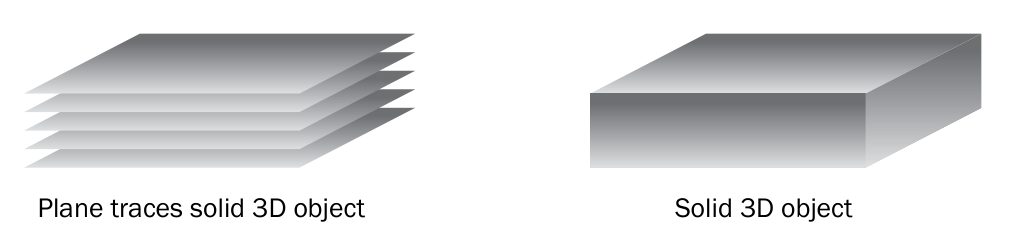
Plane traces solid 3D object
Solid 3D object
So, a line is an infinite number of points. A surface is an infinite number of lines. A solid is infinite number of surfaces. Similarly, we can imagine a four dimensional space as an infinite number of three dimensional spaces.
Now, just as we built up these higher dimensions from the lower dimen-sions, we can also see the lower dimensions as parts or sections of a higher dimension space.
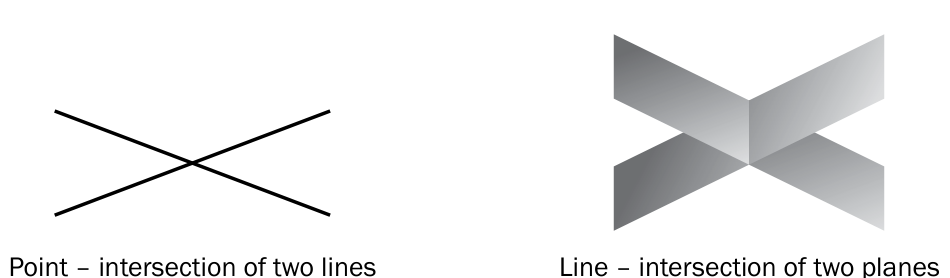
Point – intersection of two lines
Line – intersection of two planes
For example, a point is the intersection of two lines. So, a point is a section of a line.
A line is a section of a surface. A surface is a section of a solid.
Extending this, we can say a solid is a section of a four-dimensional body. Our three dimensional space is a section of a four dimensional space. P.D.Ouspensky, in his book Tertium Organum, explains these very beautifully. He extends this to say that many separate three dimensional bodies, like humans for instance, may actually be the sections or parts of one four dimensional body!
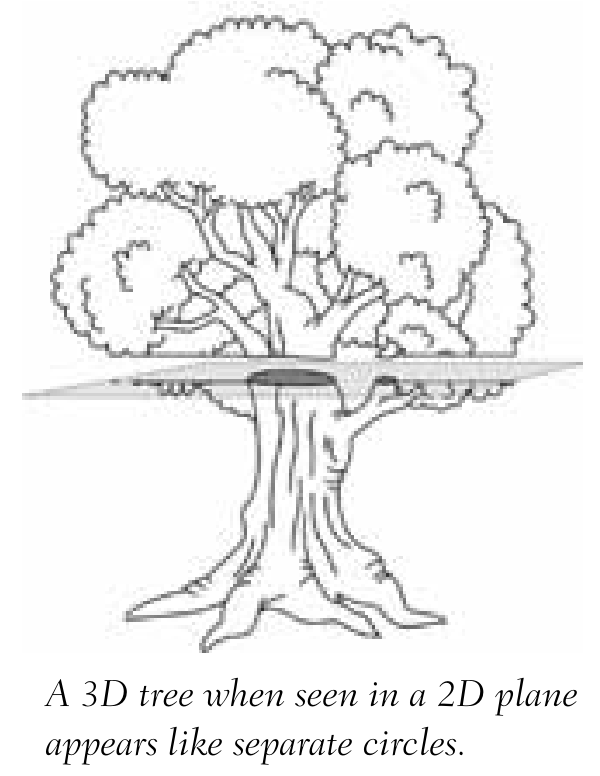
He explains this with a simple example. Suppose a horizontal plane intersects the top of a tree, parallel to the surface of the earth. Now, on this plane, the sections of branches seem to be all separate, not connected to each other. But, from the three dimensional space, we can see that these are all sections of branches of one single tree.
In our four-dimensional world, the maximum dimensions in space can be only three. We can call this fourth dimension time. So, the four dimen-sional world can be looked at as a space-time continuum. It can be said that time is the fourth dimension of space.
We understand time in three forms – past, present and future. We think that the past is over and does not exist anymore. The future has not yet happened, hence it does not exist. The present thus happens at the transition of the non-existent future to another non-exist-ence, the past.
In the three dimensional world, we see that the seemingly separate sections of the tree in the two dimensional world are actually joined in the third dimen-sion. In the same way, if we imagine a consciousness that can rise above our plane of living, this consciousness can also see the continuity in the fourth dimension of time – past, present and future all existing simultaneously. This consciousness sees the simultaneous happening of events, which the ordinary consciousness sees as distinct events separated by periods of time.
A three dimensional body, moving in time, traces a four dimensional body. Across time, we can see the motion as we grow from a child to youth, to adult, to elderly person. But we are not able to see or feel this 'four-dimensional body' because of our limited perception. Being in the same three-dimensional world,
Is this possible? Is it possible for us to go beyond the perception of the senses which give us only a three dimensional view? Can we actually see reality instead of mere glimpses of reality as phenomena in time? The answer is YES.
Through indepth research and development, the Eastern mystics and sages have discovered that it is possible to understand Reality as it exists and to expe-rience it also. This can happen as a natural way of life, not just as a chance happening. This experience has happened in them.
Through meditation, it is possible for us to experience this same state of awareness.
A beautiful Zen story:
Once, two soldiers were looking at a flag flying in the wind. One of them said, ‘The flag is moving.’ The second one said, ‘No, it is the wind that is moving.’
A Zen master passing by saw the argument going on. The soldiers requested the master to help them resolve this serious issue.
One of the soldiers asked, ‘Master, I say the flag is moving. But he says the wind is moving. Which is correct?’
The master says, ‘Neither is correct. Only consciousness is moving.’
As of now, what we feel as reality everyday of our life is also a ‘virtual’ reality. It is only a perception of things being separate in space and time. If you look deeply, you can see how our very perception of the world itself is questionable. From whatever quality of consciousness we see, THAT appears as our reality, not the absolute Reality.
REALITY CONSISTS OF ELEVEN DIMENSIONS
We think we live in a world of the three dimensions of space and the fourth dimension of time. However, there are actually eleven dimensions. The funda-mental dimensions are length, breadth, depth, time and consciousness. The higher dimensions are combinations of these fundamental dimensions.
For example, a stick has length, breadth and depth. It is in time and space. Now, if we keep length and breadth and just remove the depth, the stick will be seen, but the hand will pass through the stick. You can also keep the depth and remove the length and breadth. Then nothing will be seen, but the hand will hit something if you try to pass it through. you will experience the experience part of love, bliss. When you realize the chaos in the order, you will express the expression part of love which is compassion.