DUAL IDENTITIES
This text was machine-transcribed from the printed book and may contain errors. Select the words and choose “Report a mistake”.
We all have two identities, the identity that we project to the outer world, and the identity that we believe to be us in the inner world.
The identity that you believe to be you inside your mind is called mamakar in Sanskrit. It will always be much smaller than what you really are. You will carry or remember all your failures, past mistakes and guilt, constantly trying to work on them.
The identity that you project to the outer world is called ahankar. Ahankar is your visiting card. You print on it everything that you want others to know about yourself. This is based on the identity you show to the outer world. It will always be more than what you have, more than what you are. It will always be much more than what you are because you think you have to sell yourself. It becomes a basic need to do this, especially in the societies where you have to market yourself.
Ahankar will be based on a superiority complex. Mamakar will be based on an inferiority complex. Ahankar will be based on fear. Mamakar will be based on greed.
The basic truth is that you are much more than these two identities. When you unclutch from these two identities, you will suddenly realize that you are beyond the two identities. When that happens, these two identities can never bind you again.
An incident from the life of Ramana Maharishi:
One of Ramana Maharishi's disciples translated one of his books into another language. In the translation, inside the book, his name was also published as the translator.
When the disciple saw the book, he was shocked to see this. He went to the concerned authorities and scolded them for this mistake. He then went and told Ramana Maharishi, 'Bhagavan, they should not have put my name. I don't feel my name should be publicized. I am not that kind of person.'
Bhagavan said, 'The ego that asks for the name to be there and the ego that asks that the name not be there are one and the same. Relax.'
Be very clear, the inferior ego that is trying to show humbleness is also ego.
With a superiority complex, with a violent aggressive ego, at least society will teach you. This ego is very visible. With the humble ego, you will escape from society. That is more dangerous. It is the cunning ego that can nicely save itself. Ego is just the identity you carry about yourself.
TYPES OF EGO
The active ego is easy to recognize. People with an active ego will behave in a highhanded fashion; they will claim self-importance openly. They will be arro-gant. This ego is actually easy for a master to deal with. He just needs to bang on it a few times and it will break!
A small story:
A psychiatrist asks his patient if he is suffering from fantasies of self-importance. The man replies, 'Absolutely not. In fact, I think much less of myself than I really am!'
A person with an active ego will not be willing to let go of it at any cost.
Passive ego is very subtle and cunning. People who have a passive ego will pose as being very humble, lacking courage to face people, and shying away from taking credit. The worst part of this is that they think they are like this
A MEDITATION
Third Eye Meditation
Total Duration: 25 minutes This is an extremely powerful technique, most effective when practiced in the master’s presence or in front of a picture of the master’s eyes.
Step 1: Duration: 5 minutes With your eyes closed, just see through your eyes, whatever images you are seeing behind the closed eyes.
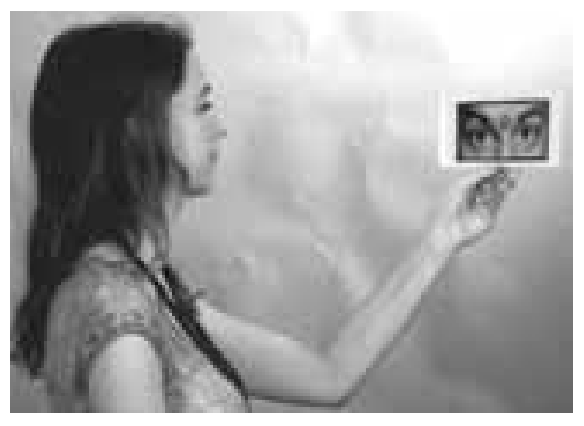
Step 2: Duration: 5 minutes
Now open your eyes and
through your third eye, look
intensely at the master’s
third eye in the picture. Look
through your eyes.
Repeat Steps 1 and 2, and finish on Step 1.
During this meditation, you may see visions of your favorite deities, or you may find that the master’s form is replaced by a beam of light. Sometimes you may see total emptiness where his picture was. Don’t be alarmed or lose your awareness at these moments. It is not hypnosis! In fact, it is a dehypnotizing process. Your superconscious is being awakened. If you see only light or emptiness, it is a sign that you have done the meditation with deep sincerity. That is the truth of our nature – we are all nothing but energy.
Seeing through the eye, you can achieve the ‘I’. Currently, you are making up your own reality. If you see through the eyes, you will wake up from it and see reality as it is!
One month passed and the two of them walked past the same sandalwood dealer again.
This time Akbar said, 'It's strange but I feel like giving this man some endowment today! How is it possible?'
Birbal replied, 'O King! A month back, the sandalwood dealer's business was suffering and when he saw you walking past he thought to himself, 'If the king dies, the courtiers would come to buy a lot of sandalwood from me for his funeral pyre.'
He sent out these negative vibrations which prompted you to feel hatred towards him. That is why last time you felt like hanging him without any real reason. I immediately purchased a lot of sandalwood from him to make tables and chairs for our kingdom. It made him very happy. Today, he feels very grateful to you for it. You are now struck by these positive vibrations from him and therefore you feel like giving him some endowment!'
According to the Law of Attraction, like energy attracts like energy. How does this apply to gratitude? Understand this: when you feel gratitude towards every-thing, it means you feel fulfilled, you feel blissful. So when you radiate grati-tude, your energy of fulfillment attracts fulfillment back to you in the form of material gains, good relationships, good health and so on. This is how it works.
The main thing is that gratitude makes you resonate with Existence and transforms you into a beautiful human being.
Psychologists have studied the effects of the feeling of gratitude on people. In their first study, two researchers, Dr. Michael McCollough of Southern Methodist University in Dallas, Texas, and Dr. Robert Emmons of the Univer-sity of California at Davis, California, concluded that gratitude played a major role in a person's well-being.
The results of the study indicated that daily gratitude exercises resulted in higher reported levels of alertness, enthusiasm, determination, optimism, energy, lesser depression and stress. They further suggested that anyone could increase their sense of well-being and create positive social effects just from counting their blessings.