Bliss is the Path and the Goal
This text was machine-transcribed from the printed book and may contain errors. Select the words and choose “Report a mistake”.
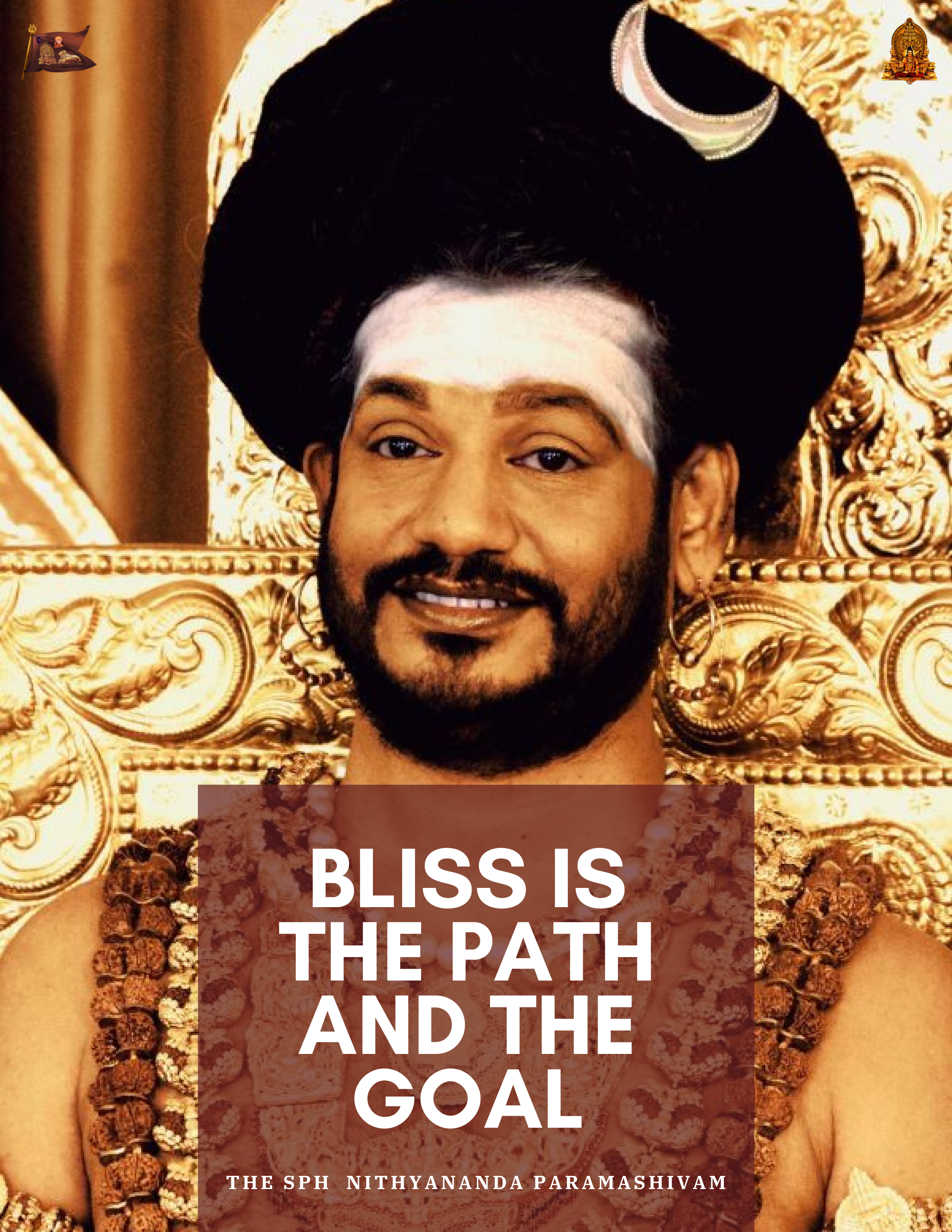
BLISS IS
THE PATH
AND THE
GOAL
THE SPH NITHYANANDA PARAMASHIVAM
BLISS IS THE PATH AND THE GOAL
Published by KAILASA's Nithyananda Hindu University | Copyright © 2021
Reprint: 2021
Ebook ISBN: 979-8-88572-588-0
Nithyananda Hindu University
9720 Central Avenue, Montclair, CA 91763 USA
www.nithyanandahinduuniversity.org
All rights reserved. No part of this publication may be reproduced, distributed, or
transmitted in any form or by any means, including photocopying, recording, or
other electronic or mechanical methods, without the prior written permission of the
publisher.
Nothing written, explained, shared or promoted in this publication should be
considered or construed as medical advice or a substitute for medical care. Any
instructions, teachings and suggestions contained in this publication are purely in a
spiritual capacity and not intended to be any sort of guarantee or definitive
statement about one's health or one's past, present, or future.
This book is not a platform, guide or instruction for learning or practicing any
meditation, siddhi, process, āsana, kriya, diet, or other technique that is described
or pictured in this book. Any such technique included in this book is for illustrative
and informative purposes only and should be practiced only under the guidance of a
trained teacher Acharya, ordained by The SPH Nithyananda Paramashivam.
Copyright © 2021 Sri Nithyananda Paramashivam. All Rights Reserved.
List of discourses used
Chaos is Order Order is Chaos
Cognitive Shift
From Lust to Love
Instinct-Intellect-Intuition
Quantum Bliss
Quantum Enlightenment
Quantum Spirituality
Who am I - The Ultimate Question
Bliss is the Path and the Goal
Nithyananda
Someone asked me: Can dead Masters also teach? I replied, "Dead masters are not dead as you think. They may be physically absent, but their spirit is present. Physically they may be absent but spiritually, they are present. When they were alive physically, their presence had the body. When they are gone, their presence has no body, but they are present. Their presence is in no way related to their body. Dead masters are not absent as you think. In the same way, living masters are not present as you think. Be very clear. I am neither present as you see nor absent as you think. The more you grow spiritually, the deeper you will experience my presence. Your idea about dead masters' absence and my presence are both wrong."
- Nithyananda
CONTENTS
Under The Banyan Tree
The Journey of a 1000 Miles
Quantum Spirituality
The Mind Works in Myriad ways
Decisions, Decisions, Decisions...
How does the Mind Work?
What is the Big Hurry?
Opening our Mind to Intuition
Shifting our Doors of Perception
Listening to Nature’s Intelligence
Chaos is Order and Order is Chaos
Ways to Invoke Nature’s Energy
The Miracle of Body Intelligence
Pain and Its Cure
Under The Banyan Tree
Chitram vatatharormulae vrudha shishya gururyuva;
Gurostu maunam vyakyanam shishyastu chinnasamsayat.
What a wonder! This vision under the banyan tree! The teacher is a young boy, the taught are old men! The teacher is silent, yet the doubts of the disciples are dissolved!
Over thousand years ago, Adi Sankara, the great reformer saint of Hinduism, sang the praise of the young Master Dakshinamurthy, an incarnation of Lord Shiva, the rejuvenator in the Hindu mythological trinity, teaching disciples far older than him in silence under a banyan tree. Dakshinamurthy is the archetypal spiritual Master, who though young was enlightened and was sought after by other enlightened Masters far older than him.
Whenever Paramahamsa Nithyananda is in his ashram in Bidadi near Bangalore, what Adi Sankara said happens almost every day just the way he sang the praise of Dakshinamurthy years earlier. Under a magnificent Banyan tree that is over 300 years old, a young enlightened Master leads a group of far older men and women in prayer, meditation and discourse. Majestic, graceful, with powerful words and compassionate as a mother, Nithyananda is an enlightened Master who states his mission to be one of individual transformation through dhyana, meditation.
He had a divine vision that he should set up an ashram in a place near Bangalore that would have a large Banyan tree. The name Dhyanapeetam came to him as the name for this spiritual center of his movement, as well as his mission to transform people across the globe through meditation. Three years ago, he had only Tamil speaking people in rural Tamilnadu who came to him, mostly to be healed. Today, in 24 countries across the globe, the Nithyananda Foundation flag flies high. More than 100 Acharyas (teachers) teach his techniques in these countries and over 3000 spiritual healers ordained by him, heal over 10,000 people every day.
The transformation that he has wrought in many is nothing short of miraculous. Helping someone shed his ego is far more difficult than materializing objects through the air.
He says time and again: I am not here to prove that I am God. I am here to prove that you are God.
What may sound pompous and laughable from any one else, comes across as Divine Truth when the Master says it with authority. The Bhagavad Gita is considered a scripture only because of the authority with which Lord Krishna, the Lord and Master speaks it.
The Bhagavad Gita is traditionally not part of the Vedas, the four Hindu scriptural works that were revealed to enlightened sages and which remained unwritten for many thousands of years, and communicated by just word of mouth. The Bhagavad Gita forms part of the Hindu epic, the Mahabharata, the story of two warring clans, the five Pandava Princes and the hundred Kaurava Princes, their cousins. In the great war of the Mahabharata, Arjuna the Pandava Prince seeks to surrender rather than fight his respected elders and loved relatives.
Lord Krishna is the charioteer of Arjuna and his advice to Arjuna on the battlefield is the Bhagavad Gita. The Gita as it is more popularly known, is read by millions even today and followed as a guideline to day-to-day life issues. Lord Krishna's advice to Arjuna, the representation of the confused human being constantly under dilemma, is considered the fifth Hindu scripture based on Krishna's authority. There is nothing to doubt and therefore it became part of the sruti, unwritten scriptures created from awareness.
Every word that Nithyananda utters is sruti, the Eternal Truth, as also his blessing ‘Be Blissful’!
The young boy teaching men far older than him is to us an incarnation of Dakshinamurthy, the primal Guru, who is as well the presiding deity under the Banyan tree at Bidadi. The Master is Shiva, the Master of Masters, the Lord of jnana (wisdom) and dhyana (meditation) under whose tutelage, transformational miracles happen every day at the ashram and world over.
Thousands come to the Master with burning issues and questions:
What do I really want to do in my life?
What will give me real happiness?
How can I make this world a better place to live in? How can I make a difference to this world?
These are questions that have arisen in the human mind, since time immemorial. It may come to different people at different junctures in their lives. To some, it is the form of a jolt in life, a trauma of one form or another that shakes up the smooth life that they had been living till then. The loss of a loved one or a sudden downturn in business or a health problem may trigger these questions.
To some others, it could come when they feel they have achieved all that they wanted to - a good education at the most respected university in the chosen field of interest, then the desired job with a great salary, a happy married life and so one. But then at the end of it, the person wonders if he had been driving himself this far to achieve just these things! He has got the very things he wanted but he wonders ‘now what?’ Life brings the person face to face with these fundamental questions ranging from ‘What do I really want?’, ‘What am I living for?’ to ‘Who am I?’
Without pulling any punches, Swami answers these queries in his discourses and programs. This book is a compilation of some of his discourses on the topic of ‘Bliss is the path and the goal’ where he makes one understand with no uncertainty that the path itself is the goal, which again is bliss itself!