Chapter 1: Arjuna Vishada Yoga: Arjuna's Dilemma
This text was machine-transcribed from the printed book and may contain errors. Select the words and choose “Report a mistake”.
धृतराष्ट्र उवाच
धर्मक्षेत्रे कुरुक्षेत्रे समवेता युयुत्सवः।
मामकाः पाण्डवाश्चैव किमकुर्वत सञ्जय।।१.१।।
Dhritaraashtra uvaacha:
dharma-kshetre kuru-kshetre samavetaa yuyutsavah
maamakaah paandavaas chaiva kim akurvata sanjaya 1.1
Dhritaraashtra: Dhritarashtra; uvaacha: said; dharma- kshetre: in the place of righteousness; kuru-kshetre: in this location of Kurukshetra; samavetaa: gathered; yuyutsavah: desiring to fight; maamakaah: my people; paandavah: the sons of Pandu; cha: and; eva: also; kim: what; akurvata: did they do; sanjaya: O Sanjaya
1.1 King Dhritarashtra asked: O Sanjaya, on this righteous location of Kurukshetra, what did my sons and those of Pandu ready to fight, do?
सञ्जय उवाच:
दृष्ट्वा तु पाण्डवानीकं व्यूढं दुर्योधनस्तदा।
आचार्यमुपसङ्गम्य राजा वचनमब्रवीत्।।१.२।।
sanjaya uvaacha:
drshtvaa tu paandavaaneekam vyoodham duryodhanas tadaa
aachaaryam upasangamya raajaa vachanam abraveet 1.2
Sanjaya: Sanjaya; uvaacha: said; drshtvaa: having seen; tu: indeed ; paandavaaneekam: the Pandava army; vyoodham: arranged in formation; duryodhanah: Duryodhana; tadaa: then; aachaaryam: the teacher; upasangamya: approaching ; raajaa: the king; vachanam: words; abraveet: said
1.2 Sanjaya said: O King, looking at the Pandava army in full formation, Duryodhana went to his teacher and spoke.
पश्यैतां पाण्डुपुत्राणामाचार्य महतीं चमूम्।
व्यूढां द्रुपदपुत्रेण तव शिष्येण धीमता।।१.३।।
pashyaitaam paandu-putraanaam aachaarya mahateem chamoom
vyoodhaam drupada-putrena tava shishyena dheemataa 1.3
pashya: behold; etam: this; pandu-putraanaam: of the sons of Pandu; aachaarya: O teacher; mahateem: great; chamoom: army; vyoodham: formed; drupada-putrena: by the son of Drupada; tava: your; shishyena: by disciple; dheemataa: intelligent
1.3 O my teacher, behold the great army of the sons of Pandu, arrayed for battle by your intelligent disciple, the son of Drupada.
अत्र शूरा महेष्वासा भीमार्जुनसमा युधि।
युयुधानो विराटश्च द्रुपदश्च महारथः॥१.४॥
atra shooraa maheshvaasaa Bhima-arjuna-samaa yudhi yuyudhaano viraatas cha drupadas cha mahaarathah 1.4
atra: here; shooraa: heroes; mahaa-ishu-asaa: mighty archers; Bhima-arjuna: Bhima and Arjuna; samaa: equal; yudhi: in battle; yuyudhaanah: Yuyudhana; viratah: Virata; cha: and; drupadah: Drupada; cha: and; mahaarathah: great charioteers
1.4 Here in this army there are many heroes wielding mighty bows, and equal in military prowess to Bhima and Arjuna - Yuyudhaana, Virata, and the great chariot warrior Drupada.
धृष्टकेतुश्चेकितानः काशिराजश्च वीर्यवान्।
पुरुजित्कुन्तिभोजश्च शैब्यश्च नरपुङ्गवः॥१.५॥
dhrshtaketus chekitaanah kaashiraajas cha veeryavaan purujit kuntibhojas cha shaibyas cha nara-pungavah 1.5
dhrshtaketuh: Dhrshtaketu; chekitaanah: Chekitaana; kaashiraajah: Kaasiraaja; cha: and; veeryavaan: courageous; purujit: Purujit; kuntibhojah: Kuntibhoja; cha: and; shaibyah: Saibya; cha: and; nara-pungavah: best of men
1.5 There are courageous warriors like Dhrshtaketu, Chekitana, Kasiraja, Purujit, Kuntibhoja and Saibya, the best of men.
युधामन्युश्च विक्रान्त उत्तमौजाश्च वीर्यवान् ।
सौभद्रो द्रौपदेयाश्च सर्व व महारथाः ।।१.६।।
yudhaamanyus cha vikraanta uttamaujaas cha veeryavaan saubhadro draupadeyaas chasarva eva maha-rathaah 1.6
yudhaamanyuh:Yudhamanyu; cha: and; vikraantah: mighty; uttamaujaah: Uttamauja; cha: and; veerya-vaan: brave; saubhadrah: the son of Subhadra; draupadeyah: the sons of Draupadi; cha: and; sarve: all; eva: certainly; maha-rathaah: great chariot fighters.
1.6 There are the mighty Yudhamanyu, the brave Uttamauja, Abhimanyu, the son of Subhadra and the sons of Draupadi, all of them great chariot warriors.
अस्माकं तु विशिष्टा ये तान्निबोध द्विजोत्तम ।
नायका मम सैन्यस्य संज्ञार्थं तान्ब्रवीमि ते ।।१.७।।
asmaakam tu vishishtaa yetaan nibodha dvijottama naayakaa mama sainyasya samjnaartham taan braveemi te 1.7
asmaakam: our; tu: also; vishishtaa: important; ye: who; taan: those; nibodha: know; dvija-uttama: the best of the Brahmanas; naayakaah: leaders; mama: my; sainyasya: of the army; samjna-artham: for information; taan: them; braveemi: I speak; te: to you.
1.7 O best of the Brahmanas, know them also, who are the principal warriors on our side – the generals of my army; for your information I mention them. 1.7
भवान्भीष्मश्च कर्णश्च कृपश्च समितिञ्जयः।
अश्वत्थात्मा विकर्णश्च सौमदत्तिस्तथैव च।।१.८।।
bhavaan Bhishmas cha karnas cha krpas cha samitim-jayah asvatthaama vikarnas chasaumadattis tathaiva cha 1.8
bhavaan: your self; Bhishmah: Grandfather Bhishma; cha: and; karnah: Karna; cha: and; krpah: Krpa; cha: and; samitim- jayah: victorious in war; asvatthaama: Asvatthaama; vikarnah: Vikarna; cha: and; saumadattihi: the son of Somadatta; tathaa: thus as; eva: only; cha: and
1.8 They are yourself, Bhishma, Karna, Krupa who is ever victorious in battle and even so Asvatthama, Vikarna and the son of Somadatta. 1.8
अन्ये च बहवः शूरा मदर्थे त्यक्तजीविताः।
नानाशस्त्रप्रहरणाः सर्वे युद्धविशारदाः।।१.९।।
anye cha bahavah shooraa mad-arthe tyakta-jeevitaah naanaa-shastra praharanaah sarve yuddha-vishaaradaah 1.9
anye: many others; cha: also; bahavah: in great numbers; shoorah: heroes; mat-arthe: for my sake; tyakta-jeevitaah: prepared to risk life; naanaa: many; shastra: weapons; praharanaah: equipped with; sarve: all of them; yuddha: battle; vishaaradaah: experienced in military science.
1.9 There are many other heroes who are prepared to lay down their lives for my sake. All of them are well equipped with different kinds of weapons, and all are experienced in military science.
अपर्याप्तं तदस्माकं बलं भीष्माभिरक्षितम्।
पर्याप्तं त्विदमेतेषां बलं भीमाभिरक्षितम्।।१.१०।।
aparyaaptam tad asmaakam balam Bhishmaabhirakhsitam paryaaptam tu idam eteshaam balam Bhimaabhirakshitam 1.10
aparyaaptam: unlimited; tat: that; asmaakam: of ours; balam: strength; Bhishmaabhirakshitam: protected by Bhishma; paryaaptam: limited; tu: but; idam: all this; eteshaam: their; balam: strength; Bhimaabhirakshitam: protected by Bhima
1.10 This army of ours protected by Bhishma is invincible whereas their army protected by Bhima is conquerable.
अयनेषु च सर्वेषु यथाभागमवस्थिताः।
भीष्ममेवाभिरक्षन्तु भवन्तः सर्व एव हि।।१.११।।
ayaneshu cha sarveshu yathaa-bhaagam avasthitaah Bhishmam eva abhirakshantu bhavantah sarva eva hi 1.11
ayaneshu: in the divisions ; cha: and; sarveshu: everywhere; yathaabhaagam: as per the divisions; avasthitaah: situated; Bhishmam: to Bhisma; eva: alone; abhirakshantu: protect; bhavantah: you; sarve: all; eva: only; hi: indeed
1.11 Stationed in your respective divisions on all fronts, all of you must give full protection to Bhishma.
तस्य संजनयन्हर्षं कुरुवृद्धः पितामहः।
सिंहनादं विनद्योच्चैः शङ्खं दध्मौ प्रतापवान्।।१.१२।।
tasya sanjanayan harsham kuru-vrddhah pitaamahah simha-naadam vinadyocchaihi shankham dadhmau prataapavaan 1.12
tasya: his; sanjanayan: causing; harsham: joy; kuru-vrddhah: old man of the Kuru dynasty; pitaamahah: the grandfather; simha-naadam: lion's roar; vinadya: causing to sound; ucchaihi: loudly; shankham: conch; dadhmau: blew; prataapa- vaan: mighty
1.12 Then Bhishma, the grand old man of the Kuru dynasty, their glorious grandfather, roared like a lion and blew his conch, giving Duryodhana joy.
ततः शङ्खाश्च भेर्यश्च पणवानकगोमुखाः।
सहसैवाभ्यहन्यन्त स शब्दस्तुमुलोऽभवत्।।१.१३।।
tatah shankhaas cha bheryas cha panavaanaka-gomukhaah sahasaiva abhyahanyanta sa shabdas tumulo ‘bhavat 1.13
tatah: then; shankhaah: conches; cha: and; bheryah cha panava-anaka: drums, bugles, horns and trumpets; go- mukhaah: cow horns; sahasaiva: quite suddenly
abhyahanyanta: blared; sah: that; shabdah: sound; tumulah: tumultuous;
abhavat: became
1.14 Then, conches, bugles, trumpets, drums and horns were all suddenly sounded, and the combined sound was tumultuous.
ततः श्वेतैर्हयैर्युक्ते महति स्यन्दने स्थितौ।
माधवः पाण्डवश्चैव दिव्यौ शङ्खौ प्रदध्मतुः ।।१.१४।।
tatah shvetair hayair yukte mahati syandane sthitau maadhavah paandavas chaiva divyau shankhau pradadhmatuhu 1.14
tatah: then; shvetaih: by white; hayaih: horses; yukte: being yoked; mahati: magnificent; syandane: chariot; sthitau: seated; maadhavah: Madhava, Shree Krishna; paandavah: son of Pandu; cha: and; eva: only; divyau: divine; shankhau: conches; pradadhmatuhu: blew
1.14 Then, seated on a magnificent chariot drawn by white horses, both Krishna and Arjuna sounded their divine conches.
पाञ्चजन्यं हृषीकेशो देवदत्तं धनंजयः।
पौण्ड्रं दध्मौ महाशङ्खं भीमकर्मा वृकोदरः।।१.१५।।
paanchajanyam hrsheekesho devadattam dhananjayah paundram dadhmau mahaa-shankham Bhima-karmaa vrkodarah 1.15
paanchajanyam: the conch named Panchajanya; hrsheeka- eeshah: Hrsheekesha, one who directs the senses; devadattam: the conch named Devadatta; dhanam-jayah:
Dhananjaya, the winner of wealth; paundram: the conch named Paundra; dadhmau: blew; mahaa-shankham: the great conch; Bhima-karmaa: one who performs terrible tasks; vrka-udarah: one with the belly of a wolf
1.15 Then, Krishna blew His conch, called Pancajanya; Arjuna blew his, called Devadatta; and Bhima blew his mighty conch called Paundra.
अनन्तविजयं राजा कुन्तीपुत्रो युधिषिष्ठरः।
नकुलः सहदेवश्च सुघोषमणिपुष्पकौ ।।१.१६।।
anantavijayam raaja kuntee-putro yudhishthirah nakulah sahadevas cha sughosha-manipushpakau 1.16
काश्यश्च परमेष्वासः शिखण्डी च महारथः।
धृष्टद्युम्नो विराटश्च सात्यकिश्चापराजितः।।१.१७।।
kaashyas cha parameshvaasah shikhandee cha mahaa-rathah dhrshtadyumno viraatas cha saatyakis cha aparaajitah 1.17
द्रुपदो द्रौपदेयाश्च सर्वशः पृथिवीपते।
सौभद्रश्च महाबाहुः शङ्खान्दध्मुः पृथक्पृथक् ।।१.१८।।
drupado draupadeyaas cha sarvashah prthivee-pate saubhadras cha mahaa-baahuhu shankhaan dadhmuhu prthak prthak 1.18
ananta-vijayam: the conch named Ananta-vijaya; raaja: the king; kunteeputrah: the son of Kunti; yudhisthirah:
Yudhishthira; nakulah: Nakula; sahadevah: Sahadeva; cha: and; sughosha-manipushpakau: the conches named Sughosha and Manipushpaka; kaashyah: the King of Kasi (Varanasi); cha: and; parama-isu-asah: the great archer; shikhandee: Shikhandi; cha: and; mahaarathah: great chariot warrior; dhrshtadyumnah: Dhrstadyumna ; viraatah: Virata; cha: and; saatyaki: Saatyaki; cha: and; aparaajitah: invincible; drupadah: Drupada; draupadeyaah: the sons of Draupadi; cha: also; sarvashah: all; prthivee-pate: King of the Earth; saubhadrah: the son of Subhadra (Abhimanyu); cha: and; mahaa-baahuh: mighty-armed; shankhaan: conches; dadhmuhu blew; prthak prthak: severally
1.16, 17, 18 King Yudhisthira, the son of Kunti, blew his conch, the Anantavijaya, and Nakula and Sahadeva blew theirs known as Sughosha and Manipushpaka. The excellent archer, the King of Kasi, the great chariot- fighter Sikhandi, Dhrstadyumna, Virata and the invincible Satyaki, Drupada, the sons of Draupadi, and the mighty-armed Abhimanyu, son of Subhadra, all of them O King, blew their own conches.
स घोषो धार्तराष्ट्राणां हृदयानि व्यदारयत्।
नभश्च पृथिवीं चैव तुमुलो व्यनुनादयन् ।।१.१९।।
sa ghosho dhaartaraashtraanaam hrdayaani vyadaarayat nabhas cha prthiveem chaiva tumulo vyanunaadayan 1.19
sah: that; ghoshah: uproar; dhaartaraashtraanaam: of the sons of Dhritharashtra; hrdayaani: hearts; vyadaarayat: broke; nabhah: the sky; cha: and; prthiveem: the earth; cha: and; eva: only; tumulah: tumultous; vyanunaadayan: resounding
1.19 The terrible sound echoing through the sky and the earth rent the hearts of the sons of Dhritharashtra.
अथ व्यवस्थितान् दृष्ट्वा धार्तराष्ट्रान्कपिध्वजः।
प्रवृत्ते शस्त्रसंपाते धनुरुद्यम्य पाण्डवः॥१.२०॥
atha vyavasthitaan drshtvaa dhaartaraashtraan kapi-dhvajah pravrtte shastra-sampaate dhanur udyamya paandavah 1.20
atha: now; vyavasthitaan: stationed; drshtvaa: seeing; dhaartaraashtraan: the sons of Dhritharashtra; kapi-dhvajah: one whose flag is marked with the ape; pravrtte: about to begin; shastra-sampaate: the arrows released; dhanuh: bow; udyamya: after taking up; paandavah: the son of Pandu
1.20 Seeing the sons of Dhritarashtra arrayed in the battle field, Arjuna, the son of Pandu, who was seated in his chariot, bearing the flag marked with Hanuman, took up his bow.
हृषीकेशं तदा वाक्यमिदमाह महीपते।
अर्जुन उवाचः
सेनयोरुभयोर्मध्ये रथं स्थापय मेऽच्युत॥१.२१॥
hrsheekesham tadaa vaakyamidam aaha mahee-pate
arjuna uvaacha:
senayor ubhayor madhye ratham sthaapaya me ‘chyuta 1.21
यावदेतान्निरीक्षेऽहं योद्धुकामानवस्थितान्।
कैर्मया सह योद्धव्यमस्मिन्रणसमुद्यमे।।१.२२।।
yaavad etaan nireekshe ‘ham yoddhu-kaamaan avasthitaan kair mayaa saha yoddhavyamasmin rana-samudyame 1.22
hrsheekesham: to Hrisheekesa; tadaa: then; vaakyam: words; idam: this; aha: said; mahee-pate: O Lord of the Earth; arjunah: Arjuna; uvaacha: said; senayoh: of the armies; ubhayoh: of both; madhye: in between; ratham: the chariot; sthaapaya: position; me: my; Achyuta: O infallible one; yaavat: while; etaan: all these; nireekshe: behold; aham: I; yoddhu-kaman: desiring to fight; avasthitan: standing; kaih: with whom; mayaa: by me; saha: with; yoddhavyam: to be fought; asmin: in this; rana: war; samudyame: situation
1.21, 22 and spoke this to Krishna, O King!
Arjuna said: O Infallible One, please place my chariot between the two armies while I may observe these warriors arrayed for battle and with whom I have to engage in fight.
योत्स्यमानानवेक्षेऽहं य एतेऽत्र समागताः।
धार्तराष्ट्रस्य दुर्बुद्धेर्युद्धे प्रियचिकीर्षवः ।।१.२३।।
yotsyamaanaan avekshe ‘ham ya ete tra samaagataah dhaartaraashtrasya durbuddheryuddhe priya-chikeershavah 1.23
yotsyamaanaan: those who wish to fight; avekshe: see; aham: I; ye: who; ete: these; atra: here; samaagataah: assembled; dhaartaraashtrasya: the son of Dhritarashtra; durbuddheh: evil-minded; yuddhe: in the fight; priya: to please; chikeershavah: wishing
1.23 Let me see these well wishers in this war of the evil-minded Duryodhana, who have come together here to fight.
सञ्जय उवाचः
एवमुक्तो हृषीकेशो गुडाकेशेन भारत।
सेनयोरुभयोर्मध्ये स्थापयित्वा रथोत्तमम्।।१.२४।।
भीष्मद्रोणप्रमुखतः सर्वेषां च महीक्षिताम्।
उवाच पार्थ पश्यैतान्समवेतान्कुरूनिति।।१.२५।।
sanjaya uvaacha:
evam ukto hrsheekesho gudaakeshena bhaarata
senayor ubhayor madhye sthaapayitvaa rathottamam 1.24
Bhishma-drona-pramukhatah sarveshaam cha mahee-khsitaam
uvaacha paartha pashyaitaan samavetaan kuroon iti 1.25
sanjaya: Sanjaya; uvaacha: said; evam: thus; uktah: addressed; hrsheekeshah: Hrsheekesha; gudaakeshena: by Arjun; bhaarata: O Bhaarata; senayoh: of armies; ubhayoh: of both; madhye: in the middle of; sthaapayitvaa: by placing; ratha-uttamam: the finest chariot
Bhishma: Grandfather Bhisma; drona: the teacher Drona; pramukhatah: in front of; sarveshaam: of all; cha: and; mahee- kshitaam: of rulers of the world; uvaacha: said; paartha: O Partha; pashya: see; etaan: those; samavetaan: assembled; kuroon: the Kurus; iti: thus
1.24, 25 Sanjaya said:
O descendant of Bharata, being thus addressed by Arjuna, Krishna then drew up the fine chariot to the middle of both the armies in front of Bhishma, Drona and all the kings and said, 'Arjuna behold the Kauravas assembled here.'
तत्रापश्यैत्स्थतान्पार्थः पितॄनथ पितामहान्।
आचार्यान्मैंतुलान्भैंतृन्पुत्रान्पौत्रान्सखींस्तथा।।१.२६।।
श्वशुरान्सुहृदश्चैव सेनयोरुभयोरपि।
tatra apashyat sthitaan paarthah pitrn atha pitaamahaan aachaaryaan maatulaan bhraatrn putraan pautraan sakheems tathaa 1.26 shvashuraan suhrdas chaiva senayor ubhayor api
tatra: there; apashyat: saw; sthitaan: positioned; paarthah: Arjuna; pitrn: fathers; atha: also; pitaamahaan: grandfathers; aachaaryaan: teachers; maatulaan: maternal uncles; bhratrn: brothers; putraan: sons; pautraan: grandsons; sakheen: friends; tatha: too; shvashuraan: fathers-in-law; suhrdah: well-wishers; cha: and; eva: only; senayoh: of the
armies; ubhayoh: of both ; api: also
1.26 There Arjuna saw, stationed there in both the armies his uncles, grand uncles, teachers, maternal uncles, brothers, sons, grandsons, and friends, as well as his fathers-in-law and well-wishers.
तान्समीक्ष्य स कौन्तेयः सर्वान्बन्धूनवस्थितान् ।।१.२७।।
कृपया परयाऽऽविष्टो विषीदन्निदमब्रव त्।
taan sameekshya sa kaunteyah sarvaan bandhoon avasthitaan 1.27 krpayaa paraya aavishto visheedann idam abraveet
taan: those; sameekshya: after seeing; sah: he; kaunteyah: kaunteya; sarvaan: all; bandhoon: relatives; avasthitaan: standing; krpayaa: by pity; parayaa: deep; aavishtah: filled; visheedan: lamenting; idam: thus; abraveet: spoke
1.27 Seeing all those relatives present there, Arjuna was overwhelmed with deep pity and spoke in sadness.
अर्जुन उवाच
दृष्ट्वेमं स्वजनं कृष्ण युयुत्सुं समुपस्थितम् ।।१.२८।।
सीदन्ति मम गात्राणि मुखं च परिशुष्यति।
Arjuna: Arjuna; uvaacha: said; drshtva: after seeing; imam: all these; sva-janam: kinsmen; krsna: Krishna; yuyutsum: all eager to do battle; samupasthitam: arranged in form; seedanti: fail; mama: my; gaatraani: limbs; mukham: mouth; cha: and; parishushyati: is parching
arjuna uvaacha:
drshtvemam sva-janam krshna yuyutsum samupasthitam 1.28 seedanti mama gaatraani mukham cha parishushyati
वेपथुश्च शरीरे मे रोमहर्षश्च जायते ।।१.२९।।
गाण्डीवं स्रंसते हस्तात्त्वक्चैव परिदह्यते।
vepathus cha shareere me roma-harshas cha jaayate 1.29 gaandeevam sramsate hastaattvak chaiva paridahyate
vepathuh: trembling; cha: and; shareere: in body; me: my; roma-harshah: hair standing on end; cha: and; jaayate: happens; gaandeevam: Gaandiva; sramsate: slips; hastaat: from the hands; tvak: skin; cha: and; eva: only; paridahyate: is burning
1.28, 29 Arjuna said: Krishna, seeing my friends and relatives present before me, eager to wage war, my limbs are giving way, my mouth is parching and a shiver is running through my body, my hair is standing on end.
न च शक्नोम्यवस्थातुं भ्रमतीव च मे मनः ।।१.३०।।
निमित्तानि च पश्यामि विपरीतानि केशव।
na cha shaknomi avasthaatum bhramateeva cha me manah 1.30 nimittaani cha pashyaami vipareetaani keshava
na: not; cha: and; shaknomi: am able; avasthaatum: to stand; bhramati: whirling iva: as; cha: and; me: my; manah: mind; nimittaani: portents; cha: also; pashyaami: I see; vipareetaani: just the opposite; keshava: O Kesava, killer of demon Kesin
1.30 My bow Gandiva is slipping from my hands and my skin is burning all over. My mind is whirling as it were, and I am now unable to stand here any longer.
न च श्रेयोऽनुपश्यामि हत्वा स्वजनमाहवे।।१.३१।।
न काङ्क्षे विजयं कृष्ण न च राज्यं सुखानि च।
na cha shreyo ‘nupashyaami hatvaa sva-janam aahave 1.31 na kaankshe vijayam krshna na cha raajyam sukhaani cha
na: not; cha: and; shreyah: good; anupashyaami: I see; hatvaa: after killing; sva-janam: own kinsmen; aahave: in battle; na: not; kaankshe: I desire; vijayam: victory; krishna: O Krishna; na: not; cha: and; raajyam: kingdom; sukhaani: pleasures; cha: and
1.31 I foresee only evil omens, O Krishna; I do not see any good coming out of killing one's own kinsmen in this battle. I do not covet my dear Krishna, victory or kingdom or pleasures.
किं नो राज्येन गोविन्द किं भोगैर्जीवितेन वा।।१.३२।।
kim no raajyena govinda kim bhogair jeevitena vaa 1.32
kim: what; nah: to us; raajyena: by kingdom; govinda: Govinda; kim: what; bhogair: by pleasures; jeevitena: life; vaa: or
1.32 Of what use will kingdom or happiness or even life be to us?
येषामर्थे काङ्क्षितं नो राज्यं भोगाः सुखानि च।
त इमेऽवस्थिता युद्धे प्राणांस्त्यक्त्वा धनानि च।।१.३३।।
yeshaam arthe kaankshitam noraajyam bhogaah sukhaani cha
ta ime 'vasthitaa yuddhe praanaans tyaktvaa dhanaani cha
1.33
yeshaam: for whose; arthe: sake; kaankshitam: desired; nah: by us; raajyam: kingdom; bhogaah: enjoyment; sukhaani: happiness; cha: and; te: they; ime: these; avasthitaah: stand; yuddhe: in battle; praanaan: lives; tyaktvaa: giving up; dhanaani: wealth; cha: and
1.33 For whose sake we desire this kingdom, enjoyment and happiness, they stand in battle staking their lives and property.
आचार्याः पितरः पुत्रास्तथैव च पितामहाः।
मातुलाः श्वशुराः पौत्राः श्यालाः सम्बन्धिनस्तथा।।१.३४।।
aacharyaah pitarah putraastathaiva cha pitaamahaah
maatulaah shvashuraah pautraaha shyaalaah sambandhinas
tathaa 1.34
aachaaryaah: teachers; pitarah: fathers; putraah: sons; tathaa eva: like that; cha: and; pitaamahaah: grandfathers; maatulaah: maternal uncles; shvashuraah: fathers-in-law; pautraaha: grandsons; shyaalaah: brothers-in-law; sambandhinah: relatives; tathaa: as well as
1.34 Teachers, fathers, sons as well as grandfathers, maternal uncles, fathers-in-law, grandsons, brothers-in- law and other relatives.
एतान्न हन्तुमिच्छामि घ्नतोऽपि मधुसूदन।
अपि त्रैलोक्यराज्यस्य हेतोः किं नु महीकृते।।१.३५।।
etaan na hantum icchaami ghnato ‘pi madhusoodana api trailokya-raajyasya hetoh kim nu mahee-krte 1.35
etaan: these; na: not; hantum: for killing; icchaami: I wish; ghnatah: killed; api: even; madhusoodana: O killer of the demon Madhu; api: even; trai-lokya: of the three worlds; raajyasya: of the kingdoms; hetoh: in exchange; kim: what; nu: then; mahee-krte: for the sake of the earth
1.35 Madhusudhana (Krishna), even if I am killed (by them) I do not want to kill these ones even to gain control of all three worlds, much less for the earthly lordship.
निहत्य धार्तराष्ट्रान्नः का प्रीतिः स्याज्जनार्दन।
पापमेवाश्रयेदस्मान्हत्वैतानातातयिनः।।१.३६।।
nihatya dhaartaraashtraan nah kaa preetihi syaat janaardana paapam evaashrayed asmaanhatvaitaan aatataayinah 1.36
nihatya: after slaying; dhaartaraashtraan: sons of Dhritharashtra; nah: to us; kaa: what; preetihi: pleasure; syaat: may be; janaardana: janaardana; paapam: sins; eva: only; aashrayet: will take hold; asmaan: us; hatvaa: after killing; etaan: these; aatataayinah: wrong-doers
1.36 What pleasure will we get by destroying the sons of Dhritharashtra, Janardana? Only sin will overcome us if we slay these wrong doers.
तस्मान्नार्हा वयं हन्तुं धार्तराष्ट्रान्स्वबान्धवान् ।
स्वजनं हि कथं हत्वा सुखिनः स्याम माधव ।।१.३७।।
tasmaan naarhaa vayam hantum dhaartaraashtraan svabaandhavaan sva-janam hi katham hatvaa sukhinah syaama maadhava 1.37
tasmaat: therefore; na: not; arhah: justified; vayam: we; hantum: to kill; dhaartaraashtraan: the sons of Dhritharashtra; svabaandhavaan: our friends; sva-janam: kinsmen; hi: for; katham: how; hatvaa: after killing; sukhinah: happy; syaama: may be; maadhava: O Madhava (Krishna)
1.37 Therefore, it is not proper for us to kill the sons of Dhritharashtra and our relations, for how could we be happy after killing our own kinsmen, Madhava?
यद्यप्येते न पश्यन्ति लोभोपहतचेतसः।
कुलक्षयकृतं दोषं मित्रद्रोहे च पातकम् ।।१.३८।।
yadyapi ete na pashyanti lobhopahata-chetasah kula-kshaya-krtam dosham mitra-drohe cha paatakam 1.38
yadyapi: if; ete: these; na: not; pahsyanti: see; lobha: greed; upahata: overtaken; chetasah: intelligence; kula-kshaya: in killing the race; krtam: done; dosham: fault; mitra-drohe: treason to friends; cha: and; paatakam: sin
1.38 O Janardana, these men, blinded by greed, see no fault in killing one's family or being treasonable to friends, incur sin.
कथं न ज्ञेयमस्माभिः पापादस्मान्निवर्तितुम्।
कुलक्षयकृतं दोषं प्रपश्यद्भिर्जनार्दन।।१.३९।।
katham na jneyam asmaabhiha paapaad asmaan nivartitum kula-kshaya-krtam dosham prapashyadbhir janaardana 1.39
katham: why; na: not; jneyam: to be understood; asmaabhih: by us; paapaat: from sins; asmaat: from this; nivartitum: to turn away; kula-kshaya krtam: destruction of a dynasty; dosham: evil; prapashyadbhih: by the discerning; janaardana: Janardana (Krishna)
1.39 Why should we, who clearly see the sin in the destruction of a dynasty, not turn away from this crime?
कुलक्षये प्रणश्यन्ति कुलधर्माः सनातनाः।
धर्मे नष्टे कुलं कृत्स्नमधर्मोऽभिभवत्युत।।१.४०।।
kula-kshaye pranashyanti kula-dharmaah sanaatanaah dharme nashte kulam krtsnam adharmo ‘bhibhavaty uta 1.40
kula-kshaye: in destroying the family; pranashyanti: perish; kula-dharmaah: the family traditions; sanaatanaah: age-old; dharma: virtue; nashte: destroyed; kulam: family; krtsnam: whole; adharmah: non-righteousness; abhibhavati: overtakes; uta: and
1.40 With the destruction of the dynasty, the age-old family traditions die and virtue having been lost, vice overtakes the entire race.
अधर्माभिभवात्कृष्ण प्रदुष्यन्ति कुलस्त्रियः।
स्त्रीषु दुष्टासु वार्ष्णेय जायते वर्णसङ्करः॥१.४१॥
adharmaa bhibhavaat krsna pradushyanti kula-striyah streeshu dushtaasu vaarshneya jaayate varna-sankarah 1.41
adharma: non-righteousness; abhibhavaat: from the preponderance; krsna: O Krishna; pradushyanti: become corrupt; kula-striyah: family women; streeshu dushtaasu: when women become corrupt; vaarshneya: O Varshneya (Krishna); jaayate: arises; varna-sankarah: intermixture of castes
1.41 When non-righteous practices become common, O Krishna, the women of the family become corrupt, and with the degradation of womanhood, O Descendant of Vrshni, ensues intermixture of castes.
सङ्करो नरकायैव कुलघ्नानां कुलस्य च।
पतन्ति पितरो ह्येषां लुप्तपिण्डोदकक्रियाः॥१.४२॥
sankaro narakaayaiva kula-ghnaanam kulasya cha patanti pitaro hy eshaam lupta-pindodaka-kriyaah 1.42
sankarah: mixture; narakaaya: for hell; eva: only; kula- ghnaanaam: of the killers of the family; kulasya: of the family; cha: and; patanti: fall; pitarah: forefathers; hi: also; eshaam: their; lupta: deprived; pinda: offering of rice to the departed souls; udaka: water; kriyaah: performances
दोषैरेतैः कुलघ्नानां वर्णसङ्करकारकैः।
उत्साद्यन्ते जातिधर्माः कुलधर्माश्च शाश्वताः॥१.४३॥
doshair etaih kula-ghnaanaam varna-sankara-kaarakaihi
utsaadyante jaati-dharmaah kula-dharmaas cha shaashvataah
doshaih: by evil deeds; etaih: these; kula-ghnaanaam: of the destroyer of the family; varna-sankara: mixture of castes; kaarakaih: by the doers; utsaadyante: are destroyed; jaati-dharmaah: caste rituals; kula-dharmaah: family traditions; cha: and; shaashvataah: age-old
1.42, 43 Admixture of blood damns the destroyers of race and the race itself. Deprived of offering of oblations of rice and water the departed souls of the race also fall, the age-long caste traditions and family customs of the killers of kinsmen become extinct.
उत्सन्नकुलधर्माणां मनुष्याणां जनार्दन।
नरकेऽनियतं वासो भवतीत्यनुशुश्रुम।।१.४४।।
utsanna-kula-dharmaanaam manushyaanaam janaardana
narake niyatam vaaso bhavateety anushushruma
utsanna: spoiled; kula-dharmaanaam: of those who have the family traditions; manushyaanaam: of such men; janaardana: O Krshna; narake: in hell; aniyatam: always; vaasah: residence; bhavati: becomes; iti: thus; anushushruma: we hear
1.44 O Janardana, we hear that those who have lost family traditions dwell in hell for an indefinite period of time.
अहो बत महत्पापं कर्तुं व्यवसिता वयम्।
यद्राज्यसुखलोभेन हन्तुं स्वजनमुद्यताः ।।१.४५।।
aho bata mahat paapam kartum vyavasitaa vayam yad raajya-sukha-lobhena hantum sva-janam udyataah 1.45
aho bata: alas; mahat: great; paapam: sins; kartum: to do; vyavasitaah: prepared; vayam: we; yat: that; raajya: kingdom; sukha-lobhena: by greed for kingdom; hantum: to kill; sva- janam: kinsmen; udyataah: prepared
1.45 Alas, we are prepared to commit greatly sinful acts of killing our kinsmen, driven by the desire to enjoy royal happiness.
यदि मामप्रतीकारमशस्त्रं शस्त्रपाणयः।
धार्तराष्ट्रा रणे हन्युस्तन्मे क्षेमतरं भवेत् ।।१.४६।।
yadi maam aprateekaaram ashastram shastra-paanayah dhaartaraashtraa rane hanyustan me kshemataram bhavet 1.46
yadi: if; maam: me; aprateekaaram: not resistant; ashastram: unarmed; shastra-paanayah: with weapons in hand; dhaartaraashtraah: the sons of Dhritharashtra; rane: in the battle; hanyuh: may kill; tat: that; me: mine; kshema-taram: better; bhavet: will be
1.46 It would be better if the sons of Dhritharashtra, armed with weapons, killed me in battle while I am unarmed and unresisting.
सञ्जय उवाच:
एवमुक्त्वार्जुनः संख्ये रथोपस्थ उपाविशत्।
विसृज्य सशरं चापं शोकसंविग्नमानसः।।१.४७।।
sanjaya uvaacha:
evam uktvaarjunah sankhye rathopastha upaavishat
visrjya sa-sharam chaapam shoka-samvigna-maanasah 1.47
sanjaya: Sanjaya; uvaacha: said; evam: thus; uktvaa: having said; arjunah: Arjuna; sankhye: in the battle field; ratha: chariot; upasthe: at the rear side; upaavishat: sat down; visrjya: having cast aside; sa-sharam: with the arrow; chaapam: the bow; shoka: sorrow; samvigna: distressed; maanasah: with a mind
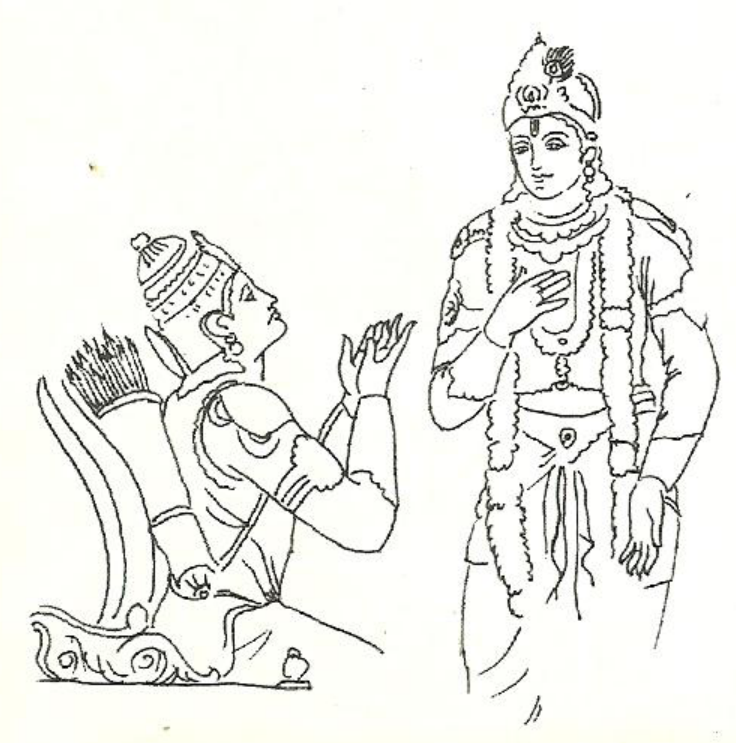
1.47 Sanjaya said: Arjuna, whose mind was agitated by grief on the battle field, having spoken thus, cast aside his bow along with the arrow and sat down at the rear portion of the chariot.
वसुदेव सुतं देवं कंस चाणूर मर्दनं
देवकी परमानन्दं कृष्णं वन्दे जगद्गुरुम्
Vasudeva Sutam Devam Kamsa Chaanura Mardanam
Devaki Paramaanandam Krishnam Vande Jagadgurum
1.47 I salute you Lord Krishna, Teacher to the World, son of Vasudeva and supreme bliss of Devaki, destroyer of Kamsa and Chanura

Bhagavad Gita
commentary by
Nithyananda
Shastras, stotras, sutras - chapter 1
Why are we here? What is the point of what we do in our lives? Will our actions bring us success or failure? How can we become spiritually mature and integrated individuals?
Thousands of years have passed since Krishna counseled Arjuna on these timeless issues on the battlefields of ancient India. Nithyananda brings to life His very words, with great inspiration and practical guidance to transform our lives as Krishna did for Arjuna.
In this book for the modern mind, Nithyananda expresses the truths of the first chapter of the great Bhagavad Gita, traditionally called 'Arjuna's Dilemma'. He teaches seekers that simple awareness of the truth can lead to the ultimate transformation needed for real success in life.
Ebook ISBN: 979-8-88572-039-7 PUBLISHED BY LIFE BLISS FOUNDATION