You And Me
This text was machine-transcribed from the printed book and may contain errors. Select the words and choose “Report a mistake”.
This chapter is traditionally called Daiva Asura Sampad Vibhāga Yoga, or the yoga of divine and demonic nature. Here Krishna explains the concept of saṁskāras (engraved memories) from an even deeper level.
In the 14th chapter, He spoke about Guṇatraya Vibhāga Yoga, satva, rajas and tamas, the three attributes of nature in which all living beings exist. These are the states of goodness, aggression and ignorance. He also explains the three layers of the body-mind system: prāṇa śarīra, manaḥ śarīra and sūkṣma śarīra, which are the physical, mental and subtle bodies, respectively.
In the 15th chapter, Krishna speaks extensively about another body-mind layer, the causal body. That chapter is called the Puruṣottama Yoga or the yoga of the perfected being.
In chapter 15, verse one, Krishna points out how the body-mind system is centered. It is like a unique tree, with its roots in the physical world, and the branches in the causal world. He says:
The roots of this tree are hanging out in the open, in a known space, the conscious space. They also extend back into the unknown space, the causal layer. They go down as if they too are branches. The tree grows both upwards and downwards with many parts of it once again going into the unknown space.
Krishna explains that the leaves of this tree are the Vedas, knowledge. The words we use continuously in our being are in the unconscious space. This space is the causal layer of the body-mind system. He then teaches us how to remove the engraved memories in the causal layer, and how to program the causal layer towards bliss, towards eternal consciousness. This summarizes the teaching of the last chapter.
Here, in the 16th chapter, He moves into the deeper energy layers of the body-mind system and takes us to the cosmic layer. Let me explain first about the energy layers of the body-mind system as traditionally described by the Taittreya Upanishad.
The Taittreya Upanishad traces the flow of energy in the universe from its source down to its end uses. This Upaniṣad says that the primal energy is first expressed as the energy of ākāśa, or ether. The source of the energy is the cosmos, the universe, the Supreme, God, Parāśakti, individual Self, Ātman or whatever name you want to give this source.
Etheric energy is the first layer of this cosmic energy as it spreads out to the manifested world. It is the energy of space, the energy of ether. Do not think that space is empty. It is empty of matter, as we know. However, it is full of energy. As we know from Quantum Physics, matter is energy, and energy is matter. They can exist simultaneously both in time and space. Etheric energy is the largest available energy source in the universe.
If you were to place our solar system in a map of the universe, planet earth would almost disappear from sight even within the solar system! When you view our sun compared to a medium sized solar system in our galaxy, it would also disappear. That medium sized galaxy in turn would disappear when it is viewed in comparison to Antares, a star much larger but not even in the top ten rating according to size.
This gives a visual idea of the vastness of the universe. Our planet is insignificant. When I say insignificant, I mean totally invisible and insignificant, even within a small corner of the universe. The vastness of the space our universe occupies cannot even be imagined. In comparison, planet earth is smaller than a microbe.
The energy that pervades this space, this universe, this cosmos, is the energy of ākāśa - ether.
Krishna speaks about the qualities of the divine and the demonic. The beauty is that both these words have the same root. Of course, it is not accidental; both qualities are rooted in the same energy. It is just a simple decision. When you choose the word 'you', you become divine, and when you choose the word 'me', you become a demon. That's all.
Sri Ramakrishna Paramahamsa, enlightened master of ancient India speaks beautifully of the same energy. No energy can be destroyed; your love can never be destroyed. It can only be converted. He says that as long as the calf says, 'ahaḿ, ahaḿ' ('me, me') it must work, suffer, get beaten and tortured. Once it is killed, musical instruments are made out of its skin; then when we beat the instrument, it says, 'tumi, 'Tumi' or 'tum' ('you, you'). As long as it says, 'ahaḿ, ahaḿ' it suffers, when it says, 'tuḿ, tuḿ,' it starts being used for wonderful purposes like singing the glory of the divine!
This is a beautiful metaphor from colloquial Bengali (the language of West Bengal). Ramakrishna explains that as long as we have the idea 'ahaḿ, ahaḿ' or 'ami, ami,' (me, me), we will continuously be a demon to ourselves and to others. The moment the cognitive shift happens in us, that is when the 'tumi, tumi' ('you, you') happens, we will be a blessing for ourselves and for others.
All the engraved memories, the saḿskāras, are stored in the causal layer. They operate without our control. Decisions are made without our knowledge. However, at the deeper level, in the cosmic layer, we decide consciously: you or me, divine or demon.
A small diagram shows how we make decisions, how our mind usually receives data and processes it, as well as how the cognitive shift happens in our being.
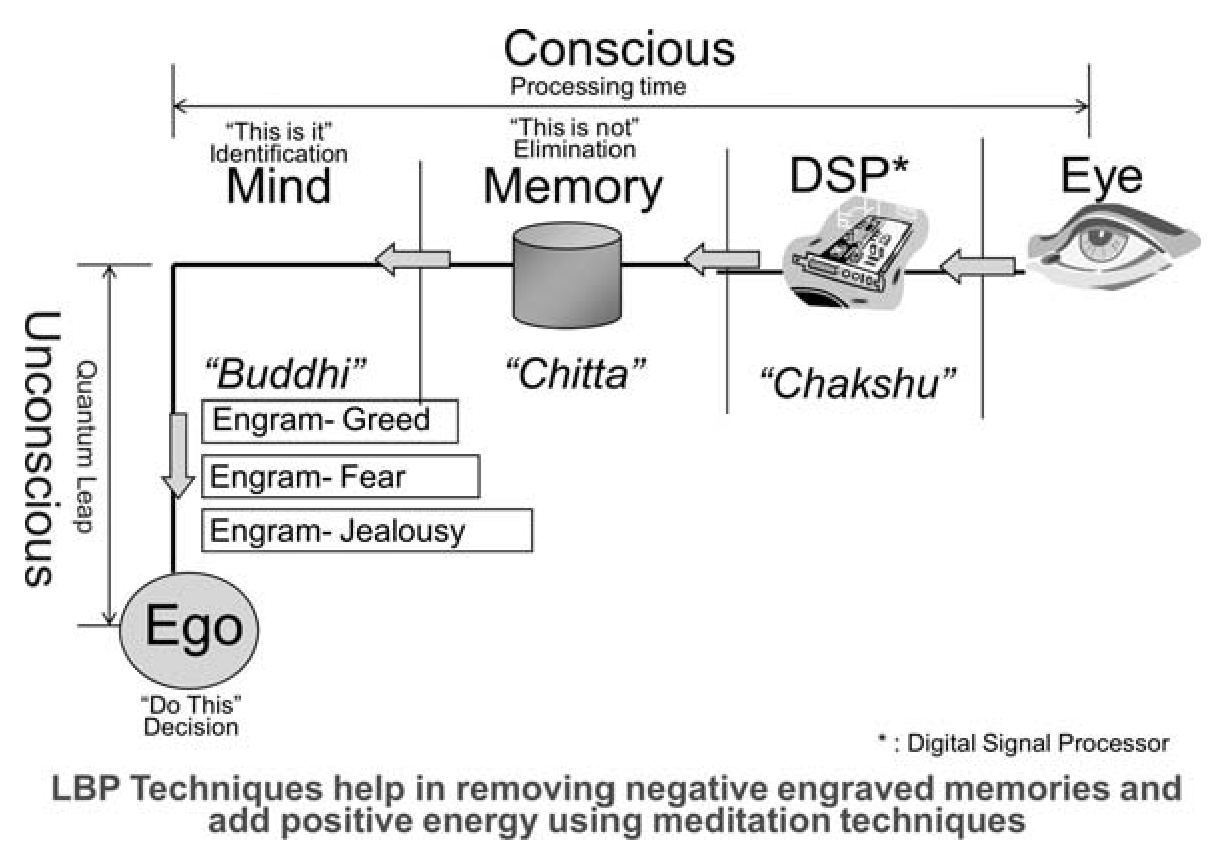
This is what Krishna explains at a deeper level.
You receive information through your eyes. For example, you are watching me delivering a discourse. The file goes to cakṣu (energy of sight), where it is converted into a digital or bio-signal file, so that it may be processed. The energy behind the eye operates much like a digital signal processor, converting the visual scene into information bytes, into a digital file.
The file then goes to citta (memory), where the excluding process of 'neti, neti,' ('this is not, this is not') happens. There you understand that what you are seeing is not a tree, it is not a plant and it is not an animal. The citta part of the mind acts like a filter. It compares what it receives with what it has in stock, and filters out the possibilities of what it sees.
Then the file goes to manas, another part of the mind that starts to identify, 'This is it, this is it.' For example, it concludes, 'This is a man. He is wearing a saffron robe. He is taking a class.' The idea comes in this fashion.
Then the file goes to buddhi - intellect. This compares the file with your past experiences with similar situations or similar people. For example, the file now carries me as data because you are seeing me. So if the past experience with me has been positive, or whatever you have heard about me is good, then you are happy and buddhi writes, 'Yes.' On the other hand, if you feel it is a waste of time, or if you are not in tune with my ideas, or the time that you spent with me earlier was unpleasant, the buddhi writes, 'No.'
The file with all these notes, these additional pieces of information, then goes to the ego. The ego decides based on relevance, 'What is in it for me? In what way am I related to this scene? What will I gain from this?' If it will gain something, the ego says, 'Yes, let me sit here and listen.' If there is no gain, if the ego is not going to be enriched, the ego naturally says, 'No, I think I will move out from here.' Thus, according to the ego's instruction, we decide. Our body either moves or sits.
This is how the process happens. The ego is the point where we choose, 'What is in it for me?' Our vested interests come into play at this point. Please understand that sometimes the whole process will say, 'Yes, I will stay,' yet at this point, the ego may decide, 'My vested interest is being impinged upon.' If this happens, we will not stay! The rest of the mind may accept what we are saying, but if the ego is not ready, the whole decision will be changed.
Similarly, if the rest of the mind says, 'No,' and yet this part, the ego says, 'Yes,' we will decide, 'Yes.' Sometimes, when you are about to do something that is immoral according to the social standard or according to your understanding, the final conclusion is 'No.' But suddenly your ego feels, 'I will be enriched by doing this activity, let me do it.' So you decide to do it. This is the place where you decide, 'You or me!' that is to say, Me or yourself.
That's the only small difference. When we make the decision of 'You,' we radiate divine qualities. When we make the decision of 'me,' we radiate demonic qualities. Actually, most people sit here because it strengthens their egos. At the end of this discourse, they know much more than others! They can tell others what they know. Many times, we sit and listen for the ego's satisfaction. So if we sit and listen for this purpose, even if we listen to the Gita, be very clear it will just create trouble for our being. We will not be helped in any way.
The decision about 'You' or 'me' is made in the cosmic layer. If we decide with the attitude of 'you,' the whole thing becomes divine; if we decide with the attitude of 'me,' the whole thing becomes demonic. The mind is neither negative nor positive; citta is neither negative nor positive. None of these, including the guṇa (attributes) are negative or positive. Even tamasic qualities, such as laziness, are neither negative nor positive. Many enlightened masters seem passive, not doing anything at all. We cannot differentiate between their attitude and laziness. For instance, Bhagavan Ramana Maharshi sat throughout his life in one little town, Tiruvannamalai. He never moved out of there. He was mostly in silence. Yet we cannot say he was in tamas since he never made any decision out of 'me.' The whole process was happening with 'you' as a center, not 'me.'
We cannot call the citta, the mind or saṃskāra good or bad. In the superficial layers, they are neither. However, the decisions we make in the cosmic layer, in the deeper layer, determine whether they are good or bad. The energy behind passion and compassion is really one and the same. When we decide based on 'me', it is passion; when we decide based on 'You', it is compassion.
We need to understand one important thing. If we feel passion strongly in our being, but our compassion has only a little intensity, then our compassion is just a pseudo-expression, perhaps for the sake of name and fame, not for anything else. If we don't have compassion as intensely as our passion, all our activities are based on ego. Even this Gita discourse can become food for the ego, if the decision is taken out of 'I' and 'me'. When the decision happens out of 'You,' even ordinary daily activities can become divine, not just Gita discourses.
We need not work on the 'doing'; we need to work on the 'being'. Doing can never lead us to anything. As long as we believe that doing can lead us to the
Ultimate, we have karma. This is called pūrva mimāmsi (those who interpret the vedic rituals literally). Only when we understand that only being can lead us to the Ultimate, we are called uttara mimāmsi (those who interpret the vedic scriptures according to vedānta-based non-duality).
According to the Vedas, there are two major types of people: People who believe in doing and people who believe in being. People who believe in transforming the ‘Being’ are vedantins, people who believe that the transformation to the Ultimate can be achieved by ‘doing’ are karmakandis. Of course, the Ultimate can be achieved only by working on the being, not by working on the doing. If we work on the doing, we either suppress or express. We continuously fight with ourselves; nothing else is achieved. Only a man who transforms his being can achieve the Ultimate.
Whether to be a demon or divine, we decide at that one point. When we receive the data, process it and deliver the result or command, how is the command delivered? What is the center from which the command comes out? If the command comes out with the thinking, ‘What is there for me, what is there for me?’ then whatever we do, including meditation, will be only ego satisfying.
Many people ask, ‘Swamiji, at some point, I felt such deep ecstasy in meditation, such beautiful bliss. But suddenly, within two hours it disappeared, it never came back! Why is this so? How can we get it back?’
Please understand that bliss is choicelessness. When we are absent, when our identity disappears, we experience bliss. The moment we want the bliss back, the moment we covet bliss, we have already chosen. We have made the choice! The moment we choose, we will always choose suffering. All choices are suffering, because choice is based on the mind. It is based on duality. Bliss is choicelessness. It is beyond duality, therefore there is nothing to choose ‘between’. Bliss occurs beyond the level of mind and choice. But the moment we want to grab or have bliss, we suffer because we have dropped to the level of the mind, comparison and duality. Bliss can never be experienced this way.
When we are blissful, we allow bliss to possess us. The moment we want to possess bliss, we turn it into suffering. When we want to possess in order to strengthen our ego, the decision is from the attitude of ‘me’. The moment the attitude of ‘me’ or ‘mine’ appears and decides, it destroys the bliss. We can no longer be divine. When we are blissful, we have said, ‘No’ to ‘me’; we are relaxed in the ‘You’ idea. The moment we want to possess bliss, we have said, ‘Yes’ to ‘me’.
We need to understand 'You' and 'me' properly. The word 'me' means ego; the word 'You' means the whole of Existence. When our identity evaporates, when our ego dissolves, whatever is left is Existence; it is divine. We create the demon by bringing in the idea of 'me'. The moment we bring in the idea of 'me,' whatever is there, is demonic. The moment the 'me' idea is removed, whatever there is, is divine.
With the 'me' idea, whatever we do, be it meditation, rituals, learning, or knowledge, it will only strengthen the ego. Anything done with the idea of 'me', whatever is done to strengthen the idea of 'me', naturally leads to more ignorance and suffering. Anything done with the attitude of 'You,' whatever it is, naturally becomes divine and leads to bliss.
In Sanskrit, we have two words: nivritti and pravritti. Nivritti - looking inwards or liberation - is centered on the idea of 'You'. Pravritti - looking outwards or bondage - is centered on the idea of 'me'. Whatever is done out of 'me', leads to liberation; whatever we do out of the idea of 'You', leads to bondage.
Ashtavakra says this beautifully in his dialogue with King Janaka:
yadā nāhaṁ tadā mokṣo yadāhaṁ bandhanaṁ tadā ।
matveti helayā kiñcinmā gṛhāṇa vimuñca mā ॥
Where there is no 'me', there is liberation. Where there is 'me', there is bondage. Considering this carefully, neither hold on to anything nor reject anything.
As long as we are centered in ourselves, we are in the bondage of attraction and aversion, greed and fear. Most people are centered in their mūlādhāra cakra, which is the energy center in our body associated with the emotion of greed, or in the svādiṣṭhāna cakra, which is the energy center in our body associated with fears and insecurity.
The mūlādhāra is all about 'me' - our possessions: 'What is in it for me? Where do I go from here?' The svādiṣṭhāna is about 'I', our identity, insecurity and fear arising from our need to protect the body-mind system. Both these bind us, block us, and keep us firmly locked in the material world.
As our higher centers of energy get energized and unblocked, and our energy rises from the mūlādhāra and svādiṣṭhāna, to anāhata (heart center) and beyond, we look beyond ourselves. The 'me' starts dropping. When the ājñā cakra (energy center between the eyebrows) becomes energized, the ego, the identity, the 'I' and 'me', disappear and the 'you' takes over. The demon becomes the Divine.
When we shed our ego, we become boundary-less. We are no longer limited by selfish thoughts about ‘me’ and ‘mine’, our kith and kin. The whole world is ours to care for. Krishna refers to this as vasudaiva kuṭumbakaṁ, ‘the whole world is one family’. As long as we feel that our body-mind is our boundary, that we are separate from the rest of the universe, we will continuously fight with Existence. We will continuously fight with nature, and we will be continuously fighting with the Whole. Please understand that the part can never succeed when it fights with the Whole.
Whatever we think, speak or do based upon the idea ‘me’, leads to more and more complications, more and more suffering.
Here, Krishna beautifully explains the demonic and divine natures.
As in chapter 15, in this chapter also, Krishna speaks. In earlier chapters, Arjuna spoke. Arjuna was expressing his ego, and a catharsis was happening. He was mad, confused, and vomiting, quoting everything he had learned. Slowly he came to the next level, allowing Krishna to speak, and the conversation began happening. Now in the 15ᵗʰ and 16ᵗʰ chapters, Arjuna is practically silent; he is listening. No questions, only doubts. All the questions have disappeared and only small doubts are left. He is asking for clarifications and more understanding from his master.
Q: Swamiji, would it be correct to say that even a demon such as Ravana in the epic Ramayana cared for his own kind and family and in that sense, had a measure of ‘You’ in him? Does that make him less of a demon?
When someone like Ravana or Duryodhana cares for someone or expresses love and positive emotions, their emotions and behavior also emanate from ego. Their identity, the ‘I’ and the possessiveness, the ‘mine’, drives them to such behavior.
Duryodhana was probably the most selfish person in the Mahabharata cast. All that mattered to him was name, fame and possessions. He would stoop to any level and commit any crime in order to fulfill his ambitions. Yet, his relationship with Karna seemed out of character. He gave Karna a part of his kingdom and made him a prince!
Duryodhana’s act was not born out of selfless or unconditional love. He recognized Karna as a warrior who could beat Arjuna, his arch enemy, and so wanted Karna on his side at any cost. Duryodhana’s relationship with Karna was primarily born out of a selfish motive.
It is the same with many others who seem to show a sense of care and love amidst a general trend of selfishness.
The truth is that, until they are enlightened, all human beings carry a mix of divine and demonic qualities. Everyone is a mixture of the attitudes of 'You' and 'me'. The 'You' arises more as you move towards satvic (goodness) tendencies, and the 'me' is predominant in the rajasic (aggressive) and tamasic (lethargic) tendencies. Just as a person has a mixture of these three attributes, each person is also a mixture of 'You' and 'me'.
The issue is how do we progress from the 'me' to the 'You', from the demon to the Divine. This is the purpose of life, if at all there is one. This is the core issue. As we shed our boundaries and grow, this transformation occurs. The growth is not external. It is purely an internal process. The experience is within. The expression is without.
We also need to understand where the 'I' and 'mine' come from. We think that the feeling of possession, the 'mine', comes from the identity of 'me'; it is the other way around. We are born with desires. They form the base of our primal energy. These desires drive us to acquire. These desires may be material, physical or psychological.
Even the infant needs nurture and care. It operates from its primal desire to live and survive. Its cries and other actions are meant to fulfill this desire. As the infant grows, its desires diversify. It needs varieties of food, clothing, shelter, entertainment, education and so on. As one desire gets fulfilled, another rises. But no desire gets really fulfilled.
The desires and fulfillment of these desires create the 'mine' - the possessions. Our basic desires come from the prārabdha karma, the carried-over mindset from our previous body. This is also called vāsanā. Our carried-over mindset from the previous birth decides how and where and as what we are born in this life. Vāsanās are the collective and cumulative mindset of our body-mind system from our previous birth. These are based upon how we lived that life. These are the unfulfilled desires with which we left the body in our previous life. Those desires do not go away. They follow us.
Not only do they follow us, but they also determine who we are in the next birth. Those unfulfilled desires constitute the 'mine'. These desires rise from the mūlādhāra cakra.
These desires and possessions determine our identity, the 'I'. Please understand, it is not the identity that gives rise to our desires and possessions and the establishment of 'mine'. It is the desires and the possessions, the 'mine', which develops the identity. You think of yourself, who you are, based on what you have around you. The labels that you give yourself at any phase of your life are based on what you have acquired or what has been thrust upon you.
This identity, the 'I' or 'me', resides in your svādiṣṭhāna cakra. This identity is your expression. The desires are your experience.
A Ravana, Duryodhana or a Hitler does not assume that identity of a demon by accident. No! They are born with that mindset based on the kind of life they led in previous lives. They had the tendency to become what they became. They came into this life with the mindset and the desires, and were born into environments that gave them the opportunity to become what they eventually became.
But this is not predestination. This is not irreversible. The desire to be powerful or wealthy does not imply that one must lead a demonic life. It is a choice that individuals make.
I have told you, time and time again, that there is no such thing as destiny or fate as far as all of you are concerned. These are mere escapist ideas. It is like people who claim that they have surrendered to me and yet they do not listen to me. Fate and destiny are useful pegs to hang our mistakes on, so that we can remain blameless. We say, 'What can I do? It is all destiny; it's God's will.'
Of course, it is God's will. This whole universe is God's will and so are we. However, God has willed that we use our free will. That is why He has given us consciousness, so that we are aware of what we do. If we truly believed in God's will, we would do our very best and leave the result to Him.
This is what Krishna said earlier,
karmaṇyevādhikāraste mā phaleṣu kadācana
Do what you have to do without bothering about the results.
When we move into the space of 'You', we move into the attitude Krishna speaks about. When we are no longer worried about ourselves and we think of everyone else's needs as our own, results lose meaning. There is no selfish pressure. There is no identity that directs us towards success instead of failure, based upon how we imagine success looks. Success and failure lose their meaning. They become the same.
Whether we act demonic or divine, the inner space in all of us is divine. The inner space is pure; it is uncontaminated. Whether we are tuned inwards towards that purity or tuned outwards toward gratification is the choice we make through our free will. A Ravana had the choice of being a Rama, and a Duryodhana had the choice of being an Arjuna. Through their own free will, they did not exercise that choice.