The Way Our Mind Functions
This text was machine-transcribed from the printed book and may contain errors. Select the words and choose “Report a mistake”.
15.15 I am seated in everyone's heart and from Me came memory, knowledge and their loss. I am known by the Vedas; indeed, I am the creator of vedānta and I am the knower of the Vedas.
15.16 There are two things, the perishable and the imperishable, in this world. There are the living beings who are perishable while there is the unchangeable, the imperishable.
Krishna says that He is memory and He is knowledge. What does this mean?
How does our mind work? How does it invent beliefs? We don't even know where our mind is. If I ask you where your mind is, you will point to your head. That's not your mind.
Every cell in our body has inbuilt intelligence. These cells constantly regenerate themselves. Therefore, our intelligence is always fresh, updated. It is not ancient. These cells make up our body-mind system. They are everywhere in our body. Therefore, there is no one place where our mind is definitely located; certainly it is not in our head!
How does this mind work? How does this collective intelligence of the cellular system of our body-mind complex function? Science has no clue even today. Science has no idea how senses perceive what they do. Scientists, neurologists, psychologists and others in the field can explain the physical pathways through which they think thoughts travel and say that this is the route our thought process takes. They have no proof.
The sages of ancient India described the process. They described it not in physical terms but in conceptual terms. Their description enables us to understand how the mind functions.
Let me show a diagram to illustrate how information that enters the eye is processed; actually, not just information entering through the eye, but information entering through any of the five senses, i.e., through the nose, ears, tongue, skin and eyes. As an example, we are using the eye.
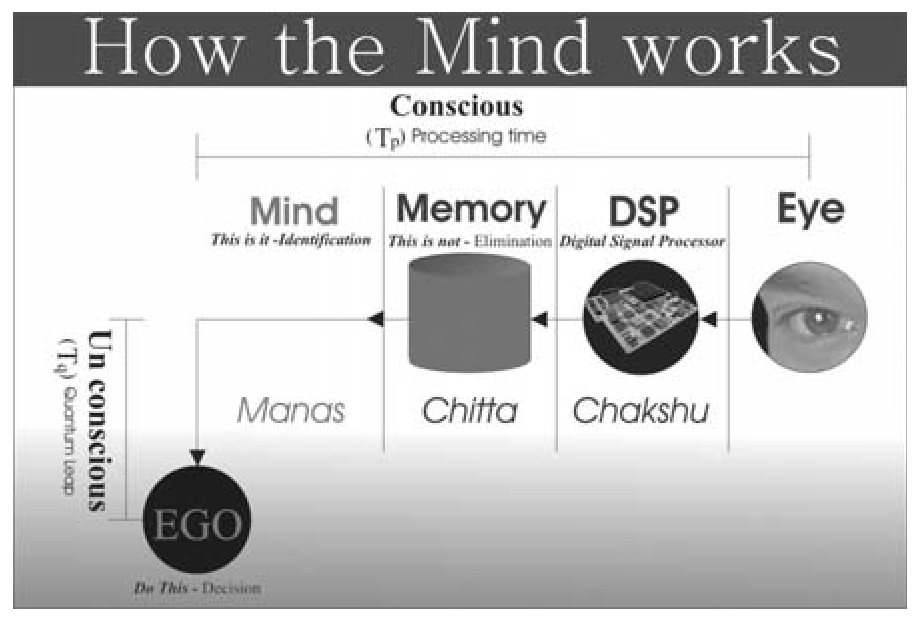
Let us take the process of seeing, which is almost eighty percent of our total sensory perception. Your eyes see me now. In Sanskrit, we call this seeing power cakṣu. It is the energy behind the physical eyes; however, it is not a physical organ. Cakṣu is a virtual digital signal processor. Its output goes into our memory, called chitta in Sanskrit, as a bio-signal file. Memory starts analyzing the facts of the case. It compares the input it has received against its database.
Chitta acts as a filter. It excludes first. It responds based upon comparison and elimination, ‘What I see is not an animal, it is not a rock.’ ‘Na iti, na iti,’ ‘not this, not this,’ it says. The partly processed, filtered file then goes to manas, our mind. Manas makes a positive identification of what is seen, again by referring the file to its huge database. The mind then says, ‘What you see is a human being talking to you.’
A computer is still not capable of performing this process of recognition of an object. The capacity required, even with today’s huge computing powers and parallel computing networks, would be so massive and complicated that no real operating system exists that can duplicate even this one process of our body-mind system.
The object identified by the mind, manas, then takes a quantum leap to our ego as a file. This ego is similar to what Sigmund Freud and others described as the identity of the individual, where all experiential data is stored. However, it may not be the same definition that I use here that you will find in western psychology.
Our ego associates the file with similar memories from the past and decides what to do in the given situation. If we have had a good experience listening to the person we see, we stay and listen. If the data shows that our experience with such a person or someone similar has been negative, we leave.
The ego decides for us whether to listen to this person or not. We express that decision and act upon that decision. This zone of the ego is not under the control of our conscious, logical and rational mind. The ego continuously stores impressions, past memories, unfulfilled desires and various emotive reactions, whether we are conscious of these experiences or not. The ego never sleeps.
The unconscious zone is filled with negative memories and restlessness. All our past memories, which we call saṁskāras in Sanskrit, all our past thought patterns are stored in this zone as files. Psychology uses the word engrams or engraved memories to denote these stored memories. There are many files stored in this zone. Without any logical connection between them, these memories or incidents are stored here, in random order. And because of so many engrams we are restless.
What happens is that when the file takes a quantum leap to this zone where so much data is stored, the file does not even reach the ego properly for a decision. It is as if our hard disk is loaded with high-resolution photographs and there is only a little space left. There is no space available to work further on our hard disk. The computer stalls; it stops. In the same way, when our unconscious is loaded with past thought patterns and memories, it becomes inefficient and makes superficial and illogical decisions.
For example, according to data that we have collected, we know smoking is injurious to health; it is not good for our body. We hold onto this decision as long as we are on the conscious level. However once the mind takes the leap to the ego, the engrams just instruct us to smoke; we decide to smoke. The conscious process says, ‘No, it is not good for health.’ However, the unconscious process says, actually it doesn’t even say, it just makes the decision and we execute it. It is a pure instinct-level decision.
This unconscious area is powerful. It can be used in three ways: at the instinct level, intellect level or intuition level. As long as the unconscious is overloaded with negative memories and restlessness, it works at the instinct level. We decide instinctively, unconsciously, just like an animal does. We make hasty decisions. When we are at the instinct level, we end up regretting most decisions.
Next is the intellect level. Here, we are conscious; we make decisions logically, but we don’t have extra enthusiasm or energy. We are not creative or innovative; we don't take big steps; we don't grow. We make decisions in a logical and conscious way, that's all.
When we are at the intellect level, we are not tired; yet we are not energetic either. We are in a break-even state. At this level, we do not use our potential to the maximum.
The level where we can actualize our entire potential is the intuition level. If we can infuse deep silence and awareness into the unconscious zone and replace engraved memories or files with silence and awareness, we are at the intuition level.
A small story:
A woodcutter was busy chopping trees at the edge of a forest. An enlightened master walked by and the woodcutter offered him what food he had. Pleased, the master blessed him and said, 'Go deep.'
The woodcutter advanced deeper into the forest the next day. He found a silver mine with rich deposits. Happily, he dug out chunks of silver, sold them and became rich.
Months later, the master passed by again. The woodcutter entertained him well. He was grateful for the master's advice that made him prosperous. The master left, once again saying, 'Go deep.'
The woodcutter progressed deeper into the forest and found a gold mine. By recovering deposits from this mine, he became very wealthy. He felt deep gratitude to the master and wished to see him to pay his tribute.
After many months, the master passed by again. The woodcutter told him all that had happened and wanted to share his wealth with the master. The master simply smiled and refused and as he left said, 'Go deep.'
Believing implicitly in the master, the woodcutter went on deeper into the forest and discovered a diamond mine. He became richer than the king of his country. He eagerly awaited the master's next visit to share the good news.
The master passed by again. Again he left saying, 'Go deep.'
This time around, the woodcutter became thoughtful. He reflected, 'There must be more to what this master says. There must be more than what I am able to understand. It is not the forest that he is asking me to go deeper into, perhaps it is into myself.' This time, with great awareness and the trust that he had developed in the master, the woodcutter focused within and became enlightened.
The greatest wealth lies within, not outside. The greatest joy lies within, not outside. In the outside world, every experience of joy is followed by sorrow. Joy creates expectations and when expectations are not fulfilled, they lead to sorrow. When the search begins inside, expectations drop, attachments drop and a new joy happens. That joy is eternal, never ending. It is ānanda, nityānanda, eternal bliss.
Because we are unaware of this, we search outside for happiness, because that is the only way we know.
A small story:
One boy used to always sleep during the guest lectures in college. One day his friend asked him, ‘Why do you come to the guest lectures? Anyway you only sleep here.’
The boy replied, ‘I suffer from insomnia and this is the only place where I am able to sleep.’
Understand, like this boy who went to the guest lecture to sleep, we too go to so many places outside of us in search of happiness. We search for the right thing but in the wrong places. We have been conditioned that way. All we need to do is turn inward.
In his commentary on the Gita, Shankara says that memory and knowledge come from Krishna to those who do good deeds and loss of memory and knowledge to those who do evil deeds. The reference to memory and knowledge here is to the understanding of our true nature, the understanding and realization that we are one with the Divine, that Krishna is seated in our hearts.
Shankara concludes in his Bhaja Govindam:
‘The true devotee who surrenders himself completely to his master sees divinity in his own heart.’
That is all that is required. Surrender to the master, surrender to Krishna. We shall then see Him.
Krishna takes Arjuna into a deeper understanding. Krishna talks about puruṣa, the principle of energy that underlies our existence. Sāṅkhya philosophy talks about puruṣa and prakṛti. Puruṣa, in one sense is energy, and prakṛti is matter. Puruṣa is the unmoving, passive energy principle, whereas prakṛti is the active material principle. Puruṣa is the male principle; prakṛti is the female principle. Puruṣa is Shiva and prakṛti is Shakti.
Krishna goes beyond that philosophy. He says Puruṣa is twofold, one imperishable and the other perishable. He says all living beings are the perishable puruṣa and they are situated in the imperishable energy.
In earlier chapters, Krishna has covered in depth, these aspects of prakṛti, which operate through the mind, senses and the attributes, the three types of guṇa. Here, He expands upon puruṣa. Puruṣa is the ultimate energy from which all emanates. ‘īśā vāsyaṁ idaṁ sarvaṁ’ says the Isavasya Upanishad, ‘All that exists is energy.’
The great scientist, Einstein became depressed when the findings from his theory of relativity and his discovery that matter can release energy resulted in nuclear bombs. He was shocked at the destruction he had unwittingly caused and turned to spirituality for solace.
When Einstein read this verse from the Upaniṣads, written possibly five to ten thousand years ago, he said, ‘I felt proud that I had discovered that matter is energy. Many thousand years ago, these sages knew this, and also knew that matter arises from energy. The last step in science is the first step in spirituality.’
More and more, scientists are beginning to sound like the Eastern mystics. They no longer have the attitude of scientists of a hundred years ago who felt that they were rewriting the laws of Nature.
Now, with advancements in quantum physics, molecular biology and such areas, scientists find that there is little they can predict about Nature. The same experiment conducted in an identical manner by two scientists yields two different results. The people observing the experiment influence the results. Our scriptures said this over a thousand years ago. Shankara has said again and again that the seer influences what is seen. That was over a thousand years ago.
The primal energy principle, puruṣa is like potential energy. It is energy, but passive. It is the operating principle behind the entire universe. Without this energy, nothing will exist. Nothing will live.
Krishna says that there are two kinds of puruṣa: one is eternal and one perishes.
The puruṣa that perishes is the body-mind energy embedded in all beings, including humans. This energy has a definite, limited lifetime. It is always changing. There is nothing permanent about it. It is programmed for deterioration and destruction.
The puruṣa that is kūtastha is the imperishable aspect of this energy. It is the energy of the spirit that is indestructible. It is the soul that is forever, that which cannot be destroyed.
Krishna points out that primal energy manifests in different ways, as perishable and imperishable. Both are aspects of primal energy. One is destroyed and the other lives. One who realizes this difference and understands the true nature of puruṣa is liberated.
Ramakrishna Paramahamsa says:
An arrogant scholar was very proud of his learning. He was a great advaitic (subject of non-duality) scholar and did not believe in the various forms of God. God came to him one day.
The mother goddess appeared before him in all Her splendor. She came as the primal energy, Parāśakti. The scholar was in a swoon for a long time. When he woke up, he shouted, 'Ka, Ka, Ka.' He could not fully pronounce 'Kali,' the name of the goddess whom he had seen. Words cannot describe the Divine!
Scholars argue endlessly about the nature of puruṣa, the various aspects of puruṣa, the difference between prakṛti and puruṣa. It keeps them occupied. It strengthens their ego. When the Divine presents itself before them, they cannot recognize what they see. Even Mother Kali has to produce her identity card before she can convince a scholar.
Q: Swamiji, you have explained so well about how the mind works. How can we use this in our daily activities?
Our mind functions in three modes. It can operate unconsciously at the level of the instinct. It can work consciously at the level of the intellect. It can work superconsciously at the level of intuition.
Our mind works at the instinct level when it is filled with saṁskāras, embedded memories carrying mostly negative emotions. These saṁskāras are buried deep in our unconscious, embedded there through repeated conditioning from childhood. At times of stress, trauma or pain, when we need to address issues with a clear mind,
these unconscious memories pop up and decide without our being even aware. The saṁskāras, the engrams, decide what we do, not our rational mind.
In the ten percent of cases where our conscious mind engages in decision making, we are confused by the choices. We dither and we later regret whatever choice we make through our intellect. No choice is ever perfect.
Do we have an option? Yes. When we decide through intuition, we can never be wrong. How can we access this state of intuition?
Intuition is the state when the mind is centered. It is what we call the present moment. Normally we are buried in past memories or speculating about our future. We are rarely in the present moment. Our mind is rarely where our body is. That is what thoughts do to us. Thoughts are the constant movement of the mind between the past and future. When thoughts stop, the mind is stilled.
Meditation makes thoughts stop. It is simple. During meditation one's awareness centers in the present moment, thoughts stop and intuition results. Whatever you decide in such a moment is always the right decision.
It is not even necessary that thoughts stop. It is enough if you stop following your thoughts. Once you learn how to witness thoughts without getting caught in their flow, your battle is won. Once you master this technique, you settle into the present moment awareness whenever you wish. There will never be a situation when you will regret the decision that you make in the present moment.
If every businessman and corporate employee learned to do this, imagine how many billions of dollars could be saved. And it's not just money that would be saved. The environment is being destroyed because people act from greed and fear out of instinct. If we act out of intuition, we can never act against Nature. Intuition is Nature.