Natural Attributes
This text was machine-transcribed from the printed book and may contain errors. Select the words and choose “Report a mistake”.
14.5 Material nature consists of the three modes: goodness, passion and ignorance.
When the living entity comes in contact with nature, it becomes conditioned by these modes.
14.6 O Sinless One, the mode of goodness, satva, being purer than the others, is illuminating, and it frees one from all sinful reactions.
Those situated in that mode develop knowledge, but they become conditioned by the concept of happiness.
14.7 Arjuna, know that the mode of passion, rajas, is characterized by intense craving and is the source of desire and attachment.
Rajas binds the living entity by attachment to work.
14.8 Know, O Arjuna, that the mode of ignorance, tamas, the deluder of the living entity, is born of inertia.
Tamas binds the living entity by carelessness, laziness, and excessive sleep.
Material nature consists of three modes or attributes: goodness, passion and ignorance. These are called guṇas in Sanskrit. This translation is incomplete because there are no relevant English words for satva, rajas and tamas. We do not have the right English word for guṇa either. We cannot aptly translate these words into English. When the eternal living entity comes in contact with nature, He becomes conditioned by these modes.
We may say that these are the different ways people behave; as the phrase goes, it is the good, the bad and the ugly.
Krishna explains how we are caught in three different mental setups. We operate through three different types of engraved memories. One is satva, the other is rajas and the third is tamas. These are translated as goodness, passion and ignorance; however, these are not exact translations.
Let me explain these concepts: Satva refers to the engrams or engraved memories or saṁskāras that lead us to bliss. These engraved memories lead us to joy and ecstasy. Rajas refers to the engraved memories that lead us to restlessness, excitement and to work intensely. They make us active and materially productive. The third attribute, tamas, refers to the engraved memories that lead us to depression, laziness and to dullness. Engraved memories that lead to ecstasy and bliss form satva. Engraved memories that lead to restlessness, anger and emotional imbalance form rajas. Engraved memories that lead to depression, dullness and low moods form tamas.
A small example:
We are like passengers riding in a car. Slowly we become lost in thoughts. After a while, we suddenly recall a person or place that disturbs us. The moment the mind feels disturbed, we come back to awareness. And we might say, ‘I should not think about it; let me think of something else.’ Sometimes we even speak these words aloud or make some gestures trying to ward off the thought.
The driver may look back and wonder, ‘What has happened? What is he doing?’
When we are lost in thoughts and a memory arises that makes us depressed, dull or disturbed, we suddenly come back to awareness. We ask ourselves, ‘What am I thinking?’
Sometimes we say it aloud, ‘I should not think about this. Oh God, what am I doing? I should think of something else.’
Those engraved memories that automatically arise and lead to depression are called tamas.
Sometimes a thought suddenly comes up, ‘I will not let him off so easily. I will see that he learns a lesson. I will not let him go.’ We may unexpectedly make an angry gesture with our hands while engrossed in this thought.
Engrams that make us active or cause anger or violence and imbalance are called rajas. We are normally caught between rajas and tamas. Very rarely do we get satvic engrams. Satvic engrams do not disturb us. They give rise to a memory of deep bliss or joy that we have experienced. For example, if we come here everyday, the moment it is 4:30 pm, an engram like this may come up, 'Oh, yesterday the discourse was wonderful. The meditation was beautiful. I should go today as well.'
However, if it is 4.30 pm, instead of that satvic engram, we typically get the engram to eat a snack or drink a cup of coffee!
If we are pulled inwards, if we are made to do something good that leads to bliss, ecstasy and peace of mind, it is due to engraved memories of satva, satvic memories or satvic engrams. If we go to the Himalayas for a few days, we may experience joy and peace. Then later when we see pictures of a mountain, the memory of the Himalayan experience suddenly comes up and we think, 'Oh, I should spend a couple of months in the Himalayas again. It was so peaceful.' Engrams that lead us to peace, bliss and ecstasy are satvic engrams.
These three different types of engraved memories or saṁskāras rule our entire life. Knowledge of these engraved memories is the basic knowledge that must be possessed by anyone who wants to live successfully. The vedic science of health and wellness, Ayurveda, is structured around the concept of guṇas and their effect on our body-mind system.
It is like an owner's manual for using the mind. Without an owner's manual, when we use a product, either we miss the whole thing, or we miss the knowledge of many of the product's applications and features.
There are so many uses and features of a computer. Even the humble calculator has hundreds of applications that we are unaware of. We may use the calculator for basic features like addition and subtraction; however, we may not take advantage of its other applications. In the same way, if we don't have and don't know the owner's manual for the mind, we do not use it the way we ought to, or to its full potential.
Understanding the three different engraved memories or saṁskāras is the operating manual for the mind. Krishna calls it Guṇatraya Vibhāga yoga. When we don't comprehend this manual, we are not able to catch the whole understanding of life. We miss so many opportunities. Because we have never learned or understood about the guṇas, we live only a very small fraction of what's possible in life. We miss the beauty and potential of life when we don't have the owner's manual.
At the outset, saṁskāras are not dead memories. Here once again we don't have the correct translation of saṁskāras in English.
We can never understand or fully appreciate Shakespeare’s work in another language. If we read the translations of Shakespeare, at the most we will understand what Shakespeare was trying to express. However, we will never understand how he expressed it or the depths that he reached. If we want to enjoy Shakespeare, we must read it in the original language and not in today’s spoken English. In the same way, if we want to understand these great truths, we must know a little Sanskrit.
When I ask people to learn a bit of Sanskrit they think I’m trying to spread the language. I say, ‘No, for spirituality, a little knowledge of Sanskrit helps you understand many technical terms.’
Let me give the exact meaning or the idea expressed by the word saṁskāra.
Saṁskāra is not any dead engraved memory. It is an engraved memory that is alive and active. It has the power to pull us down and make us travel the same path again and again. Usually the word memory is understood as a dead record; however, saṁskāra is not a dead record. It is not a dead memory. It is not like the memory of a computer where pictures and Word documents are stored. No. Saṁskāras have the power to pull us down repeatedly and to make us walk the same path over and over. We end up going in dead-end circles.
Saṁskāras automatically attract us, call us and make us travel the same path. Then, when we do walk down the same path, the engraving becomes even deeper and those memories get further entrenched. Modern science understands this fact. Experiments have shown that repeated emotional experiences create more receptors for that emotion being developed in the brain. Physically, physiologically, the more anger outbursts you have, the more anger receptors your brain develops. This is a horrifying thought but it’s true. The great ṛṣis, the inner scientists have known this for thousands of years.
If certain emotions are not expressed, the corresponding brain parts or receptors degenerate and die. So, the more we manage to stay out of negative emotions, the less they bother us. On the contrary, the more we indulge, the more our brain demands the same indulgence. This is the cause of addictions. Our entire life is ruled by saṁskāras.
Saṁskāras are living memories, not dead memories. The more we travel with these memories, the more we live with these memories, the more they become a part of our being. They take up residence in deeper levels of our consciousness. They get embedded. They get engraved into our brain structure.
Krishna explains step-by-step how we become caught in these three levels of memories and how, again and again, we are pulled and pushed by these memories. It is almost like having three wives. If we have one woman in our life, enlightenment is a luxury. If we have two women, enlightenment is an option. If we have three women in our life, enlightenment is compulsory! With three wives or husbands, one cannot live without enlightenment.
Someone asked me, 'Why did Krishna have so many girlfriends?' I answered, 'This is solid proof that He is enlightened! The fact that He survived despite having so many girlfriends is evidence of enlightenment. No doubt, that is also solid proof that He is God!'
Here, He gives us an understanding of how to live with these engraved memories. Another important point is that becasue these memories are living energies, they can be used for bad deeds or good deeds.
When a person has energies to do bad deeds, we can tap into those energies and make him do good deeds. From my experiences of conducting meditation programs in prisons, no one puts in as much effort and goes into such deep meditation as a prisoner. We conduct meditation programs in prisons. They are so involved and go into meditation more deeply in comparison to people outside. When prisoners take up meditation, they really take it up. They are intense. They don't do anything half-heartedly. When they are transformed, their whole life is transformed!
If we look at the lives of Indian ṛṣis like Valmiki or the great saint Arunagirinathar, they and many others were sinners. However, a dramatic change happened and a cognitive shift took place in their being. The shift usually happens in the way that our mind receives data, processes it and delivers the result. Once the cognitive shift takes place, we receive data, process it and go inside instead of outside. As long as we react externally, we are working towards depression. However, once we go in, we move into bliss.
For example, the death of someone close to us, our near and dear ones, can lead us to the spiritual path or to frustration. We can think, 'Anyway, I am also going to die, so I should do what I want to.' Or we can decide, 'I too will die some day. Let me learn what I can and grow.'
A small story:
A person was about to be hanged. The officer on duty asked him if he had any last wishes. The prisoner said, 'No.' The officer said, 'You can pray to God. You can ask forgiveness and ask for His blessing. We can bring in a priest.'
The prisoner said, 'I want to remember God, but not in the way you suggest. Had I known earlier I would be executed for these crimes, I would have committed a few more sins.'
The prisoner continued, 'If I had known that I was going to be hanged, I would have committed more sins. So if I pray, I will ask God why He didn't let me know earlier that I was going to be hanged. I don't need a priest for that.'
When some people understand that death is the ultimate, they think, 'Death is the ultimate so let me work towards the Divine, achieve God, or realize ātman.' Others react differently, 'Anyway we are going to die. Let us do whatever we want and live the way we want to.' One group takes the path of meditation and the other takes the path of the outer world. The path we choose is up to us.
Engrams are living energies. Through engrams we can choose to either suffer and torture ourselves again and again or make our life a blissful experience. If we know the science of how these engraved memories happen in our being and how they can transform our being, we can take the help of these engraved memories to achieve eternal consciousness, eternal bliss in our being.
Krishna explains how engraved memories disturb our mind and through this understanding, we can transform our being.
Before explaining these verses, let me present a small diagram through which we can understand how engrams affect our decisions and how to come out of the influence of engrams. I have given a basic understanding of this diagram elsewhere, but let me repeat it so that we can connect with saṁskāras.
Please understand how we receive information or data from the outer world, how we process it and how we make decisions. First, we see something through the eyes. I have taken the example of sight but we can replace it with any other sense: like hearing, smelling, tasting or touching. Among these five jñānendriya (senses of perception), any one can be used here.
There are five jñānendriya and five karmendriya (senses of action) that are the means of communication between the external world and us. Jñānendriya are the senses of perception, the five senses of smell, taste, sight, touch and hearing. The karmendriya are five actions of elimination, procreation, locomotion, grasping and speaking. Each sense is related to one of the energy centers (cakras) in our body-mind system. For instance, locomotion is related to the maṇipūraka cakra (energy center located in the stomach region), and the energy of fire.
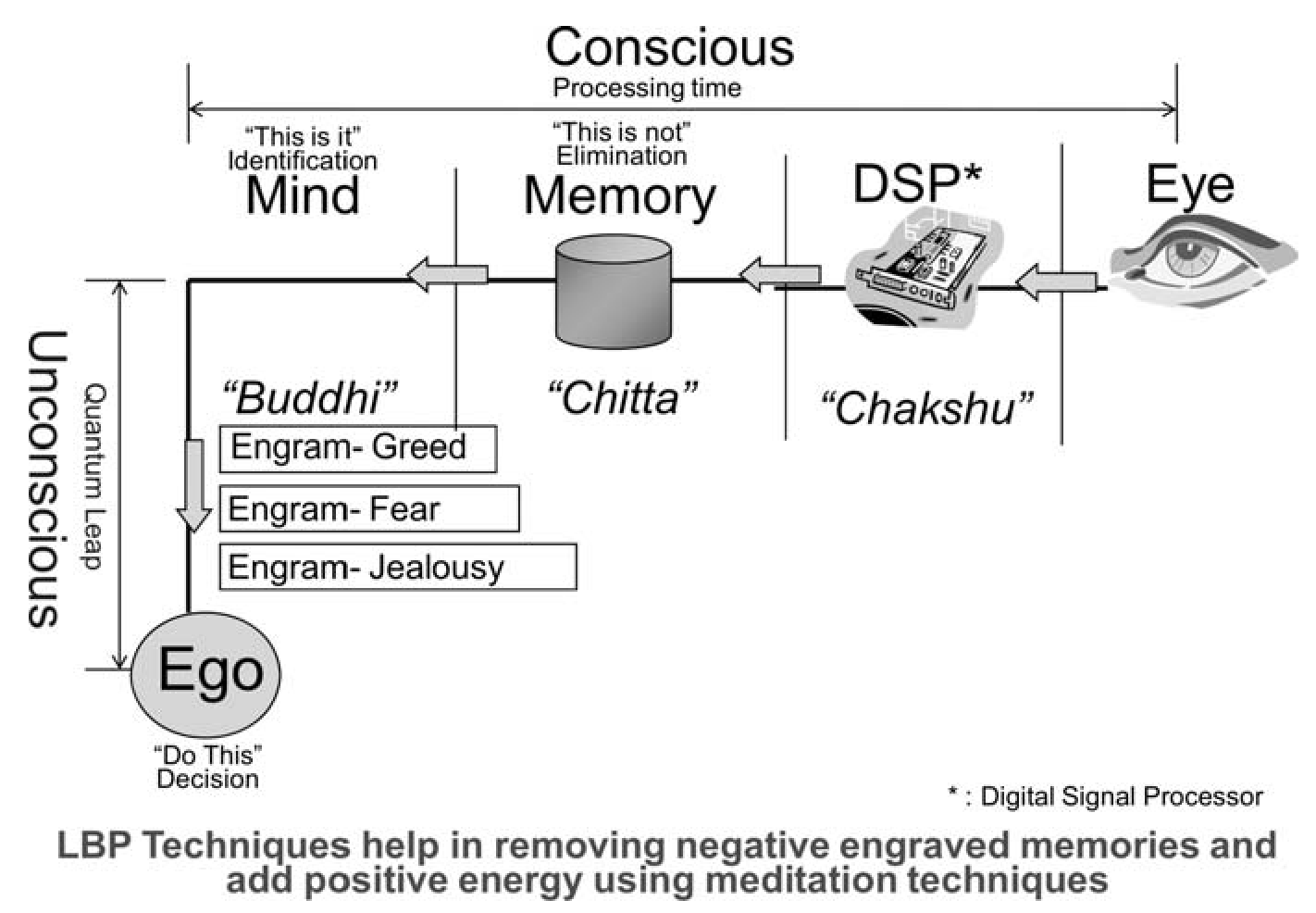
We can take any of the five jñānendriya to replace the eyes in this example. Through the eyes we see a scene. Let us say we see this scene of this discourse happening. You see me talking to you. First your eye captures this whole scene like a picture and this picture goes to the cakṣu (the energy behind the eyes). Understand, we don't see with the eye, we see through the eye. There is an energy that is inside or behind the eye that actually sees. There is an energy inside or behind the ears that hears. The ears by themselves cannot hear. That is why when we are engrossed in a book, we may not hear the alarm or doorbell ring. If we are reading, we may not know if our spouse walks into the room. Of course if it is late at night, all wives know when their husbands sneak into the house, that is a different matter!
A small story:
A man goes to the police station to meet a thief who had burgled his home the previous night and taken all the cash. The officer on duty refuses to allow him to meet the thief saying, 'You cannot talk to him now. You can meet him in court tomorrow.' The man pleads, 'I don't want to disturb him. All I want to know is how he entered my home without waking up my wife. I have been trying to do this for years and have not been able to do it! How did he manage it?'
So there is an energy inside the eyes that sees. We call this energy cakṣu. The whole scene is converted into a file like in a digital signal processor in a computer so that our mind can process the data.
The cakṣu is almost like the digital signal processor or the DSP in electronic systems. If we are to work on sound or light or a photograph, it must be first converted into a digital file. In a computer, whether it is an audio or visual file, it must be converted into a digital file. In the same way in our system, whatever we see or hear is converted into a bio-signal file like a digital file. This conversion happens in this cakṣu area.
Then the file starts moving up, step-by-step. The file goes to the part of the mind called citta (memory). If we understand this, our whole life can be transformed. We will know where and how we react. We will realize how we make big decisions based upon our assumptions, and consequently suffer.
This is what happened in the story where the teacher imagined that alcohol was the liquid leaking from her gift and tasted it without thinking. We can understand how these mistakes happen by analyzing this diagram.
The file goes to citta, the place where past memories are collected. This area is where the work of excluding happens. When the file reaches this place, the excluding process starts - Na iti, Na iti - this is not, this is not. The process of neti neti (this is not, this is not) takes place in this area. Upon seeing this file, our citta starts eliminating whatever the object is not.
Take the example of this scene: First you see me, the whole scene is photographed. It goes to cakṣu and becomes a bio-signal file. The file is then taken to citta. Citta says, 'This is not a tree. This is not an animal. This is not a plant. This is not this. This is not that.' The excluding process happens in citta.
It is like searching for the word ‘cow’ in a dictionary. You first eliminate all other letters to reach ‘c’. Then you search for ‘o’ and eliminate all other letters. Then you reach ‘w’ by eliminating all other letters. In this manner, you reach the word ‘cow’. This is how citta works.
Next, the file goes to manas, another part of the mind. The manas tries to positively identify, ‘This is a human being. He is wearing a saffron robe. He is standing on a stage.’ The identification process, ‘iti, iti’ (this is it, this is it) identification process happens in manas. In citta, ‘neti, neti’ or the ‘not this, not this’ elimination happens.
Once this positive identification happens, the file goes to a third part of the mind called buddhi or intelligence. Buddhi is where the trouble starts. Here the analysis starts, ‘How am I related to this file? How am I connected to this scene? How is it relevant to me? How should I respond to this scene?’
If past memories about me have been good or pleasant according to your intelligence, you respond in a positive way. You immediately refer to those past memories and review, ‘It was so good at yesterday’s discourse.’ Your intelligence refers to the past memory and makes a decision based upon these experiences. If past experiences with me have been positive, your intelligence tells you to stay and listen. If past experiences have been unpleasant and you felt bored, your intelligence tells you that this is not the place for you and that you should leave. These are logical decisions based on conscious memories retained by your mind.
Up to this point, transmission of what is perceived by the senses and what is registered by the mind is relatively straightforward. It is a conscious process. I explained earlier about conscious and unconscious minds. Psychologists talk about a subconscious mind as well. This does not exist. This is a term used to further confuse you.
Mind specialists know that ninety percent of all that we sense goes into an unknown, unconscious zone and we are unaware of what we sense. It is a leap into an abyss. It is a quantum leap into our dark unconscious mind. There is no logic to this leap. This is shocking, but true. As a corollary, ninety percent of what we process mentally happens in an unaware state of the unconscious. The conscious mind is just the tip of the iceberg. Ninety percent is below the surface. We do not see it. We do not sense it and we do not use it.
The good news in this is that we have a great potential in this area. Even if we awaken another ten percent of this unconscious mind, the power of our mind can be doubled. Then just imagine what can happen. Everyone will be an Einstein! We can also learn to put that extra mind capacity to good use.
If the processing of sensory data is stopped at this conscious level, at the intelligence level, we make decisions at the conscious level by using our intellect. This is alright, however, it is limiting because the conscious mind is still only ten percent of the total mind capacity. This is what we call intellect-based decision-making. These decisions are based on logic and rationale. We are proud of this achievement. The French philosopher Descartes said, ‘I think therefore I am.’ He didn’t realize that he limited his potential to only ten percent. What a sad state!
Because of the limited capacity of our conscious mind, nature wires us to use our unconscious mind to decide many things. Unfortunately this unconscious mind is a conditioned mind. It is full of engraved memories, beliefs and value systems drilled into us from childhood. All that parents and elders have taught us plus all that we have been force-fed by religion and society from a deeply impressionable age are stored in this vault that is never open to us. It opens on its own when it chooses to, especially in moments of stress and trauma. Just as viruses and bacteria attack when our immune system is down, the virus of engrams and saṁskāras influence us when our emotional systems are weakened.
Saṁskāras do not accumulate only during this lifetime. The mental attitudes are carried over from previous births. Neural scientists tell us about the part of our brain called the reptilian brain that stores memories of our evolution from marine and amphibian creatures. Religions may not accept this, yet science does.
From the conscious mind, the information is passed to the unconscious region of the mind, the ego.
I call this unconscious region of the mind ego not because it is arrogant, but because it provides you the identity of who you are. The word 'ego' is derived from a Greek word that means 'a mask'. Your identity is a mask that you wear. It is not you.
Your identity stems from your unconscious. You project who you wish to be, never who you are. You do not even know who you are. Who you are is deeply buried in your unconscious. All the major decisions that shape your life are consigned to this unconscious zone. This is the repository of all those emotionally-filled memories and beliefs about yourself, which constitute what you are and therefore, create your identity. This is what I call the ego.
The conscious mind does not make important decisions. It makes a few decisions that can be reached by its limited intellect. Anything important moves to the unconscious ego. Our unconscious handles all life-threatening situations, the so-called fight-or-flight decisions. Our conscious mind is too slow to handle them.
Let us go back to the incident of you watching me here. The problem arises if your conscious mind does not make a direct decision. If you have had past experiences with other persons wearing saffron robes, you will have engrams about that experience. You will not bother to see who this person is. You decide based on that memory that says, 'No, with that master I suffered like this; with some other master, I suffered like that.' It will be a generalized memory. You make a decision based on your past collected saṁskāras.
That is where we create trouble. When decisions are made with a straight understanding, there is no major problem. However, most of the time we collect and react based on engrams that are unrelated to each other.
For example, you see someone wearing a white dress. You may have been hurt in the past by someone wearing a white dress. The moment you see a white dress, the memory comes back even if you don't want it to.
In the same way, if we are abused or disrespected in a house, the memory comes up automatically the next time we visit that house, even if the person who did it is not there. We experience the same feeling, feel depressed and go into a low mood.
We connect and associate things with places, with triggers, with memories, and put them into memory files. We are not able to work spontaneously. We must rely on some technique, some method to reduce our processing work. Naturally, we opt for some kind of arrangement in our memory. Consequently, we miss out on real life.
Only in the first few days of marriage do we respond spontaneously to our spouse. Within the first few months of living with our spouse, we form a clear idea about him or her. After that, we don't really live with him or her. We live with our imagination of him or her. We live with our understanding of him or her. After that, whatever our spouse does is wrong. We come to a predetermined conclusion that the spouse is always wrong. If our spouse does something right, we say that it happened by mistake!
So after a few months, we come to a conclusion about the other persons in our life. We create an engram related to them based on our judgment. After that, we judge whatever he or she does through the filter of the engram, or engraved memory. Sometimes we create engraved memories in our system based on experiences that others have or from media influences.
A small story:
One day, a funeral procession slowly made its way down the road. A man was walking two bulldogs as he moved along ahead of the body of the dead woman. There was a long queue of people following slowly behind him.
An onlooker observed the number of people in the procession and thought, 'She must have been a famous woman.' He approached the man with the bulldogs and asked, 'Who is the dead lady?'
The man replied, ‘She is my mother-in-law.’
The onlooker asked if the two dogs were the dead woman’s pets. The man replied, ‘No. They attacked and killed her.’
‘Killed her?’ the onlooker asked. ‘Yes,’ said the man. The onlooker asked, ‘Can I borrow the dogs for two days?’
The man pointed to the people following him and said, ‘Join the queue.’
When we enter into relationships with preconceived notions, this is what happens! We collect so many memories that we never relate to people as they are. We only relate with the preconceived memory we have of the person.
People ask me, ‘Swamiji, is our life pre-destined or open to free will?’ Understand, the more engrams we have, the more our life is pre-destined. This is because we will go along the same route repeatedly. The fewer engrams we have, the more freedom we enjoy.
The number of saṁskāras determines whether we have free will or if our life is pre-destined. For example, the file travels to the ego, and the ego gives the decision, and we execute it. If there are more engrams, the file travels to every table like in a bureaucratic office. Each engram stamps, puts its signature and writes its opinion.
Take the example of attending this discourse and seeing me. One engram says, ‘I had a master in my life. He was a blessing. He helped me a lot. I think I should sit here.’ So this engram signs, ‘Yes, I will sit here.’ The next engram says, ‘I read in the newspapers that these masters do this or do that.’ There is enough written in the press, especially in South India, where being abusive to masters is fashionable. So, the second engram signs off saying, ‘doubt’. Then the file goes to the next table, and the third engram says, ‘I attended his discourse yesterday. What he says makes sense, I think I should stay.’ This engram signs, ‘yes’.
The file reaches the ego. The ego comes to a conclusion based on all the ‘yes’ responses and all the ‘no’ responses. Yes or no is not a problem; however, we have wasted so much time and energy on this small decision. For example, when we sit in our office, not doing anything, just sitting and worrying, we become stressed. Within fifteen minutes, we have pain in our shoulders. Worrying about simple decision-making leads to shoulder pain. The more engrams, the more restless and rajasic we will be.
People with many engrams never relax. People with stress cannot sit quietly. So much physical movement and physical restlessness is due to many decisions taking place inside their unconscious. This space between the buddhi (intelligence) and ego is the unconscious mind. Because we do not know what happens here, we don't know how many blocks are there. It is like an Indian Government office. There may be three hundred tables occupied by people who must sign as a bureaucrat to approve a decision. The file must move through three hundred tables to get approved. When it will move, who will sign what, and what the final result will be, neither we know nor God knows!
The conscious zone is like an honest office. I don't know what example to give of such an office! I don't think there are any relevant examples.
Take the example of smoking: According to the data collected at the conscious level, we know smoking is injurious to health. According to simple, straightforward data that we have assimilated, we know smoking is injurious to health; however, when the time comes, suddenly we decide to smoke.
How does the file take such a quantum leap? How is the decision totally changed? When the file travels to the unconscious area, engrams say, 'No, no! The last time I smoked, I felt really good, I felt relieved from all the stress.'
If we want to eliminate stress, wear a tight shoe instead of smoking. When we wear a tight shoe, we forget other worries. Smoking and wearing a tight shoe are the same. By smoking, we try to forget. By creating bigger problems, we try to forget the smaller problems. The same applies to wearing tight shoes. If we wear tight shoes, we automatically forget smaller worries.
Here, in the unconscious area, all the past memories reside: 'I smoked. I felt good. I felt relieved. All the stress disappeared.' We suddenly make a decision that we did not want to make, because of these unconscious memories.
We make countless decisions based upon engraved memories. We repent and suffer later on. Suddenly we shout and after ten minutes, we repent, 'Why did I shout? I always wanted to keep a smiling face. I wanted people to acknowledge that I have a smiling face. Why did I shout?' We repent. We made a sudden decision. We reacted suddenly due to these engrams.
We will see later how engraved memories disturb, torture and twist our decisions. Krishna says that we should ask our being how we missed reality. Why are we deluded by engraved memories?
Krishna speaks of satva guṇa saṁskāras that lead us to bliss and peace, rajasic guṇa saṁskāras that lead to restlessness and violence and tamasic saṁskāras that lead to depression. He further explains how these saṁskāras influence our decision-making process.
Let us say our radio suddenly stops working properly and we simultaneously connect with frequencies from three channels: One channel is playing an advertisement for a cosmetic product. The second channel gives instructions for farming. The third channel is playing a comedy drama. The result will sound like this to us, ‘Please spray a little bit of pesticide. After that wipe your face clean. Now brush your teeth properly and put on a little more pesticide. Finally jump up and down and laugh flailing your arms and legs!’
If we try to execute decisions based on these mixed, cross-wired instructions, just imagine what our plight would be! Similarly when we try to work with different types of engrams, satva, rajas and tamas and all three cross each other, they create hell in our lives. Please understand that intelligent people collect arguments to arrive at a judgment while most of us collect arguments to support a pre-existing judgment.
If we look into our life we will know: how many times have we accepted our mistakes? Of course, to even look into our lives and see how many times we have erred needs intelligence. We usually react out of arrogance or guilt. We say, ‘So what if I made a mistake?’ We brush it aside. This is one kind of attitude, the attitude of might is right. The other attitude is that of suffering from guilt.
Please understand that an unintelligent man never feels guilty. Of course I tell you to drop your guilt as well. That is in a different context. Only an intelligent man who thinks of dharma (righteousness) suffers from guilt. Only he feels guilt. A person who only lives and feels at the instinct level never feels guilty. An Arjuna or a Yudhishtira feels guilty. A Duryodhana will not feel guilty.
A person at the intellect level suffers guilt. Someone at the level of intuition goes beyond guilt. He understands the truth as it is. Krishna speaks of how to handle these three guṇas properly and use them to the maximum. Getting the maximum out of them is an intelligent process.
A small story:
A young child swallowed a coin and was taken to the doctor. The doctor used different methods to no avail. The nurse also tried, still the coin didn’t come out. A friend standing nearby made an attempt without success. A passerby observed this and offered his assistance. The doctor asked, ‘What can you do?’ The passerby said, ‘Give me one moment.’ He spoke to the child and came back smiling with the coin. The surprised doctor asked, ‘I am a doctor. I could not take the coin out. How did you do it?’
The passerby said, ‘I am a con artist. I can extract money out of anybody.’
Krishna gives tips and techniques to get the maximum out of all the three guņas! Before entering into these three layers of engrams, samskāras related to satva, rajas and tamas, let me illustrate how we are caught in these and how these engrams work. Then, we will enter into each technique.
These are the seven energy layers of our body-mind system. These are seven parts of our being.
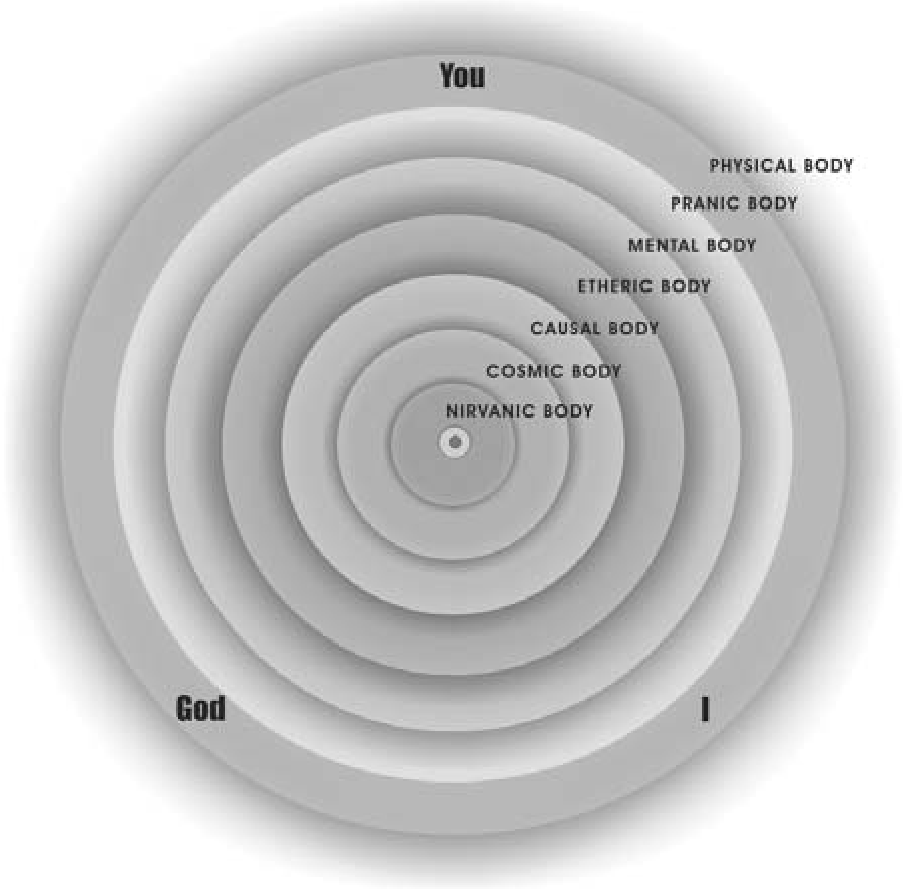
The first is the physical body, our flesh and bones. Next is the pranic layer, the energies of prāna, vyāna, udāna, apāna and samāna, or the five air movements that take place in our body-mind system. The third is the mental body. This is where our mental inner chattering continuously takes place. A continuous recorder goes on as inner chatter inside us whether we are standing, sitting or doing nothing. Sometimes we open our mouth and chatter. At other times, we close our mouth and continue to chatter. Whether we open our mouth or not, talking continues. This is inner chattering or the mental body or cancala, which means inner movement.
The fourth is the etheric body. This is the space where our intense emotions and painful experiences are stored. Usually intense emotions are of pain and suffering. We do not know any other intense emotion. If we do, we are a spiritual person.
When we look into life, we see that pain gives such an intense feeling. When we are depressed or in pain, we become intense and our whole mind is centered. Our mind does not move towards anything else.
Have you experienced bliss to the same extent or depth that you have experienced pain? No. All we know is pain.
We cannot intellectually understand the three bodies beyond the etheric body. They can only be experienced spiritually through meditation.
The pranic layer is the body filled with desires. The mental body is filled with ‘I should have’ or guilt feelings. The etheric body is pain. Understand these three. Desire, guilt and pain are the feelings or the experiences stored in these layers.
When emotions, desires and feelings arising out of these three attributes are pure, they are called satva, rajas and tamas depending on the quality of the emotion. Usually, they are impure. They are mixed with each other. We should know how to purify them. If we can purify our desires, we will be liberated. Please understand that we cannot live without desires. We can only cleanse and purify the desires, directing them towards the right path. Without desires, we can’t breathe. Even inhaling and exhaling cannot happen without desires. We cannot live without desires. Desires must be handled properly. Desires must be straightened. That’s what we need to work towards, satva.
Next comes guilt or rajas. Our restlessness is created by thoughts like, ‘I should have done that’, ‘I should have lived like that’, ‘Because I did not do it then, let me do it now’, ‘I should have reacted in a certain manner; however, at that time, I did not have the intelligence. Let me teach him a lesson, I know what to do now.’ This is how restlessness or rajas operates.
The third is pain. Whether we do right or wrong, we know how to make it painful. Whatever it is, we know how to create suffering through tamas.
The first four body-mind layers are influenced by the three guṇas. The mind cannot experience the remaining three layers beyond the fourth layer. They can be experienced only through meditation. In the fifth layer, the causal body, we sleep soundly without dreams. It is called kāraṇa śarīra, the energy layer that we experience during deep sleep. The sixth layer is the cosmic layer, filled with joyful memories, and the seventh is the nirvanic layer or the bliss body.
Just remember the first four layers of physical, pranic, mental and etheric energy. That's enough, because we will work only on these now. Krishna has already spoken about the physical layer. Now He works on the other three guṇas of satva, rajas and tamas. Satva is related to the second layer that is the pranic layer, rajas is related to the third layer that is the mental body, and the fourth layer is the etheric layer of tamas. In the next chapter when Krishna explains about the other layers we will understand those.
As I was saying, satva is related to desires and the prāṇa śarīra. When our desires change, our prāṇa flow or our airflow changes. Prāṇa is the life giving energy that we inhale alongwith the air that we take in. Air is only a medium to take in prāṇa. It is prāṇa that sustains life in us. This prāṇa is affected by the changing desires in us. For example, if we are caught in lust or an intense desire, our inhaling and exhaling becomes intense. The prāṇa going in and coming out increases. With any desire, the prāṇa flow totally changes. If we are in a silent, peaceful mood, the prāṇa flow will be so mild, we will not know prāṇa is flowing.
Understand that this pranic layer is filled with desires. What should we learn about satva, about this pranic layer? Let me explain.
Whether we believe it or not, we are God. We are pure consciousness. Whatever thoughts we create in our pure consciousness gain power. This space exists in all of us and is called Self, ātman, or inner divinity. Whatever thoughts we create in this space, the deeper they are, the more power they get from this consciousness. It is like placing a slide in front of the bulb in a slide projector. That slide becomes reality on the screen. This inner Self is also light and any slide we create in this area becomes reality in the outer world.
But, the problem is we create self-contradictory desires. We suffer with our desires because of this. Whether our desires are fulfilled or not, the resulting suffering is inevitable. If the desires are fulfilled, there will be emptiness and if they are unfulfilled, there will be restlessness. In both cases, we move towards tamas. Why?
Why should we suffer because of desires? First, understand self-contradicting desires. For instance, if we want to get rid of a headache, normally we create an engram that continuously says, 'I should get rid of this headache. I should get rid of this headache.' We repeat the same words constantly in our unconscious. By continuously thinking that we want to get rid of the headache, we will never be able to get rid of it. When we repeat a word, in this case 'headache', we actually give power to it. The headache intensifies instead of disappearing.
It is a subtle understanding. Whatever words we repeat unconsciously become reality in our body, mind and in our world. It is because we have the power to give life to any word. If the words ‘Let me get up and go’, come to our mind, with those words, immediately our body will move, we will stand up and start going.
One word can make us do whatever we want. Words that appear in our mind are important. Words that appear in our mind are mantra (sacred sounds). When put together, all the words that appear in our mind form our life, especially the words that we repeat unconsciously.
For example, if we observe what happens when we brush our teeth in the morning, we see that our mind is somewhere else. For example, when we are in the shower, the mind is elsewhere. Especially when we take a cold water shower, we sometimes even sing to divert our mind. Cold showers and singing are closely connected! Since nobody is watching us in the bathroom, we talk or sing freely. Sometimes people even argue with themselves loudly in the bathroom.
A man was standing near the bathroom when his wife came out. He asked, ‘Who were you arguing with inside the bathroom?’
She said, ‘I was talking to myself.’
He asked, ‘Why were you arguing?’
She said, ‘I know what I was doing, so stay out of it.’
He continued, ‘I can understand that you were talking to yourself, but why were you arguing with yourself?’
She said, ‘You know me. I don’t accept stupid logic. That is why I was arguing with myself!’
We play games all the time! We continuously talk without coming to reality. We utter the same words when brushing our teeth every day of the week. The moment we start brushing our teeth, we will have the same trend of thoughts. Every time we shower, we have the same type of thoughts too. If we observe ourselves closely, we will realize these things.
Thoughts that we repeat unconsciously are more powerful than words we use consciously. We create many thoughts, so many saṁskāras that are self-contradictory. ‘I should get rid of this headache’ is a self-contradictory thought. When we repeat those words we remember the headache as well. By remembering the word ‘headache’ again and again, we bring back that memory and we bring back that headache into our mind. How do we expect to get rid of the headache then?
If we constantly repeat, ‘I should get rid of this headache,’ we bring that memory back every time we utter the word ‘headache’. We bring that whole file of suffering back to our mind. How can we get rid of the headache then? Instead of using the word headache, create a saṁskāra such as, ‘I should become healthy’ again and again. Then we can remember the idea of health!
Whatever mantra or word we use, that dhyāna or meditation automatically happens in our unconscious. If we use the word ‘headache’ again and again, we will be meditating on the headache again and again. If we use the word ‘health’, again and again, we will be meditating on health again and again.
That is why when we start to meditate upon god, we start with a dhyāna śloka
- meditation verse. Before meditating, we recite the dhyāna śloka. It is like the invocation verses that invoke god with the right words. In these verses we verbalize what good things we wish to visualize in our lives.
Verbalization of visualization is the dhyāna śloka. Now, if again and again we verbalize the word headache, headache, headache, what will we visualize? We will visualize the person who gives us a headache, or what we feel like when we get a headache. We will continuously visualize the headache scene and that mood.
Whatever we visualize again and again will be inscribed or engraved in our memory, in our inner space, in our inner being. If we have a disease, please never create and repeat a word that carries the name of the disease. For example, never say, ‘Let me get rid of this heart problem. Let me get rid of this diabetes. Let me get rid of this high blood pressure’ Use straight words, not self-contradictory words. If we have pain or an illness, use words like ‘Let me become healthy.’ Words create a visualization and energy of what we want to happen.
Always use these words, ‘Let me become healthy.’ Never use words like, ‘Let me get rid of this back pain.’
Never use self-contradicting engrams. The more we use self-contradicting engrams, the more we engrave that disease into our inner space. The more we engrave, the more powerful they become. Please do not abuse the inner space or icchā śakti (power of creation). The pranic layer is our icchā śakti. It has the energy to make things happen. It has the energy to fulfill our desires. Do not waste icchā śakti by creating self-contradicting thoughts or self-contradicting engrams.
Self-contradicting thoughts corrupt our whole satva space. When you go home today, spend just ten minutes to do this exercise. Sit for ten minutes with yourself and write down the thoughts that come to your mind regularly. Then see where you are creating self-contradicting engrams and edit them, clear them. Don't bring self-contradicting thoughts into your mind.
The latest research shows that when psychiatric diseases are analyzed and publicized, millions of people across the world immediately start suffering from that disease. As long as we don't name the disease, people don't suffer from that disease even if they have it. The moment we inform them that these are the symptoms of the disease, this is what the disease is called, everybody thinks, 'I am suffering from this disease,' and they somehow contact the disease also!
Many people in good health experience symptoms of illness described by medical studies. Almost all of us feel giddy at one time or another, more often if we tend to get angry easily. This does not mean that every attack of giddiness relates to a blood pressure problem. Many people wake up sweating in the night. It does not mean that they are experiencing heart attacks. Yet once it is drilled into them that these are symptoms of dangerous diseases, they become neurotic. They turn into hypochondriacs. They become nervous wrecks.
This is a dangerous game. We should not let words created by pharmaceutical research companies about various diseases create doubts in us. This idea, 'I think I also have this problem,' gets created when we listen to disease reports and commercials. Immediately we create an engram that says, 'I have this problem; I should get rid of it.' By the time we finish repeating these words ten times, we will have the problem.
We continuously allow ourselves to be exploited by what we hear and see. People who don't know the truth of the mind and consciousness influence us. All these problems arise because we don't know that pure joy of inner space is possible.
Let me make a bold statement that no medicine or chemical can help our mind. All anti-anxiety medicines, all anti-depression medicines are consolations. First, we visualized that we suffered from depression and now we visualize that we have taken some medicine, that's all.
Let me share another important secret. It is a business secret! Many people say, 'Swamiji, that person has done some black magic on me. He has laid a spell on me. Someone has put an evil spirit behind me. Some evil being possesses me.' There are many people who exploit this kind of fear in others, cashing in on this fear. Understand: All such negativity has only one power, our faith in it.
All negativity such as black magic or evil or demonic acts, has only one power and that is our faith in them. Our faith in them gives them power. Because we believe in them, we connect all the incidents and make trouble for ourselves. And then we struggle to free ourselves.
When people come to me with these fears, I say, 'There is nothing, don't worry. There is no problem.' Then they think, 'This master is young. He doesn't know much. Let's go to an older person who will give us some counter-spells, some talisman, someone who will do some exorcism and remove this negativity and blockage.'
They think I don't know anything. Then what do I do to help them? I give them some talisman and say, 'You don't have to pay. Just put this under your pillow and you will be healed. You will be cured.' The talisman, the yantra, has nothing in it. I am clear that the yantra has nothing in it. The person has created an idea within himself. He has this negativity. By giving him the yantra, I create an idea in him that he doesn't have any negativity. It is like using one thorn to remove another thorn. There is nothing else in this.
I tell people, 'Don't think that by having these yantras something will shower from your roof. Nothing can shower from your house except rats!' These yantras are antidotes for their negative faith. They already created the faith that they have certain problems. I just tell them honestly, 'You created this trouble and now I am your help to undo it.' So understand: All negativity has only one power: our faith in it.
If the person who exploits these fears only takes money for it, that's fine, we can earn back that money. The danger is that he also creates an engram in us. He creates a saṁskāra that continuously haunts us. For anything and everything, we run to him like slaves. It is better to be caught in the hands of the ghost than in the hands of a sorcerer! At least, the ghost will trouble us only once in a while; however, this person will exploit us completely.
With the ghost, we have only mental suffering. With this person, we have mental and economic suffering! The big problem is that not only does he take our money; he also creates an engraved memory in the form of fear in us. With every small sound we hear at night, we think, 'I think that the effects of that talisman is over. Now I must get a new talisman.'
People in this business also give out talismans that need to be recharged! After a couple of months, we must take it back to be recharged. I was surprised when I heard about a rechargeable talisman!
All we need is an advertisement! I saw an advertisement in a newspaper. A man was standing in a pose as if he is granting blessings and he claims to be an Atharvana Veda scholar. I was surprised because this scripture of Atharvana Veda is not about such things. This scripture is a pure science to improve our life. It is a pure science to handle our mind blissfully. No scripture teaches exploitation of others.
In fact, the first Jyotisha Sutra (vedic astrology) states that intuition happens only to a person whose inner space is pure, who does not expect benefit or return in the form of money, good name or goodwill. So never go to people who engage in these mantra and yantra, spells and talismans. Also understand that evil entities have only one power, that is our faith in them.
Now, when we create self-contradicting thoughts, we start believing them. Especially when they name a disease in psychoanalysis, it is like the fashion business. In the fashion business, every week they launch a new dress. Similarly here, every month they invent a new disease.
By repeating that negative idea, by meditating on the symptom, we start creating that symptom in us. It is a dangerous game. Don't be caught in that game. We disturb the satva, the pure space of our being, by creating self-contradicting thoughts. So write down your major thoughts and desires and analyze them. Observe how many thoughts are self-contradicting. This is the first step.
Next, let us see how two desires contradict one another. We want to lead a peaceful life and we want wealth. With wealth comes responsibility as well. Either decide to take responsibility and be happy with that responsibility, or decide to relax and accept whatever happens.
Only one thought should be strengthened when two desires conflict. When we have both, we have a self-contradicting mental setup. In the satva space, in the satva energy, when we create self-contradicting engraved memories, we are automatically thrown into rajas.
Let me describe what Krishna says about rajas. The mode of passion is born of unlimited desires and longings. This is a beautiful verse.
Krishna says, because of this, the embodied living entity is bound to doing result-oriented actions.
He talks about desires and longings. What is the difference? Desires and longings - rāga means desire; tṛṣṇā means craving, longing. What is the difference? Some memories have our emotional support whereas some memories have been inserted into our being by advertisements.
Advertisements are not only on the television or in a movie theatre. If our father repeats something time and again, that is an advertisement. If our mother says again and again, 'This is right, this is right. This is for us, this is for you,' that becomes an advertisement. Some desires have our mental support. We feel these will give us fulfillment; we feel these are our genuine needs. Some desires have been sold to us by someone else. That is the difference between desires and longings.
Desires are ours and longings have been given to us by society. They are a social conditioning. Desires are inborn. They are our nature. If we fulfill desires, we feel fulfilled and relaxed. With longings, the moment we fulfill them, we feel empty. This is the difference between desire and longing. Desire gives us fulfillment. Longing gives us emptiness.
Krishna shows us how self-contradicting desires lead us to rajas. When desires contradict each other, we get confused. We fall into rajas, restlessness. When the information about an object comes into our system, it passes through cakṣu, citta, buddhi and then goes to the ego. On its way, before this file reaches ego, it passes through the unconscious space of engrams that write their opinions on this file.
Let us say ten engrams write a decision saying, 'I want to sit and listen to the discourse' and another ten engrams write, 'No, let us go watch a movie, it is the weekend.' Ten engrams write similar decisions on the file, and another ten engrams write another kind of decision on the file. By the time the file reaches the ego, we are confused. As a result of these contradicting opinions from our engrams, we have inner restlessness.
The more engrams, the more time it takes to make a decision. We will suffer and be in a dilemma. Man is a dilemma. Continuously we think, 'I should have done this,' or 'I should have done that.' Dilemma is due to too many engrams.
Dilemma is what Krishna calls rajas and restlessness. In rajas, we have tremendous anger, violence and inner restlessness. A person caught in rajas shouts at others and experiences an irritable mood. He has a poisonous tongue. He waits to vomit out his irritation and anger on others.
Once we remove the rajas engrams, we can make one thousand decisions without getting stressed. The file will go straight to the ego without interruption.
To make a decision we don't need to cross three hundred tables like an Indian government office. There will be two or three tables. One says, 'Yes', the other says, 'Okay'. By the time the file reaches the ego, there will not be many differing opinions. It can decide instantly and send the file back for action. The process will be easy. Making decisions will be easy and our time and energy will not be wasted.
That is why Krishna says that when we don't expect the result, when we don't think of karma phala (result of the work done), we can do the work intensely.
When we don't expect or worry about the result, we work beautifully because there are fewer engrams. We will not suffer or be tortured by engraved memories.
In the next verse Krishna talks about tamas.
He addresses Arjuna, 'Oh son of Bharata, know that the mode of darkness, tamas, is born out of ignorance. It is the delusion of all embodied living entities. The results of this mode are madness, indolence and sleep, which bind the conditioned soul.' This is a beautiful explanation of tamas.
If there are more saṁskāras or engrams, the file does not reach the ego easily. In fact, the file may not reach the ego fully. A powerful engram may make the decision on the way. It is similar to a 'non application of mind' in legal terminology.
Why does this happen? Why do you decide unconsciously and regret later?
This unconscious zone is filled with negative memories and restlessness. All our past memories and past thought patterns, saṁskāras or engrams, are stored in this zone as files. So many files are stored in this zone without any logical connection between them.
This is what happens. When the file takes a quantum leap to this zone, it does not reach the ego properly for a decision because this zone is where all the data that causes restlessness in you is stored. It is as if your computer hard disk is loaded with high-resolution photographs and there is no further scope to work on your hard disk. Like that, when your unconscious is loaded with past thought patterns and memories, it becomes inefficient and makes superficial, illogical decisions.
Take this example: According to data that you have collected, smoking is injurious to health. It is not good for your body or mind. You can hold onto this decision as long as you are at the conscious level. But once the mind takes the leap to the ego, the engrams instruct you to smoke; you simply decide to smoke! The conscious process says, ‘No, it is not good for health.’ Yet the unconscious process just makes the decision and you execute it! It is a pure instinct-level decision.
When we have more engrams, we don’t know what decision will come out. It is like a Pandora’s box. We don’t know what will come out since the inner space is full of engrams and saṁskāras. We are at the level of an animal. We act on instinct.
When there are only a few engrams, it is like not having three hundred tables for the file to have to move through. There are only a few tables, similar to a private corporation. This is the human level or the level of intellect.
When there are no engrams, there will be no need for the file to drop into the unconscious zone for a decision. It straightaway meets the buddhi and ego after the mind. There are no blocks. The time taken for the unconscious process will be less than the conscious process. We will be intuitive or at the level of God.
The level of an animal is the level of instinct; the level of man is the level of intellect; the level of God is the level of intuition. The level of instinct is the level of tamas; the level of intellect is the level of rajas; the level of intuition is the level of satva.
In satva, our mind works continuously and we make decisions, yet we do not become tired. We can be active twenty-four hours and yet remain peaceful. This is what I call action in inaction and inaction in action. Krishna says we will be centered when we are in satva. Though lots of activity go on around us, we will remain utterly relaxed.
The whole thing is dependent on one thing: our engrams or engraved memories. The number of engraved memories determines whether we are caught in satva, rajas or tamas. These three are not enlightened states. Enlightenment is beyond these three.
If we are caught in tamas, we need to move towards rajas. If we are caught in rajas, make the move towards satva. If we are caught in satva, it will automatically lead us to enlightenment. How do we do this?
Krishna speaks of tamas. ‘Know that the mode of darkness, born of ignorance, is the delusion of all embodied, living entities. The results of this mode are madness, indolence and sleep which bind the conditioned soul.’
For example, we create a self-contradicting desire at the satva level. Because of that we create restlessness in the rajas level. When we feel too restless, we drop everything. We decide not to take any responsibility and we sleep instead. We fall into tamas.
Tamas is not only sleep or depression. Not taking enough responsibility is also tamas. For example, we are in tamas if we studied to become a doctor and we do not practice our profession out of laziness. If we don’t practice for some other reason, that is fine. However, if we are avoiding because of laziness, we are in tamas. Don’t drop out from anything due to tamas. If we drop out because of a spiritual reason, that is different. Some people drop out to meditate, go on a pilgrimage or to do spiritual work. That is fine. However, we are caught in tamas when we drop out due to laziness or for no reason at all.
Dropping out due to tamas means that we don’t have enough energy and we cannot make a responsible decision. Why? Too many engrams block our decision process. By the time we make one decision, we feel tired and want to sleep. That is why we attempt to escape from life. Escapists are tamasic people.
Q: Swamiji, is there scientific evidence to support saṁskāra formation?
Good question. Surprisingly, the answer is yes. It is surprising because this is not an area that science has been interested in, especially medical science. Western medical science has focused on treating the body independent of the mind and whatever has been studied about the mind has been based on disabled minds.
A few path-breaking scientists have established that our genes do not determine our behavior; rather it is the other way around. In his seminal book, Biology of Belief, Dr. Bruce Lipton, a celebrated molecular biologist, established that our conditioning determines our biology. He studied living beings at the cellular level to establish their behavior, the positive and negative influences of the environment and conditioning and how they changed the very cellular structure.
It is also well-known that our brain functions differently at various stages of our growth. We have different brain wave patterns based on frequency levels. It has been established scientifically that in early childhood our brain operates at low frequency levels of delta and theta waves. As we grow up, they shift to alpha mode until about adolescence. Adult brains operate at beta wave patterns at over 14 hertz.
Low frequency waves imply a high degree of being influenced. Young children accept anything said by adults as gospel truth. They do not reason and discriminate. Authority figures influence them to a greater degree than commonly understood. This is the origin of saṁskāras in this lifetime.
If we extend the work of Bruce Lipton, behavioral changes that affect our genes and DNA will influence our progeny as well. Saṁskāras then carry on through generations. As I mentioned earlier, the presence of the reptilian brain indicates the continuance of evolutionary saṁskāras created before this lifetime.
The vedic system believes in the imperishability of the Self. The body may die and disappear; however, the Self or soul lives on. Matter perishes. Energy lives on. At death, the essence of one's lifestyle in that life carries over as vāsana into the next birth. This vāsana is the seed of one's saṁskāras. This is truth as I know it and as I have experienced it. Science will catch up with this truth one day.
The Life Bliss Programs and Ananda Spurana Programs are based on this truth. Our saṁskāras drive our actions. When the Upaniṣad scriptures say that our thoughts determine our actions and therefore our destiny, they refer to the saṁskāras that create and influence thoughts. It is possible to dissolve the emotional blocks created by the saṁskāras and eventually dissolve the saṁskāras.
At the first-level Life Bliss Program (LBP level 1), we teach methods to dissolve emotional blocks so that we can lead a productive life free of emotional disabilities. At the next level program - LBP Level 2 or Nithyananda Spurana Program, we teach how to work through saṁskāras at various energy levels in order to relieve them. Finally, when people take initiation to become Nithya Spiritual Healers, they are initiated into a meditative process that constantly removes saṁskāras. This meditation, called the Ananda Gandha meditation, takes one beyond the three guṇas. Guṇas are what generate saṁskāras and karmas. This meditation has the ability to make us a triguṇa rahita, one who is beyond the bondages of the. It is a meditation for enlightenment.