Journey Into The Causal Body
This text was machine-transcribed from the printed book and may contain errors. Select the words and choose “Report a mistake”.
15.1 Bhagavān says,
‘It is said that there is an imperishable banyan tree whose roots are on the outside; leaves and branches are under the earth.
The leaves are said to be the vedic hymns. He who knows this tree knows the Vedas.’
15.2 The branches of this tree extend below and above the earth, nourished by the three human attributes, guṇas. Its buds are the sense objects.
This tree also has roots going down and these are bound to the resultant actions of humans.
Krishna refers to the causal body as the banyan tree. This is a continuation of the previous chapter. Chapters 14 to 17 are interconnected. They are connected discourses. In Chapter 14, Guṇatraya Vibhāga Yoga, yoga of the division of the three guṇa (attributes), Krishna speaks about the first four layers of our being. In this chapter, Puruṣottama Yoga, yoga of the supreme Self, He refers to the fifth layer.
Seven energy layers surround us. I talk about this in great detail in the Nithyananda Spurana Program (NSP) also called Life Bliss Program - Level 2. In this four-day course, the participants are taken through the experience that they will face at the time of death. At this time, the spirit traverses seven layers of energy that surround it before it leaves the body-mind complex. The seven layers are: physical, pranic, mental, subtle, causal, cosmic and nirvanic layers.
The first layer is our physical body, the body with flesh and bones. The other layers are components of our being. The totality of the seven layers is our body-mind-spirit system. The second layer is the pranic body, the body that controls air movements inside our physical body. It controls prāṇa, apāna, udāna, vyāna and samāna (various air movements inside the body).
In the previous chapter, Krishna explains that this layer is filled with desires. He further explains how we create contradicting desires and suffer. Self-contradicting desires leave us in rajas (restlessness). They make us suffer and force us into tamas (inactivity or depression).
The fifth layer is the causal body. It is where all saṁskāras, our embedded memories, are stored in seed form.
Every night we enter the causal body in deep sleep. We take saṁskāras out from this layer and create the world.
In this chapter Krishna reveals the secrets of this layer. In the previous chapter, Krishna explained how to use the power of desire energy. Desire is also energy. That energy is abused by creating self-contradicting desires. Self-contradicting desires put us into restlessness. After that, if we don't correct ourselves, we fall into depression. He gave techniques to clear self-contradicting desires.
A few desires are our own. These are desires born out of our vāsanās, the mindset that we carry over from previous births. These are also referred to as prārabdha karma, karma we are born into this body with. These desires carry their own energy for fulfillment, as they are the basic needs and purpose with which we were born.
The universe blesses us with the power to meet all our real needs. As Mahavira, the founder of the Jain religion says, when we are born on this planet we are sent with all that we need. However, once here, we accumulate other desires. These desires are the wants that we borrow from others by comparing, copying and envying others.
Ramana Maharshi says, 'This universe can fulfill the needs of all its inhabitants; but it cannot fulfill the wants of even a single person.' How true!
When desires are borrowed, when they are based on coveting other people's belongings, there will be a serious contradiction between our wants and needs. Fulfillment of our needs gives happiness, true joy. That is why a poor man eats his simple meal of roti and dal (bread and curry) with such gusto.
Chasing wants, borrowed desires, causes sorrow. Have you ever seen a rich man eat with true happiness? His accumulated wealth invariably gives him ulcers, diabetes, heart disease and many other problems so that he needs to have a designer diet. He needs personal trainers and dieticians to keep him fit and healthy.
Desires are caused by saṁskāras, deeply embedded memories of experiences and sense perceptions. Saṁskāras are stored in our unconscious mind layer. Over ninety percent of what we perceive through our senses is stored in the unconscious. Our mind finds it difficult to cope with even the remaining ten percent of sensory inputs that are fed into its conscious realm. Imagine what would happen if it were one hundred percent!
Embedded memories, saṁskāras, drive our actions. The Brihadaranyaka Upanishad says, 'We are our desires. Desires shape our will. Our will shapes our actions. Actions make us what we are.'
We do not realize that these desires are not the true desires that carry energy to be fulfilled. They are simply picked up from others based jealousy and comparison. But for the most part, our saṁskāras define us.
Now Krishna moves on to the next layer, where saṁskāras are stored in the seed form. Even if we move beyond the three layers of desire, restlessness and depression, these saṁskāras in seed form (called bīja saṁskāra, bīja meaning seed) need to be cleared.
Krishna speaks of techniques to destroy these saṁskāras. These may not express themselves in us right now. Yet if they are allowed to be there in seed form, at one time or another, they will exploit us.
In an office, some files are on the table, some are in the archives, while others are in the safety vault. The previous three layers are like the office table and archived material. This causal layer is the office safety vault. The next two layers are the external vaults. In the previous chapter, Krishna explains techniques to clear the table. Now He gives techniques to empty the office safety vault.
Krishna says, 'The roots of the tree are on the outside; the branches are inside.' From the causal body, if the roots are taken to be outside, it should be in the earlier three layers ending with the physical body. In a tree, the roots feed nutrients to the tree. The tree takes water and minerals through the roots. The roots decide the condition and growth of a tree. That is why Krishna says the roots of the tree are in the physical body. The tree of saṁskāra is watered by the five senses of the physical body and our actions. The saṁskāras in seed form in the causal body are formed and watered by the five senses of the physical body.
Krishna further says that the leaves are the vedic hymns and one who knows the tree is knower of the Vedas. He says saṁskāras are the vedic hymns, the mantras. Mantras are defined as manasasya sthiraha iti mantraḥ, whatever controls or stabilizes the mind, or manaḥ trāyate iti mantraḥ, that which redeems the life of man.
Words that are settled in our inner selves pave our road. Words expressed or coming out when we are alone, are the saṁskāras printed in the causal body. Our lives revolve them.
Words are double-edged swords. Whatever words we use to offend others settle in our inner self. They emerge whenever they find a chance to push out of our inner self. No man is intelligent enough to use harsh words on others and smooth words inside. It is an unconscious action. That is why, in ancient Indian society, the usage of harsh words was controlled by various customs.
Our mind is constantly occupied in inner chatter. Eventually we express part of this chatter in words. Part of it we suppress for fear of societal repercussions. We do not express what we fear would hurt others or what might be unacceptable to others. All these words settle deep inside our maṇipūraka cakra, the navel energy center, which is the seat of words.
There are words we feel comfortable using based on our position relative to the listener. We may say harsh things to subordinates, spouses, children and others whom we think we control. We dare not dream of saying those words to superiors and strangers. Words that are harsh, whether expressed externally or internally, settle down within us. What goes out also goes in. These settle within our navel energy center. Both expressed and unexpressed words build our bank of saṁskāras.
I have mentioned before about the book, The Hidden Messages in Water. In it the Japanese scientist Dr. Masaru Emoto, talks about experiments with water. Emoto filled several bottles with ordinary tap water. He placed labels on the bottles with words such as love, hate, fear, worry, trust, faith, surrender, children, enemies, Koran, Bible, etc. He spoke to each bottle several minutes a day on the subject written on the label. For example, he spoke of love and with love to the bottle with the 'love' label. To the bottle labeled 'fear', he spoke of fear and with fear.
After a month or so, he froze the water in these bottles. He looked at these ice crystals through powerful microscopes. To his amazement, the crystals reflected whatever he had spoken to that particular water sample.
Ice crystals from the water labeled 'love' shone brilliantly as if they were diamonds. Ones from the bottles labeled 'fear' looked ghostly and misshapen. Amazingly, the crystals from the bottle labeled 'Koran', to which he spoke from the Holy Koran, seemed to contain the image of the Holy Kaabaa shrine at Mecca.
Emoto then froze polluted industrial water and studied the crystals. As expected, these looked terrible. He invited Buddhist monks to direct their prayer energy to these bottles. When he analyzed the crystals of the energized water, these crystals looked like diamonds, exquisite and sparkling.
Emoto concluded that words and thoughts influence natural elements such as water. Our scriptures support his findings. There is an important corollary to his findings. The human body is made up of nearly eighty percent water. Therefore, every word we speak affects us and affects those who listen to them or at whom they are directed. The same effect happens with thoughts.
One who understands this can influence other people through his thoughts and words, perhaps more effectively than through his actions. Even we do not know how our thoughts and words influence and affect other people; they may not be as focused and effective, but they will still affect others and us.
For those in business and corporate life, communication is the key to success. Communication is not about our facility with language. It is not about the accent we cultivate. It is not about how fluently we speak. Communication is expressing what we feel. If our feelings and thoughts are negative, however much we try to hide these, our words or body language reveal the inner feelings and motives.
Someone who practices and masters the art of using only positive words automatically develops positive thoughts. These two are interconnected. Sometimes it is difficult to develop positive thoughts about certain people and situations. However, if we constantly change the negative words that we use to express our feelings into positive ones, our attitude towards others changes.
In business, this leads to money. When practiced sincerely in personal relations, this brings happiness. The basis of this is simple. We cannot say a word without visualizing the object. The moment we say 'cow', our mind visualizes the animal that we call a cow. Try saying 'cow' while thinking about an elephant. Even if it is not impossible, it makes us definitely uncomfortable.
Similarly, when we use negative adjectives to describe a person or situation, a picture crops up on our mental screen. With practice and awareness, we can erase that word before it surfaces with respect to that particular person and situation. As the word changes, our mental image changes.
In this area, we have good news as well as bad news. The good news is that at any time we can reorganize our causal body. The bad news is that our present negativity is responsible for any suffering that we go through.
A woman telephoned her husband at his office. Her husband explained that he was too busy to talk. The wife said, ‘It won’t take long. I have one piece of good news and one bit of bad news.’
Her husband replied, ‘Tell me the good news because the bad news can be handled later.’
She said, ‘I have just discovered that the airbag in our car is working perfectly.’
The bad news was obviously that she had had an accident; that is why the airbag in the car went into operation!
Every piece of good news has hidden bad news. So we have good news and bad news about the causal body.
Krishna further states that one who knows this tree is the knower of the Vedas. He says one who has the knowledge that saṁskāras, which constitute the causal body, are the result of the five senses, knows the Vedas or has the knowledge of life’s guiding force.
The water a tree receives through its roots mainly decides the condition of the tree. If good water and manure are available, the tree flourishes. The leaves will be green. If poison is poured on it, the tree sheds its leaves and slowly dies.
This tree of saṁskāras, which is in the causal body, lives mainly due to the five senses. Krishna uses the word aśvattha which also means that which is transient, that which is not today as it was yesterday and which will not be tomorrow as it is today. It refers to material life where nothing is what it seems to be. Everything is temporary; as Buddha says ‘aniccha,’ impermanent.
Life, as people say, is not unreal. If it were truly unreal, we would not be able to experience it. The fact that we experience material life and seem to enjoy it, even if temporarily, means it is real. It is unreal to the extent that whatever we experience is transient and impermanent.
Unreal does not mean nonexistent. If something is nonexistent, we cannot perceive it or experience it, even temporarily. Even a dream is real. We say dreams are unreal, but we cannot deny that we experience dreams. People recollect some dreams vividly. How can dreams be unreal? However, it is a fact that we do not have self-awareness while dreaming.
Once we become aware, we wake up from the dream. It has never happened that a lion or a murderer chasing a person has caught that person in a dream. It may happen in a movie, but not in real life. As soon as we are threatened, as soon as we become aware of ourselves, we wake up and the dream ends.
Dreams are not unreal in the sense that they are nonexistent; they are unreal to the extent that we are unaware. In the same manner, sages tell us that we are unaware even when we are awake. ‘Jagrat, jagrat,’ they say, ‘wake up, wake up.’ They do not ask us to wake up from sleep. They ask us to wake up from our unaware wakefulness into an aware wakefulness.
Aśvattha signifies this state of unawareness. To understand this unawareness produced by our senses and directed by our saṁskāras, is to gain knowledge, the Vedas. Krishna goes on to explain more about this state of unawareness.
Krishna says the roots go upwards as well as downwards. He says the leaves of the tree are decided by the tricks of the five senses and the resultant action of mankind. The roots are not only in the physical body, but also in the action. Krishna says the tree is deeply rooted because the action of the entire mankind is always result-oriented. It is always guided by greed and fear.
The aśvattha tree, the banyan tree, is like a human body. Its roots, like in a human being, are above, like our hair. The hair is said to be a channel to draw in cosmic energy. Our limbs, hands and legs are like branches of the banyan tree. The human system is truly upside down!
Krishna gives a beautiful tip to clear the saṁskāras. If we are not guided by greed and fear, if our actions are not result-oriented, no saṁskāras will be created. If you serve selflessly for at least half an hour a day, it will do you a lot of good.
While doing service, don’t plan anything. Don’t even plan to have a group of volunteers do the service. Just do any work that you can do. It may seem silly and a waste of time. But at a later date, this time alone will be felt as purposeful. If your service is fueled by greed or fear, you may end up in a mess and be a nuisance to others, too.
There are three interlinked elements in the karmic cycle. Vāsanās are the mental attitudes, the essence that the human spirit carries with it as it moves from body to body. Imagine for a moment that we are all bubbles on a white space. Let us imagine that these bubbles are circles drawn with a colored pen on a white paper. The colored circumferential lines are our body-minds, our boundaries.
The space inside the circles, or the bubbles, is the same as the white space that is outside. This white space is energy. Outside, it is the cosmic energy; inside, it is our life energy.
When we die, the colored lines are erased. The energy inside becomes one with the energy outside. Matter perishes into energy. This is death. It is the shift from one state to another.
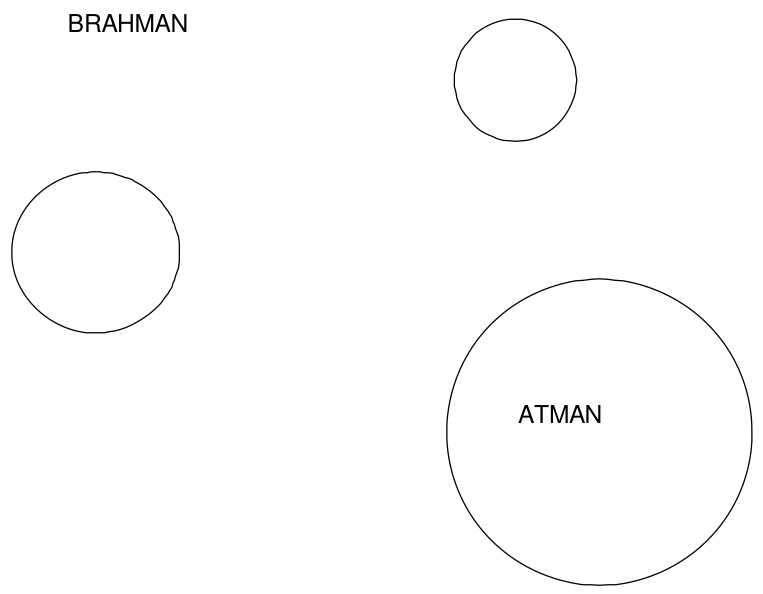
One small difference exists though. Each individual white space is slightly colored by its vāsanā, its mindset. When the spirit goes into the cosmic space, it remains separated from the cosmic space by this shade or essence of vāsanā; the spirit then seeks a body-mind to suit the particular mindset with which it left the previous body. This is how rebirths are determined.
Vāsanā is like a seed. It is subtle. If we have insight, we can see the potential plant inside a seed. In fact, British scientists were shocked when they photographed a rose plant without flowers and found that the photograph contained impressions of flowers yet to come!
There is no vāsanā in an enlightened person. Consequently, when he leaves the body-mind system at death he fully merges into the cosmic energy without any separation. Thus, he has no rebirth.
For the rest of humanity, vāsanās carry over into a new body. This mindset creates the saṁskāras as the new body-mind develops. Experiences of the new body-mind allow carried-over vāsanās to bloom into saṁskāras. If vāsanā is a seed, saṁskāra is a plant. Finally, saṁskāras drive us into action. This action is karma.
Karma is the fully-grown tree born out of the seed of vāsana, which first grew into the plant called saṁskāra. Vāsanas are also called 'bīja karma' or karmic seeds.
To understand, imagine that a woman sees a pair of shoes in a store window while shopping in a mall. At first, it may be a curious glance. However, if she is attracted to it, she will look a few more times. A seed is sown in her mind to possess that pair of shoes. That is vāsana, the seed.
After a few looks, her mind tells her how elegant she will look in those shoes and how she will be a hit at next weekend’s party. A picture forms in her mind. She has now developed a strong desire. This is the saṁskāra working. The plant has grown from the seed.
Finally, she buys the shoes. She is convinced she cannot do without them. This is action; this is karma, the tree.
The first week after the party, she wears the shoes on all occasions. Over the next two weeks the attraction wears off and she wears them less often. Soon, the shoes are discarded under the stairs, not to be looked at again. Then she sees another pair of shoes!
The saṁskāra cycle and karmic cycle go on and on. As long as the desires are unfulfilled, they reappear. The saṁskāras remain to reappear again. If all we can afford is one pair of shoes, our desire will be fulfilled with one pair; that will be our mindset. Our saṁskāras for shoes will not bother us. We enjoy what we get. We do not hanker after the getting, without ever enjoying it fully.
This is why business tycoons are never satisfied no matter how much they achieve. How big is big? Business theory says that that which does not grow will shrink and die. Therefore, there is this constant struggle to expand. As long as the business objective is selfish, be it of benefit to the owner or the shareholders, final satisfaction in terms of achievement is elusive. The greed to acquire and build generates attitudes and behavior that are selfish and harmful to others. That is why corporations have earned notoriety for their disregard for public welfare and environment.
If corporate goals were to become more open, inclusive and of greater benefit to society and the world, corporate saṁskāras would dissolve, just as selflessness benefits an individual in dissolving saṁskāras!
Selfish desires when met can never give fulfillment. They are food for our ego and they serve no universal cause.
A small story:
The boy scouts in a school were required to do one act of social service daily and report it to their scoutmaster. Three boys jointly said that they helped an elderly lady cross the street. The master was not able to understand. ‘Helping an old lady cross the road is a good service, but it does not require three boys. One is sufficient. Why three of you?’
The master was puzzled. The boys said, ‘No sir, it was a job for three of us, because the old lady did not want to cross the street. We had to carry her!’
Systemized service often leads to such a situation. So don’t plan anything. Just do service anywhere. Then the service you do will infuse enormous power into your being. For at least half an hour a day do something selflessly. I tell my devotees to contribute service to the mission for at least half an hour a day. This service is meditation. It inculcates the spirit of collective consciousness and lays the path to realizing the divinity underlying the service.
Bhagavan says, ‘karmānubandhīni manuṣya loke.’ All our actions revolve around results. So, at least in this service, don’t think of dollars or fame. Don’t plan to impress. Don’t plan to make your presence felt. Do the work for its own sake.
Even when we do so-called philanthropic or charitable work, we must be careful not to bind ourselves to the results of our actions. People ask, ‘What is the point in meditation when the rest of the world suffers?’ If we can genuinely feel the suffering of humanity and wish to do work to help that suffering, that is good. However, we must have the sense of this extended consciousness to feel this compassion.
Mostly we do charitable work based on notions of earning brownie points that will do us good in our afterlife, whether we believe in rebirth or not. Or we would like to see ourselves in the media and feel good. It fulfills our need for attention either in this world or in another world after death.
There is no concept of sin or merit on the spiritual path. No one, neither a Chitragupta nor a Saint Peter stands at the Pearly Gates enquiring whether you have done your necessary quota of charity work down below.
When you work, whether it is charitable as you and society define it, or commercial and mercenary, as long you do it with no expectation of results, your actions will be selfless. These actions are not motivated by fear and greed. They will not result in the hangover of saṁskāras.
This may seem difficult for the intellect to accept. When individuals and corporations embark upon philanthropic activities, they measure the success of their input, whether in terms of money or effort, by what has been achieved. Objectives need to be well defined, budgets need to be created, results need to be analyzed and the course must be corrected.
Yet, there is a way in which the process is defined and not the results. When a defined process is followed, results naturally follow. If we follow the right path, we reach the right destination. It takes courage to believe and implement this. It takes courage to say that we will work without expecting rewards. It takes a truly confident person to accept that what is important is 'doing' and not 'doership' and that status is not as important as the state of doing.
If we are able to accept this, we will find a true liberation within ourselves. A load will be lifted from our shoulders. The anxiety of constantly looking over our shoulder to peep into the future will be gone. We look at past results to define what needs to be done for the future. This so-called course correction is of no value since conditions in the future may be different from what prevailed in the past.
What needs to be done is focus on the present, define a path and a process and ensure that the process is followed. If this is done with awareness, results will follow.
Q: We have been told that charitable activity is good. I am confused when you say charity is not always good. Please explain.
Understand the meaning of charity. Charity must arise from selfless causes. In Sanskrit the word for wealth is dān and for charity dān. Giving up wealth and material possessions is charity.
Charity cannot be giving up what you can afford to give up. That is not charity. It is a matter of convenience. Charity cannot be for tax deductions. It is then business. Charity cannot be for getting your name and face in newspapers. That is pure ego boosting. Charity needs to be unselfish and anonymous. Charity cannot arise from feelings of 'mine' and 'I'.
Charity is something that you cannot afford to give and yet you give. Charity is treating the next person and the person after him as yourself and sharing what you have with them. True charity arises from expanded consciousness. It happens when you believe that the world is your family, Vasudaiva kuṭumbakaṁ.
A beautiful story from the ancient Hindu epic Mahabharata:
A mongoose went to check out Yudhishtira’s rājasūya yāga - a celebrative fire ritual. This was the celebration ritual after the Pandava princes won the war. The mongoose was golden in half its body. After rolling over the ashes of the fireplace, the mongoose declared the ritual to be useless.
The startled princes asked why. The mongoose said that half its body had become golden when it rolled over sprinkled flour on the floor at the house of a poor brāhmaṇa family. The family had given all their food to a guest and starved to death.
Ever since, the mongoose had been visiting sacrificial sites hoping to make the rest of its body golden.
The greatest ritual of the greatest ruler on earth could not do this. It did not match the simple sacrifice of the poor brāhmaṇa family that gave away what it had at the cost of the life of its members.
This is charity. Charity can have no expectations. When you can walk away from all that is precious to you so that it benefits someone in greater need, you are charitable. When you get nothing in return and yet you are happy, you are charitable. Otherwise, whatever you do is just another business deal.