Consciousness Is Eternal
This text was machine-transcribed from the printed book and may contain errors. Select the words and choose “Report a mistake”.
13.13 I shall give you the full understanding about the knowable, with which one can taste eternal bliss or the being or the consciousness that has no beginning.
A life beyond the law of cause, effect and the material world.
13.14 With hands and feet everywhere, with eyes, heads and mouths everywhere, with ears everywhere, He exists in the worlds, enveloping all.
The Paramātman (supreme spirit) is all pervading. He exists everywhere.
13.15 The Paramātman is the original source of all the senses. Yet, He is beyond all the senses. He is unattached.
Although the consciousness is the maintainer of all the living beings, yet He transcends the modes of nature and at the same time He is the master of the modes of our material nature.
13.16 The supreme Truth exists both internally and externally, in the moving and nonmoving. It is beyond the power of the material senses to see or to know Him.
Although far, far away, He is also near to all.
13.17 Although the Paramātman appears to be divided, He is never divided. He is situated as one.
Although He is the maintainer of every living entity, it is to be understood that He consumes and creates all.
13.18 He is the source of light in all luminous objects. He is beyond the darkness of matter and is formless.
He is knowledge, He is the object of knowledge, and He is the goal of knowledge. He is situated in everyone's heart.
Krishna says, 'I shall explain the knowable, knowing which, you will taste the eternal Being, the beginning-less consciousness that lies beyond the causes and effects of this material world.' In the previous verses, Krishna talks about the qualities that happen with the flowering of the divine consciousness within. Now He reveals to Arjuna that this consciousness is eternal.
Please understand that our mind associates a time and space with every incident or event. The mind can only think chronologically. It is like an inner reference chart and all incidents are placed in this chart of time and space. Modern science asks questions like, 'How did this happen? What was there before this? What came after this? What triggered this?' When they asked about the creation of this universe, they explained it with the Big Bang theory.
They said that a tiny mass of fire exploded and gave rise to our universe. What they could not answer was, 'What existed before that?' Krishna says that this universal energy, the ultimate consciousness, always existed. It manifested in various forms as planets, as humans and so on, but it is eternal. It will continue to manifest itself and return to the Source and it will always exist.
The concept of time and space that we have is based on our mind and senses. Whatever we perceive is a projection of our mind. This understanding of time is different from an enlightened master's understanding. He measures time in terms of kṣaṇa. Kṣaṇa is the time between two thoughts. It is the space between two thoughts. Buddha referred to this time and space as śūnya. Adi Shankaracharya referred to it as pūrṇa. It is the no-mind zone, the mindful zone, in which we touch base with ourselves. It is the present moment, in which we come face to face with the divinity within, by which we recognize the cosmic energy that is our essential nature.
When we are caught in chasing one material pleasure after another we have so much stress, tension and worry bombarding our heads every second. Our kṣaṇa is very small because of the high number of thoughts inside us. This is why we get a suffocated, panicking feeling. We are running in a rat race. We constantly feel time is running out. We are greedy for more and more experiences before this body dies and we are afraid that we might lose whatever we have come to possess.
We feel this way because we associate ourselves with the kṣetra, the temporary body and mind. Please understand that the body and mind are made up of the five elements and they return to their source once they have served their purpose.
On the other hand, an enlightened master knows he is kṣetrajña. He knows that he is not the body-mind system. He has realized that he is the ultimate consciousness. He has no urgency to run in the rat race because he knows that life goes on, even if this body perishes. He has become a witness to the mind. Any thought that springs up will be only an action-oriented thought, never an unproductive thought. The moment the thought happens, it will immediately expresses itself as an action. No thoughts accumulate inside him. He experiences eternity because of this thoughtless zone that he stays in.
This is the beginninglessness of the consciousness that Krishna explains here.
When we are in front of an enlightened master, one who is in a no-mind state, the number of thoughts in us also comes down and our kṣaṇa becomes longer. The gaps between thoughts increase. So without even trying, we become calmer, more peaceful, and more aware!
Our logical mind tries to reason everything out. We rationally want to convince ourselves all the time about why each thing is in a particular way. But all our logical understanding and all our knowledge through books only gives information about the changing world around us. The knowable that Krishna explains is beyond these changes. It is eternal because it does not follow the laws of creation and destruction like other objects around us. It has always been there and will always continue to exist.
Whatever physical matter we see around us follows a particular cause-effect relationship. However, our deepest core is untouched by these changes. Please understand that every thought inside us affects the functioning of the whole cosmos. Whether we want to accept it or not, we do not operate as separate islands. Thoughts that are present in the space that we live in affect our mental setup, that is the way we think and operate.
If you search on the internet for the book title ‘The Hidden Messages in Water,’ you can read the research findings of Masuru Emoto, a Japanese scientist, on samples of water. He took many samples from the same water source and started talking to each sample with a different emotion. He labeled one sample ‘love’ and spoke words of love to it. Similarly, he labeled another sample ‘hate’ and spoke with vengeance and violence to it. He later crystallized these samples and observed them under an electron microscope. The sample labeled ‘love’ showed beautiful crystals that sparkled. The one labeled ‘hate’ was ugly and repelling.
If one man’s thoughts could have so much impact on a small sample of water, can you imagine what impact the collective emotions of humanity have on the
universe? Today there is a rise in the collective unconscious, the collective negativity. The universe responds to that. People ask me, ‘Swamiji, why did the tsunami kill so many innocent people?’ Please understand that these natural disasters are a projection of our collective unconscious, in the form of earthquakes, tsunami, wars and other forms of mass destruction.
In exactly the same way, collective consciousness does mass-purifying. It is not to say that those who were killed were impure. It is that the total collective negativity must get expressed somehow, somewhere, through these natural events. That is why sages and yogis started the concept of Kumbh Mela where the energy of millions of enlightened beings comes together in the waters of the sacred rivers Ganga and Yamuna. Imagine the purification process that occurs when the enlightened energy of millions of masters touches the waters of these rivers. It has a counter-balancing effect. That is why taking a dip in the Ganga during Kumbh Mela bears so much significance.
Last year, on September 21ˢᵗ, the United Nations World Peace Day, the worldwide centers of the Nithyananda Mission organized twenty-four hour meditation rallies for world peace. The concept is the same: When thoughts with the intention of peace and harmony come together, it results in a sweet mood of peace and adds to the collective positive consciousness of planet Earth.
This positivity and negativity, creation and destruction, are all properties of the changing world around us, of the kṣetra that we live in. The minute we know that we are not this changing kṣetra but the eternal and unmoving kṣetrajña (the consciousness that runs the kṣetra), we are liberated.
Krishna calls this eternal bliss jñeya, knowable. When the knowing happens, the knowable (jñeya), knower (jñātā), and the knowledge (jñāna) merge. In this experience, the knower, known, and knowledge become one. No separate experience, experiencer or object of experience exists. It is called triputi, where no difference between the three entities exists.
It is like this: Imagine that you love driving and are sitting in a nice new car with all automatic systems and you are driving on a highway at full speed. You are so immersed in that joy of driving the car that you forget yourself. After some time you suddenly realize you are not even driving; the driving is simply happening. You have become the experience of driving and there is no more a sense of you doing the driving. The car is moving forward on its own and you have become the experience. Similarly, if you are immersed and involved deeply in any other passion, the experience, experiencer and object of experience suddenly merge into the eternal consciousness. You call it being ‘in the Zone.’
Krishna explained that His eternal nature, the eternal Self, is not bound by time. Now He says that He exists everywhere and He is not bound by space. Normally we understand the presence or absence of an object or person in terms of physical attributes. We function in our lives based upon what we see, smell, touch, taste and hear. If our pañca indriya, five senses, cannot sense anything, we think nothing exists.
One important and surprising thing is that an enlightened master is more present in his absence than in his physical presence. This means that his energy never dies nor does it know any barriers. Many disciples in different parts of the world tell me, ‘Swamiji, we wish to be with you more often, please visit us.’ I tell them, ‘Truly, sixty six percent of Nithyananda is in the mission and the message; only thirty three percent is in this body.’ If we limit an enlightened master to his form, we miss him completely. His energy transcends time and space and is always available everywhere forever!
When you are in the energy field of an enlightened master who is no longer in his body, as in a jīva samādhi, the final resting place of the master’s body, without even making an effort, you become calmer and experience that space of peace within. Many great temples such as Tirupati, Tiruvannamalai, Mantralaya and Pazhani in India are built around the final resting places of enlightened masters. That is why these places serve as powerful energy centers today, drawing millions of people every year.
Although physically the master is no longer in the body, we feel his presence. Why? Because he is not bound in space by the body. The cosmic energy that he manifests transcends space and time. Only we know physical barriers. Here, Krishna uses the phrase, ‘eyes everywhere.’
During my parivrājaka (monastic wandering), I had a wonderful opportunity to stay and learn with a great mystic in the Himalayas, a Naga Baba. Naga Baba refers to those from the Naga sect. Those belonging to this sect would not wear any clothing. This baba had a unique method of teaching. Whenever people came to learn from him, he would stick his trident (a weapon with three prongs believed to be used by Lord Shiva), in the ground and ask them to look at all three tips of the trident simultaneously. Sometimes his students would sit for three months staring at the trident all day, trying to perfect themselves. It is much harder than it appears to be! For one moment you can see one tip in your vision, and the next moment the next tip, and the next moment the third tip. It is very difficult to see all three tips at the same time! I first thought it would be easy! But when I started practicing, I was shocked. I thought, ‘Oh God, I can’t even see this small trident
entirely, all at once!' Only then did I understand that without moving the eyeballs, without shifting the gaze, we couldn't see more than one point.
The trident is a great weapon to create awareness of the third eye (the energy centre between the eyebrows). It is a tool to expand our awareness. Right now, your field of vision is 120 degrees. If you start concentrating on one particular point, it will slowly become 30 degrees. The more you concentrate, the narrower the field of vision becomes. However, if you center yourself on the third eye, your awareness will slowly expand beyond 120 degrees, and you will first see 180 degrees, then 240 degrees, and ultimately 360 degrees! To create awareness by centering yourself on the third eye means awakening your consciousness.
When Krishna says, 'Hands and feet everywhere, eyes, head, ears and mouths everywhere,' what does He mean?
This is beyond the comprehension of the human mind and needs a little bit of internalization. We understand only one body - the physical body - because we associate ourselves with it completely. Let me explain with a small diagram:
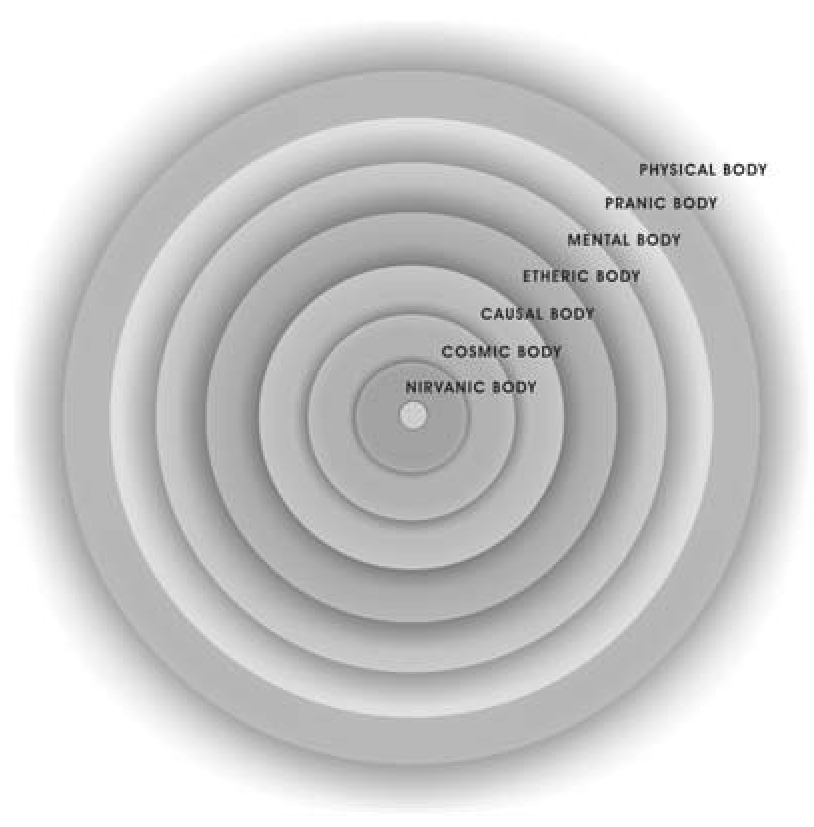
This diagram shows the seven energy bodies or layers that we have in us. The outermost layer is the physical layer, with which we associate ourselves all the time. We know this body as having a pair of eyes, hands, legs, one nose, head, etc. Now let us take a few points on that layer. Let us call them 'you', 'me', 'your neighbor', 'Krishna', 'Buddha' etc. So, at the gross layer, you are different from your neighbor; your neighbor is different from me and different from the various forms of God. You can see each point being distinct from the others. We are so rooted in this physical gross layer and so we see many barriers between us and everything around us, because everything appears to be different from the other in this layer.
Now, for each point, if we follow the corresponding points in the inner layers, as we go deeper and deeper, we suddenly realize that we all merge in the nirvanic layer. It is here that the universal energy connects every being. There is no difference in this space between you and me. This is the space of consciousness that Krishna talks about. Here, Krishna and Buddha are no different. All are various forms of God, all are manifestations of the same divinity.
The women who used to look after the cowherds during Krishna's time, that is the gopīs, were great devotees of Krishna. Despite their other household chores, they were soaked in devotion for Krishna all the time. It is said in the rās līlā - divine play of Krishna wherein he gave the experience of universal consciousness to the gopīs - that Krishna danced with each of the hundred thousand gopīs in Brindavan. Krishna manifested a form for each of the gopīs in order to dance with them individually. It was not merely one form, one body of Krishna, but one hundred thousand forms manifesting simultaneously.
Please understand the deeper meaning in this. Each gopī was so deeply connected with that divine consciousness, the Krishna consciousness, that each one felt His presence. When we go within, into our core, we see divinity in everything. The gopīs saw Krishna everywhere and in everything they did. This universal consciousness knows no physical barriers. That is why Krishna says He is 'all pervading'. He is all enveloping. He is omnipresent.
That is why I say, 'All those who I ordain as healers are my hands, all our ācāryas (teachers) are my vāk (energy of verbal expression), and all our organizers are my mind.' I can only heal a limited number of people with these two physical hands. I can only conduct a limited number of discourses and programs with this one mouth, and I can only organize a limited number of events with this one brain. That is why I operate through my healers, teachers and organizers. The cosmic Nithyananda operates through them!
For a phone connection to happen from one country to another, we need to have the infrastructure: all the cables installed below the sea and so forth. But for this cosmic connection to happen, nothing is needed. If we simply connect to the Self within, suddenly there will be no barriers. We will simply fly!
Krishna goes on to give further qualities of the Self. But understand that all this is said only to inspire us to experience it first hand ourselves. If somebody asks us, ‘What does sugar taste like?’ and if he has never tasted anything sweet before, how will you explain to him? You may tell him, ‘It will be in the form of white cubes, transparent, very sweet.’ When he asks, ‘What does ‘sweet’ mean?’, what will you say? You can continue to tell him other things about it, ‘Sugar is made from sugar cane. Sugar cane is full of sugary syrup, it is fibrous, you can chew on it.’ What is the use?
Instead if he puts a handful of sugar in his mouth, he will automatically say, ‘This is how sugar tastes! This is how something sweet tastes!’ Unless he experiences what ‘sweet’ means, things will remain a theory for him, although the conviction about sugar might grow in him.
But the problem for intellectuals is that they are clouded with doubts and skepticism so a theoretical explanation is important. We want to measure everything based on what we know. Krishna is compassionate. He is patient.
In Chapter 11, He revealed to Arjuna His cosmic form, the viśvarūpa darśan. But soon after that, Arjuna feels intimidated and cannot handle the energy. He pleads with Krishna, ‘I cannot understand You. I cannot withstand Your glory.’ But Arjuna wants to know what Krishna is talking about. So once again Krishna gives all kinds of descriptions to penetrate Arjuna’s doubts and fears.
The compassion of an enlightened master is so great. In spite of the doubts and skepticism, he quietly and patiently sits with the disciple until, one by one, all doubts are washed away. You see, our doubts and questions arise from our mind, forming a thick layer over us. A master’s grace gently dissolves this layer.
Let me narrate an incident that happened in Buddha’s life:
A blind man argued with everyone that there is no such thing as light. If someone said that there was light, he would ask that person to catch hold of it and give it to him. He said, ‘If there is something called light, I want to touch it, taste it, go around it, play with it. Only then will I believe that there is light.’ He argued with everyone until they gave up and accepted that he was right.
One day he went to Buddha. Buddha did not argue with him. Without a word, Buddha asked a doctor to examine and treat him. The blind man received his vision. As soon as he could see, the blind man’s joy knew no bounds. He enjoyed seeing all the colors. Then he brought some flowers and fruits and offered them at the feet of Buddha and prostrated.
The blind man spoke from the depths of his heart, 'O Lord Buddha! Blindly I have been arguing with everybody. Others also argued with me and destroyed me. It is good that you have not argued with me. If you also had argued, I too would have argued with you and I might have been ruined. But now I understand that light exists.'
Out of the same compassion that Buddha had for the blind man, Krishna explains to Arjuna the same truth in many ways so that something might trigger the spark inside. In this verse, He says that He is responsible for the functioning of all senses but is beyond them. He is responsible for any life that happens, but is detached from it. He is the one who causes the three main qualities of aggression, laziness and goodness to happen, but is beyond all three of them.
Krishna says all life happens because of the thread of the universal energy flowing through. You see, so many things are happening around us, on their own, beyond our awareness. When we put a piece of bread in our mouth, we chew and swallow it. After that, the whole process of converting this to energy happens without our giving instructions. Forget giving instructions, we don't even know what is happening inside. Today, scientists may understand the chemical reactions, but they still don't know what differentiates a dead cell from a living cell. How then can one understand the universe and all the millions of stars and planets in the galaxies, running in perfect synchronization? Is there any policeman sitting in space and controlling them? No!
Please understand that the life force that conducts the whole show, that controls every breath we take, the same energy that maintains an order in the chaos of the universe, is pure intelligence. In Sanskrit, there is a saying that means not even a blade of grass can move without the will of the Divine.
Krishna is sending a message to us about how much we depend on Him, who is the cosmic intelligence, for anything to happen. At the same time, without getting involved, the universal energy is a witness to all activities and all life forms.
If we look deeper, we realize that whatever we see and perceive as objects, are creations of the mind along with the senses. We create a world of our own. Deep down, the true Self watches the whole thing without getting involved. Our mind reacts to a particular situation, causing pain or happiness. The mind projects some people as good, some as bad, some incident as painful, others as joyful, etc. and then runs after or away from the people and experiences.
Earlier Krishna explained about the three qualities: Tamas (lethargy), rajas (activity) and satva (harmony). These form the triguṇa, the three qualities. Any food that we eat, or action, or object can be classified as belonging to one of these categories. As long as we identify ourselves with this body and see everything in terms of names or forms, we keep classifying them, for example, we say, meditation is good, overeating is bad, etc.
For an enlightened being, a knower of the truth, everything is the same. He stops labeling because he has moved beyond names and forms, and beyond the dualities of good and bad.
Ramakrishna, an enlightened master from West Bengal, India, gives a beautiful analogy. When we stand in a valley, we see pits and depressions on the ground if we look down, and mountain cliffs when we look up. But when we climb up to the summit, we observe that all the ups and downs below no longer matter. We have transcended the ups and downs that we saw when we were on the ground.
How to climb to the summit? How to fly into the sky above all the ups and downs? You must relax. You must realize that you are already on the summit. You are beyond the ups and downs. You are beyond the three nirguṇas. But no, we don't want to believe it. Our mind tells us, ‘No. What is he saying? I have important things to do in life. How can I relax?’ We love our tensions and problems too much. We like to clutch onto our lives. We do not want to let go because we think this is all there is. We do not relax. We do not realize that if we relax, we can fly. We can become the nirguṇas - beyond the three qualities - that Krishna speaks about.
A small story:
A hunter in a forest came across a clearing where there were many birds. He took a twig and tied a rope at the center of the twig. Then he took the two ends of the rope and tied them firmly to a pole on each side. Now the twig was hanging by the rope. He sprinkled a few grains around the setup. He was a clever hunter. Happily, he went away for a nap.
After some time, a bird was attracted by the grains and sat on the twig. The minute it sat on one side of the twig, the whole twig turned upside down due to the bird's weight. The bird now saw the whole world upside down and became frightened. It thought it was trapped! It clasped to the twig harder than ever and prayed to God to be set free.
After an hour, the hunter returned leisurely and caught hold of the bird. After that, you know what happened.
This is what we do in our lives. The bird did not realize that it was always free! All it needed to do was let go of the twig and fly away. Instead, what did it do? It held onto the twig tighter and tighter, thinking it was trapped. We do the same thing. We grasp and clutch onto our past. We clutch onto the pains and joys and keep missing the point. We keep missing the present moment. We miss eternity. We miss our consciousness inside.
The supreme truth is inside and outside all living entities. It is moving and non-moving on account of being subtle. It is near and far. Krishna uses all these terms and concepts such as moving, non-moving, near, far, inside and outside because these are the only terms we can understand and comprehend. He is giving us an idea to tell us that supreme consciousness is beyond these concepts and terms that we know.
We always evaluate whatever we see with a fixed frame of reference, based upon a physical reference such as near, far, inside, outside, etc. Please understand that these adjectives are relative. They happen when we use a fixed set of references to compare against. What is near for somebody may be far for somebody else. What is inside of something can be outside of something else. For example, we can say that the television is inside the house and the tree is outside. However at the same time, we can say that the tree is inside that town or city. With relation to the house the tree is outside, and with relation to the city the tree is inside. So it is relative to which objects, spaces or locations we use as our reference.
You see the world full of objects with different qualifiers because you associate yourself with a fixed entity. You think you are this body with a fixed boundary that is watching the rest of the world. When you cut yourself off from the rest of the objects around you, you label everything else based on this reference you have created. You say something is far or near based on the physical boundaries, with respect to the coordinates of your body. You have created a reference point. Whatever you do, what you think, is based on this reference point. You live in this space enclosed by your physical boundary called ghaṭākāśa.
You see, there are three spaces we can live in: The space that is covered by the body, the space that is covered by the mind, and the space that cannot be covered by body and mind. The first is ghaṭākāśa, or the space enclosed by this physical body. This space exists inside our physical body. Most of us live in this space nearly all the time. The next is cidākāśa, the space that you are aware and conscious of. Right now, if you are aware of this hall it is your cidākāśa. This is the space of the thoughts and mind. The third is mahākāśa. This is the whole space, cosmos, everything put together.
The ghaṭākāśa is made up of the five elements that are: earth, water, fire, air and ether. These elements become subtler as we move up, from earth, to water, to fire, to air, to ether. None of the first four reflect consciousness. Ether, the subtlest element, connects with consciousness. It reflects consciousness. And that is the reason why we are alive. The problem is, we think consciousness is bound by ghaṭākāśa. We think it is limited to this body.
That is why we make this body the reference when we view the outer world. We think this body is the ‘I’ that sees the rest of the world. You see, all science had this as its basic foundation: we are separate entities defined by physical boundaries. Enlightened masters who have moved beyond ghaṭākāśa into mahākāśa understand that all this division of space is due to our ignorance.
Please understand that space can never be divided. Yet we divide it into boundaries and associate terms: within, inside, outside, near, far, etc. because of our limited understanding. This is the cause for our suffering. First of all, we divide the space because of our ignorance. Second, we try to possess the space that we think is in our control. And third, we fear that the space might be taken from us. All fears, including the fear of death, happen because we constantly try to protect the space covered by our body and mind.
We must understand the basic truth that space cannot be divided. When we understand that we are mahākāśa, we transcend all boundaries. When the jump from ghaṭākāśa to cidākāśa, and from cidākāśa to mahākāśa happens, we realize that there is no such thing as inside, outside, near or far.
Whatever space we may be in, the possibility of achieving a higher space is available to every one of us. Man, as such, is only potentiality. He is not actuality. He is not what he is supposed to be. As of now we are in seed form and have not expressed our potential fully. We have not become trees yet. But that does not mean we cannot grow and become trees. When we transcend these relative boundaries we will understand through experience what Krishna says.
Krishna says that the supreme truth is inside and outside all living entities. It is moving and non-moving on account of being subtle. This is the space of mahākāśa, which includes the space of everything. This space is absolute. Everything is included in this space. When there is no ‘two,’ how can we compare? How can we say something is near or far when there is only one? The truth is absolute and one.
Although the supreme spirit appears to be divided as the cosmic and individual entities, it is never divided. It is to be known that this is the basis of generation, maintenance and destruction of life. The same universal energy that has no name or form manifests itself in this world as various shapes, names and forms. What is integrated and one appears as many.
When we pour water into containers of different shapes and sizes, it takes on their shapes. Water in each of the jars appears to be different from the others. If we carefully examine their contents, all of them contain the same water. Similarly, the world of many forms and shapes, so many species of plants and animals, appears as though there is so much variety. Underlying them all is the same energy. The prāṇa śakti, life force, running in each of them is the same.
In the Upaniṣads there is the analogy of the waves and the ocean that I spoke of earlier. Each wave rises from the same mass of water and falls back into it. In this brief period of time, from the time it rises until the time it falls, it thinks that it is different from the rest of the ocean. Similarly, each wave thinks it is independent and disconnected. The baby wave that is just born is given a name by the other waves, which are already present. Not only that, after a while this wave starts to define for itself an identity: ‘This is my father wave,’ ‘This my mother wave,’ ‘These are my friends,’ ‘These are my teachers,’ ‘These are my enemies,’ and so on.
After a while, the wave forgets that it has risen from the ocean. It gets busy in carving this false identity for itself. And before it realizes, it falls back into the ocean! Whether the wave likes it or not, whether it wants to believe it or not, it must fall back into the ocean because that is where it came from. It has no choice. It came from the ocean and it must go back into the ocean. All problems arise when the wave thinks it is different from the ocean and resists it. Different waves start to compare themselves with each other about which one is better, and even fight wars with each other.
If the wave understands that once it falls back it will emerge elsewhere as another wave, then there is no need to resist the fall. It will relax and enjoy. The wave will suddenly start to enjoy its play in the ocean. If the wave understands that other waves present in that vast mighty ocean are the same water, the wave will suddenly feel a deep connection with other waves because it knows that at the core, they are all one.
If we understand this simple theory of life - that we came from the same Source and we return to it - we will realize that we are connected to something much greater than our individual self.
A small story:
Once a boy saw a truck being hauled by another truck with the help of a rope. Both the trucks were moving slowly and causing a traffic jam. The boy saw this and started laughing loudly. The truck driver didn't understand what was happening and asked the boy why he laughed. The boy replied, 'You are using two trucks to carry a rope. That is why I am laughing.'
This is how our life is now. When we are in ignorance, we are fooled by everything in the world and we miss what it really is. The blind men fought with each other because they did not understand that the different things they perceived belonged to the same elephant. If we don't catch the thread that connects the entire universe, we miss the beauty and the bliss. It's only when we realize that each of us is a manifestation of the same divine energy that we feel a deep connection with everything and everyone.
The universal consciousness manifests in numerous ways and is also responsible for destruction. When the same universal energy is unmanifest, unexpressed, it exists in potential form. This is referred to as puruṣa in the scriptures. When this energy manifests itself in this world, taking various names, forms, and shapes, it expresses itself as prakṛti. Prakṛti is the creative expression of puruṣa.
Puruṣa, or the unmanifest energy, is beyond Brahma - the Creator, Vishnu - the Maintainer, and Shiva - the Rejuvenator. The universal consciousness that runs in all beings is beyond names and forms. However, this same universal consciousness in manifestation becomes Brahma, Vishnu, and Shiva. The creation, maintenance and destruction happen when this very same energy manifests as prakṛti.
The life force that caused us to be born also maintains us. Every little thing happening within us is carried out by the same intelligence that brought us into this world. Similarly, the same intelligence accompanies us when we leave the body.
The water of the ocean is the puruṣa and the waves that dance and play are prakṛti. The water appears to be divided in the form of waves of many shapes and sizes. In reality it is one mass of the same water. Similarly, Krishna reminds Arjuna that the supreme spirit appears to be divided into puruṣa and prakṛti because of the different creations and expressions of prakṛti. However, He is beyond all this and exists undivided. At their core, all are creations of the universal energy.
Krishna says that He is the supreme Self, or witnessing consciousness that is the source of all light in all luminous objects.
There is a beautiful verse in the Kathopanishad:
na tatra sūryo bhāti na candra tārakaṁ
nemā vidyato bhānti kuto yamāgni l
tameva bhāntamanu bhāti sarvaṁ
tasya bhāsā sarvamidaṁ vibhāti ll
This means: The sun, moon, and stars cannot illumine that self-illuminating consciousness, what to say of fire? But by following that self-illuminating consciousness, sun, moon, and others become bright. From the brightness of the body of the supreme Lord, the whole universe becomes bright.
The sources of light as we understand them are the sun, moon, lightning, fire or artificial means like electricity. All these produce light, which makes life possible. An object that is around us becomes visible because of the light energy. The cakṣu, the energy behind vision, can perceive that object when the surroundings are lit up. The light energy from the sun is responsible for the birth and growth of all living beings. All beings on planet Earth depend on the sun for their survival.
What gives these sources of light the energy to run? What drives them? The universal consciousness gives energy to all sources of light. Krishna calls this Self the ‘Source of light’. The sources of light - the sun, the moon and lightning derive their energy from that self-luminous Self. That is why there is a common adjective given to the Self as ‘effulgent’ or ‘luminous’.
In a deeper sense, when the Self is referred to as luminous, it is not what we normally understand. The Self is pure intelligence and this knowledge dispels ignorance. An enlightened master sees everything with clarity. He sees truth as it is. You see, when you are in a dark room you are ignorant of what is present in that room. When the lights are switched on, you become aware of things around you.
An enlightened master uses the lamp of consciousness to see the truth as it is, without any filters. Using this lamp, he experiences his surroundings in totality. This lamp is not like any other lamp; it cuts the layers of ignorance, however deep they may be. That is why the master sees 360 degrees around him. He does not filter what he sees like we do. Please understand, the filtering that we do is the cause of our problems. We do not see whatever exists as it exists. We distort it to suit our ideas that are born out of our engraved memories.
Our ego, which is loaded with emotions and memories, does not allow us to see and experience reality as it is. It is just like what happens when your computer is
overloaded with high-resolution images. What happens? It can't process whatever information is passed to it. Similarly, we use a filter of past emotions, ideas and memories to see the world. As a result we stop seeing things as they are. When we operate from our ego, we live in a fantasy world of our own without knowing what truly exists.
The ego is like darkness; it has no positive existence. Just as darkness is the absence of light, the ego is the absence of awareness. To struggle to kill the ego is like struggling to push darkness out of the room.
So how do we see things as they are and experience the truth? To expel the darkness, what you need to do is to forget about dealing with the darkness. Focus your energy on light instead. Bring a small lamp into the room and the darkness will leave on its own! This lamp of consciousness and awareness is available to all of us. It lies within us.
Forget all about the ego. Instead, focus on bringing a lamp of awareness into your being. When your entire consciousness has become a flame, the ego is no more.
Q: Swamiji, I am confused by what I have read about puruṣa and prakṛti. You said puruṣa is the water of the ocean and prakṛti is the waves. It is so simple. Why are other explanations so complicated?
All truths are simple. We complicate them because we do not understand the truths ourselves. We are full of self-doubts so we wish to cover all possibilities of it. We want the reader and the listener confused so that they do not ask more questions. The objective of all philosophers is to confuse others so that they cannot make out how confused they themselves are!
Don't get tied up in knots trying to understand these words. There is no need. Scholars and philosophers can worry about them. What you need to know is that there is one energy source. It is the same source that runs this universe and each of us. The absence of this awareness causes our problems and suffering.
This energy source is what Krishna calls Paramātman, which when loosely translated means 'the supreme spirit'. This is Krishna consciousness, God, or whatever else you wish to call it. It pervades everything and everyone, and without this energy nothing can work. This energy is intelligent. It is buddhi and śakti, intelligence and power, or powerful intelligence.
The Sāṅkhya philosophers, such as Kapila, dissected this concept further. They termed puruṣa as the unmoving part of this intelligent energy. This is the base, the foundation, the unseen, unmanifest energy. As an analogy, this is the ether of the space, the water of the ocean and the soil of the earth. Prakṛti is the manifestation of this potential energy. Puruṣa is pure energy; prakṛti is its manifestation as matter, so to speak. Prakṛti represents the waves in the ocean and the plants in the soil.
Understanding that it is all the same undifferentiated puruṣa is Self-realization, nothing else. Enlightenment is directly experiencing that you are one with that intelligent energy, the Paramātman. That is why there is no need to achieve enlightenment. You only need to be aware that you are that. You need to understand that you are not the separated wave, different from the waters of the ocean. You are the ocean. You are the wave and the ocean.
This is all there is to it. Let the philosophers worry about all the attributes of prakṛti and so on. You relax!