Charity Must Be Selfless
This text was machine-transcribed from the printed book and may contain errors. Select the words and choose “Report a mistake”.
18.2 Krishna said, the wise describe the essence of sanyās as giving up all selfish work based on desire, and renunciation as the freedom from all attachment to the results of one's actions.
18.3 Some learned men say that all kinds of result-based activities are sins and should be given up, but there are yet other sages who maintain that acts of service, charity and austerity should never be given up.
18.4 Arjuna, here is what I say about renunciation; there are three kinds of renunciation explained.
18.5 Acts of service, charity and austerity are not to be given up; they should be performed. Even the sages are purified by sacrifice, charity and penance.
18.6 Arjuna, all acts of duty must also be performed without any expectation of result. That is My considered opinion.
Krishna replies: ‘Bharata, now hear my judgment about renunciation. Renunciation is of many types. Let me explain the truth.’
And then He starts.
Bhagavān says that some learned masters say that giving up activities based on material desires is renunciation. Others say that giving up the results is renunciation, tyāg. Hence some say that giving up activity is renunciation whereas others say that it is giving up the results.
No other master is as compassionate as Krishna. He is the ultimate master. He does not merely teach. He knows it is difficult for people to believe. It takes time to believe. So He gives logic to support His teachings. Again and again, He tries His best to convince Arjuna. Considering the level that He is at, there is no need for Him to come down to the level of Arjuna. He can say, ‘This is the truth. If you want you can follow it, otherwise get out!’ But He does not do that. He is compassionate. Again and again, He comes down and explains the truths step-by-step.
Some learned people recommend ritualistic actions, such as killing an animal for a sacrifice. Other learned people denounce that act. Thus there are different opinions regarding the same action by different sages. Krishna clarifies these opinions now.
After all, it is Krishna in the form of the Ultimate who originally created the scriptures and laws. Therefore any explanation from Him should be considered the last word. He says that any process of renunciation should be considered within the context in which it is performed. Renunciation can be of three types: sacrifice, charity and penance. These purify even those who are already evolved and pure.
It must be understood that the purpose of performing sacrifices is the purification or upliftment of the human being on the spiritual path. They link cosmic energy with individual energy.
Krishna says that any sacrifice done for the welfare of humanity is not to be given up. As sacrifices are meant to achieve the supreme, performing charity is recommended to purify one’s heart and put one on the path of spiritual progress.
Sacrifice is normally understood to be rituals such as yajña and homa, etc. These are the fire rituals prescribed in vedic literature to propitiate the deities. When carried out with awareness, these powerful techniques link us to the cosmic energy. In ancient times, living beings were also sacrificed to the ritual fire based upon the idea that their spirits would move into higher planes. Those who performed these sacrificial rituals had full understanding and awareness that the body is a mere shell and the spirit cannot be destroyed when offered to the fire. The spirit is thus purified and enhanced in evolutionary terms.
However, these may be inappropriate in modern times when this understanding is absent. Nobody would want to believe that an animal being sacrificed could move up in evolution. Since these rituals have lost their inner meaning and have become mechanized, we can sense the pain involved in the sacrifice but not the purpose.
Here you must understand that Krishna talks about the reality of what existed more than five thousand years ago when these rituals were performed with awareness. In performing an aśwamedha yajña, a powerful king let loose his prize horse to roam as it pleased in enemy territory and waged war with anyone who dared stop the horse. All the land that the horse covered became his vassal territory and those kings accepted the sovereignty of the owner of the horse.
When the horse returned to its home country, it was sacrificed in front of the fire pit of the aśwamedha yajña with the belief and awareness that its spirit would move up in evolution. It was considered a blessing for the horse, not a torture. But these things change over time with different understanding and are inappropriate in the modern age.
This is what we know from the epics Mahabharata and Ramayana that detail these sacrifices. The Upaniṣads talk about the metaphorical significance of these rituals. In the scriptures, reference is made to the inner aśwamedha yajña, meditating upon the sun that is identified with aśwamedha.
In our times, sacrifice refers to any selfless service. Whatever we do for others without expecting anything in return is a sacrifice. Unfortunately, many people engaged in sacrifice are more interested in seeing their pictures on the television or in newspapers than in the service. That is why their photographs are shown with them smiling into the camera!
Charitable service is giving with no expectation in return. Charity is not giving while posing for a picture that will be published in tomorrow's newspaper. That is business. Those who are truly charitable never allow others to know what they are doing. That is why it is said that your left hand should not know what your right hand is giving. Only then charity achieves its purpose.
Charity should also involve pain. You can call it charity when you cannot afford to give something away and yet you give it away. Charity must become a penance and lead to austerity if it is to be real.
Penance is denying oneself sense pleasures. Ultimately, the purpose of all spiritual exercise is to control the mind and senses. Penance is turning inwards whereas sacrifice and charity are focused outwards.
‘All these activities should be performed without attachment or expectation of results. They should be performed as a matter of duty and this is My final opinion,’ says the master.
Krishna gives His opinion. Earlier He explained what others said about renunciation, as either giving up the activity itself or the results of the activity. Now He says that His opinion on renunciation is living without attachment.
This must be understood in depth. Whether it is spiritual or worldly activity, as long as you struggle with a purpose and a goal, you can never relax. Please be very clear about this. The person who surrenders to the flow of life, experiences the inner space and outer space at the same time. He enjoys the inner and the outer space at the same time. Whatever Krishna has spoken in these seventeen chapters, He is now giving its gist.
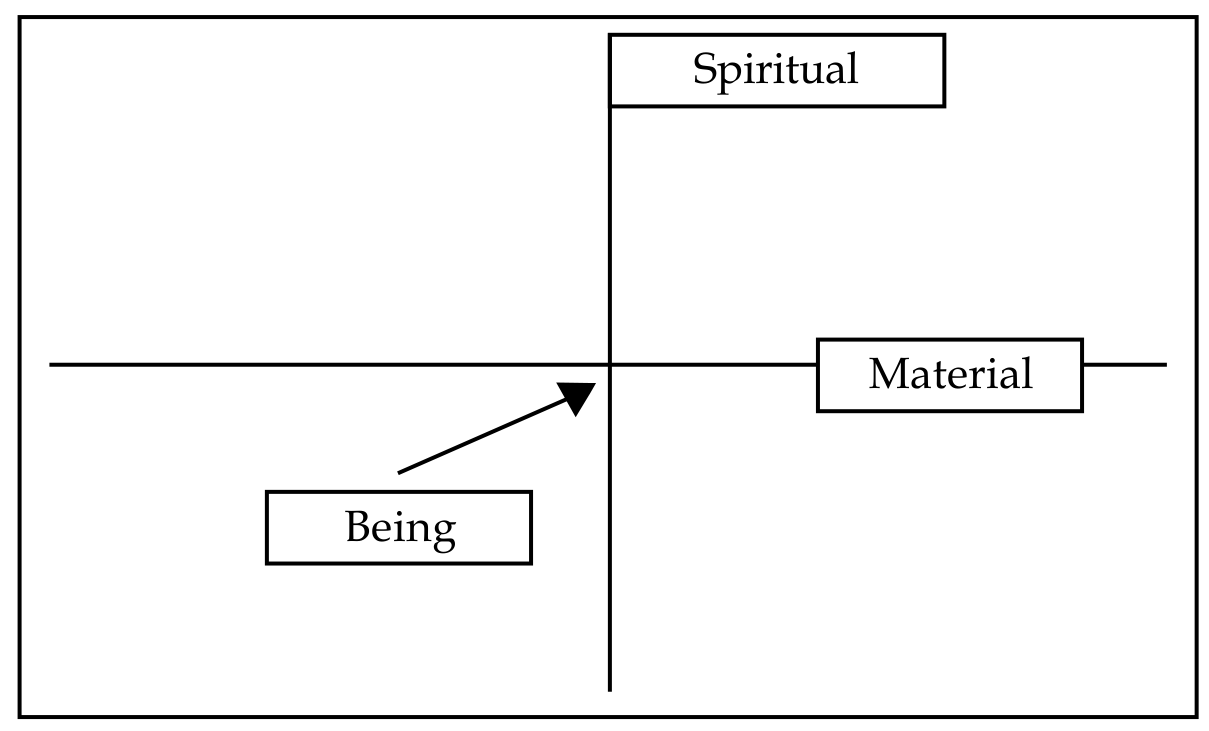
Let me explain what I mean by the word surrender. Then you can understand better. Think of two intersecting lines, axes.
The vertical axis is spiritual life. The horizontal axis is material life. The point of intersection is your being. This is the goal you have. You have some goal in your material life and also in your spiritual life. To achieve your goal in your material life, you are continuously struggling and working. You are somewhere on the horizontal axis. To achieve your spiritual goal, you are again working intensely doing yoga, prāṇāyāma, pratyāhāra, etc. You practice spiritual techniques. You are somewhere on the vertical axis. So when you struggle with material goals, you are on the horizontal line whereas when you struggle with spiritual goals, you are on the vertical line.
As long as you are struggling, you can struggle either in this direction or that direction. As long as you struggle in material life, you avoid spiritual life. As long as you struggle in spiritual life, you avoid material life. Both are a struggle.
Krishna says, 'Relax from both.' You may think, 'What is this funny instruction He is giving!' You think that if you relax in both you will lose both. However, the truth is that when you relax in both, you fall into your inner consciousness, your being or your inner space. When you experience this inner space, this inner consciousness, you will suddenly realize that you can explode in all directions. You do not need to choose between horizontal and vertical lines. You can travel on both lines at the same time!
Not only that, you can explode in all directions. The only difficulty is that you must surrender at least to your own being. You do not need to surrender to somebody else. To whom you surrender is unimportant. Just relax into your own being. Just relax into your inner space, into your inner consciousness. Just surrender to your own inner space. Stop your struggle in the material world and the spiritual world.
In the material world, the world of 'mine', your properties are your goal. You struggle to achieve these goals. In the spiritual world also you have certain goals, such as enlightenment. And you constantly run to attain that goal. Actually, spiritual goals create more ego than material goals. At least with material goals, at some point, you realize that you cannot achieve real happiness by running behind them. It can be tiring. But with spiritual goals you do not even understand what you are doing. Both goals take your being away from your being. When you surrender and relax into your being, you suddenly realize you are neither the body nor the mind, to choose between the horizontal and the vertical lines.
As long as you believe you are the mind, you will be forced to choose between the vertical and horizontal lines. You will be in a dilemma because the mind wants to choose. The mind and dilemma are the same thing. The mind ceases to exist once dilemmas vanish. The mind exists as long as you have dilemma. As long as you have confusion, the mind exists. Has your mind existed without dilemmas? No, never! You may be in a dilemma even to answer this question; that is all! The mind continues to exist only in dilemma. You continuously worry about whether to choose this or that.
A small story:
A man was sitting at home crying loudly. Usually men do not cry and especially not loudly!
His wife asks, 'Why are you crying?'
He says: 'Do you remember when your father caught us red-handed when we were together twenty years ago? He threatened me that if I did not marry you he would have me put in jail.' The wife replies, ‘Of course, I remember. Why are you crying for that?’
The man says, ‘If I hadn’t done what he said, I would be a free man today!’
Whenever you choose something, someday you will definitely wonder about the choice you made. The mind is based only on dilemma. The mind only exists because of dilemma. As long as you are based in your mind, you will be choosing between material and spiritual goals. The people who choose material goals will feel that they are missing spiritual life. And those who pick spiritual goals will feel they are missing material life. This is because you choose between the two.
For the first time, Krishna gives the ultimate technique for Quantum Spirituality. He is the first quantum scientist of the inner world. He says relax and surrender and you will experience the intensity of your inner consciousness. You will understand that you do not need to choose between the horizontal and vertical lines. You can explode in all 360 degrees. You need not make a choice. You experience choicelessness. Choicelessness does not mean that you do not choose anything. When you stop choosing, you will choose everything.
Similarly, surrender does not mean passive surrender or pretending to give up. Many people claim, ‘Swamiji, I have surrendered everything to God.’ It is mere lip service only. It is not reality.
People come up with odd statements. They tell me, ‘Swamiji, I have given up everything, I have surrendered everything to God. Bless me so that I get a better paying job!’
Most of the time, our surrender is false. Before making a statement, please be clear about its meaning. A woman told me, ‘Swamiji, you must take care of me because I have totally surrendered to you. Please give me mental peace.’
I said, ‘Okay, attend the next meditation program and we will see.’
Immediately she replied, ‘I cannot spare two days!’ She had just told me that she had surrendered to me!
We sometimes make statements without knowing what the reality is.
A small story:
A journalist saw a crowd gathered around an accident on the road. He tried to find out what had happened, but could not get through the crowd. He shouted, 'Oh! My son has been hurt in the accident. Please move out of the way.' The people gave way. He moved forward, only to see that a car had hit a donkey!
Before making any statement, know the situation. Otherwise, you will suffer! With the word surrender you make that mistake. With real surrender you do not exclude anything. You include everything. You experience everything at once. You do not need to choose between horizontal and vertical lines. You can experience both and something more. You can explode! You experience something beyond your imagination. You experience different dimensions of your being.
Again, when I say surrender, you do not need to surrender to any God or guru. God or guru are symbols or representations. Just surrender to your own being, to your own consciousness, to your own inner space. The problem is you do not respect your inner space. That is why in the initial level you need an entity called God or guru.
Somebody asked me, 'Swamiji, I have surrendered to you. What should I do?'
I told him, 'If you really surrender, you will not have that question! You will be guided from within. When you fully surrender, intuition or divine intelligence automatically guides you. As long as you have doubts, you have not surrendered.'
Q: Swamiji, you said that rituals connect us with the cosmic energy. Please can you explain how.
The Isavasya Upanishad says beautifully: īśā vāsyaṁ idaṁ sarvaṁ - From energy, all matter was created.
When Albert Einstein, the famous physicist read these words, he exclaimed: I had developed the theory that all matter can be converted to energy. Five thousand years ago these great masters have gone beyond what I have found out, by saying that all matter came from energy. Spirituality indeed starts where science stops!
The Taittreya Upanishad says that from the cosmic energy came the energy of space. From space came the energy of air. From air came the energy of fire. From fire came the energy of water. From water came the energy of earth. From earth came plant life. From plant life humans were created.
The Taittreya Upanishad goes on to develop the theme of the five layers or sheaths that surround our body, called the panca kośas.
The first and outermost layer is the food layer, the physical or gross layer, the annamaya kośa. The next inner layer is the prānamaya kośa, where the breath energy resides. The next layer is the manomaya kośa, or the mental layer from which our senses operate and generate thoughts. Further inward is the vijñānamaya kośa, the wisdom layer where our energy centers, the cakras, lie. The innermost layer surrounding the Self or ātman is ānandamaya kośa, the bliss layer. Beyond all this is the ātman, the Self, that is the reflection of the universal energy within us, the Divine, God or whatever name you wish to give it.
In the Atma Spurana Program, you are taken on a journey through these five layers to understand what happens in these sheaths surrounding our inner Self. In the Nithyananda Spurana Program or NSP we take you through the seven layers the spirit passes through as it leaves the body. These seven layers are also related to the five kośas. The meditation techniques specifically designed for each layer in these programs provide an understanding of how your body-mind-spirit system operates. So these techniques heal physiological, emotional and mental blocks in each layer and provide a glimpse of the inner consciousness.
Humans digest four of the five elemental energies described in the Taittreya Upanishad: air, fire, water and earth are ingested in one form or other by humans. We breathe air, drink water, cook and warm through fire, and we feed off the earth.
The energy of space or ether, ākāśa, is not directly accessible. The mind or ego layer that surrounds us prevents us from absorbing this energy, the biggest elemental energy source. This creates the illusion of separation from the elemental energy from which we are formed, and it insulates us.
Meditation is the only method through which we can drop the mind layer and open ourselves to receive the energy of the universe, through the energy of space.
Fire rituals, such as homas and yajñas, are mass meditation techniques since they help link a large group to the elemental energy. In a fire ritual, the energy of space is invoked into the fire through air. It is then transferred to the water in the pots that are kept around the fire. The water is then poured onto idols, humans or the earth, thus transferring the energy to them. Our great sages developed this simple technique to absorb the energy of the universe.
These original methods have been reduced to mere rituals today. The spirit has been removed from spirituality to leave only 'rituality' behind! When you become aware of the meaning behind these powerful rituals, something opens up within you. The awareness of your inner consciousness expands. That is why Krishna specifically stipulates that these sacrifices should only be practiced with awareness.
Meditation opens us up at the individual level to receive the cosmic energy, whereas rituals, such as homas, open us up at the mass level. We had a mass yajña in the city of Salem in Tamilnadu, India in 2006. One thousand yajñas were conducted simultaneously by brahmacāris trained at our ashram. Nearly 10,000 people particiated in the performance of the ritual over two days. Effects of such rituals when done in the presence of and by masters have far reaching effects.