To Be In Action Is Human Nature
This text was machine-transcribed from the printed book and may contain errors. Select the words and choose “Report a mistake”.
3.5 Surely, not even for a moment can anyone remain without doing anything.
He is always in action, despite himself, as this is his very nature.
3.6 He who restrains the sense organs, but who still thinks of the objects of the senses, is deluded and is called a hypocrite.
3.7 He who begins controlling the senses with the mind and performs selfless work through the organs of action is superior, O Arjuna.
3.8 Do your prescribed work, as doing work is better than being idle.
Even your own body cannot be maintained without work.
Usually people ask, ‘Swamiji, you say that life is purposeless. Then I may as well just lie down and relax. Who will give me food? Who will pay my bills?’
Let me tell you, you can never lie down forever. You may lie down for the next four or five days, because you always go to the extreme, like a pendulum. Now the pendulum is at one extreme.
If you remove your hand, it will swing to the other extreme. For a maximum of one week you will be able to lie down. After that, you won’t be able to lie down. By your very nature you will start doing some work.
When I say life is purposeless, I am not asking you to just lie down and relax in your house. All I am saying is, ‘Let your body and mind work without disturbing your inner space. You don’t have to sell your inner space to enjoy the outer place. You don’t have to sell your inner bliss to have outer comforts.’
‘By your very nature,’ Krishna gives the assurance here, ‘By your very nature, your body and mind will work; if you just keep quiet that is enough; they will function beautifully.’
Somebody asked me, ‘Swamiji, how can I do the right thing? How should I train my mind to do the right thing?’
I told him, ‘Just keep quiet. Automatically your body and mind will do the right thing. If you just get out of your system, that is enough, the Divine will get in.’
All we need to do is just get out, for the Divine to enter.
‘By nature,’ He says, ‘prakṛti-jair-guṇaiḥ’- by their very nature your body and mind know the right thing to do.’ The problem however is that you never trust your body and mind. You never follow your body and mind fully. You always trust your ego and it finally dumps you! Yet you never trust your body and mind.
Be very clear, your body and mind by nature will do their work. All you need to do is keep quiet, relax from your ego. Don’t think your inner space is needed for the outer work. The person who understands what nitya (eternal) is, and what anitya (transient) is, the person who understands what is eternal and what is ephemeral and relaxes into Existence is always in eternal consciousness. He always resides in nitya ānanda – eternal bliss!
Krishna says, ‘A karma yogi (one who follows the path of action) is a man who relaxes into nitya ānanda and does his work.’
Just relax into your inner space, and automatically you will be guided. You always think, ‘If I relax mentally thinking that life is purposeless, how will I know what is right and what is wrong? How will I finish my work on time?’
Please be very clear, when you worry about what is right and what is wrong, you will not make small mistakes; you will commit big blunders. The person who doesn’t worry, who never bothers, may make small mistakes. But the person who continuously worries will never make small mistakes; he will commit big blunders. And I tell you, to take this leap of faith needs courage. Even if you make one or two mistakes, what is wrong?
Taking the risk and jumping, and living without worrying, is what I call courage, the courage to enter into spiritual life. When you take the jump, you will naturally make some small mistakes. Don’t worry about them.
Putting up with that mistake is what I call penance. Penance is nothing but accepting the small mistakes which you make when the conscious transition happens in your being.
When you move from ephemeral consciousness to eternal consciousness, when you move from worry to bliss, when you move from falsehood to truth, you will make a few mistakes.
You will fall and rise just like a baby learning to walk. When babies learn to walk, they always fall the first few times. But just because of that, can you say they should never walk? No! Even if they make one or two small mistakes, they have to stand up and start walking. Those small mistakes of falling and trying to stand up are the penance done to learn how to walk.
In the same way when you start trying to live without the ego, initially you may commit mistakes. But don't worry about that. That is penance.
Have courage and just enter into the zone of no-ego. Enter into the zone of eternal consciousness. Simply start living and realize the purposelessness of Existence.
Decide, 'Today onwards I will live without worrying. Life is too short to be spent worrying.'
Don't bother about the goals - just drop the goals. The moment you understand the beauty of purposelessness, all the wounds which you have created in your inner space will be healed. You will fall into the comfort of eternal bliss.
A man who keeps his senses under control, but who is not able to keep his inner space under control is called a pretender, a hypocrite, says Krishna.
Please be very clear, the quality of your life will be judged only based on the quality of your inner space, not the quality of your outer space. When you leave your body and enter into your next life, nobody is going to keep accounts of what type of car you drove, in what type of house you lived or what your bank balance was. No! These details will not come with you.
How you lived, how your inner space was, what was the quality of your inner space when you lived, these are what you are going to carry forward with you. That is why the scriptures state, 'You are going to carry with you only the saṁskāra (engraved memories), the karma (unfulfilled desires) and the vāsana (mindset) of your inner space - not the outer space.'
A beautiful story from Ramakrishna Paramahamsa, the enlightened master from India:
A monk was living in a temple, doing meditation and preaching the glory of the Lord. Opposite to his dwelling lived a prostitute who was busy all day long. She was deeply devoted to the Lord. No matter what her business was, she was immersed in the silent contemplation of His glory.
As was the tradition in earlier times, she and the others from her group would serve the temple by singing and dancing in front of the deity.
Everyday this monk would notice everyone who entered the prostitute's house, at what time they entered, at what time they left, how many people entered; he would keep track of everything because he had no other work. When you don't have any work you will be interested in other people's work;
Continuously, he kept accounts of how much time each person spent there, etc. He was almost like the diary maintainer for that prostitute!
He maintained a complete diary of who came, who left, who visited regularly, who came once in a while or often. The whole day he thought about what was going on in there.
But the prostitute lived in a different way. She thought, 'My life, my natural duty is this. This has been given to me in this life. I don't know any other profession. I have to live only like this. For my food I have to live this life. But please save me, O Lord! Let my mind and heart always be at Your feet.' She was deeply devoted to Krishna. Her inner space was filled with the Divine. Her inner space was filled with God's name and Divine love.
Life went on. After many years, suddenly, both the monk and the prostitute died on the same day. The story is really beautiful!
Both of them reached Yama Dharma's (Lord of death) court for judgment. First, the prostitute came in. Yama Dharma saw her list of sins and merits and said, 'Alright! Don't worry. You lived all your life thinking of the Divine, so you can go to heaven.' She was sent to heaven.
It was then the turn of the monk. The moment the monk arrived, Yama Dharma said, 'This is your list of sins and merits. Throughout your life you thought about the wrong things, so you must go to hell.'
The monk started shouting, 'How dare you send me to hell!' He is a professional preacher, so he knows how to shout! He started shouting, 'I will sue you.'
Yama Dharma said, 'Please relax. Up here in heaven we don't bother about what you do in life; we bother about how you live. Through your body you lived a pure life. Look at planet earth and see how your body is being honored.'
There the monk saw that his body was being honored like that of a celebrity; people were falling at the feet of his body. Big garlands were offered. Grand worship was being offered to the body. His body was being carried to a tomb earmarked for holy men and his body was receiving great respect.
Yama continued, 'Through your body you lived a pure life; your body is now getting the rewards. But through the mind, you lived an impure life; so you have to go to hell.'
Yama continued, 'Similarly, she lived an impure life through the body. Look at her body.'
Nobody was there even to care. Because she was a prostitute, no husband, no sons, nobody was there even to do the last rites; the body was stinking. The scavengers just came and dragged the body and dumped it somewhere.
Yama continued, 'See! Through the body she lived an impure life. Her body is suffering. But through the mind she lived a pure life, a divine life. She is therefore going to the Divine.'
It is important how you live in your inner space. It is your inner space which matters. Please be very clear, again and again Krishna declares:
karmendriyāṇi saṁyamya ya āste manasā smaran |
indriyārthān vimūḍhātmā mithyācāraḥ sa ucyate ||
If you can't clear your inner space, even if you control your body, even if you control your senses, you are just a hypocrite. Your life will not be a blissful life; your life will not be a real life. Not only will it not be a spiritual life, it will not even be life!
The meaning of living is bliss, but there is no purpose. The more you think about purposes, the more worries you will create; the more will you try to squeeze the most out of life. But life is much more intelligent than you.
When you try to squeeze the maximum out of life, it just slips through your fingers.
Life is like a river. If you place your hands in the river and keep them open, the river will always be there in your hands. But if you try to hold it, you will have only empty hands!
Life is a flowing river. If you just allow it to happen it will continuously flow through you. The moment you try to possess it, you will have only empty hands. You will not be able to have life itself.
The moment you experience in your inner space that nothing is going to be with you permanently, a deep healing, a breeze enters your consciousness. Your whole inner space is healed.
You have so many wounds in your inner space. Wounds created by your desires, wounds created by your failures, wounds created by your near and dear ones. All these wounds will be healed with this one medicine.
This one understanding that life is purposeless, that whatever you achieve is just nothing, and that nothing is going to be with you, is enough.
A small story about Alexander:
Alexander the Great, who committed so many murders, can never be called ‘the Great’. Please be very clear: Never teach your kids that Alexander is great. Then you are inspiring them to commit murders! You are inspiring them to enter into war. Unconsciously, you are putting all these ideas into their heads. Never do that.
Of course, he did one good thing. Fortunately or unfortunately, he met an enlightened master in India. Somehow, his teacher in Greece gave him the idea, ‘Bring one enlightened master and the Vedas from India, and I will change the whole society.’
So Alexander decided he would take at least one enlightened person from India. Somehow he got the chance to meet an enlightened person. He invited him, ‘Please come to our country.’
The master just laughed and said, ‘No, no! I don’t want to come anywhere; I am happy here.’
Alexander said, ‘No! Please come. I will give you a big palace. Here you are living like a beggar without even clothes, without even enough food. Please come with me. I will give you a big palace and all the comforts.’
The master just laughed and said, ‘No. I am quite happy here, I don’t want to come.’
You know the next step a king will take. First, by addressing the master’s greed he tried to entice him. When it did not work out, the next step, he tried through the fear factor. He simply took his sword out, pointed it at the master and said, ‘If you are not ready to come, you will be killed.’
Faced with the naked sword, the master just laughed. Please be very clear, laughing now is very easy, but laughing when faced with a naked sword is very difficult, especially when the person who is holding the sword is a king - because if he kills there is nobody to even question him.
But in front of the naked sword, the master laughed and said, ‘Fool! You are a liar.’ He straightaway looked into the eyes of Alexander and said, ‘Fool! You are a liar.’
For the first time Alexander was shaken. For the first time he was afraid! He asked the master, ‘Are you not afraid?’
The master replied, ‘Afraid of what? You can never kill me. You may destroy this body, but you cannot kill me.’
That is the courage and confidence gained by the spiritual experience as we study in the Gita:
nai ’naṁ chindanti śastrāṇi nai ’naṁ dahati pāvakaḥ |
na cai ’naṁ kledayantyāpo na śoṣayati mārutaḥ ||
It means: Ātman or the soul cannot be killed; the soul cannot be destroyed; it cannot be burned.
This had become an experience for the master. That is why he had such courage and confidence. He just laughed.
Slowly, Alexander started thinking, ‘If he can laugh in front of my naked sword, how courageous he must be!’ For the first time he was shaken, because he had never seen anybody who could laugh in front of a naked sword, who could laugh in the face of death. Even he was afraid.
Please be very clear, all the so-called great warriors are cowards. They kill others before they are killed, that's all. They live in constant fear of death. That is why they kill others. Just to hide their cowardice or to escape from the fear of death, they start killing others. Alexander was totally shaken. He was shocked to see the courage of this master. He asked him, ‘Please tell me something. How are you so courageous, so bold?’
The master asked him in return, ‘Tell me, why did you come to India?’
Alexander replied, ‘To conquer India.’
The master continued, ‘After that, what are you going to do?’
Alexander replied confidently, ‘I will conquer the next country.’
The master again asked, ‘After that, what are you going to do?’
Alexander continued, ‘I will conquer the next country.’
The master persisted, ‘And after that?’
Alexander replied as if the answer was obvious, ‘I will conquer the whole world.’
The master questioned further, ‘After that?’
Alexander replied, ‘I will relax and enjoy.’
The master said, ‘Fool! That is what I am doing now!’
The master said, ‘Don’t you see that that is what I am doing now? Why do you need to go around and conquer the whole world to relax and enjoy? That is what I am doing now right in front of your eyes!’
Only a man who has understood the impermanence of life can relax and surrender totally even in the face of death. The master gave a glimpse of the Truth to Alexander.
That is why Alexander said to his ministers, ‘After my death, during the funeral procession, please let both my hands hang out of the coffin, visible to all. Let people know that even the great Alexander could not carry anything with him’.
Even Alexander could not carry anything with him.
This is a beautiful story.
You need to understand three things. The first thing is the courage and confidence radiated by an enlightened person.
The next thing is the purposelessness of our running. For what was Alexander running? To relax and enjoy. This master was already doing the same thing!
The third thing is that we are not going to carry anything with us when we leave. Even if the whole world worships you as a king, you cannot carry that with you! You have to go empty handed.
Mad people also claim they are kings, while people who are sitting on the throne also claim they are kings. Why is it that the former are put in an asylum and the latter are respected?
If the person is cunning enough to convince others about what he says, he is respected and given a throne. People who are innocent, people who are not so cunning, people who are not able to frighten others into accepting what they say, are put in the asylum, that’s all.
In Existence, there is no mad person, and there is no king. Both are one and the same. A person who can make others believe that what he says is the truth sits on the throne. The one who doesn’t have that much cunningness sits in the asylum.
A small story:
One man in India suddenly started thinking and claiming that he was Jawaharlal Nehru. At that time, Jawaharlal Nehru was the Prime Minister of India.
If he had only been claiming, it would have been okay. He started dressing like him, which was also okay. Then he started writing letters to all the officials and signing them, ‘Jawaharlal Nehru.’ Naturally, he was taken to an asylum and treated for six months.
After the treatment, he started behaving normally. The doctor said, ‘I think you can be discharged now.’ The day he was about to be discharged, fortunately or unfortunately, Jawaharlal Nehru himself visited the asylum.
They brought this man to Nehru and introduced him. 'Sir, he is the person who used to claim he is Jawaharlal Nehru.'
After the formal introduction, the man asked Nehru, 'Who are you?' Nehru said, 'I am Jawaharlal Nehru.'
The patient said, 'Please stay here for six months. They will cure you!'
Understand that there is no difference between these two. Somehow one is able to convince others that what he says is the truth. The other one is not able to convince others, that's all! There is no other difference.
In Existence, there are no boundaries. In Existence there is no post.
Never think that having comforts in the outer world will give you inner fulfillment. Never! All developed countries are filled with depression. They have the best roads, the best dams, the best bridges, the best infrastructure, but their people are depressed. Never think that outer space will give you inner space.
If you want inner space, you need to work for the inner space. You need to understand the dynamics of inner space.
Here, Krishna is giving you the technology to gain inner space. Let us see how we work, or how our mind moves. This graph represents your being. Material life
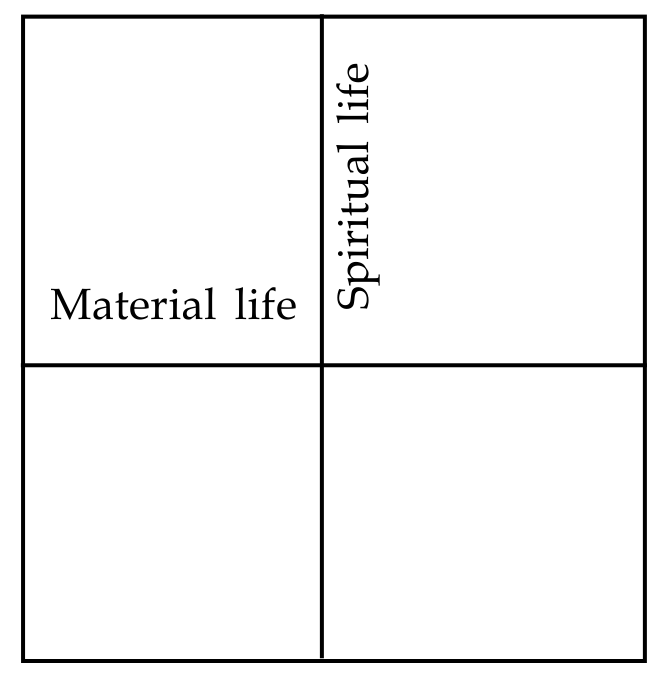
is the horizontal line and spiritual life is the vertical line. You continuously worry about whether to choose the horizontal line or the vertical line; whether to go on this (horizontal) path, or that (vertical) path.
You are always stuck somewhere on the horizontal line or somewhere on the vertical line. You try to move but you are always caught in the dilemma of whether to go this way or that way.
Mind is dilemma. Mind is nothing but dilemma. Whatever you choose, whether material life or spiritual life, you will always feel you are missing the other part. You will continuously feel you are missing something.
As long as you think you are the mind, as long as you live with the mind, you will have this problem of material life verses spiritual life.
Just like how people have goals in material life, they have goals in spiritual life too. There are so many people who say, ‘I should meditate for seven hours daily. I should become enlightened. I should become that, I should do this, I should be that.’
Please be very clear, goals in material life and goals in spiritual life, both make you go mad. If you want to become mad, continuously think of some goal. It is the easiest way to go mad! But if you can just withdraw into your being, you will just forget about the goal. And you can still work. By withdrawing into your being, you stop trying to locate a purpose somewhere all the time and running towards it.
The man who runs behind the material goals, will always feel he is missing the spiritual goal. This is the reason all rich communities invariably follow spiritual masters. They carry a deep guilt and fear that they are missing spirituality.
You can see this in every society. If the community is rich, they will have strong gurus, because of the deep guilt that they are missing spirituality.
Please be very clear, that is why the so-called religious men and rich men are always trying to be together. You will always see these two types together because the rich man needs the religious man and the religious man needs the rich man. Both feel that they have missed the other aspect in their own lives.
The person who travels along the horizontal line feels he is missing the spiritual life and the person who travels along the vertical line feels he is missing the material life. Both are trying to fulfill each other cerebrally.
The materialist fulfills the spiritualist’s ideal and the spiritualist fulfills the materialist’s ideal. The person who chooses the spiritual life feels that if rich men are around him, what he is missing will be fulfilled. In the same way, the person who chose the worldly life feels that if he goes to a spiritual man or a religious man, he will be fulfilled. Both are helping each other.
The man who realizes the purposelessness of both these goals, the purposelessness of the running, just falls back into his being. When you realize that whatever you consider the purpose or goal of your life is ultimately meaningless, the very moment you realize this and the glamour is gone, that very moment the need for perspiration is also gone; you stop running.
Mind you, it is not inspiration; it is just perspiration that you give up! The moment all respect for the purpose is gone from your life, you will simply fall into your being.
One important thing: The moment you fall into your being, you explode! Not only do you start flowing in the direction of both horizontal and vertical lines, but you also explode in 360 degrees in all dimensions. Whatever you can imagine and whatever you can't even imagine will start happening. Only then do you become a truly multi-dimensional being.
A man who has fallen into his being, one who has dropped goals, who has tasted the beauty of purposelessness of Existence, who has realized, who has fallen into his being, explodes in 360 degrees, in all dimensions. He simply radiates in all directions!
He starts experiencing the ultimate bliss of spiritual life and the ultimate happiness of material life and something more! Only he enters into eternal bliss or Krishna consciousness.
As long as you are caught up with material goals or spiritual goals, you travel only in one direction, because you think you are body or mind.
The more you are caught up with purposes, the more you will think you are body or mind. When you realize the purposelessness of it all, you will straightaway fall into the depths of your being.
Please be very clear, the Original Sin is thinking of yourself as body and mind. Don't think that Adam eating the apple was the Original Sin. No! Why should we suffer for Adam's sin? The Original Sin is not Adam eating the apple; it is you thinking of yourself as body or mind.
Actually, for an individual to become enlightened, you don't need the whole Gita. This single verse is enough to make an individual enlightened.
Then why am I speaking on all the verses? It is only because there are so many different kinds of individuals. This are different keys for different individuals, which is the reason for explaining all the verses.
If you can fall into yourself, just look into yourself and understand this one verse for yourself, not for the sake of going home and explaining it to your wife, or to your mother-in-law, or to your friend, or to somebody else, but for your own self.
Whenever I speak, understand that I am speaking to you. Don't prepare notes in your mind to go and repeat it to somebody else. When you prepare notes you think, 'I should go and tell this to my husband; he really needs it.' When you do this, you are sure to miss the experience yourself!
Just allow this one idea to work on you: the truth of the purposelessness of life. You can just close your eyes and think, contemplate for two or three minutes: 'What is really the purpose of my life? Why am I doing what I am doing? Where am I going? What is happening?'
If your inner eye opens, if your inner space experiences the beauty of purposelessness, that is enough. You will fall into your being.
As of now, you can experience neither material life nor spiritual life because when you are here, you are looking there and when you are there, you are looking here. You never experience either in a solid way.
Your mind is not where your body is. You are not living inside your boundary. The other side of the river always looks greener. Something else is always calling you. Only when you experience the beauty of purposelessness will you be able to understand what Krishna says throughout Karma Yoga.
Relax! Understand this one thing. Just understanding this one single idea can transform your whole way of thinking, working and living. When you understand there is no purpose of life, you will start enjoying every single moment; you will start living intensely in every single inch of your body. Every moment will become meaningful.
When you think that life as a whole has a purpose, the individual moment will lose its meaning. If you think one month of your working time is worth fifty thousand dollars, you will judge the value of that one month as being only fifty thousand dollars.
Please be very clear, one month of your life is more than just fifty thousand dollars! If you calculate the value of your life at fifty thousand dollars a month, it may come to some 10 million, 20 million or even 100 million dollars.
Suddenly, if someone says, 'I will give you 50 million dollars, give me your life,' will you be able to give him your life? No! But, this is the way you are calculating and working! We are ready to sell our mind, our moments, our inner space by calculating the value of our lives. Logically, you fix the rate for your life. Once you fix the rate, only the rate is on your mind. You forget the work itself, or living itself, which is beautiful. But you miss it.
If you think the whole has a purpose, then the part loses its meaning. When you realize that the whole has no purpose, the part will become meaningful. Your very living, every day itself, will become very beautiful. Your life everyday, your living, your sitting, your walking, your standing, everything will become a joyful experience.
That is why they say sat chit ānanda, which means 'the bliss of the very existence'. Your very existence is blissful. You don't have to think that in the end you will have bliss. No! Your very existence is blissful. The meaning of existence is bliss, eternal bliss, nitya ānanda. But you need to take steps towards that bliss.
By nature, man has to work. What I mean is, by their very nature, the senses have to be engaged in some action. Even if you try and control them and do nothing externally, the very act of restraint is an action in itself.
The choice is really about how to work. Here, Krishna gives the answer to that. He says that we should perform work with devotion and without attachment to the results. Work without unnecessarily being bothered about whether or not it will fetch the results that you expect. If when we work, our thoughts are on the future, then we are not in the present moment. Am I right? Then how can we be performing to our fullest potential? How can I say that I am doing my work with full devotion if my mind is not totally merged with the task at hand? It's not possible. And how can I get the results I want if I'm not working to my full potential?
When do you get worried or afraid? It is when you have an expected result, when there is an unwritten expectation, and an unconscious desire to achieve something as the result of an action. Krishna says, 'Drop the very desire, drop the very expectation.'
We wonder, 'How can we function if we drop expectations?' Be very clear, I am not saying you should not plan and or you should do something without thinking. I am saying, 'Plan, but plan chronologically, not psychologically.'
You see, there are two things: chronological planning and psychological planning.
Chronological planning is planning on a timescale. You decide you to get up at a particular time, finish your morning routine by a particular time, reach the office at a particular time, finish the list of tasks you planned at the office by a certain time, and so on. This is a practical way to organize your work in such a way that it can give the best results. This is fine.
But what do we do? We don't stop at this. We review the plan in our head over and over again, thinking in different ways about whether we will be able to manage it. We keep supposing, 'What if this happens? What if that happens?'
In the name of contingency planning, we just worry. A contingency plan should help come up with alternative solutions. Then it won't sap our energy. But we are thinking about how to handle something if the plan does not go as expected. Instead, if we apply our awareness to the problem in an objective way, the solution will simply stand out.
But we complicate the whole process. We get worked up about contingency situations and introduce a complex negativity in the whole thinking process. We start hoping unconsciously that such a situation will not arise. We start worrying about what the possible unknowns are that have not been accounted for in the plan, and what not!
Psychological planning boosts your ego. It makes you feel great and worthy. It makes you stay serious and feel that you are handling great things.
Krishna says, 'One who does devotional work, without attachment, and controlling the senses, is superior to one who merely pretends to be in control of his senses and acts in renunciation.'
There are people of the intellectual type, who are philosophers, who are well versed in all the scriptures, who look down upon the devotional and emotional practitioners! Intellectuals believe that their dry understanding of the non-duality of the Self is superior to that of those who fall at the feet of the Divine. Krishna firmly says, 'No, it is not so!'
Krishna says that what makes the difference is your lack of expectations, the sense of purposelessness that defines your state. Sanyās (renunciation) is a state, not a label. The state of renunciation is not a state of doing nothing. You can never sit without doing anything. Even if you sit still in one place, you are sitting, you are breathing, is it not? The internal functions in your body are happening. Maintaining this very body requires that work be done.
The breath that you take in carries prāna, the life energy that sustains you. Constantly, air that is laden with prāna goes in, leaves the prāna inside and comes out. From the cosmos, we are taking in prāna through air. This is also an action being performed to sustain the body. So, you cannot say you are not doing anything.
You may think that it is better not to do any work rather than analyze what work you should do, how to do it, whether it will suit you etc. You can take this as an excuse for laziness, for your tamas. Tamas means laziness, lethargy. When Krishna says, 'I am not the doer, it is just the senses performing the actions according to their nature,' you say, 'Why should I even bother to do anything? '
Be very clear, by your very nature, you will act. Your body and mind, the gross body and the subtle mind, are, by nature, forced to do something.
Just try telling your mind not to do any work, not to think about anything. Try to sit with a completely blank mind, with no mental activity, not thinking about anything. Just relax and try this simple exercise. You will initially try not to think about anything. You will try to be aware if any thought comes to your mind. But, after a few moments, you will find yourself having some thought, about something from the past or the future. Some random thought about something would pass through the mind.
By nature, your mind will think about something or the other. If you try to force silence upon your mind, you will be forcing a dead silence, the silence of suppression. How long can you sustain that? The moment you drop your guard, mind will express its nature and start the wandering.
So, neither expression nor suppression is the solution. It is better to be aware of the nature of the senses and the mind, and be engaged in work with a sense of devotion. Be aware that when you are in action, it is the senses acting. Then you will not get attached to the action or its result. Then you are free; you are liberated from the bondage of action. Action binds you only when you consider yourself the doer and have expectations about things being a certain way.
Q: Swamiji, is it possible that meditation can take us into inaction? Even though my intention is to energize myself through meditation, I find I lose interest in things after meditation. Why?
This is an interesting and real issue.
Normally, you are in a state of action, which is the state of rajas. When you are in rajas, also described as aggression or passion, you are externally oriented. Your thoughts are focused on action of some sort or another, usually with some goal in mind. This is the state of most human beings, whether in business, academics or looking after the household. You plan your activities and goals and work towards fulfilling them.
When you go into meditation and practice seriously (this happens especially when you are in an ashram environment), you realize the futility of these goal-based actions. Suddenly you will see everything that you are doing with a negative attitude. A lot of negativity will seem to be surfacing in you, telling you that whatever you are doing is meaningless.
When you drop these negativities and do want to have anything to do with them, the state that you move into is tamas, or lazy inaction. Then suddenly you will find that you are uninterested in everything. You may just want to sleep, that is all. It is not quite depression, but a disinclination to act, because all actions seem meaningless.
This may last a while, a few days, but not for long. Let it happen. Allow yourself to go through this process. Let all the negativities work themselves out of you.
Then gradually you will move back into action with awareness, satva. You will act, since you cannot but act, as Krishna says, but now you will act without a purpose! The results of your action will no longer be of relevance to you. Success and failure no longer bother you.
So do not worry if you slip into what you think is laziness while practicing meditation. It is likely to happen. It is a normal process. Just continue and you will move into purposeless action.
People think that moving directly from rajas - aggression to satva - calmness is the natural evolution. It does not work that way. When you move out of your normal active and aggressive behavior, you first fall into tamas, inactivity. This is the movement of the mind when it turns away from aggression; it moves into inaction.
When this shift is caused by meditation, the inaction does not last long. The mind soon moves into a relaxed, calm state.
I have talked about this elsewhere in detail. The mind is constantly looking out through the senses. Its focus is external. It settles on the periphery. However, deep inside there is a longing inwards. So it is constantly getting pulled towards the center from the periphery. It is constantly getting pulled from the material to the spiritual.
Usually it settles somewhere in the middle. That is why I say that all humans are eccentric! Their senses pull them to the periphery and their being attracts them to the center. The mind settles eccentrically in between.
Meditation aids the movement inwards. As attention shifts from the periphery to the core, there is a resistance to what was experienced in the periphery. This leads to temporary inaction and detachment to peripheral experiences.
Once a glimpse of the core is achieved, there is no detachment or dislike. There is neither attachment nor great attraction for something, nor detachment nor dislike for something. All experiences are viewed non-judgmentally and with non-attachment. At the core it is always bliss; it is the state of nityānanda, eternal bliss.