Jump First, Think Later
This text was machine-transcribed from the printed book and may contain errors. Select the words and choose “Report a mistake”.
Q: Is it normal to speak less and seek silence as sādhana or spiritual practice progresses?
There is a Zen saying, ‘When I was not meditating, a tree was a tree and a mountain was a mountain. When I started meditation, they were both not what they were. When I finished meditation and became enlightened, the tree was again a tree and the mountain was a mountain.’
Before the sādhana you speak a lot. After enlightenment, you may speak a lot but with a totally new awareness, but during sādhana people usually tend to become silent.
As your spiritual awareness progresses, you may find one of two things.
In the past, you had an opinion about everything and you had to express it. If you did not you felt inadequate. You felt that others will not respect you unless you stood up for yourself, expressed yourself loudly and volubly, and most importantly, argued so that the other person felt small and withdrew.
As your energy level increases with spiritual practice, you are more centered and you do not feel the need to prove yourself anymore. You also realize that words can harm far more than physical attacks. So you settle into yourself and become silent.
At another level, you find that you can communicate just as well and perhaps better with others of similar energy just being silent. The need to talk reduces.
Either way, you find silence golden.
Q: Krishna continuously keeps calling Arjuna a kṣatriya and goads him to fight. I still feel Krishna is violent.
I have talked about this partly earlier. Let me explain more clearly.
First let us understand the word non-violence. The moment you say ‘I’ and ‘mine’, you are violent. Please understand what kind of beings we are. We can be intellectual or emotional or at the being-level.
During our lives we have stages of each of these three characteristics. How do we know what type of beings we are? The moment you ask this question, be very clear, you are intellectual. Emotional people will never have this question and people at the being-level will not even have this as a doubt.
Before you are married you may be an intellectual. Take the case of young men, especially a young Indian college student. Invariably, he does not prostrate or bow down before anyone and he considers traditional actions unworthy. He simply stands and looks while his parents pay their respects. Of course, I do not expect this from anyone, as this physical action is not of great consequence. But I always say to myself, ‘Just wait till you get married, then we shall see!’ Two years later the same young man, now married, falls flat at the feet! In just two years he has grown so much and is now so obedient and polite!
So, before marriage you are intellectuals and after marriage you invariably develop your emotional side as well.
Krishna knows very well that Arjuna is talking emotionally. Emotions of fear and greed have taken over and Arjuna is scared to face the consequences if he goes ahead with the fight because the opponents are his own relatives whom he is attached to. Arjuna wants to run away from the battlefield, not because he is a believer in non-violence, but because of his identity with his kinsmen and elders, because of his identification with these people. He would have had no problem battling them had he not known them, had he not been associated with them. Arjuna wants to run away because of this false identification which breeds violence.
Krishna would never persuade Arjuna to stay on and fight if truthfully, Arjuna proceeded from nonviolence. Krishna enlightens Arjuna to the falsehood of his beliefs and destroys his false belief that he is proceeding from nonviolence that had risen out of his attachment to his own identity.
Secondly, you need to have a clear understanding of how the varṇa system that we deride now as the caste system evolved in our vedic culture.
Krishna is referring to Arjuna's character, his mindset and his conditioning when he addresses him as a kṣatriya. A kṣatriya is fearless; a kṣatriya is power and courage personified; a kṣatriya acts before he thinks. However, now Arjuna does not act and talk as behoves a kṣatriya; he is behaving like a brāhmaṇa.
A brāhmaṇa is an intellectual. A brāhmaṇa is focused on knowledge, inner truth. The scriptures are his guideline. His behavior is based on satva, peace. Instead of being a commissar that is his natural state, Arjuna is now trying to quote scriptures and behave like a saint. Krishna is pulling him back into his natural state.
To a kṣatriya, a warrior, the greatest dishonor is to experience and express fear. Krishna says that such behavior will not only taint Arjuna in this life, but in the lives hereafter as well.
In the ancient vedic system four varṇas were classified. The brāhmaṇa were the intellectuals who read and maintained the knowledge of the scriptures and focused within. Kṣatriya were the warriors and rulers who took care of the brāhmaṇa and other people, their citizens and wards. Brāhmaṇa acted out of satva guna (calmness and peace) and kṣatriya out of rajas guna (passion and aggression). One acted with his word and the other acted with his sword.
The other two classifications were the vaiśya and śūdras. vaiśyas were focused on wealth creation and maintenance, the traders and businessmen. Śūdras were the workers in various fields focused on service.
There never was an attempt to compare one group with another, positively or negatively. The classification was based on natural aptitude. It was a very advanced system of training a person for the vocation for which that person was best suited. It was not hereditary. The son of a brāhmaṇa could as well be a śūdra if his aptitude was different.
A child was handed over to a master before the age of seven in the vedic gurukul system. The master identified the aptitude of the child and classified him as per the varṇa system. There was no bias. It was a very scientific system. Though the system was not designed to be hereditary, the very conditioning increased the probability of a child born to a brāhmaṇa parent being a brāhmaṇa. It made no difference though, since each group understood its unique purpose and did not in any way consider itself superior or inferior to another group.
Over time the system got corrupted, especially when foreign invaders introduced their cultures into our country. To protect themselves, people made the varṇa system hereditary. This became even worse when the gurukul system was destroyed by the British in their attempt to conquer the Indians. They realized that the only way to do it was to destroy their culture, and the best way to destroy the culture was to destroy its base of education and knowledge transfer. Millions of gurukul centers that existed even some five hundred years ago have been reduced to the few thousand in existence today.
It is the invaders as well who dramatically vilified and painted the varṇa system black. This system was what they themselves used as the guild system in their country, which helped them prosper. In the same manner that they divided and conquered India, they also divided the different varṇa groups and set them against each other.
The actions of the British still haunt India in many ways. In regions like Tamil Nadu, hatred created between varṇa groups resulted in destructive atheism and a total lack of respect for the vedic culture that had sustained the country for many thousands of years.
In today's society where one's value is measured purely in terms of dollars, it is the vaiśya group who would be the most sought after. Countries are no longer ruled by persons with a warrior mindset. They are ruled by people who are commercially and politically savvy, the vaiśya class. However, in the vedic tradition, there was no superiority of one class over another, unlike what we see throughout the world today.
It is not that someone born in one class could not become an expert in another field. Drona was a brāhmaṇa, but became the most feared of all warriors. Buddha and Mahavira were from the kṣatriya class but became enlightened masters through the path of knowledge. But Krishna is now trying to keep Arjuna on track as a kṣatriya. There must be a reason for this.
Much depends on the desires with which the spirit leaves the earlier body and the prārabdha karma (desires to be fulfilled in this birth) with which it enters the present one. This prārabdha could even lead in a direction different from the environment into which one is born. This is what happened to Buddha, Drona and others. This usually happens fairly early in life before too much conditioning happens through the environment. In the case of Arjuna, this was not so.
Arjuna was a prince who excelled as a kṣatriya. He was the greatest archer and a fearless warrior. His natural state and prārabdha was that of a kṣatriya. This is why Krishna time and again pulls him back into that mould. This is why He tells Arjuna that it is dishonorable for him to run away from the battlefield. He tells him to stand up and fight.
Is Krishna being violent?
Krishna is neither violent by Himself nor is He goading Arjuna to violence. As a master and the greatest of all masters, Krishna is focused on only one thing, which is to help Arjuna realize his own potential. Each of us is unique. A Buddha cannot become an Arjuna. An Arjuna cannot become a Mahavira. The master is fully aware of the inner potential of each individual disciple. He knows where that disciple has to go and how. He chisels him into that form and path, which ultimately takes the disciple to enlightenment.
This is what Krishna is doing here on the battlefield. If for one moment Krishna thought that Arjuna was sincere in his desire to walk away from the fight, He would never have urged him to fight. Arjuna was not shying away from killing. He was reluctant to kill a few people whom he felt attached to. This is not non-violence. This reluctance is arising from the fear of losing one’s possessions, one’s relationships and ultimately one’s own identity.
Arjuna’s behavior is based on ego, the fear of losing his identity. This is not nonviolence; it is a form of inner violence that differentiates between one and another. Arjuna’s reluctance arises from discrimination between those whom he considers his own and others who do not belong to him.
You may ask how you can call this fear violence. It is this fear of losing one’s identity that breeds terrorism. Terrorists are not courageous people. They are cowards who are desperately clinging to some actions and philosophy that can justify their existence and that can justify their importance. Their fear erupts as violence. It is like a rat being cornered. Even a rat will bare its teeth when its identity or life is threatened. Fear and the survival instinct breed violence.
This can be proved scientifically as well with the theory of the fight or flight response. It is the same chemical, adrenalin, which causes both reactions. Any trauma or fear makes a part of the brain, the hypothalamus, trigger the master gland or pituitary which causes the release of adrenalin into the blood stream. Adrenalin activates the extremities, hands and feet. Depending upon the situation, you use one or the other or both!
You either run with fear or fight with fear!
Krishna does not want Arjuna to operate out of fear. He is dissolving the fear that fills Arjuna. He is transforming Arjuna so that he will act out of conscious awareness instead of unconscious patterns and fear. Krishna wants Arjuna to move away from the unconscious fear that has gripped him. The only way to do that is to bring him to his natural state, which is that of the kṣatriya.
Q: I have read that we have three bodies. You had talked about seven energy layers. Are these similar?
In our first level course or Life Bliss Program, LBP Level 1, we cover the seven energy centers in the body, the seven cakras. These cakras govern our emotions and therefore our behavior. They control our emotional and physical wellbeing. When these centers are blocked we feel uncomfortable; we are in dis-ease. When these centers are energized, we get well and we move into ease.
In the second level LBP 2 course, called Nithyananda Spurana Program or NSP, you are taken through the seven energy layers in the body-mind system that the spirit passes through at the time of its departure from the body. The three bodies you refer to are part of these layers.
These three bodies are the physical body, the subtle or etheric body and the causal body, corresponding to the first, fourth and fifth energy layers. These are termed as sthūla śarīra or gross body, sūkṣma śarīra or subtle body and kāraṇa śarīra or causal body. They also correspond to the states of wakefulness, dreaming and deep sleep respectively.
Our body-mind system operates at the first two levels, the gross and subtle layers. The gross body is the material or physical body and the subtle body is the collection of our emotions and thoughts. We can see, touch and feel the physical body; it is made of flesh and blood. In comparison, the subtle body is atomic; it is intangible.
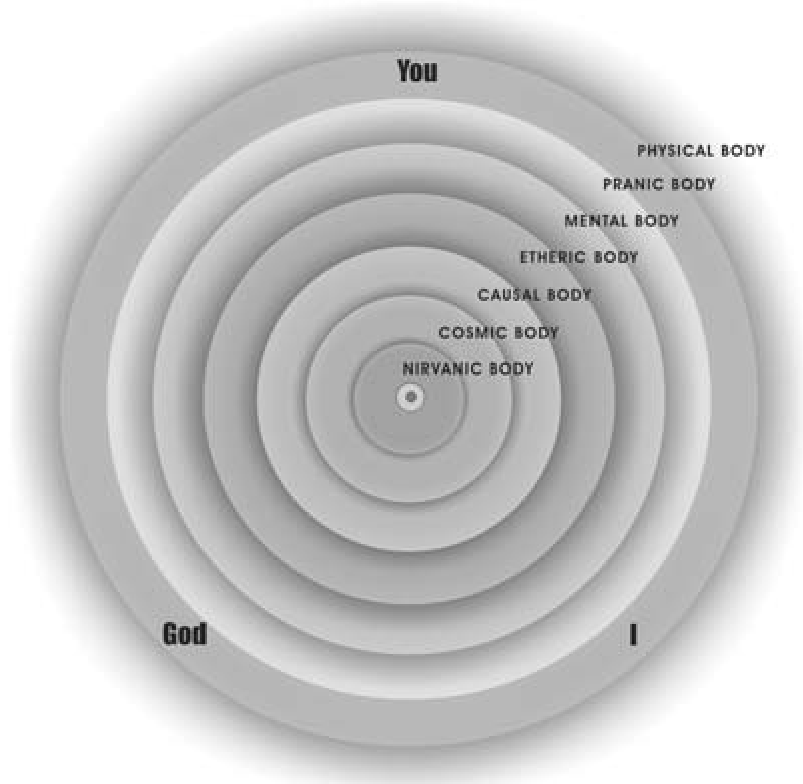
The subtle body comes from the past life, as desire, and becomes the prārabdha karma in the present body. The subtle body enters the gross body in the womb. The subtle body searches and finds a suitable carrier and when it does, it enters that gross body in the womb.
During the process of death and rebirth it is the subtle body layer that travels. It is not the Self, the soul that travels. The soul energizes the subtle layer, the etheric layer, which moves from one physical body to another. It is like a train driven by electricity. The electricity is the soul, which powers the train system. The train carriages and what is inside are the subtle and gross layers.
At death, the subtle layer and the gross layer perish. The spirit is separated from these two layers. The physical and emotional boundary that was created between the soul and the Brāhman, the individual energy and the cosmic energy, disappears. It is not that the soul and Brāhman were unconnected before; they were not; but the body-mind system, the ego and identity, created a barrier of ignorance between them, veiling the realization that we are one with the cosmic energy.
Without the subtle layer, the physical layer cannot exist. It cannot exist in the fashion that we know. Spiritual efforts aimed at Self-realization are exercises to destroy the subtle layer. Once the subtle layer is destroyed, once the collection of emotions, expectations, unfulfilled desires, thoughts and saṁskāras which form this subtle layer are destroyed, then the boundary between us and the cosmic energy disappears. We become one with the Divine. We reach our natural state.
The causal layer is the transition point between the present life and the next. It is the passage to death. Once this layer is crossed the spirit cannot return to the previous physical and subtle bodies. During the transition one is in a coma and can still return. This experience of the causal layer is the near death experience of those who experience death but do not die. Every night during deep sleep, the body-mind system passes through to this layer and returns. It is a regenerative process without which we cannot survive.
With meditation we transcend these three layers into a fourth state, the state of consciousness with awareness but no mind and no thoughts. This is the state of the soul, realization of the Self.