Drop Your Ego!
This text was machine-transcribed from the printed book and may contain errors. Select the words and choose “Report a mistake”.
Q: Swamiji, when you say that we should live without ego, is it really possible to do that when we live in the material world? Wouldn't we then become failures materially?
Ego, as I have used the term here, has two aspects. In Sanskrit, we call these ahankāra and mamakāra.
Ahankāra is ego projected outwards. It is about what you convey to others about who you are. This is always more than what you are. You would like people to think that you are more handsome, smarter, richer and in all ways better than what you really are.
Mamakāra is what you think about yourself within you. It is always less than what you really are. People say to me, 'No Swamiji, I have a very high self-esteem.' Remember, as long as you do not realize that you are God, your self-esteem is low!
The gap between ahankāra and mamakāra is what causes trouble. You like to project something that you do not think you are. You may term this differential ego. This is the differential you need to drop.
When you are the same while looking inwards and projecting outwards, there is no problem. You are quite natural. You are the real self. You do not need to boast, you do not need to hide.
If you reach this state, you will in fact do far better materially, because people will have far greater respect for you. You will be doing what you promise and promise what you can deliver. There will be no differential.
Of course, in a deeper sense, as you progress spiritually, you may drop all attachment to your self, your body-mind system. This does not mean that you cannot function in the material world. Many masters have functioned in such a state. In such a state, one’s identification is not with this material body-mind system at all, but with the Existential energy. Then, your ahaṅkāra and mamakāra are harmonized, at the highest possible level of divinity.
Q: Swamiji, you described four states of mind. How does one distinguish between the state of deep sleep, suṣupti, and the mindless state of awareness, turiya, the fourth state?
We have a combination of thoughts and identity to give us four states of the mind.
When we have thoughts in our mind, and we are aware of our identity, we are physically awake. This is the first state, the state in which you are listening to me
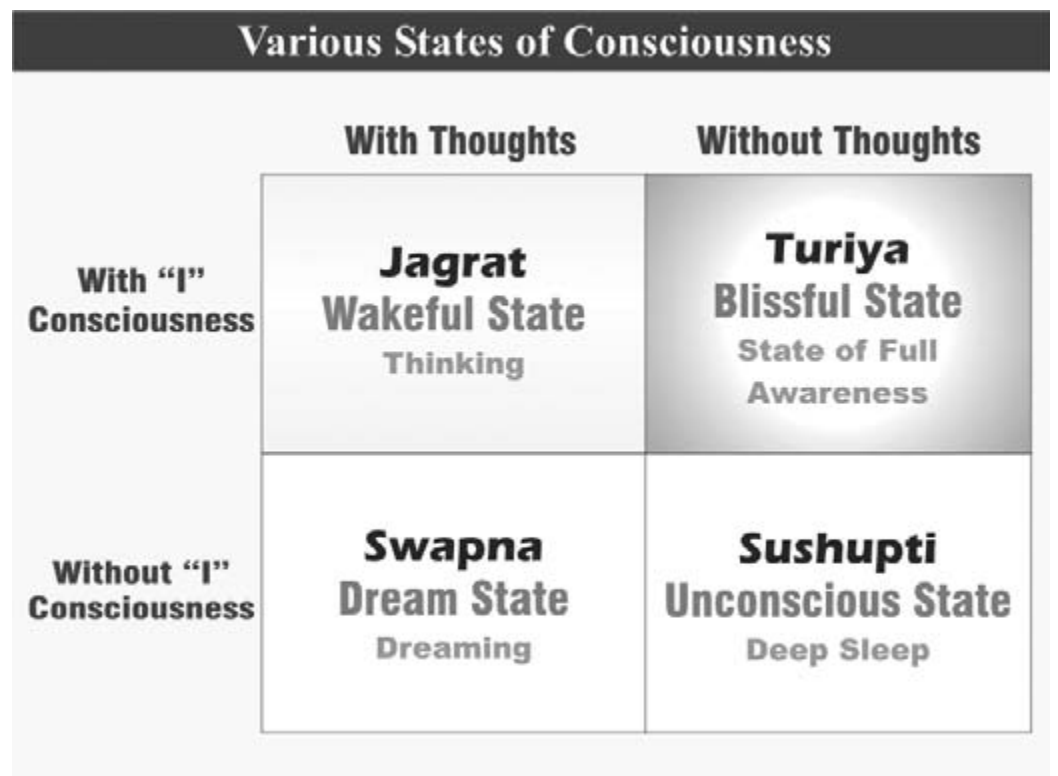
now. When we are unaware of our identity but still have thoughts, we are dreaming. This is the second state. While dreaming, there is no ‘I’ identity right? This is why we are startled into wakefulness when a nightmare seems to threaten our life, our identity.
Third, when we are in deep sleep, we have neither thoughts nor a sense of our identity. For all practical purposes we are dead. The body-mind system is refreshing itself by dying and being reborn every night and day.
The fourth state, called by some the Fourth Way, is the state where we are fully aware but have no thoughts! At least there is no attachment to thoughts, no linking of thoughts. It is only witnessing. This is the state called samādhi. Samādhi means returning to one's natural state, or simply put, the realization of Self.
Enlightened beings are in the samādhi state all the time. This does not mean that they are withdrawn with eyes closed continuously, not at all. As Krishna says, they are awake when others are asleep and asleep when others are awake. This means that they are always in awareness and that their senses are controlled or asleep.
Let me give you a simple tip to evaluate how evolved a person is. Watch that person when he is asleep, when he is in really deep sleep and he does not know you are watching. If that person is like a flower when asleep, totally blissful, with no movements and no facial changes, that person is in turiya or samādhi state. The body is asleep but the mind, while without thoughts, is fully aware. The body-mind is at rest and in bliss, nityānanda.
Thank you.
Thus ends the second chapter named Sāṅkhya Yogaḥ of the Upaniṣad of Bhagavad Gita, the scripture of yoga dealing with the science of the Absolute in the form of the dialogue between Sri Krishna and Arjuna.
BhagavadGita
Beauty of
Purposelessness
CHAPTER 3
Life is to enjoy living, not to chase goals. There is no real purpose to life; life in fact is purposeless. Once we create goals to reach, we create sorrow to follow.
◆ Swamiji, you say that skepticism is a big hindrance to learning. But you also urge us to voice our doubts. Why?
◆ If we are to drop the memories of what happened in the past as the master indicates to his disciple, won't there be more problems? People do learn from their past, from their past mistakes. If they drop their impressions of the past, they will suffer. Wouldn't they?
◆ Swamiji, is it possible that meditation can take us into inaction? Even though my intention is to energize myself through meditation, I find I lose interest in things after meditation. Why?
◆ Swamiji, what is suffering? Why do we suffer? Is suffering essential?
◆ Swamiji, whenever I am in your presence, all questions disappear and everything seems possible. But when I am away from you, all the familiar doubts creep in. Why does this happen and what can I do about it?
◆ Swamiji, in India we are brought up to follow rituals and idol worship. Are you for or against these?
◆ Swamiji, can you explain the concept of karma?
◆ Swamiji, when a relationship is not working out, when should we persevere and when should we abandon it and get on with our lives?
◆ Swamiji, you ask us not to suppress our natural passions. But is it right to indulge these passions?
◆ Swamiji, you tell us to 'give our all' in love. But what if the love is not appreciated or returned?
# Beauty of Purposelessness
The whole of Existence, the whole universe, is purposeless.
Of course, it would be very shocking to hear this. From a very young age, we are taught and socially conditioned to believe that life has got some purpose. We are always made to run towards some goal, towards some purpose.
‘What is life without purpose?’ you may ask. You may wonder, ‘How can this statement have any meaning?’ We feel that any activity, let alone one’s entire life, has to have a purpose, a definition, and an end point. Only then does it become meaningful. That purpose is what drives us, motivates us and adds spice to our day-to-day activities.
‘You are confusing,’ you would say. ‘All our life we have been brought up to believe that we are here for a purpose. As children we are expected to do well at school, and later at college. Once we grow up, we are supposed to get married and bring up our children. In each phase of our life, we have specific templates, specific guidelines that society and our family has set up for us. How can we let them down? How can we believe that all these expectations are wrong, and that there is no purpose to life?’
You would say, ‘You are turning our life upside down!’
The more you run towards a goal, the more you are considered a successful person. The greater the speed, the more you are respected. The greater the speed, the more the rewards. From birth, again and again, you are taught, society teaches you, that life has a purpose and a goal. Life without purpose seems meaningless to us. We cannot even comprehend such a possibility.
Understand that this is only what you have been brought up to believe. This is not the truth of Existence. Life does not need a defined goal to make living worthwhile, meaningful and happy. The absence of purpose makes our life meaningful. The absence of goals in life makes living worthwhile.
The universe, nature, has no purpose. It just is. It exists. A river runs downhill towards the ocean because it is its nature to run downhill. It is not because it has a purpose, to meet the ocean. Our life too, has no purpose. We were not born for a purpose. We were born to live, to enjoy life and to be happy. Instead, we set ourselves up for unhappiness; we set goals for ourselves, and almost always these goals are based on fantasies and not on realities. In the process, we stop enjoying life.
The more you run towards the goal, the more you miss life itself!
A person who is continuously bothered about goals will never be able to enjoy his life. He lives in the future and ignores the present. When we are in the present moment, the here and now, we do not need a goal to guide us.
Just the awareness of the present moment will help us decide what needs to be done at each point in time. When the present moment is taken care of with awareness, the future gets resolved on its own. As long as the path is right, whatever destination we reach will be right. We do not need to define the destination; the right path defines its own destination.
However, we constantly worry about the future. We constantly think of the past, relate it to the future and define our expectations based on what we have missed in the past, or what we believe will provide us happiness in the future.
For example, when you are studying you think, 'When I get a job, I will be happy.' When you have your job you think, 'After marriage my life will be happy.' After marriage, you think, 'When I have kids and my own house, I will be happy.' After you have kids and your own house you think, 'When the kids grow up and all my responsibilities are over, I will be happy.' By the time your kids are settled, by the time your responsibilities are over, when you want to relax, your being is so conditioned to running that you can't relax!
With this mental attitude, we are constantly running to stay in the same spot. Happiness is where we are. It is not where we think we should be.
A small story:
A very successful investment banker from New York was getting burnt-out. He had been earning millions since his youth by constantly running after goals and targets. Seeing him getting burnt-out, his friends advised him to take a break.
Knowing that the word ‘relaxation’ was not in his dictionary, they advised him to go to a distant rural spot well-known for fishing. They told him that fishing was very good for health so he could come back more energetic.
The man agreed and he went out and bought designer gear - clothes, shoes, hat, and of course, the most expensive fishing gear, including a designer bait. He took a flight to the nearest city and then drove down the village. He booked himself in the most comfortable place to stay.
Early next morning, he got dressed, and with all his gear went to the fishing spot. He sat under a shady tree, made himself comfortable and put his fishing line into the water and waited. He waited and waited. An hour passed. There was no sign of any fish being caught. He was getting impatient but he could not accept that he was not successful at something as simple as fishing when he could handle such complex businesses.
Just then, an old man who was living there, dressed in crumpled shorts and a simple shirt, came by and sat a few meters downstream from him.
The banker watched this old man with amusement, wondering what fish this old man intended to catch! The old man had a fishing rod, which was nothing but a long and sturdy twig, and a can of worms for baiting the fish. He settled down and put his fishing rod into the stream.
Within minutes, the old man was catching fish; not just one, but one after another. Without hesitation, the old man was throwing the fish back into the water and laughing. He was thoroughly enjoying himself.
Suddenly, the old man became aware of the young banker staring at him. He turned to him with a broad smile and greeted him, ‘Hi,’ he said, ‘Why don’t you shift over here? This is a better place to catch them.’
The young banker quickly moved next to the old man who guided him as to where to cast his rod. Soon, the young banker was also catching fish. He was very excited.
The banker was a typical businessman. His business mind started to race. He said to the old man, ‘You are so brilliant at what you do. You should come to New York. I can introduce you to rich people whom you can teach and you can make a lot of money.’
The old man listened attentively to the banker. He then asked the banker, 'Are you rich?' The banker said, 'Yes, sir. I earn a lot of money.'
The old man asked, 'What do you plan to do now, now that you have a lot of money?' The banker replied, 'I am married to a lovely lady and hope to have a couple of children.'
The old man continued, 'Then?' The banker said, 'Oh, we shall build a lovely house.'
The old man asked, 'Then?' The banker said, 'We shall take vacations. Whenever I need a break from work, I shall come here and fish.'
The old man simply said, 'But that is exactly what I am doing now!'
Most of us need to get stressed out before we can relax. We do not understand what it is to relax. When I tell people to relax during meditation, they ask me, 'Swamiji, please give us detailed guidelines how to relax!' We feel we need to lose our happiness before we can start searching for it.
The tension of running behind something has become a part of our being. It has become part of our conditioning. After that, resting will not be rest anymore. It will not be relaxation anymore. It will be a state of restlessness!
When we run behind goals, all that seems to matter is the achievement of that goal. Any sacrifice seems to be worth it. We don't even feel connected to people around us when we run behind our goal, even those who we claim we love and care for.
When we decide to rest at the end of our lives, we will feel lonely because we have been conditioned to run after something. We have been conditioned to associate ourselves with some activity or the other all our life.
The more you run, the more titles you receive. You are called a 'multi-dimensional personality'. I tell you, this is just another name for schizophrenics.
Only a person who has deeply experienced himself, who rests in himself, who experiences inaction in action, only such a person can be a multidimensional personality. Only such a person understands himself and his many personalities, and is comfortable with all of them.
Only a Krishna can be a multidimensional personality. Only a man who completely rests in himself, who knows how to relax within himself, can be a multidimensional personality.
A person who runs to satisfy society, who is made to run by society, can never experience peace. Be very clear - the more you run, the greater is the possibility of you going mad. But society wants you to run. Only then will you be useful to it.
Society doesn't want you as you are. It wants you as it thinks you should be. It wants you as a useful member of society. If you are a doctor, if you are a lawyer, if you are an accountant, if you are useful to society in some way, then you are rewarded, you are praised. That is why society gives so much importance to your title. It makes you feel inadequate if you don't work for such titles.
You are respected just based on your title, not for what you are. The more titles you have, the more respect you get. The fewer the titles you have, the lesser the respect. The more useful you are to society, the more you are respected.
Please understand: Life is purposeless. Look into your life deeply. Whatever you think of as the goal of your life, even if it were fulfilled, do you think you will be able to rest? Do you think you will feel fulfilled? No! You will only look for the next goal.
As each goal is fulfilled, another springs up in its place. There is no resting point. There is not even time to appreciate what you have achieved, to enjoy your achievement and acquisitions. You are driven from one goal to another, from one desire to another. In the process, there is no fulfillment. There is always a feeling of discontentment. You run not because your being wants to, but because society drives you.
A person came to me and said, 'Earlier I used to smoke and drink. My wife used to fight with me all the time. She always blamed me whenever things went wrong. She would connect anything and everything to my smoking and drinking and blame me. If the kids did not study well, she would say, 'You are a drunkard. You don't care for your kids. That is why they are not studying well.' If something went wrong in the house, again she would find some way of connecting it with my smoking and drinking. I was continuously blamed this way. I was totally disturbed. So finally, somehow, I gave up smoking and drinking.'
I asked, 'Oh! Is she happy now?'
He said, 'No! Now she is unhappy that she is not able to complain about anything anymore!'
When you have something or someone to blame, you can always put the responsibility on them and feel comfortable. You can feel relaxed. When you can't put the responsibility on someone else, you suffer. It is easy to escape reality by putting the responsibility on someone else. When we can't handle reality, we look for convenient excuses to hide. Here, Arjuna is doing the same thing by asking Krishna this question in the third chapter of the Bhagavad Gita. Arjuna is shifting responsibility away from him.
Q: Swamiji, you say that skepticism is a big hindrance to learning. But you also urge us to voice our doubts. Why?
You can raise questions due to either skepticism or doubt. But there is a world of difference between the two.
Skepticism is a state where one refuses to believe in anything at all, just like that! The skeptic will raise arguments just for the sake of raising them. In this sense, skepticism itself is an unconscious belief; it is a foregone negative conclusion against anything and everything.
The skeptic has no opinions and no ideology of his own. He only has an argument against whatever idea you place before him. He will argue against an idea for hours, and if you present another idea that is just the opposite, he will argue against that also, equally emphatically!
Actually, he has already settled into a permanent attitude of 'no' towards everything. In this sense, skepticism marks the end of the journey for the learner, because with this attitude it is impossible to get anywhere. The skeptic has closed himself to all possibility of change.
Skepticism arises from inner violence. It surfaces as questions that require no answers, since each answer will automatically be followed by another question. In fact, the questioner will not even be listening to the answer to his questions. He would have already assumed that whatever the answer may be, it will not be the right answer for him!
This is why, when I answer questions, I always say that I do not answer the question but the questioner.
Doubt, on the other hand, is a state of openness and receptivity. Doubt is an acceptance of 'I don't know, but I can learn'. This marks the beginning of the learner's pilgrimage. Doubt is the path of the seeker; it simply seeks to eliminate all that is untrue in order to perceive the Truth.
A man with doubt listens with respect, not with defiance. He possesses the humility of the ignorant. His is the attitude of YES. He is only waiting to experience so that he can trust.
Doubts seek the truth. Doubts arise out of faith.
When a person of sharp intellect turns to skepticism, it is a dangerous sign because it can be very ego-fulfilling to put down all ideas in an effective manner. But ultimately, the skeptic is only burning his own bridges.
Especially with a master, if you adopt the attitude of skepticism, there is just no way He can get through to you. There is no point in going to a doctor just to question the value of every pill in his prescription, is there?
So ask your questions, by all means. But just watch the attitude with which you ask them!