CHAPTER 14: Guṇatraya Vibhāga Yogaḥ
This text was machine-transcribed from the printed book and may contain errors. Select the words and choose “Report a mistake”.
FIND YOUR ROOT PATTERN AND COMPLETE
HUMAN BEINGS HAVE THE CHOICE OF
BEING IGNORANT OR ENLIGHTENED, BEING
INCOMPLETE OR COMPLETE. MOST OFTEN
WE EXERCISE OUR FREEWILL AND CHOOSE
TO STAY IGNORANT. KṚṢṆA EXPLAINS
HOW TO CHOOSE TO BE COMPLETE AND
ENLIGHTENED!
FIND YOUR ROOT PATTERN AND COMPLETE
A small story: On the last day of the school term, all the students brought gifts to their teacher. The first student presented the teacher with a nicely wrapped gift. The student's father owned the local bakery. The teacher looked at the package, shook it and asked, 'Is this a box of pastries?' The child said, 'Yes.'
Next, a student, whose father was the owner of a clothing store, presented a beautifully decorated gift and again the teacher shook it close to her ears. She then asked, 'Is it a dress?' The child said, 'Yes.'
Another girl came up with a nicely wrapped box. Her father owned a liquor store. The teacher shook the box. She noticed that the package was leaking. She dipped her finger in the leaking fluid and asked the girl curiously, 'Is this some kind of beer?' The child said, 'No.'
The teacher dipped her finger again in the fluid, tasted it carefully and asked, 'Ah, this tastes quite exotic. What is it? Is it some kind of wine?' The child again said, 'No.'
Then the teacher said, 'Alright, I give up. Please tell me, what is it?'
The child said in a worried tone, 'It is a puppy.'
The moral of this story is simple: Please don't put anything in your mouth unless you know what it is! What this really means is, don't make major decisions in your life based on your past experiences. Everything has roots. The way you behave, the way you think, the way you react, the way you respond, the way you cognize and why you behave the way you behave—everything has a root thought pattern!
Whether you feel unhealthy or helpless, or emotionally weak, tired, bored, lazy, agitated or irritated, all these put together is what I classify as powerlessness, feeling powerless. The good news is that you can live without any of these. The bad news is that you need to work for it! Our past experiences are stored in our unconscious as root thought patterns. They will only mislead you to a space of powerlessness, incompletion. In Saṁskṛit, the right technical word for these root thought patterns is mūla vāsanā or mūla vichāra dhārā.
We make incomplete decisions when we make the major decisions through root thought patterns or mūla vāsanā. The teacher thought that the gift was a bottle of wine since the student's father sold alcohol. In the same way, time and again, we make powerless decisions driven by our root thought patterns.
Before we put anything into our mouth, we should be sure to know what it is, else it can lead to a lot of trouble. Before we make any decisions, we should find the root of our incompletions and complete with it, else it will lead to more and more powerlessness, more and more suffering. When you are in the space of powerlessness, the only decision you have to take is to come out of powerlessness.
Let me define ‘root thought pattern’.
The first strong cognition you receive in your life, which influences you to continue to function based on the same cognition, is a root thought pattern! When the first attack of any strong emotion happens in you and imbalances your whole cognition of life, giving birth to your mind, the pat-tern you develop from that moment is the ‘root thought pattern’. It is a pattern you develop when powerlessness takes you over for the first time in your life. Your pure cog-nition is imbalanced and that is the root on which the mind is born!
I will give you a simple example for root thought pattern.
In the young age, if your mother teaches you, ‘Don’t go in the rain. You will catch cold’. Naturally, at that age your immune system is yet to be developed. But even after you are twenty-five, when your immune system is at its peak, you don’t even go in the rain, you just see the rain through the window and you start sneezing, ‘hachoo’. What you internalized, what you cognized in the very young age, which has imbalanced your nature is root pattern. Your natural existence is root thought pattern. Get out of your root thought pattern and complete with it.
Please understand, it may be anything as simple as your mother not giving you the cake and giving it to your brother. It may be as simple as your mother making you sit on the dining table so that you will not run around and make a mess; or you trying your best and failing in your exam or some competition. It can be even that small!
Understand, what is a pattern? It is an action that is unfulfilled as per your fantasy, either because of an outside hindrance or an inside hindrance, and is in incompletion. If your expectations are not met by yourself or by others, it remains as an incompletion.
For example, you always wanted to wake up early in the morning and practice yoga, but you never succeeded in that, so it remains as an incompletion. You always wanted your father to be very loving and caring, and he never honored your expectations, this remains as an incompletion. I tell you, the incompletions embedded in you, go on creat-ing more and more incompletions. So, first find the root of incompletions, the root pattern.
Please listen!
The moment a root pattern enters your system you are dead. After that only the root pattern lives through you. You don’t live. Your life is over. Your body may be functioning but your life is over. The first thing any human being should do is—learn this science of discovering the root pattern. I tell you, anything you discover is yours. Anything you have not discovered is not yours. When you discover your root pattern and complete with it, your whole being will be filled, your being will have the space to live integrity, authenticity, responsibility and enriching.
This whole chapter called Guṇatraya Vibhāga Yogaḥ, is about the science of completion—discovering your root thought patterns, mūla vichāra dhārā, your guṇas (root attributes) and completing with them to experience the space of completion, pūrṇatva.
Please listen! What is Completion?
Completion means consciously reliving the same experience and relieving the powerful impact of the past, which makes you powerless in the present.
The powerful impact of the past which makes you powerless in the present should be relieved from your system. Past should not bind you in the present. What we term perception is not the experience we perceive through our senses; perception is how we respond emotionally to the ex-perience. This response is an incomplete, inadequate response based on our root thought patterns.
Modern psychology tells us that almost 90% of our mind is uncon-scious. This means that we typically use 10% of our conscious mind. In other words, our conscious mind drives only 10% of our thoughts, words and actions. The rest is driven by the unconscious. We have no control over how our unconscious mind functions. Many unconscious memories called root thought patterns are based on fear and pain. They rise up in moments of trauma or difficult situations. They influence decisions with no awareness on our part.
All that we perceive is not true; all that we do not perceive is not unreal. It is a simple truth that what you cognize is only a fraction of what our five senses perceive. The rest goes directly into the unconscious as a pattern. Yet this does not mean that these perceptions and the memories of these perceptions are forgotten. They remain as deep incompletions in us. And these memories strongly drive our actions.
You don’t see what IS. You only see what you want. You create what you want. Human beings are in such an unfortunate space, they very strongly believe that only what ‘IS’ is perceived by them.
What is your reality? It is just your perception—your perception about what you feel as you —your mamakāra, what you project to others as you – your ahaṁkāra, and what others expect about you—anyakāra.
Please understand, all human beings need to know why you behave the way you behave, why you do the way you do, why you do what you do. You may be a doctor, an engineer in the corporate field, or a politician, or in the field of finance or religion—whatever you may be, whether you act with softness, peace, agitation or irritation, it is your root thought pattern that is responsible for the way you react, the way you function.
Understand this. The first strong cognition you go through in your life which influences you to continue to function based on the same cognition is root thought pattern.
For example, at the age of three or four, for some reason, somebody tries to attack you. Shivering and frightened, you run and hide yourself. The cognition was so deep in you that your whole inner space was filled with fear for a few minutes. The possibility for all other cognitions is shut down and this one cognition just fills you for a few moments. Even after that person has gone, you are still shivering in your hiding place. Please understand, if you had this kind of experience at that young age, you lit-erally never came out of that hiding place after that! You may physically come out, but the suffering and shivering continue to happen. Even at the age of ninety-five, you will be shivering just like the three-year-old boy.
Once some root thought pattern starts in you, your growth stops. After that, only that pattern grows in you, not you! Listen! Only pattern grows in you, not you. If you had chosen to attack him back with whatev-er you got in your hand, even that will be a pattern.
FIND THE ROOT OF YOUR HAPPENING
Listen! How you behave, how you feel, how you respond—this means the cognition that happens in you and fills you at a very young age and overpowers you. Sometimes it is fear, sometimes it is greed, some-times it is jealousy and sometimes it is the decision to prove yourself. Sometimes it is just being blocked out with confusion and worry!
The first thing you need to know is that only when you find your root thought pattern and complete with it, your life as a human being starts. Otherwise, you go on cheating yourself most of the time.
We tend to think that our actions are based on a logical sequence of thoughts. However, almost all our decisions have neither logic nor awareness. One of the worst things is that the root thought pattern becomes so much part of you that you don't even realize that the root thought pattern and you are two different things! You just listen to your root thought pattern and behave as if the decision is your own.
It is like some traitor becoming the power-center of that country! What will happen to that country? In the same way, root thought pattern is your traitor. It means that it is your enemy. If your enemy becomes part of your decision-making mechanism, your life will be destroyed!
Listen! Look in. Unless you find your root thought pattern and com-plete with it, your independent life does not start. Do not allow root pat-terns to get rooted in you. Look into the root patterns, into why you be-have how you behave.
Everything in Existence has a root. Everything you do has a reason, a root. There is a reason for every happening in Existence. Find out the root of your happening. When you find your root pattern and complete with it, you will understand your prārabdha, the purpose of your happening.
In this chapter called Guṇatraya Vibhāga Yogaḥ, Kṛṣṇa explains the root of our happening; why we do the way we do, why we perceive the way we perceive. Kṛṣṇa explains the three different guṇas (attributes) to Arjuna. How we act—actually I can't say we 'act', I should say how we 'react' to every situation—is based on these three guṇas, the root patterns and how to complete with them.
WHY KṚṢṆA REPEATS
Bhagavān Kṛṣṇa says,
I will declare to you again the Supreme wisdom,
The knowledge of which has helped all Sages
attain Supreme perfection.
By becoming fixed in this knowledge,
one can attain the transcendental nature, like My own,
And establish in his Eternal Consciousness, that one is not born
at the time of creation, or destroyed at the time of dissolution.
The total material substance, called Brahman, is the source of birth,
It is that Brahman that I impregnate, making possible the births
of all living beings, O son of Bhārata.
Arjuna, understand that all species of life are made possible by
birth in this material nature, and I am the seed-giving father.
By repeating the truth again and again, Kṛṣṇa tries to create the right inner space of completion in Arjuna. Please understand why Kṛṣṇa repeats Himself. He literally uses the same words again and again. Why? Why should Kṛṣṇa repeat?
Kṛṣṇa is a Master who is result-oriented. He persists with what He wants as if Arjuna is going to get enlightened today, but He is ready to wait until the last person gets enlightened. He is the embodiment of Enriching, which is the constitution of life. His whole life is a play from the space of enriching. He is radiating the power of not giving-up on people with His uncompromising compassion. He is not easily satisfied with the attitude, 'I said whatever I had to say; whether he wants to listen or not is up to him.'
No! Kṛṣṇa takes the responsibility to make Arjuna responsible. Again and again, He repeats Himself because He wants to create a bio-mem-ory of His teachings, the space of completion in Arjuna’s inner space. He does this so that even if Arjuna misses listening to the teaching the first time, perhaps he will give his authentic listening the next time. That is why He repeats the truth again.
CARRY THE RIGHT INNER SPACE
Any transmission of knowledge, energy or experience happens be-tween us only when you give your listening!
In the Upaniṣads, it is told that when the young seeker Śvetaketu was initiated by his Guru, his Guru said to him only nine times, ‘Tat Tvam Asi! Tat Tvam Asi! Tat Tvam Asi!’ (You are That!) Śvetaketu became enlightened just by hearing those words! Then how come you don’t become enlightened even if you listen to ‘Tat Tvam Asi!’ nine thousand times? You have to be carrying the right inner space!
Listen. On the rock, seed cannot sprout as a tree. In the right fertile ground only, the seed can become tree. In the right inner space only, the teachings can become reality.
Let me define exactly what is the right inner space!
Right inner space means where all the root thought patterns of suffering are destroyed. All the root thought patterns are destroyed where your inner space is fertile for experiencing the higher ideal and ideas.
Listen! Inner space means when you close your eyes and look inside, how you feel and what you feel as you, that is your inner space. In that inner space, if you suddenly feel as if you have taken bath in the cold water and the whole thing inside is in eternal peace, and there is no agitation; it is all completely in peace, in restful awareness, in completion, that is what I call inner silence or the right inner space. It means the space where all your root patterns of suffering are destroyed.
You may wonder, ‘When will I experience the right inner space or inner silence?' Whenever you want, that's all.
It is actually you who needs to feel tired of wandering around. Un-less you feel tired of wandering around or if I have to use a strong term— fooling around, your mind will continue to go on fooling around, being in incompletion. Instead of the real source of joy, you will just go around and try to taste everything. When I say everything, I mean everything. I tell you, your mind needs to be little tired of roaming around, only then will it look in and decide to find and destroy the root patterns and create the fertile ground of the right space.
Here Kṛṣṇa says, 'I shall declare once more, I will speak to you about the ultimate Truth, through the knowledge of which all the Sages have attained Supreme perfection.'
śrī bhagavān uvāca
paraṁ bhūyaḥpravakṣyāmi jñānānāṁ jñānam uttamam ।
yaj jñātvā munayaḥsarve parāṁ siddhim ito gatāḥ ॥ 14.1
You need to have tremendous love and patience. I tell you, in any field, life happens to you, completion happens to you, only when there is tremendous love for people and a decision not to give-up on people. Kṛṣṇa is expressing the power of passion and the power of patience.
Listen. I am not tired of my own past. That is why I can repeat the same principles any number of times, without changing a word, without changing the tone, for any number of classes! When you are not tired of your own past, you are a jīvan mukta, living enlightenment.
Whether we believe it or not, man by nature is a mechanism. Not only at the body level, he is a mechanism even at the level of the mind. At most, we can call it a bio-mechanism, yet he is still a mechanism. He works based on memories, the root patterns or what we call mūla vāsanā in Saṁskṛit.
If you have a certain pattern in you as a compulsive disorder, it is a bio-memory. It is just dead memory. If you get frightened, you will run away. If you have some thoughts or doubts that a person doesn't love you, that person doesn’t care for you, all other thoughts will immediately wake up, and you will be in depression.
Please understand, memories which stay in you and make you con-tinuously respond unconsciously in the same pattern again and again, is bio-memory. If you learn the essence of the lessons you need to catch from the bio-memory, and live spontaneously based on that essence, it becomes bio-energy.
Understand. For example, you see a snake and you know that you may die if the snake bites. This situation can become a bio-memory in you—that even if you see the photograph of a snake, you may step back. I have seen people who don’t even touch a snake’s photo on the TV screen or computer screen! This is bio-memory. See, I am not saying that you should not have bio-memory of snake fear or go and catch the snake! No! If you learn just the intelligence from that incident, you are clear that snake bite can lead to death, so you don’t go near the snake, but you don’t have the compulsive patterns related to snakes and snake fear. You only have the intelligence. Then, that same thing becomes bio-energy.
Understand, in every situation, if you catch bio-memory, you will miss the bio-energy. If you function on just bio-memories, you are a bound soul. You are a baddha jīva, entangled soul. Living in bondage! Not only that, when you are living here, you also accumulate more and more muscle-memory. All the patterns you accumulate and continue to accumulate are muscle-memory. The confusion between muscle-memo-ry and bio-memory is a confused memory! So for every act, you will not know the right reason; if you know the reason, you do not know how to act. It is a kind of chaos.
Listen! Man is continuously caught in the web of these confused memories in his mind and his being, because he works based on root patterns that have been stored in his bio-memory, and accumulated as his muscle-memory.
So, you do not know the reasons for the act you performed! Muscle-memory is the memory you accumulate in this janma (life-time). Bio-memory is the memory you bring from the past births. Even in this birth, the muscle-memory can become bio-memory. When you psychologically collapse, with whatever ideas you elevate yourself and stand up, those ideas will become bio-memory in you, even though you accumulated them in this body.
DOES GOD EXIST?
Many religious rituals are designed to build the right muscle-memory and bio-memory in us. Going to a temple or a satsang (spiritual gathering) reinforces our desire to move forward spiritually. They create the right space—the environment, the mood for the right decision to happen. These actions cannot liberate or enlighten us. However, they can create the right inner space in us and program our unconscious mind, the muscle memory and bio-memory to work in a particular way. They can rewire us.
In the Vedic tradition, the power of sound is used. Vedic chanting is nothing but becoming It just by declarations. Every morning you declare, ‘Ahaṁ Brahmāsmi Ahaṁ Brahmāsmi, Ahaṁ Brahmāsmi (I Am That)! Śivo‘ham Śivo‘ham Śivo‘ham (Śiva I Am).’ Just the declaration! Such a powerful declaration. Especially the collective declarations. You are in that right inner space.
Science is about facts that can be recorded. Spirituality is about the truth that needs to be experienced. That is why our scriptures never both-ered about historical accuracy and factual details. They dealt with issues that affected our consciousness. To understand our scriptures, we cannot use logic. Truth has nothing to do with our head. It has everything to do with our being.
People ask me, ‘Can you prove the existence of God?’
Listen! Everything is experienced by you as per the space you carry. Everything—your reality of God, reality of yourself, reality of society and reality of Universe is experienced by you as per the space you carry. Whether it is the great realities of cosmos or the realities of life or the realities of mind, the space you create, creates your reality. God can only be experienced when we drop our root patterns and create the space of completion. How can we prove His existence through the logic of our mind? If we can comprehend Him through our mind, our patterns how can He be in any way superior to us? How can He then be God?
God can only be experienced. He cannot be proved or disproved. He cannot be believed or disbelieved. If you wish to experience God, come to me and be in the space of listening. If you have courage, find your root thought pattern and complete with it and I will show you God. You will experience Him in you.
Kṛṣṇa wants to take Arjuna there, to the space of completion. In fact, He already took him there when He revealed His cosmic form to Ar-juna through Viśvarūpa Darśan Yoga (ch 11). Now, Kṛṣṇa wants to take the rest of humanity to the same space of completion. So again and again, without giving up on us, He repeats the techniques of completion so we may realize our divinity. In His deep compassion He gives us a chance to catch the lifeline. He is throwing us so that we can be saved.
YOU CAN ACHIEVE MY STATE
For the first time, Kṛṣṇa says that we will reach His state. So far He said, 'Worship Me. Surrender unto Me.' Now He says, 'You will achieve the same state in which I am. Anyone can attain the transcendental nature like My own, mama sādharmyam āgatāḥ.'
idam jñānam upāśritya mama sādharmyam āgatāḥ ।
sarge ‘pi nopajāyante pralaye na vyatthanti ca ॥ 14.2
We can achieve the state in which He is. Kṛṣṇa is the first Master courageous and bold enough to declare that Enlightenment is available to everybody; anybody can achieve it. Enlightenment is not an accident. It is an incident that we can create.
Until the time of Śrī Kṛṣṇa, the Upaniṣads, Brahma Sutras and other scriptures spoke as if Enlightenment was an accident. Some people became enlightened; however, nobody knew why. Nor did they know why others could not get it or how exactly to get it. Nobody knew. Kṛṣṇa is the first Master who showed how to achieve Enlightenment. He showed the exact Science of Enlightenment. We can experience it through our conscious decision to create the space of com-pletion.
He says that by being fixed in this knowledge, 'One can attain— mama sādharmyam āgatāḥ.' He doesn't say, 'You can attain it,' indicating only Arjuna. He says one can attain it, meaning that anybody can attain it.
Kṛṣṇa beautifully declares, 'By establishing yourself in this knowl-edge, you can achieve the experience, or you can establish yourself in the same state in which I am, like My own.' 'Mama' means 'My own'. Kṛṣṇa declares, 'This truth will directly lead you to the state in which I am established—mama sādharmyam āgatāḥ.'
There are very few concepts Kṛṣṇa repeats in Bhagavad Gīta. One concept is, 'understand me, you will become God'. It may look very arrogant for an onlooker. Kṛṣṇa says, 'understand my Divinity, you will become God'; 'understand Me you will become Me!'; 'understand My inner space, you will achieve that space'. It means that when you understand the inner space of Enlightened beings, without even missing a single step, now you know the method to reach that space.
See, when you look at the personality, the power, the valor, the courage of an Enlightened being, you take Him for granted and think, 'He is from a different plane. He will be like that only'. That is why when people say, 'I am God', I feel, 'No! Don't use that word and take me for granted.' The moment you use that word, you stop studying my personality which will make you as God!
Listen! Personality of the enlightened being is not a person, it is personification. When you grasp the personality of an enlightened being, suddenly you know why you are the way you are, why you behave the way you behave. You know all the possible confusions and incompletions. And you will see, you will simply know the methodology to experience completion, pūrṇatva.
YOU ARE ETERNAL, NOT LIMITED BY BIRTH AND DEATH
Kṛṣṇa talks about the truth that one is eternal, and not limited by birth and death. The state of being eternal transcends creation and dissolution. It transcends the past and future. Eternal is to be here and now. Eternal is the present moment of completion.
He declares—sarge api nopajāyante pralaye na vyathanti ca (14.2).
Brahma is the Lord of creation. Creation is of the past. To exist in the physical plane, we need to have been created. To maintain is the job of Viṣṇu. Maintenance is about the future. It is about how we wish to be, what we wish to have, our desires, our expectations and everything related to the future. Śiva is the Lord of the present. He is the Destroyer of the future, making it flow into the past, by way of the present. He is the Master of the here and now.
Śiva is the Rejuvenator, not just the Destroyer. The present always rejuvenates. In Saṁskṛit, Śiva means ‘causeless auspiciousness’. The present is the most auspicious; whatever happens in the present is auspicious. We should develop the attitude of accepting what happens in the present as auspicious.
Past, present and future, all three are in the same DNA seed of Kāla! Listen! If Kāla is the seed, past, present and future, all these three are in that seed, in the form of DNA. Your attitude towards the past and your attitude towards the future will be same. If you think that you are powerless, you were powerless in your past and you will be powerless in the future also. Understand, the impact of the past enters as a perverted inadequate cognition in your present and destroys your future.
Listen! Your inner space experiences the past and future in the same language, in the same way. I will tell you how your past is built. Incidents, your perceptions and your self-assessments are the pillars on which your past is built. If you complete yourself now, if you complete your perception and self-assessments, sixty percent of your past will be burnt! Then can your past stand as it is now? No! It will just be with facts. So, your past will lose its power over you. Your past will be transformed. That is the way your future will be transformed.
You need to catch it and live it! The words you utter inside and outside you is hundred percent you. It is not bad news. It is good news. Understand, because you can change now! If you utter the word now and complete, 'I drop the past; it has no power over me' 'I am declaring and committing to myself that I am a winner. I am a success. I am Śiva— Maṅgalatva (auspiciousness)!'
You can be complete now! By declaring that you are complete, just once in the present, you can finish off all your millions of declarations in the past. Because when time and space cross, the declarations you make are alive and powerful! Time and space always cross in the present mo-ment. In any legal system, the latest order will be the order that will be executed. Even in your life, only your latest declaration will be executed.
Śiva is completion. Completion is auspiciousness. If you declare com-pletion now, you are complete. When you complete, you transcend the past and the future. Wherever you go, you are going to be carrying this auspiciousness, radiating it. You will be a moving auspiciousness.
There are two kinds of people. The first type looks at everything sus-piciously. They find everything unsatisfactory, incomplete. These peo-ple say, 'All very well, but...' They cannot say anything without 'butting'. Such people can never be happy. Their logic gets sealed in inadequate cognitions when incompletions drive them. They live with an idea of what life should be, rather than accepting it as it is. They are purely materialistic.
When you are driving out of incompletion, you may have one dimension success in the life. But you will fail in life itself! Listen! One dimension success in life is not success. For example, if you have a root thought pattern of fear or shivering in you, even if you make billions of dollars out of that root pattern, you will not achieve satisfaction. Because the reason why you are making money is to feel secured. You will feel secured only when you break that pattern, not my money! It is wrong strategy, for the wrong reason!
Life has no ‘ifs’ or ‘buts’! But our fear does not even allow us to think that there is a space where there is no ‘ifs’ and ‘buts’. This space of no ‘ifs’ or ‘buts’ is Enlightenment.
The second type finds everything to be auspicious! Whatever happens is as it should be. They welcome life as it is. They carry the space of completion. These are the people who Kṛṣṇa says transcend creation and dissolution, past and future—sarge api nopajāyante pralaye na vyathanti ca. They live in Kṛṣṇa consciousness.
THE GREAT ‘WHY’
Kṛṣṇa is trying to answer philosophical questions that can never really be answered: How is the whole Universe created? If everything is God, why is the Universe created? How are we born? Whoever tried to answer these questions just created another philosophy.
Out of frustration, someone once asked me such questions, ‘Why are we born? Why this whole drama of taking birth, meditating, then achiev-ing enlightenment? Why? For whose sake is this drama? If we must end up working out our karma, why do we create karma in the first place? What is the reason for this?’
You need to know one important truth. When it comes to Cosmic questions, unless you discover your answer, you will never be in peace. ‘Why’, ‘the why’ related to the outer world can be answered by others. ‘Why should I drive the vehicle from the left?’; ‘why should I drive a vehicle at all?’ ‘Why’ related to the outer world can be answered by the law of the land or the outer world science. But all the ‘whys’ related to cosmic law, all the ‘whys’ related to life can be answered only by yourself by discovering it. I tell you, the religion you discover is your religion, not the religion you are born in, is your religion. Answer you discover is your answer!
For this great ‘why’ you have to discover an answer. If you accept my answer for ‘why’, you will be living for my answer. At the most, my answer should be an inspiration for you to find out the answer for ‘why’.
Kṛṣṇa tries to answer these questions as an inspiration for Arjuna to find his own answer for his ‘why’. However, this answer is not the ulti-mate Truth. He says, ‘Please wait until the teachings are over.’ Normally when we don’t receive an answer for our philosophical question, we will be stuck with that ‘why’.
Kṛṣṇa says, ‘I am the seed-giving father, the pitā, I am the root cause for everything—ahaṁ bīja pradaḥ pitā (14.4).’
‘Why’, this ‘great why’ is Kṛṣṇa’s seed put inside you and sent, so that you won’t rest until you become a tree. Understand, each seed has an en-ergy called ‘vīrya’ that does not rest until it produces more seeds. Until then, it cannot rest. Even if you destroy the seed or eat the seed, that vīrya goes into your body and does its job in some other way! Here, Arjuna also comes back to the same great ‘why’ again and again and gets stuck. For the sake of inspiration or just for the sake of giving him an under-standing, Kṛṣṇa gives an answer.
Listen, Kṛṣṇa’s words can be fully understood only when we experi-ence the consciousness of Kṛṣṇa. Until then, it is just a cognition. Even if it is a cognition, it is okay. Proceed with this new cognition into the next chapters, into the next verse. Suddenly, when you see the result, we will understand that whatever you have cognized is the truth. Kṛṣṇa makes this declaration so that you can understand the truth. You can discov-er the root cause based on which you cognize your whole life, based on which your consciousness functions.
NATURAL ATTRIBUTES, GUṆAS
Material nature consists of the three modes:
goodness, passion and ignorance.
When the living entity comes in contact with nature,
it becomes conditioned by these modes.
O Sinless One, the mode of goodness, satva, being purer than the
others, is illuminating, and it frees one from all sinful reactions.
Those situated in that mode develop knowledge, but they become
conditioned by the concept of happiness.
Kaunteya, know that the mode of passion, rajas, is characterized
by intense craving and is the source of desire and attachment.
Rajas binds the living entity by attachment to work.
Know, O Arjuna, that the mode of ignorance, tamas, the deluder
of the living entity, is born of inertia. Tamas binds the living entity
by carelessness, laziness, and excessive sleep.
Material nature consists of three modes or attributes: goodness, passion and ignorance. These are called Guṇas in Saṁskṛit. Kṛṣṇa explains how we are operate through three different types of root thought patterns. One is satva, the other is rajas and the third is tamas. These are translated as goodness, passion and ignorance; however, these are not exact translations.
Let me explain these concepts: Satva refers to the root patterns that lead us to bliss, the space of completion. These root patterns lead us to joy and ecstasy. Rajas refers to the root patterns that lead us to restlessness, excitement and to work intensely. They make us active and materially productive. The third attribute, tamas, refers to the root patterns that lead us to depression, laziness and to dullness. Root patterns that lead to ecsta-sy and bliss form satva. Root patterns that lead to restlessness, anger and emotional imbalance form rajas. Root patterns that lead to depression, dullness and low moods form tamas. Those root thought patterns that automatically arise and imbalance our cognition, and lead to depression are called tamas.
Sometimes a thought suddenly comes up, 'I will not let him off so easily. I will see that he learns a lesson. I will not let him go.' We may unexpectedly make an angry gesture with our hands while engrossed in this thought.
Patterns that make us active or cause anger or violence and imbalance our cognition are called rajas. We are normally caught between rajas and tamas. Very rarely do we get sātvic patterns. Sātvic patterns do not disturb us. They give rise to a memory of deep completion, bliss or joy that we have experienced. If we are pulled inwards, if we are made to do something good that leads to bliss, ecstasy and peace of mind, it is due to root patterns of satva, sāvtic memories.
For example: if we go to the Himalayas for a few days, we may expe-rience joy and peace. Then later when we see pictures of a mountain, the memory of the Himalayan experience suddenly comes up and we think, 'Oh, I should spend a couple of months in the Himalayas again. It was so peaceful.' Patterns that lead us to peace, bliss and ecstasy are sāvtic patterns.
THE SCIENCE OF COMPLETION
These three different types of root thought patterns or saṁskāras rule our entire life. Knowledge of these root patterns is the basic knowledge that must be possessed by anyone who wants to live success-fully. Ayurveda, the Vedic science of health and wellness, is structured around the concept of guṇas and their effect on our body-mind system.
Understanding the three different root thought patterns or saṁskāras is the operating manual for the mind, the inner space. The science of completing with these roots thought patterns is the owner's manual for life. This is the basic life science! Kṛṣṇa calls it Guṇatraya Vibhāga Yoga.
When we don’t comprehend this manual, we are not able to catch the whole understanding of life. We miss so many opportunities. We miss expansion in life, growth in life. We miss many possibilities in many dimensions. We miss the actual life itself! Because we have never learned or understood about the guṇas, we live only a very small fraction of what is possible in life.
Listen! At the outset, root patterns are not dead memories. Mūla vāsanas are living bio-memories and muscle-memories, not dead mem-ories. The more we travel with these memories, the more we live with these memories, the more they become a part of our being. They take up residence in deeper levels of our consciousness. They get engraved into our brain structure.
Kṛṣṇa explains step-by-step how we become caught in these three levels of root patterns and how, we are pulled and pushed by these pat-terns. It is almost like having three wives. If we have one woman in our life, enlightenment is a luxury. If we have two women, enlightenment is an option. If we have three women, enlightenment is compulsory! With three wives or husbands, one cannot live without enlightenment.
Someone asked me, ‘Why did Kṛṣṇa have so many girlfriends?’ I answered, ‘This is solid proof that He is enlightened! The fact that He survived despite having so many girlfriends is evidence of Enlighten-ment. No doubt, that is also solid proof that He is God!’
Here, He gives us an understanding of how to find these root thought patterns and complete with these bio-memories and muscle-memories. Another important point is that because these memories are living energies, they can be used for creating powerlessness, the space of incompletion or powerfulness, the space of completion.
Understand, the inner space you carry is such a powerful space. When a person has energies to do powerless acts out of incompletion, we can tap into those energies and make him do powerful acts out of completion. From my experiences of conducting meditation programs in prisons, no one puts in as much effort into meditation as a prisoner. When prisoners take up meditation, they really take it up. They are intense. When they are transformed, their whole life is transformed!
You are hypnotized to believe that your past has influence over your future. No! Till this moment if somebody is a sinner, in the next moment he can become a saint. Till this moment if somebody is a saint, next moment he can become a sinner! That is the beauty of Mahākāla, Time. If we look at the lives of Indian Ṛṣis like Vālmikī or the great saint Aruṇāgirināthar, Pattināthar, Tulasidās and Angulimāla, they and many others were sinners.
Look at Vālmikī! What was his history? He just decided for a moment that he is disassociating from all the powerlessness space, he became a saint. See Aruṇāgirināthar, the great saint who lived in Tiruvannamalai. Till the age of thirty, he was a drunkard! In one moment he decided to live in the space of completion. The whole cognitive shift happened. He became a saint!
Same way, there are millions of stories where people decided to be in incompletion only for a moment and fell down. I can give a big list. Hṛdaya Cattopādhyaya in Śrī Rāmakṛṣṇa’s life served him sincere-ly for almost twelve years. Only for one moment he decided to live in incompletion out of anger and disappeared from Śrī Rāmakṛṣṇa’s life. Perumal Swami in Bhagavān Ramaṇa Maharṣi’s life served him so much. Just for a moment he decided to be in incompletion and fell down. One moment of incompletion, you can vertically fall down. In one mo-ment of completion, you can vertically fly up; because completion or incompletion does not work logically in a horizontal way, it works in a vertical way.
Please understand, how the science of completion and incompletion work, how powerfulness and powerlessness work, how the space of satsaṅga and nissaṅga work. When you associate yourself with powerfulness, you are in satsaṅga. When you associate yourself with powerlessness, the wrong association, you are in nissaṅga.
When you allow incompletion, you cannot say, ‘Oh! I allowed incom-pletion only for three minutes, then how can thirty years of completion be destroyed?’ You cannot say, ‘Oh! I put only a drop of poison in the milk!’ Same way, in one minute of deciding to be complete, your janmas (births) of sins will be washed away. You cannot say, ‘What is this? It is unfair. This person was in completion space for only one minute! How can all his sins be washed away?’
When we entertain and associate ourselves with powerlessness, powerlessness is so powerful that it can destroy us. Powerlessness is worst than alcohol and poison. Poison destroys our physiology. Alcohol destroys our psychology. Powerlessness destroys both our physiology and psychology. If we entertain powerfulness, if we complete, the same way completion will raise us so quickly! See Aruṇāgirināthar! See Pattināthar! See Vālmikī! Please understand, even for a few minutes if we decide to be in incompletion, it can put us in a space where we will stoop so low, all the janmas (births) of spiritual achievement will be destroyed. And the same way, if we decide to be in the space of completion for a few minutes, it can open a new consciousness for us.
The powerfulness and powerlessness, completion and incomple-tion doesn't work logically, it works miraculously. Miraculous changes happened to these sinners and a cognitive shift took place in their being. The shift usually happens in the way that our mind receives data, process-es it and delivers the result based on the root patterns.
Once the cognitive shift takes place, we receive data, process it and go inside instead of outside. We respond from the complete cognition we carry inside and create more and more completion outside also. As long as we operate from the incomplete cognition, we react externally and we work towards depression, powerlessness. However, once we go in and complete with our root patterns, and associate ourselves with powerfulness, we move into bliss.
HOW THE MIND AND SENSES WORK
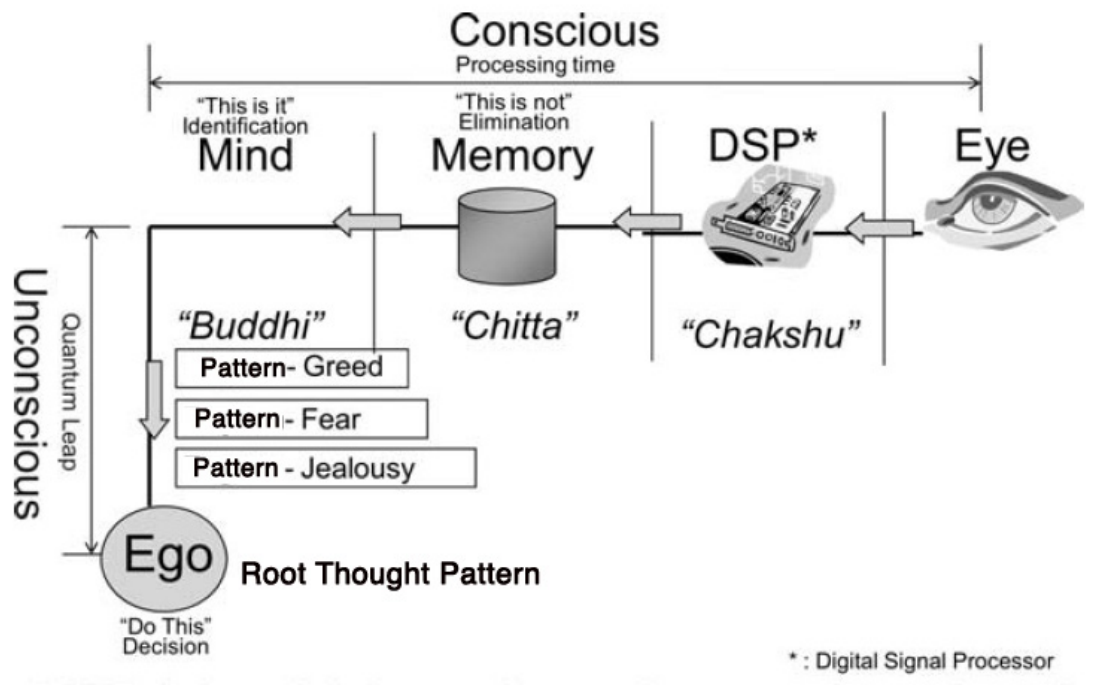
Kṛṣṇa explains how root thought patterns disturb our inner space and through this understanding, we can transform our being.
Before explaining these verses, let me present a small diagram through which we can understand how patterns affect our cognition, our decisions and how to come out of the influence of patterns.
Please understand how we receive information or data from the outer world, how we internally process it or cognize it, and how we make decisions.
I am defining Cognition.
Cognition is the process of receiving information through our five senses, processing that information internally, relating with it based on our root patterns, and responding to life based on our patterns. This is known as cognition.
First, we see something through the eyes. I have taken the example of sight but we can replace it with any other sense: like hearing, smelling, tasting or touching. Among these five jñānendriya (senses of perception), any one can be used here.
There are five jñānendriya and five karmendriya (senses of action) that are the means of communication between the external world and us. Jñānendriya are the senses of perception, the five senses of smell, taste, sight, touch and hearing. The karmendriya are five actions of elimination, procreation, locomotion, grasping and speaking. Each sense is related to one of the energy centers (cakras) in our body-mind system.
Let us say we see this scene of this discourse happening. You see me talking to you. First your eye captures this whole scene like a picture and this picture goes to the cakṣu (the energy behind the eyes). Understand, we don't see with the eye, we see through the eye. There is an energy that is inside or behind the eye that actually sees. There is an energy inside or behind the ears that hears. The ears by themselves cannot hear. That is why when we are engrossed in a book, we may not hear the alarm or doorbell ring. So, there is an energy inside the eyes that sees. We call this energy cakṣu. The whole scene is converted into a file like in a digital signal processor in a computer so that our mind can process the data.
The cakṣu is almost like the digital signal processor or DSP in electronics. In a computer, whether it is an audio or visual file, it must be converted into a digital file. In the same way in our inner space whatever we see or hear is converted into a bio-signal file like a digital file.
Then the file starts moving up, step-by-step. The file goes to the part of the mind called citta. If we understand this, our whole life can be trans-formed. We will know why we do the way we do, and how we react. We will cognize how we make big decisions based upon our root thought patterns, and consequently suffer.
The file goes to citta, the place where past bio-memories are collected. Citta means mind, inner space. This area is where the work of excluding happens as—‘Na iti, Na iti’—this is not, this is not. The process of neti neti (this is not, this is not) takes place in this area. Upon seeing this file, our citta starts eliminating whatever the object is not.
Take the example of this scene: First you see me, the whole scene is photographed. It goes to cakṣu and becomes a bio-signal file. The file is then taken to citta, bio-memory. Citta says, ‘This is not a tree. This is not an animal. This is not a plant. This is not this. This is not that.’ The exclud-ing process happens in citta.
Next, the file goes to manas, another part of the mind. The manas tries to positively identify, ‘This is a human being. He is wearing a saffron robe. He is standing on a stage.’ The identification process, ‘iti, iti’ (this is it, this is it) identification process happens in manas. In citta, ‘neti, neti’ or the ‘not this, not this’ elimination happens.
Once this positive identification happens, the file goes to a third part of the mind called buddhi or intelligence. Buddhi is where the trouble starts. Here the analysis starts, ‘How am I related to this file? How am I connected to this scene? How is it relevant to me? How should I respond to this scene?’ If past bio-memories about me have been good or pleasant according to your intelligence, you cognize and respond in a positive way. You immediately refer to those past memories and review, ‘It was so good at yesterday’s discourse.’
Your intelligence refers to the past bio-memory and muscle-memory and makes a decision based upon your cognition of these experiences. If your cognition about the past experiences with me has been positive, your intelligence tells you to stay and listen. If your cognition of the past experiences has been inadequate, unpleasant and you felt bored, your in-telligence tells you that this is not the place for you and that you should leave. These are logical decisions based on conscious memories retained by your mind.
Up to this point, your cognition, the transmission of what is per-ceived by the senses and what is the response based on that pattern is relatively straightforward. It is a conscious process.
From the conscious mind, the information is passed to the uncon-scious space of the mind, the ego. I call this unconscious space of the mind as the ego, not because it is arrogant, but because it provides you the identity of who you are.
Your identity stems from your unconscious incompletions which are your root patterns. You project who you wish to be, never who you are. You do not even know who you are. Who you are is deeply buried in your unconscious. All the major decisions that shape your life are consigned to this unconscious space. This is the repository of all those emotional-ly-filled memories, the root thought patterns and beliefs about yourself; which constitute what you believe as you, what you project as you, what others expect you to be, and what you expect others or life to be for you and therefore, create your identity. This is what I call the ego.
Identify your root pattern! Listen! I am defining ‘root pattern’ once more.
Root pattern means the first time in your life when your cognitions were imbalanced, disturbed by some external force; and your terrorized being started defining yourself with a disempowering word and started defining the world in that disempowering powerless state; and to compensate from this death, the disempowering inner identity—the inner image, you create a pseudo alternative compensating cognition—the outer image. This is what I call root pattern.
When your root pattern starts, that is moment you feel yourself as an individual identity. If it starts in an accidental moment, your life will be an accident forever. It is an eternal accident. Till you complete with that root pattern, you will continue to have accidents in your life.
Completion takes away the agitated confusion and the alternative compensating image we create in our life. Understand, this example of your life.
Please listen! Because we have a very disempowering cognition about ourselves, we go on creating an alternative compensating cognition to compensate with our inadequate cognition. It is like you first declare you are a beggar, forgetting the billions of dollars you have in your bank bal-ance, and then you yourself try to project the rich image to cover your belief that you are a beggar. But unfortunately, the final thing is you will project that your whole life—that you were a rich man, but lived as a poor man, but in reality you were the richest man.
Understand, you project and you try so hard to prove to the world that you are a rich man, but you always believed yourself and lived as a poor man; but in reality you are the richest man. You never knew about the wealth you had in your bank balance. It is like you kept all your money in some Swiss Bank and you forgot the number. To compensate the inadequate cognition which got created unconsciously inside you, which is your inner image, mamakāra, you create an alternative compen-sating cognition which is your outer image, ahaṁkāra.
Till the end you never feel satisfied, because you feel the guilt you showed, which is not true, without realizing your true identity is much more than what you can imagine and show. So, your whole life ends in deep incomple-tion and the trial and error methods you do with these incompletions.
If you complete now, the first thing you will realize is that the alterna-tive compensating cognition is a lie and it will melt down. Second thing, your disempowering cognition about yourself will melt down. Third, you will realize that your original self is much more than what you projected as your outer image, the alternative compensating cognition. And you will have complete easeness between what you feel as you, what you show as you, and what you are as you.
The conscious mind does not make important decisions. It makes a few decisions that can be reached by its limited intellect. Anything important moves to the unconscious ego or root patterns. Our unconscious handles all life-threatening situations with the disempowering cognitions, the so-called fight-or-flight decisions. Our conscious mind is too slow to handle them.
For example, the file travels to the ego, and the ego makes the deci-sion, and we execute it. If there are more incompletions, the file travels to every table like in a bureaucratic office. Each incompletion stamps, puts its signature and writes its opinion. Take the example of attending this discourse and seeing me. One conflicting pattern says, 'I had a master in my life. He was a blessing. He helped me a lot. I think I should sit here.' So this pattern signs, 'Yes, I will sit here.' The next conflicting pattern says, 'I read in the newspapers that these masters do this or do that.' So, the second conflicting pattern signs off saying, 'doubt'. Then the file goes to the next table, and the third conflicting pattern says, 'I attended his discourse yesterday. What he says makes sense, I think I should stay.' This conflicting pattern signs, 'yes.'
Listen. The effects of your root pattern are your conflicting patterns. Conflicting patterns are the branches which sprout from the root pattern.
When the file reaches the ego, the ego comes to a conclusion based on all the 'yes' responses and all the 'no' responses based out of your conflicting patterns. Yes or no is not a problem; however, we have wasted so much time and energy on this small decision. Not only that, any decision you take out of powerlessness, restlessness, will lead you to more and more powerless space. Understand, it is very important. Any decision, whether you get into some challenge, or you get into any relationship, or you get into a business decision, any decision, please see to it that you are in the space of powerfulness, completion!
You break relationships, you break businesses, you break part-nerships, you break families, you break life itself when you are pow-erless, incomplete! Powerless moments in life create more and more powerless moments in life. For example, when we sit in our office, not doing anything, just sitting and worrying, we become stressed. Within fifteen minutes, we have pain in our shoulders. Worrying about simple decision-making leads to shoulder pain.
Continuously, again and again, look into the reasons for your pow-erlessness—why are you in conflict? Why are you in a powerless space? Whenever you are possessed by powerlessness, confusion, agitation, and you don't know what to do, please don't take any decisions in your life. All restlessness is powerlessness. The more patterns you have, the more powerless you feel, the more restless and rājasic you will be.
Take the example of smoking: According to the data collected at the conscious level, we know smoking is injurious to health. However, when the time comes, suddenly we decide to smoke. How does the file take such a quantum leap? How is the decision totally changed? When the file travels to the unconscious space, patterns say, 'No, no! The last time I smoked, I felt really good, I felt relieved from all the stress.'
We make countless decisions based upon root thought patterns. We repent and suffer later on. Suddenly we shout and after ten minutes, we repent, 'Why did I shout? I always wanted to keep a smiling face. Why did I shout?' We reacted suddenly due to these patterns.
We will see later how root thought patterns disturb and torture our decisions. Kṛṣṇa says that we should ask our being how we missed reality. Why are we deluded by root thought patterns?
Kṛṣṇa speaks of satva guṇa saṁskāras that lead us to bliss and peace, rājasic guṇa that lead to restlessness and violence, and tamasic saṁskāras that lead to depression. He further explains how these saṁskāras influ-ence our decision-making process.
When we try to work with different types of conflicting patterns, satva, rajas and tamas and all three cross each other, they create hell in our lives. We need intelligence to even look into our lives to find our root pattern, and see how many times we have carried the same pattern. We usually react out of arrogance or guilt. We say, 'So what if I made a mistake?' We brush it under the carpet leaving it incomplete. This is one kind of attitude, the attitude of might is right. The other attitude is that of suffering from guilt.
Kṛṣṇa gives techniques on how be complete with these three guṇas. Before entering into these three layers of patterns—satva, rajas and tamas, let me illustrate how we are caught in these guṇas and how these patterns work. Then, we will enter into each technique.
SEVEN ENERGY LAYERS OF THE BODY
These are the seven energy layers of our body-mind system. These are seven parts of our inner space, our being.
The first is the physical body, our flesh and bones. Next is the prāṇic layer, the energies of prāṇa, vyāna, udāna, apāna and samāna or the five air movements that take place in our body-mind system. The third is the mental body. This is where our mental inner chattering continuously takes place. This is inner chattering or the mental body or cañcala, which means inner movement. The fourth is the etheric body. This is the space where our intense emotions and painful experiences are stored. Usually intense emotions are of pain and suffering.
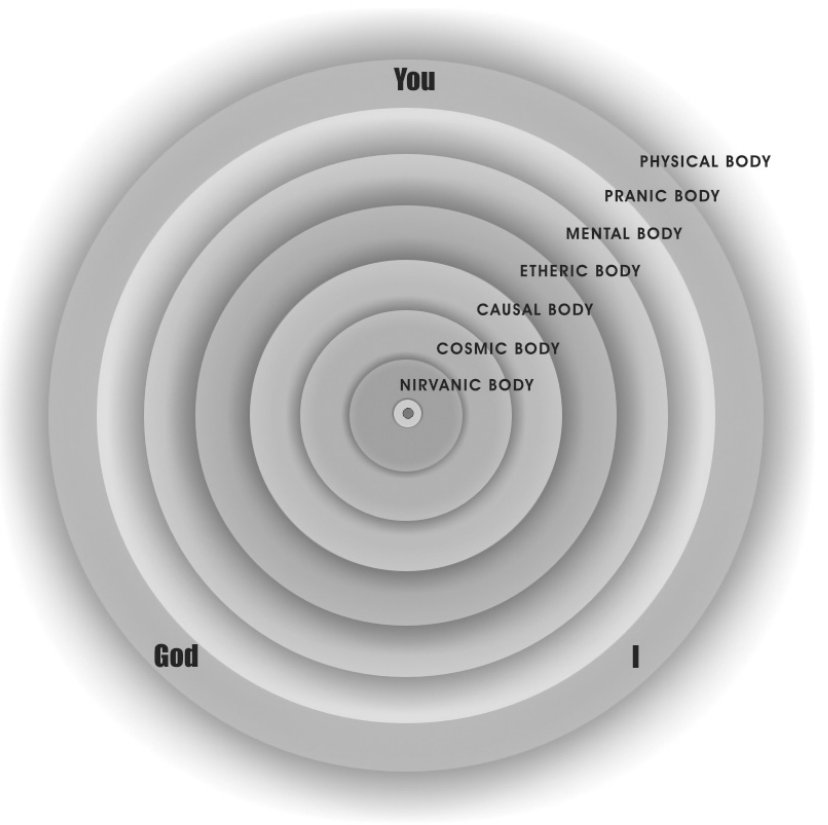
The prāṇic layer is the body filled with desires. The mental body is filled with 'I should have' or guilt feelings. The etheric body is pain. Understand these three. Desire, guilt and pain are the feelings or the experiences stored in these layers.
When emotions, desires and feelings arising out of these three attributes are pure, they are called satva, rajas and tamas depending on the quality of the emotion. Usually, they are impure. They are mixed with each other. We should know how to purify them. If we can purify our desires, we will be liberated. We cannot live without desires. We can only cleanse and purify the desires, directing them towards the right path. Without desires, we can't breathe. Desires must be handled properly. That's what we need to work towards, satva.
Next comes guilt or rajas. Our restlessness is created by thoughts like, 'I should have done that', 'I should have lived like that', 'Because I did not do it then, let me do it now', 'Let me teach him a lesson, I know what to do now.' This is how restlessness or rajas operates.
The third is pain. Whether we do right or wrong, we know how to make it painful. Whatever it is, we know how to create suffering through tamas.
The first four body-mind layers are influenced by the three guṇas. The mind cannot experience the remaining three layers beyond the fourth layer. They can be experienced only through meditation. In the fifth layer, the causal body, we sleep soundly without dreams. It is called kāraṇa śarīra, the energy layer that we experience during deep sleep. The sixth layer is the Cosmic layer, filled with joyful memories, and the seventh is the nirvāṇic layer or the bliss body.
Please listen!
Powerlessness in the level of physical body is tiredness and boredom. Powerlessness in the level of prāṇic body is dilemma. Powerlessness in the level of mental body is worry. Powerlessness in the level of subtle body is depression. Powerlessness in the level of causal body, kāraṇa śarīra is inability to trust life.
Just remember the first four layers of physical, prāṇic, mental and etheric energy. That’s enough, because we will work only on these now. Kṛṣṇa has already spoken about the physical layer. Now He works on the other three guṇas of satva, rajas and tamas. Satva is related to the second layer that is the prāṇic layer, rajas is related to the third layer that is the mental body, and the fourth layer is the etheric layer of tamas.
As I was saying, satva is related to desires and the prāṇa śarīra. When our desires change, our prāṇa flow or our airflow changes. It is prāṇa that sustains life in us. This prāṇa is affected by the changing desires in us. For example, if we are caught in lust or an intense desire, our inhal-ing and exhaling becomes intense. The prāṇa going in and coming out increases. With any desire, the prāṇa flow totally changes. If we are in a silent, peaceful mood, the prāṇa flow will be so mild, we will not know prāṇa is flowing.
Understand that this prānic layer is filled with desires. What should we learn about satva, about this prānic layer? Let me explain.
YOUR INNER SPACE IS PURE CONSCIOUSNESS
Whether we believe it or not, accept it or not, we are God. We are pure consciousness. No matter how many millions of reasons you give, there are some things which cannot be changed. Our inner space is all-powerful! Our inner space is infinite and infinitely powerful! Our inner space carries the DNA of Ahaṁ Brahmāsmi (I Am That)!
How many ever arguments we may give, a country's constitution cannot be changed. In the same way, we may give a million reasons, many arguments to prove that we are not God, and we are not divine, and we are not powerful.
You think, 'I am not even able to get a cup of coffee when I want it. Then how can I be all-powerful? I don't even know what is happening in my spouse's mind. How can I be all-knowing?' You have very silly reasons to deny the possibility of your inner space. Please understand, you never tried to explore your inner space. How can you deny it before even trying?
Understand: if I am expressing the aṣṭa mahā siddhis, extraordinary eight yogic powers, it is not to show that I am extraordinary; it is just to show that it is possible for you! It is possible for you! Nothing more is required than carrying the space, with the understanding—'When Swamiji can do it, I can do it!' That's all!
Please understand, the space you create inside is so powerful, it can straightaway affect the way you experience life and the way others around you experience life.
Let me define the term 'space'! How you feel things are going to be— that is what I call the 'space you create inside'.
If you are very clear that your space is already in a low energy, and you have thoughts like 'Anyhow, whatever I do is not going to work out, it is not going to be successful!', then you have already dictated it. You have already given the plan to the Cosmos—'I want my life to be like this only, as a big failure. Please make it happen for me!' So Cosmos will stitch it and give it to you.
The space you carry inside is not the effect of the happenings of your life, it is the command you are giving to the Cosmos. You may put the blame somewhere else. You may say, ‘No, no, no! I am in low mood be-cause of the continuous failures that have happened in my life. If you were in my shoes, you would understand why I am like this!’
Please understand, the space is the order you give to the Cosmos to prepare your future. Listen! Just like how you place the order in the restaurants after looking at the menu card, the inner space you carry is also an order you give to the Cosmos, ‘I want this, this, this in my life.’
Whatever you carry in your inner space is a possibility. If you are carrying sadness, you are ordering the Cosmos to bring greater sadness into your life. If you are carrying joy, you are waiting for more joy to come in your life. If you are carrying an inability, ‘Yes, I have the wrong in-ner space. I am depressed, but I don’t know how to change it,’ that is one more inner space; it means you are ordering the Cosmos to give you more powerlessness.
Whatever thoughts we create in our pure consciousness gain power. This inner space exists in all of us and is called Self, ātman, or inner divin-ity. Whatever thoughts we create in this inner space, the deeper they are, the more power they get from this consciousness.
But, the problem is that we create self-conflicting desires. We suffer with our desires because of this. Whether our desires are fulfilled or not, the resulting suffering is inevitable. If the desires are fulfilled, there will be emptiness and if they are unfulfilled, there will be restlessness. In both cases, we move towards tamas. Why?
It is a subtle understanding. Many times people ask me, ‘How can I complete just by declaring completion?’ You can! You are nothing but the bunch of words you uttered, consciously or unconsciously to yourself and to others. Unfortunately, most of it is unconscious. That is where the problem starts. Many times, you do not recognize the power of the words you utter, especially towards yourself.
Whatever words we repeat unconsciously in our inner space become reality in our body, mind and in our world. It is because we have the pow-er to give life to any word. If the words ‘Let me get up and go’, come to our mind, with those words, immediately our body will move, we will stand up and start going.
Understand, the first lesson you need to learn is the ability to trust the power of integrity.
If you say, ‘I am free’, then, you are free! If you say, ‘I am a liar’, then, you are a liar! If you say, ‘I am powerful’, then, you are powerful! It is just you! The words you utter to yourself and others is life. What a big relief! It can be great news for you if you start living it. It can be good news for you if you start believing it. It can be bad news for you, if you start worrying about it. But the words you utter towards yourself and to others is you, you, you!
One word can make us do whatever we want. Words that appear in our inner space are mantra (sacred sounds). When put together, all the words that appear in our inner space form our life, especially the words that we repeat unconsciously.
Thoughts that we repeat unconsciously are more powerful than words we use consciously. Your inner space is nothing but the words you repeat, again and again within you. So, now decide consciously that you will repeat the right words within you. Whatever mantra or word we use in our inner space, that dhyāna or meditation automatically happens in our unconscious. If we use the word ‘headache’ again and again, we will be meditating on the headache. If we use the word ‘health’, again and again, we will be meditating on health.
That is why when we start to meditate upon God, we start with a dhyāna śloka—meditation verse. It is like the invocation verses that in-voke god with the right words. In these verses we verbalize what good things we wish to visualize in our lives.
Verbalization of visualization is the dhyāna śloka. Whatever we visualize again and again will be inscribed in our memory, in our inner space, in our inner being. If we have a disease, please never create and repeat a word that carries the name of the disease. Always use these powerful words, ‘Let me be wealthy’; never say, ‘Let me be free from my poverty.’ Declare, ‘I create the space of completion’; not, ‘I am working hard on my incompletions.’
Please do not abuse the inner space or icchā śakti (power of creation). The prānic layer is our icchā śakti. It has the energy to make things happen. It has the energy to fulfill our desires. Do not waste icchā śakti by creating self-conflicting or self-doubting patterns. Declare completion with all the self-doubting patterns.
COMPLETE WITH SELF-DOUBTING PATTERN
Understand, all of you have one important pattern of self-doubt-ing. Please listen, along with your root-pattern and split-up of your personality, one more thing has entered into you—constantly doubting. This is because any part of your personality decides or does anything, the other part doubts that cognition. Whatever your right hand does, your left hand is doubting. Whatever your left hand does, your right hand is doubting! But, you have to do everything with both hands, only then it will be successful.
Self-conflicting and self-doubting patterns corrupt our whole satva space. The satva space, restful awareness with you is your basic right and I declare that it is possible for you to reclaim your basic right. I tell you, in the cosmic constitution, restful awareness is your basic right. Enlightened beings land on planet Earth to ensure that your basic right is restored to you.
We continuously allow ourselves to be exploited by what we hear and see. People who don’t know the truth about how the mind and conscious-ness influences us. All these problems arise because we don’t know that pure joy of inner space is possible.
Let me make a bold statement that no medicine or chemical can help our mind. All anti-anxiety medicines, all anti-depression medicines are consolations. First, we visualized that we suffered from depression and now we visualize that we have taken some medicine, that’s all.
How many of you behave like a self-fulfilling negative astrologer for you? You go on telling yourself, ‘My time is not good, I will not be able to do anything.’ And even after you do it, you start believing it so strongly that you fulfill it. You are the astrologer, you are the trainer for you, and you are the judge for you. You first give the self-fulfilling prophecy, ‘I am a failure’. Then you train yourself for that, so that even the Guru should not make you successful, even by mistake! And you wait for those kinds of responses from society. You do not bother about the support you receive, but you are haunted by the discouragement you get, because you are training yourself to be a failure!
So, who is the decision-maker for your life? First, you are an astrologer who declares that you are a failure. Then, you are a trainer who trains yourself to be a failure, and if failure does not come even then, you become a judge and you declare that you are a failure!
Listen. Don’t be caught in that self-doubting game. We disturb the satva, the pure space of our being, by creating self-conflicting and self-doubting patterns. Sit with yourself. Complete with all the negative conflicting patterns. Complete with all the self-doubting patterns. Allow the grace to move in you. Create the right inner space by completing again and again with yourself by doing svapūrṇatva, self-completion. Create the right space, right mood, and right experience.
COMPLETION WITH RAJAS PATTERN
Next, let us see how two desires conflict one another. We want to lead a peaceful life and we want wealth. With wealth comes responsibility as well. If you actually analyze your attitude towards wealth with integrity, you will understand that you are actually afraid of wealth. You hate wealth!
The fear of responsibility and the greed for wealth always go hand in hand. If you look in, you have greed for wealth, but you are not ready to take responsibility that comes with wealth. This is the self-conflicting desire. Either decide to take responsibility or decide to relax from that desire and restore your integrity by completing with it and accept whatever happens.
Only one thought should be strengthened when two desires conflict. When we have both, we have a self-conflicting mental setup. In the satva space, when we create self-conflicting patterns, we are automatically thrown into rajas.
Let me describe what Kṛṣṇa says about rajas. The mode of passion is born of unlimited desires and longings. This is a beautiful verse.
Kṛṣṇa says, because of this rajas, mode of passion, born of unlim-ited desires and longings, the embodied living entity is bound to doing result-oriented actions.
rajo rāgātmakaṁ viddhi tṛṣṇā saṅga samudhavam ।
tan nibadhnāti kaunteya karma saṅgena dehinam ॥ 14.7
He talks about desires and longings. What is the difference? Desires and longings—rāga means desire; tṛṣṇā means craving, longing. Some memories have our emotional support whereas some memories have been inserted into our being by advertisements.
Advertisements are not only on the television or in a movie theatre. If our father repeats something time and again, that is an advertisement. If our mother says again and again, 'This is right, this is for us, this is for you,' that becomes an advertisement. Some desires have our mental support. We feel these will give us fulfillment; we feel these are our genuine needs. Some desires have been sold to us by someone else. That is the difference between desires and longings.
Desires, rāga are ours and longings, tṛṣṇā have been given to us by society. Desires are inborn. They are our nature. If we fulfill desires, we feel fulfilled, relaxed and complete. With longings, the moment we fulfill them, we feel empty, incomplete. This is the difference between desire and longing. Desire gives us fulfillment, completion. Longing gives us emptiness, incompletion.
Kṛṣṇa shows us how self-conflicting desires lead us to rajas. When desires contradict each other, we get confused. We fall into rajas, restlessness.
I have a small story for you.
One barber asks a man, ‘How did you lose your hair?’
The man replies, ‘Worry!’
The barber asks, ‘What did you worry about?’
The man says, ‘About losing my hair!’
Your worrying makes you lose your hair. And in turn, you are wor-rying about losing the hair. It is a vicious circle. The more patterns you have, the more time it takes to make a decision. We will suffer and be in a dilemma. Man is a dilemma. Continuously we think, ‘I should have done this,’ or ‘I should have done that.’ I tell you, life is a failure, if in your old age, you think that you should have done all this when you were young. Dilemma is due to too many conflicting patterns
Dilemma is what Kṛṣṇa calls rajas and restlessness. All restlessness is powerlessness.
In rajas, we have tremendous anger, violence and inner restlessness. A person caught in rajas shouts at others and experiences an irritable mood. He has a poisonous tongue. He waits to vomit out his irritation and anger on others. What is agitation? Not taking the responsibility for what you mean to others is agitation. When you don’t take responsibility for your commitments to others, you get agitated. You get irritated. If you take the responsibility for your commitments, you will not be agitated or irritated.
Please listen. How to complete with the rajas patterns? The first truth you need to know about completion—do completion just to be in the space of completion. All other reasons lead to more and more incompletions. Completion done in the space of completion transforms your personality, transforms your being; the intense, constant agitated violence you carry towards you and others due to rajas patterns.
When you drop a stone in the water how the ripples are created; in the same way the moment incompletion is dropped in your consciousness, the ripples of violence towards you and others starts in your being. Worrying becomes your lifestyle. Worrying becomes the compulsive pattern in you. Not only worrying, because of worrying, the inability to handle life. At the most, you only push your life under the carpet. Pushing life under the carpet is not going to be the solution.
See, there are only three ways to handle your incompletions.
One, by pushing them under the carpet.
Second, by trying to forget them either by alcohol or by other entertainments.
Third, by completing them and liberating yourself.
Listen! Continuously completing for the sake of completion leads you to the experience of Enlightenment. I tell you, nothing can be done. When you try to push your incompletions into your unconscious mind, unfortunately, it reaches deeper and goes closer to your consciousness. Anything closer to consciousness becomes powerful. That is why a small incompletion that happened in your life when you are young or a small incompletion which you are suppressing without completing it, it explodes in you as a dangerous imbalance of your rājasic guṇa patterns.
Many times, your imbalance is such that you do not care about your destruction. You go on waiting in anger and expecting the other person’s destruction. No! If you drink poison, how can the other person die? It is not possible. That is the biggest foolishness human beings get into. They drink the poison thinking the other person is dying.
No! I tell you, all vengeance is rooted in incompletion. Complete it. Trust the Cosmos and complete it. Once we do completion with the rajas patterns, we can make one thousand decisions without any stress, vio-lence or suffering. That is why Kṛṣṇa says that when we don’t expect the result, when we don’t think of karma phala (result of the work done), we can do the work intensely. When we don’t expect or worry about the result, we work beautifully because there are fewer patterns. We will not suffer or be tortured by root thought patterns. We will be in the space of completion, which will lead to more and more completion.
CONSCIOUSNESS CAN NEVER BE TIRED
In the next verse Kṛṣṇa talks about tamas.
He addresses Arjuna, ‘Oh son of Bhārata, know that the mode of darkness, tamas, is born out of ignorance . It is the delusion of all embodied living entities. The result of this mode is madness, indolence and sleep, which bind the conditioned soul.’
This is a beautiful explanation of tamas.
tamas tv ajñānajaṁ viddhi mohanaṁ sarva dehinām I
pramādālasya nidrābhis tan nibadhnāti bharāta II 14.8
If there are more vāsanas or patterns, the file does not reach the ego easily or even fully. A powerful pattern may make the decision on the way. Why does this happen? Why do you decide unconsciously and regret later?
This unconscious space is filled with negative bio-memories, and powerlessness, restlessness. All our past bio-memory or root thought patterns are stored in your inner space as files without any logical connection between them.
This is what happens. When the file takes a quantum leap to this space, it does not reach the ego properly for a decision. It is as if your computer hard disk is loaded with high-resolution photographs and there is no further scope to work on your hard disk. Like that, when your unconscious is loaded with past root thought patterns and memories, it becomes inadequate, inefficient, and incomplete and makes superficial, illogical decisions.
Take this example: Why does drinking alcohol become a pattern, but drinking water is not becoming a pattern? Both of them, people drink every day. Water people drink more! Then, why does drinking alcohol becomes a pattern and drinking water never becomes a pattern? Because drinking water gives you completion and you are not stuck. After drink-ing water, you are out of thirst and are more energetic. But unfortunately, all alcoholics are either stuck with elated mood or belated mood, or de-pressed mood. It is the mood associated with alcohol that makes people stuck, not alcohol itself. Please understand, when a person drinks alco-hol, if he feels elated or belated, he wants that mood again and again. That is why he starts and continues drinking alcohol.
Sometimes, people start enjoying even the self-sympathy, the victim mood, the depression! Even for that reason they start drinking alcohol! How do you think I liberate so many people from alcohol and smok-ing just through meditation, through the Inner Awakening program? Because, first I attack that mood pattern. I make sure neither they feel that elated pattern nor they feel that depressed pattern. When you break the pattern, they don’t feel inspired to drink. Then addiction disappears.
Listen. When there are no patterns, there will be no need for the file to drop into the unconscious inner space for a decision. It straightaway meets the buddhi and ego after the mind. There are no blocks. The time taken for the unconscious process will be less than the conscious process. We will be intuitive or at the level of God.
The level of an animal is the level of instinct; the level of man is the level of intellect; the level of God is the level of intuition. The level of instinct is the level of tamas; the level of intellect is the level of rajas; the level of intuition is the level of satva.
In satva, our mind works continuously and we make decisions, yet we do not become tired. We can be active for twenty-four hours and yet remain peaceful. This is what I call action in inaction and inaction in action. Kṛṣṇa says we will be centered when we are in satva. Though lots of activities go on around us, we will remain utterly relaxed in restful awareness.
The whole thing is dependent on one thing: our root thought pat-terns or bio-memories. The number of root thought patterns determines whether we are caught in satva, rajas or tamas. These three are not en-lightened states. Enlightenment is beyond these three.
If we are caught in tamas, we need to move towards rajas. If we are caught in rajas, make the move towards satva. If we are caught in satva, it will automatically lead us to enlightenment. How do we do this?
For example, we create a self-conflicting desire at the satva level. Because of that we create restlessness, the powerless space in the rajas lev-el. When we feel too restless, we drop everything. We decide not to take any responsibility and we sleep instead. We fall into tamas.
Tamas is not only tiredness, sleep or depression, not taking enough responsibility is also tamas. Work does not need to make you tired. It is the wrong idea taught to you by the society. The only two enemies human beings have are boredom and tiredness. When you entertain them, you build wrong patterns. When you are bored of doing some work, you invoke tiredness—‘Om tiredness swāha! ihāgachha! ihāgachha! (chant to invoke the presence of a deity or a quality). Please come here! Come here! Reside here! Reside here!’ You invoke tiredness! You invoke depression!
Scrutinize your inner space with integrity. You will see that when-ever you don’t want to take responsibility, you invoke boredom, tired-ness, and fear. Sometime, even greed is used as a substitute for enjoyment. Greed and fantasy are used as substitutes for alcohol and drugs. Listen, when you have a pattern of addiction and drugs, you go for it. When you are afraid that they will spoil your health, you use fantasy and greed as a powerful substitute for alcohol.
For example, we are in tamas if we studied to become a doctor and we do not practice our profession out of laziness. If we don’t practice for some other reason, that is fine. However, if we are avoiding because of laziness, we are in tamas.
If we drop out because of a spiritual reason such as to meditate, to go on a pilgrimage or to do spiritual work. That is fine. However, dropping out and giving up on you due to tamas means that we don’t have enough energy and we cannot make a responsible decision. Why? Too many patterns block our decision process. By the time we make one decision, we feel tired and want to sleep. That is why we attempt to escape from life. Escapists are tāmasic people.
How many of you struggle with this tāmasic pattern of tiredness and laziness? It is just lack of integrity. Be integrated to your Soul. The Soul can never have tiredness, consciousness can never have tiredness. That is the truth. Whether you realize or not, you are Soul and Consciousness.
GUARDING THE SENSES
The mode of goodness, satva conditions one to happiness,
passion, rajas conditions him to fruits of action,
and veiling of knowledge , tamas binds one to madness.
Sometimes the mode of passion becomes prominent,
defeating the mode of goodness, O son of Bhārata.
And sometimes the mode of goodness defeats passion, and
at other times the mode of ignorance defeats goodness and
passion. In this way there is always competition for supremacy.
When the light of Self-knowledge illuminates all the senses
(or gates) in the body,
Then it should be known that goodness is predominant.
O Bharatarṣabha, chief of Bhārata, when there is an increase
in the mode of passion, the symptoms of great attachment,
uncontrollable desire, hankering, and intense endeavor develop.
Kṛṣṇa further explains the three modes.
‘O Bhārata, sometimes the mode of goodness, satva, becomes prominent, defeating the modes of passion and ignorance, and at other times, ignorance defeats goodness and passion. In this way, there is always competition for supremacy.’
All of us are not completely caught in satva or rajas or tamas. We swing between satva, rajas and tamas. Sometimes we get up in the morning and feel fresh. We feel as if all our questions are answered; we are fresh, alive and we think we have become almost enlightened! Everything goes beautifully until evening. Suddenly we become restless. The very next day, we are in tamas. We don’t want to do anything. These mood swings take place continuously.
Obesity and mood swings are closely related. When we allow these mood swings to happen, we torture ourselves. Sometimes we are restless, sometimes we are peaceful and sometimes we are in tamas. When we are in tamas we don’t want to do anything; we want to escape from everything and run away. We are caught in these three modes of na-ture: sometimes in instinct, sometimes in intellect and sometimes in intelligence.
WHY DO WE HAVE MOOD SWINGS?
Why? This happens if we have collected too many patterns about something over many years. For example, the pattern of drinking devel-ops if, from a young age, you were repeatedly taught not to drink and that drinking is a sin. This raises your curiosity to taste alcohol at least once. Never give a law to children. Instead give them understanding and the spirit behind the law.
If we want to bring up children blissfully, we need to bring them up without guilt. Breaking rules creates guilt. To give understanding, we need two things. First we need to be intelligent enough to understand the meaning behind the rules we are trying to enforce. Next we need patience to explain it all to them. Even though it takes more time and energy, focus on giving them understanding.
People complain to me, ‘Swamiji, in these modern times, there is no time. My daughter goes to school. I have a job. How do we find time to make her understand?’ I say, ‘Why did you give birth to your child if you don’t have time to bring her up? You should have decided earlier in life.’
Before deciding to have children, find your root thought pattern and become complete, enlightened. That is the only qualification we need. Un-less we are in the space of completion, we will not have any clarity how to guide them, and we will go on creating more confusion, guilt and incom-pletion in them. Till we learn the science of completion, we should not plan to have children.
Understand, without completing your root thought pattern, your DNA layers are not awakened, mitochondria cell energy is not awakened. For common human beings, two layers of DNA are awakened. If you find your root thought pattern and complete, six layers of DNA, your kuṇḍ- alinī (potential energy) will be awakened in you. If six layers of DNA are awakened, your child will be an enlightened being! If you decide to have children, have the intelligence to give them the right cognition behind all that you tell them.
When parents bring their kids to me, they force them to touch my feet. I say, ‘Never do that. This is your greed.’ These parents think that they and their children get puṇya or good credits by touching my feet. They impose this idea on their kids, an idea based on their greed. I ask these parents not to force them. Namaskār (respectful salutation) is more than enough. By forcing them, they make the kids hate me. The next time these kids see the orange robe, they will grumble, ‘Oh, now we must do that exercise.’
Never enforce rules on kids. We are suffering from rules given to us by our parents. The rules given by our parents are in our rajas and tamas layers. They lead us to restlessness and deep depression again and again. They create more and more incompletion, powerlessness for us.
DESIRE AND GUILT PATTERNS
Desire and guilt are two forms of the same energy. One is related to the future. The other is related to the past. Desire is related to the future. Guilt is related to the past. ‘I should have done that’ plays a major role in our ‘I should do this.’ ‘I should do this’ is determined by ‘I should have done that.’
Guilt that is created by rules handed down to us by our elders creates hell in our life and leads us to tamas. Kṛṣṇa says we are led to antaḥ (the end). We fall into ignorance or into the end.
Kṛṣṇa says the manifestations of the modes of goodness can be experienced when all the gates of the body are illuminated by knowledge.
This is the technique. The gates of the body are the gates through which we cognize: we receive knowledge or information through the eyes, ears, nose, tongue and the sense of touch or physical pleasure. These are the files through which we receive information from outside. He says that we should keep these five carefully guarded by prakāśa (illuminated knowledge). We should ensure security at these gates and knowledge is that security.
We should have knowledge about what should be taken in and what should not be taken in. Knowing this, we will reside in satva forever. We will reside in bliss forever. He says we should appoint a guard for the gates of our body. There is no security system for our body. We have security for our home. If someone breaks in, automatically the call goes to 911. We reside twenty-four hours every day in this house called our body, yet we don't have a security system!
Ramaṇa Maharṣi sings in beautiful homage to the sacred Aruṇācala Hill in Tiruvannamalai in his famous song ‘Aruṇācala Akśaramaṇamalai’, ‘When these thieves, the five senses, have entered into the house, Oh Aruṇācala, were you not at home? How did they enter?’ He asks Śiva, ‘When these five senses entered the house (body-mind), were you not there? Why did you let them enter?’
Kṛṣṇa says, let us have the security, the protection of knowledge at the five gates, and we will reside in continuous bliss. Completion is Bliss. This means that we should not allow the incomplete thoughts that create suffering to enter our inner space through the eyes and other senses.
This means, avoid the television or media. At least do not watch programs that create violence, depression, and powerlessness in you. We should only watch programs that give joy and make us complete, bliss-ful. When we protect our senses with satva, we will not allow negative patterns to come in.
Please do not infuse your consciousness with powerless thoughts that create suffering in you. Continuously add thoughts of completion that give power, bliss and peace. We may think this is impractical. We may think, ‘How can we live in society without knowing what’s going on in the world?’ Be very clear, knowing what’s going on in the world is a disease. Collecting information is a disease.
The other day, someone said, ‘Swamiji, we should watch television to get an idea of the culture.’ However these television shows are trash. They are nonsensical. The more we watch, the more negative patterns we imbibe. We simply suffer. We put ourselves into rajas and tamas again and again.
Life is much too valuable and too short to be spent worrying. Do not allow powerless thoughts that create depression, low mood and longing, into your system, especially at sandhyā time - the twilight time at which day and night meet. Our ancient masters knew that sandhyā time, when day and night meet, is a critical time. There are two sandhyās, dawn and dusk. Our masters knew that whatever thought-seeds are sown inside our being at sandhyā come out as full-blown trees. That is why the masters insisted that at sandhyā time, one should spend time in a temple, pray-ing, listening to prayers, reading devotional material. Meditate or go to a temple and do something spiritual at this time. These spiritual ideas go inside as seeds and become a valuable complete tree in our life.
Protect your senses twenty-four hours a day. Do not entertain any form of powerlessness at any time of the day, in any level of the body, mind and consciousness. If you cannot guard your senses at all times, protect yourself at least during sandhyā time.
Kṛṣṇa gives one technique, one suggestion: Protect the five senses from negative ideas of powerlessness, the incompletions and infuse posi-tive ideas of completion through the five senses. Whatever we feed upon becomes our being and we radiate that energy.
Next, Kṛṣṇa says that attachment, greed, craving, and restless actions are indications of rājasic behavior. This fits most people, but it fits most aptly anyone in business or a corporate career.
Greed is the corporate creed. People who recruit and train employees use motivation as their only tool. What is motivation? The whole idea of motivating someone is ill-motivated. To motivate someone, we must hold a carrot in front of him or her. Then the carrot becomes the goal. If we are donkeys, we follow the carrot. If we have any intelligence, we will realize that the carrot will always be dangled in front of us just out of reach!
The donkey powerlessly runs after the carrot in restless action. It can-not stay still. The carrot is so near and yet so far. So how can it stay still? This is the story of the corporate people.
Instead of enjoying the path, we worry about the goal and constantly live in incompletion. We worry about when we will reach, where we will reach. In the process, we do not notice how we are traveling. We miss the beauty of the path.
When we torture ourselves with worrying about quarterly results, how can we enjoy work? How can results be achieved? As long as we struggle, we suffer even if we make money. The goal that we are chas-ing will be a mirage, an illusion. As soon as we reach that goal, we will be forced to chase another goal. Acquisition becomes the goal, not enjoyment.
That is why people who are successful have both passion and patience for what they do. They do not care about what happens in the end as long as what they do is from the space of completion. If we are complete about what we do, we will enjoy what we do. Whatever we do will be wonderful and successful.
We can never be happy in rajas. It drives us like a donkey until we are exhausted and we collapse with our incompletion. We need to decide whether or not this is the way we want to live.
Ask: Do I wish to be a donkey driven by a carrot dangling in front of me all my life? When we decide, ‘No, this is not what I want,’ it is time to break away from rajas and move towards bliss, nityānanda.
THE DEPRESSION OF SUCCESS
O son of Kuru, when there is an increase in the mode of
ignorance, madness, illusion, inertia and darkness are manifested.
When one dies in the mode of goodness [satva],
He goes where the realized souls are.
When one dies in the mode of passion [rajas],
he takes birth among those engaged in activities.
When he dies in the mode of ignorance [tamas],
he takes birth in the space of the ignorant.
By acting in the mode of goodness, one becomes purified.
Work done in the mode of passion result in distress, and actions
performed in the mode of ignorance result in foolishness.
From the mode of goodness, real knowledge develops; from the
mode of passion, greed develops; From the mode of ignorance
develops foolishness, madness and illusion.
We act like a wind-up toy when we are steeped in rajas, and like a battery-operated toy with a dead battery when we are in tamas.
Kṛṣṇa uses powerful words to drive home how desperate that state is: ignorance, madness, illusion, inertia and darkness.
aprakāśo ‘pravṛttiś ca pramādo moha eva ca |
tamasy etāni jāyate vivṛddhe kuru-nandana || 14.13
It is surprising how quickly one can slip from rajas to tamas. To slip from restless activity into inactivity and inertia is simple. Activity without meaning, activity with tension and stress and activ-ity totally focused on sensual satisfaction quickly leads to deep fatigue. The activity without any meaning that we find in tamas is not the same as activity without a purpose and goal that we experience in satva. Please do not confuse the two.
THE PURPOSE OF LIFE
I mentioned earlier that the real danger of rajas is that we are constantly focused on a goal and we forget to be in completion and enjoy the path as we pursue a meaningless purpose. Life has no purpose. It only has meaning. The meaning of life is to be in the space of completion; to be in restful awareness, to realize our inner Divinity. That is why I say that I am here not to prove my Divinity, but to prove your Divinity.
To be divine and to realize that inner divinity is our true meaning in life. Anything less than that is meaningless. Being aggressive, being restlessly active, or being constantly on the move does not help us understand or realize this meaning. We will be running after one thing or another. We are just plain greedy.
If we are driven by mere possessive obsession, we are bound to become tired sooner or later. Aggression results in deep depression. This is what I call the ‘depression of success’. I see this often in countries like the USA. People struggle to increase their material wealth, disregarding everything else. People change cars every year, houses every third year and their spouses every fifth year!
People run after material possessions and trophies without knowing the right context of ‘why they are doing, what they are doing’. One day when they have acquired and reacquired so many things and still feel incomplete, unhappy, uneasy and listless, they wonder why they acquired the things that they struggled for. They go into deep depression, deep incompletion what we call tamas.
The depression of success is difficult to address. To experience failure when we have always been successful and worked so hard is difficult to accept. What results then is depression, tamas. Tamas is generally born out of the ignorance of our true Self. Sometimes tamas can arise out of an effort to move out of that ignorance. A highly rājasic person, one who has been aggressively pursuing material gains, when moving into a spiritual path can easily move into tamas for a while.
Listen. Life happens to you inside and outside, both. If you think it is only inside and not outside, you don't know the outside. If you think it is only outside, you don't know the inside. If life is not happening to you inside, it is depression; if life is not happening to you outside, it is inefficiency. If life is happening to you inside, it is responsibility; if life is happening to you outside, it is success.
Tamas is darkness. It is negative. We can only remove darkness by bringing in light. In the same way, we dispel ignorance by bringing in awareness of the science of completion, pūrṇatva. The Upaniṣad says— tamaso mā jyotirgamaya—meaning, let my darkness be removed by light.
Let the light and wisdom of Kṛṣṇa, the Jagadguru, dispel your dark-ness and tamas.
In these verses, Kṛṣṇa tells us where the person goes after death when steeped in these attributes of satva, rajas and tamas. A sātvic person be-comes divine. A tāmasic person chooses a lower life. A rājasic person continues to suffer due to greed.
In another verse in the Gītā, Kṛṣṇa tells Arjuna that a person is reborn based on the last thought before death. Here Kṛṣṇa explains how that last thought is not an accident. It is based on one’s guṇa, nature, his patterns. The mental setup, the conditioning, the mūla vāsanā with which we led life and with which we leave our life as well. When we are reborn, our spirit finds another body to occupy.
BE REBORN WITH GODS
Please listen! Every birth is your declaration of completion. You decide, ‘Come on! I declare completion. I will now work from the space of completion.’ During the birth you declare completion and start the whole think anew; and if you fall from the space of completion, you bring some of those past incompletions back. That is what is prārabdha karma. Karma which you bring back from the past incompletions is prārabdha. What-ever bio-memory you brought with you when you assumed the body is prārabdha. The muscle-memory you are accumulating is agāmya, and all collective bio-memories is sañcita. If you come to planet Earth only with bio-energy, without bio-memory, you are an Incarnation.
In the Inner Awakening program, we study the root thought patterns in great detail. People sometimes ask me, ‘What do you give during Inner Awakening?’ I tell you, I give you your life. I give your ‘life’ to you in Inner Awakening!
Only when you have found your root thought pattern and removed it and regained your consciousness, you will understand, ‘Oh, God! I have literally wasted my whole life!’ Understand, in the Inner Awakening program, I give you your life, because I help you find your root patterns and destroy it! Many superficial and deep root thought patterns will be burnt out during the meditations that the participants go through in this program. Therefore, symbolically, I give them the option to take a new spiritual name at the end, signifying a rebirth.
Kṛṣṇa says that a person living in satva goes to higher spaces, the abodes of the realized sages. He becomes divine, tadottama vidāṁ lokān amalān pratipadyate (14.14). When we are steeped in satva, we live in restful awareness, the space of enlightenment. We live in the present moment. We are no longer attached to the results of our action and we are no longer controlled by fear and greed root patterns. We stop thinking about ourselves and we start living for others.
When one is in tamas, in deep ignorance and darkness, one sinks lower in rebirth. Kṛṣṇa says such a person is reborn as an animal. The lowest energy center of a human being is the mūlādhāra cakra, the root center. Human beings are provided with intelligence to move upward in consciousness. We have the freedom to make mistakes and we do make mistakes. When Kṛṣṇa talks about being reborn in ignorance and as an-imals, it is not to denigrate animals. He means, a human being who be-haves instinctively, out of a blocked mūlādhāra cakra, and out of an ani-malistic nature, is ignorant of his potential as a human.
We are not human beings striving for a spiritual experience. We are spiritual beings enjoying a human experience. That is the truth. We can be in this state only when we are in satva. When we are in tamas, we forget our spiritual nature. When we are in rajas, we have a vague idea; however, even that spiritual experience becomes an attachment, another pattern, goal and desire. We become attached to something that is beyond attachment. Kṛṣṇa says that we are reborn into this human form, back into this cycle of life and death, this cycle of saṃsāra, with all its suffering.
It is our choice to be instinctive and unconscious, in deep tamas, like an animal, or to be logical and chasing objects out of rajas. The third choice is to be beyond attachments, in a super conscious state of completion, in an intuitive state, in tune with our sublime satva nature. This choice determines our next birth. In fact, it determines whether we will even be born again.
Kṛṣṇa, the Master psychologist is right on the mark: Purification and knowledge are from satva, distress and greed are from rajas, and foolish-ness, madness and illusion are from tamas!
YOUR TRUE NATURE IS PŪRṆA BEYOND TRIGUṆA
Our center is our true nature. Our true nature is divine. We are one with the universal energy, God, Parāśakti or whatever we want to call it. We cannot describe it. We can just experience it. We experience bliss when our focus is in that central core and not out at the edges of our personality. Throughout life we run away from that center, that core of bliss, that space of completion.
Let me define Completion.
Completion is removing the delusion of incompletion, which makes you cognize the other is separate from you; the delusive cognizance, the delusive cognition.
Our senses lead us towards the periphery where incompletions are, where material objects are. Our inner core is empty: it is śūnya. But it is also pūrṇa, complete by itself with nothing else needed to top off the bliss. However, the outer periphery of incompletions is forever changing. Nothing is eternal about it. Even when objects are the same, our perceptions keep changing. This periphery is māyā, illusion, tamas, ignorance. Understand, incompletion has no existence. Incompletion is the delusive cognition that stands between you and the Whole. Complete with everything.
Our rājasic nature, the restless activity that strives to introduce purpose into something that is essentially without purpose, keeps driving us away from the center of completion into this peripheral darkness of incompletions, tamas and māyā. Rajas always drives us into tamas. Aggression, passion, attachment and aversion eventually take us into delusion and ignorance.
But from time to time we get that spark of intelligence that says— there is more meaning to life than fantasies. We start searching. When we seek our true nature, we move towards our center, the core of bliss. Then something in the external space attracts us and we move out to the periphery. We keep moving in and out, from center to periphery, from periphery back to center. That is why I call human beings eccentric! They can neither be in the center nor in the periphery. They settle in between and keep oscillating. They are eccentric. They are neither in complete madness nor in completion with their divine consciousness.
The movement towards our core, our true self, ātma is driven by satva. The movement outwards is driven by rajas. When we are fully settled in the periphery, we are caught in tamas. We are no longer human. When we settle into the center which is the space of completion, we go beyond the three guṇas. We become the triguṇa rahita, the Divine one who is beyond the three attributes, who is pūrṇa—complete.
WHERE DO WE GO FROM HERE
Those situated in the mode of goodness, gradually go upward to
the higher planes; those in the mode of passion live on the earthly
planets; and those in the mode of ignorance go down to the worlds
below.
When you see that there is nothing beyond these modes of nature
in all activities and that the Supreme Lord is transcendental to all
these modes, then you can know, attain My spiritual nature.
When the embodied being is able to transcend these three modes,
he can become free from birth, death, old age and their distresses
and can enjoy nectar even in this life.
Kṛṣṇa provides the key to liberation here. Those who go beyond the three guṇas, beyond the activity-producing attributes, beyond the root thought patterns and become complete, free of bondages, enjoy bliss in this world. This is the assurance of the Master. This is a guarantee.
These words are a great technique.
Step one is when we realize that each of our thoughts, words, and activities arises from one of the three root patterns, guṇas—satva, rajas and tamas.
Step two is the understanding about which guṇa, root pattern it is and exactly what that guṇa is doing to us; what disempowering cognition that guṇa is building about our inner image (mamakāra), our outer-image (ahaṁkāra), others' image (anyakāra), others' expectation about us, and life's image (svānyakāra).
Step three is to do the completion and the creation process; do completion with that guṇa or root pattern and do creation of the satva guṇa, the right inner space to create the reality that we want. Finally we transcend satva guṇa and enter into nirguṇa or ‘no guṇa state’.
Whatever we are doing, whatever is happening to us, we need to become aware of the attribute, the guṇa, the pattern that is driving us and complete with it. If it is a fantasy, we work out of tamas. If it is fear and greed, we work out of rajas. And if we are complete, unattached and undisturbed by all that is happening in and around us, we act out of satva guṇa.
Here Kṛṣṇa assures, ‘Those situated in the mode of goodness gradually go upward to the higher planes—ūrdhvaṁ gacchanti sattva-sthā (14.18).’ A continuous tireless completion process creates the basis for higher level practices, for higher planes.
We have talked about the saṁskāras or root thought patterns that are buried in our unconscious. They drive us through one of these attributes (guṇas). Conscious, logical and analytical procedures cannot easily identify them, let alone remove or repair them. That is why so-called catharsis processes that aim to rid us of negative emotions give only temporary relief. The basic negativity remains buried.
ONLY ENLIGHTENED MASTER DISSOLVES GUṆAS
Visualizing consciously or unconsciously does not take us out of rajas and tamas. We can be dragged deeper into the fantasyland of tamas. Those moments are the most dangerous moments you are spiritually vulnerable.
Listen. Crying out of powerlessness due to rajas or tamas is not okay. When your immune system is down, any wrong negative spiritual concepts can infect you. Infection by the root pattern can happen in you during those powerless moments. When the infection of neative patterns happens in you, it is almost incurable. Only an Enlightened Master can do the surgery and cure it. That surgery is called Inner Awakening.
The only way to move into satva and dissolve saṁskāras is to move into a super-conscious state through powerful meditations processes on root pattern completion. There is no other way that we can achieve it ourselves. Only the presence of super-conscious energy, the Enlightened Master can dissolve saṁskāras, the root patterns and burn out our vāsanas, the conflicting patterns developed through these root patterns. It is the only way. All other techniques do only one thing; they make money for those who promote them and put those who are seeking help into deeper trouble.
So first bring integrity to your thoughts and actions. Identify which guṇa they come from. If it is a fantasy, rooted in tamas, complete and drop the fantasy and move into the present reality.
Please listen. Every one of you has a fantasy deep down about you becoming all-powerful, all-knowing, sarvajña, that’s all. I tell you, living as per the expectations of you, behaving as you expected about you, is the greatest joy you can experience in life. Completion does that to you! I tell you, nothing else can do that to you.
This realization and awareness that completion helps you move out of the zone of fantasies and creates your reality as you want, can only come as a result of learning the Science of Completion.
GOING BEYOND THE GUṆAS
Arjuna inquires:
O my Lord, by what symptoms is one known
who is transcendental to those modes? What is his behavior?
And how does he transcend the modes of nature?
Śrī Bhagavān says:
He who does not hate illumination, attachment and delusion
when they are present, nor longs for them when they disappear;
who is seated like one unconcerned, being situated beyond these
material reactions of the modes of nature, who remains firm,
knowing that the modes alone are active;
He who regards alike pleasure and pain, and looks on a
lump of earth, a stone and a piece of gold with an equal eye;
who is wise and holds praise and blame to be the same;
who is unchanged in honor and dishonor, who treats friend
and foe alike, who has abandoned all result-based undertakings,
such a man is said to have transcended the modes of nature.
With great clarity the Master tells us what to do. He uses specific terms that cannot be misunderstood or misinterpreted. Kṛṣṇa explains the nature of one who has transcended the three guṇas, one who has gone beyond his natural attributes, one who has com-pleted with his root patterns. He explains what we need to do to become a triguṇa rahita, to become liberated from the influence of the three guṇas.
One who is beyond the three guṇas is unaffected by their play. He is beyond the play of emotions. Whatever happens is right for him. Success and failure mean the same. Friend and foe make no difference. Poverty or richness has no influence.
Such an attitude of total detachment requires one thing: complete trust. When we trust that whatever happens is what needs to happen and we accept whatever happens as it arises, we are totally detached. Then whatever happens will be right. Such trust can only come from surrender.
I tell my disciples that because I have no home, every home that I visit is my home. Anywhere and everywhere I stay, whether it is under a tree or out in the open, is my home. Four walls, a door and a lock do not create a home for me. There is neither attraction nor aversion. Just as people admire the clothes or accessories on a mannequin, I admire the clothes and jewelry on this body. They have no connection to me.
Every movement I make is at the order of Existence. I cannot move a finger without the permission of that universal energy. When we are one with Existence, one with nature, nothing affects us. I walked tens of thousands of miles barefoot across the length and breadth of India. People ask, 'How is it your feet are so soft, not calloused and broken as ours would be, if we walked barefoot even ten miles?' I tell you: If we trust Nature, Nature looks after us.
We create pain and pleasure through association with powerlessness, through conditioning. We create greed and fear through association. Our root patterns, our conditioned muscle-memories and bio-memories, create pain and pleasure.
Light and darkness, good and bad, right and wrong are based on root patterns. Our inadequate cognitions, the civilized education and refinement tells us that a person dressed in a particular manner is acceptable in society and another dressed differently is not.
No scripture ever said that one person is inferior to another. All scriptures affirm that every human being is a spiritual being; all of us carry the seed of Divinity in us.
When you complete with everything, animate or inanimate, you will experience the space of non-duality, Advaita. Relationships are nothing but your own extensions. Relationships are not outside; they are just your own extensions. The you extended outside you are your relationships. Completing with all your extensions, you learn to complete the incomplete you present in the other. Your negative cognitions disappear and from the space of completion, all that one can see is the Divinity in others, the space of non-duality, Advaita.
EXPRESSION OF THE DIVINE
14.26 One who engages in full devotional service, who does not fall down in any circumstance, at once transcends the modes of material nature and thus comes to the level of Brahman.
14.27 And I am the basis of Brahman, which is the rightful state of ultimate happiness, and which is immortal, imperishable and eternal.
Kṛṣṇa concludes the chapter by saying that the transcendental state beyond the three attributes of nature, guṇas, is Brahman, the ultimate Cosmic Consciousness, the ultimate space of Completion. He says you reach this through devotion. He says that He is that Brahman, the source of Eternal Bliss—brahmaṇo hi pratiṣṭhāham.
brahmaṇo hi pratiṣṭhāham amṛtasyāvyayasya ca ।
śāśvatasya ca dharmasya sukhasyaikāntikasya ca ॥ 14.27
Kṛṣṇa speaks as Parabrahma Kṛṣṇa, the supreme energy and not as Vāsudeva Kṛṣṇa, the individual. He is in the expanded consciousness of Brahman, and beyond the three guṇas. He is the Source of the guṇas.
YOUR LEVEL OF COMPLETION DECIDES
What is the difference between Parabrahma Kṛṣṇa (Ultimate Consciousness) and Vāsudeva Kṛṣṇa? In the case of an ordinary human being, even though he has the potential of Divinity, he has not realized it. That is the difference between you and an Enlightened Master, an Incarnation. Both of you are Divine to the same extent. Yet you are un-aware of your Divinity, whereas the Enlightened Master, the Incarnation is fully aware of it.
In the case of Śrī Kṛṣṇa, He is the Master, the Complete Incarnation. Why then the difference? The difference is not to do with Him. It is to do with us.
Listen! In Vedic tradition, we narrate hundreds of Purāṇas, the recorded historical happenings, where Māhadeva Himself comes, where Kṛṣṇa appears to give victory and protection, to their devotees.
What is the gap between the life during Vedic times and now? Surely, our Masters are very logical, scientific people, never spreading superstition. But, in the modern days, all these things are thought to be superstitious. Why is it that all which happened at that time, is not happening now? Why is there so much gap? I tell you, the only gap, why it was happening then and why it is not happening now, the answer is— incompletions!
When you complete, complete, and complete, then everything what you read in the Vedic tradition becomes reality. It can be reality. I tell you, completion is the bridge to reach the Vedic tradition, to reach extraordinary powers, to experience Divine expressions in your life.
Completion is life at every level. I can give you the whole list. The only difference between you and Śrīnivāsan Rāmānujan, the genius mathematician is the level of completion. The only difference between you and Ādi Śaṅkara is the level of completion. The only difference between Arjuna and Parabrahma Kṛṣṇa is the level of completion. I tell you, with completion you start living with God directly!
The frequency of Parabrahma Kṛṣṇa is not visible to and approachable by mortals. That is why Arjuna had to be given the Divine vision to perceive Parabrahma rūpa or viśvarūpa. In order for humans to perceive Him and interact with Him, Parabrahma Kṛṣṇa must become Vāsudeva Kṛṣṇa. To a certain extent He must subject Himself to the play of the guṇas. When an Enlightened being has merged with the Universal energy and incarnates in human form, that Incarnation must have some satva guṇa infused into Him in order to take human form. Within some time, this satva guṇa also disappears, leaving the being beyond the three guṇas and once again in an Enlightened state.
Each Enlightened Master, each Incarnation is unique in His expression of the experience as the Divine. Some express experiences and some don't. Our scriptures say that if two enlightened masters say the same thing, one is a fake! The experience is the same, yet the expres-sion is different. Kṛṣṇa is different from Buddha and Śiva. Each has the same theme of compassion, yet the way the compassion is expressed is different. Buddha expressed it as contemplation and Kṛṣṇa in joyous loving completion. So we choose a Master based upon how we vibrate to His expression. If our path is devotion, we gravitate to Kṛṣṇa; He is lovable. If we are the meditative type, we go to Śiva, the Master who teaches in vibrating, alive silence.
SURRENDER OUT OF COMPLETION IS REAL SURRENDER
It does not matter who our Master is. What matters is our faith, trust and the attitude or space of surrender. Our Master can be an unenlightened being. If we trust him, we can become enlightened, even though he may not be. What matters more is our attitude and feeling connection based on the level of our completion, our guṇa, and not the Master's state. Even if we worship a stone and surrender to it from a complete inner space, cognizing it to be our ultimate savior, we will be liberated. It is true.
Please listen. When you practice the right reason, right results come. When you practice even the same values with smaller reasons, only the small results come. More than what actions you do, what matters is the space from which the actions are done. If you do not have the right context, even when you worship a deity or a God, it is useless. Listen, because even while you pray, if you strengthen the space that you are poor, you are weak, if that gets strengthened more and more, even your prayer will make you weak.
Surrendering not even bothering to whom you are surrendering, as a quality of surrendering is Enlightenment. Understand, surrendering without even looking up to whom you are surrendering, like Lakṣman’s surrender out of his completion is real Surrender.
In Rāmāyaṇa, the great Hindu epic history of Lord Śrī Rāma’s incarnation, Lakṣman is the younger brother of Lord Rāma, who devoted his whole life in selflessly serving the feet of Śrī Rama and Mātā Sītā.
When Sītā is kidnapped by Rāvaṇa, some of the vānaras (monkeys) gathered some jewels thrown by her and brought it to Rāma for identifying them.
Lakṣman could only recognize the anklets of Sītā. Rāma asked, ‘why are you not able to recognize the jewelry?’
Lakṣman said, ‘No. I have never seen the Mother above the feet. I look at both of you only when I do nāmaskār (surrendering salutation), but I never looked directly or intensely.’
Lakṣman never even saw the upper jewelry of Mātā Sītā.
Whatever we understand, we understand; but it is true. I tell you, Lakṣman does not even know whose feet he is falling at, he just sees the feet. It means that you are very clear, you are not that big! It is the realization that you are not that big; that humbleness without the humility.
Understand, humbleness as a fact not as a quality is the right context, the right space. Humbleness as a quality can bring ego, incompletion. ‘I am very humble, I am very humble’. No! Humbleness as an effect of the space of completion, this is the way—‘I am in humbleness without feeling humiliated.’ These are different qualities, guṇas.
So, don’t even bother to whom you are surrendering. It is the joy of surrender, the celebration of surrender. I can surrender in front any stone, I have no problem at all. Not just here, at any temple, anywhere, any deity, any stone. You can see very clearly, that is one job I do very sincerely. Because I have the space of surrender, I can surrender to Śiva, I can surrender to Viṣṇu. I can surrender to my own Pādukas (sacred foot-sandal of master). In Vedic tradition, we can surrender to even a tree or a tulasi plant (holy basil plant). In Indian houses, even door-frames are worshipped, one lamp is worshipped.
The faith and the surrender help us transcend the nature of all activities. We surrender the result of our actions to that Master, whomsoever He may be, whomsoever It may be. We do everything meditating on that Master and surrender it all at His feet. That space of completion alone liberates us.
This is what Kṛṣṇa means by devotion, bhakti-yogena sevate (14.26), which is unfailing in all circumstances. Nothing more is needed. Kṛṣṇa is not talking about the flute-playing, yellow-robed Kṛṣṇa. Anyone that we surrender to totally, is Kṛṣṇa and we then fall into Kṛṣṇa consciousness, the Consciousness of Completion.
Let us pray to Parabrahma Kṛṣṇa, the Universal Consciousness, the Ultimate Energy, to give us all this understanding in our life, to make us experience the truth that He teaches and to establish us in Completion, make us radiate Eternal Bliss, Nityānanda.
Thus ends the fourteenth chapter named Guṇatraya Vibhāga Yogaḥ, The Yoga of Division of the three Guṇas,’ of the Bhagavad Gītā Upaniṣad, Brahmavidyā Yogaśāstra, the scripture of yoga dealing with the science of the Absolute in the form of Śrī Kṛṣṇārjuna saṃvād, dialogue between Śrī Kṛṣṇa and Arjuna.

C H A P T E R