Verses Of Gita Chapter 3
This text was machine-transcribed from the printed book and may contain errors. Select the words and choose “Report a mistake”.
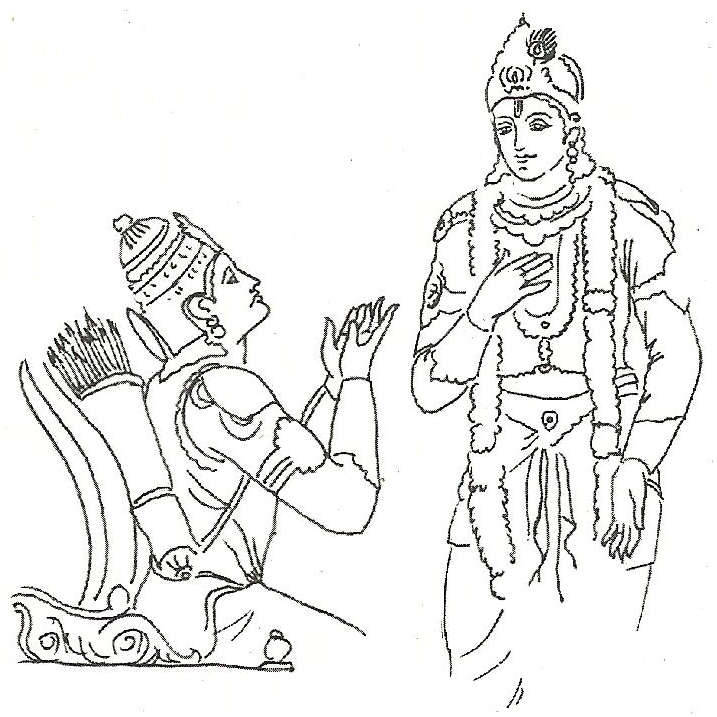
अर्जुन उवाच
ज्यायसी चेत्कर्मणस्ते मता बुद्धिर्जनार्दन।
तत्किं कर्मणि घोरे मां नियोजयसि केशव।।३.१।।
Arjuna uvaacha:
jyaayasi chet karmanas te mata buddhir janardana tat kim karmani ghore maam niyojayasi Keshava 3.1
Arjuna: Arjuna; uvaacha: said; jyaayasi: speaking highly; chet: although; karmanah: action; te: your; mata: opinion; buddhih: knowledge; janardana: Janardana; tat: therefore; kim: why; karmani: in action; ghore: terrible; maam: me; niyojayasi: engaging me; keshava: Keshava (slayer of gthe demon Keshu)
3.1 Arjuna said:
O Janardana, O Kesava, Why do You make me engage in this terrible war if You think that knowledge is superior to action?
व्यामिश्रेणेव वाक्येन बुद्धिं मोहयसीव मे।
तदेकं वद निश्चित्य येन श्रेयोऽहमाप्नुयाम्।।३.२।।
vyaamishreneva vakyena buddhim mohayaseeva me
tad ekam vada nishchitya yena shreyo aham aapnuyaam 3.2
vyaamishrena: by ambiguous; iva: as; vakyena: words; buddhim: intelligence; mohayasee: confusing; iva: as; me: my; tat: therefore; ekam: one; vada: tell; nishchitya: for certain; yena: by which; shreyah: benefit; aham: I; apnuyam: may have
3.2 My intelligence is confused by Your conflicting words. Tell me clearly what is best for me.
श्री भगवानुवाच
लोकेऽस्मिन्द्धिविधा निष्ठा पुरा प्रोक्ता मयानघ।
ज्ञानयोगेन सांख्यानां कर्मयोगेन योगिनाम्।।३.३।।
Shri Bhagavan uvaacha:
loke asmin dvividhaa nishthaa puraa proktaa mayanagha
jnana yogena saankhyaanaam karma yogena yoginaam 3.3
Shri Bhagavan uvaacha: the Lord said; loke: in the world; asmin: this; dvividha: two kinds of; nishtha: faith; pura: before; prokta: were said; maya: by Me; anagha: O sinless one; jnana yogena: by the yoga of knowledge; saankhyaanaam: of the Sankhya; karma yogena: by the yoga of action; yoginaam: of the yoga practitioners
3.3 The Lord said,
‘O sinless Arjuna, as I said before, in this world there are two paths; Self knowledge for the intellectual and the path of action of the knowing.
न कर्मणामनारम्भान्नैष्कर्म्यं पुरुषोऽश्नुते।
न च संन्यसनादेव सिद्धिं समधिगच्छति।।३.४।।
na karmanaam anaarambhaan naishkarmyam purushoshnute na cha sannyasanaad eva siddhim samadhigacchati 3.4
na: without; karmanaam: of the actions; anaarambhaan: abstaining; naishkarmyam: freedom from action; purushah: man; ashnute: achieve; na: not; cha: also; sannyasanaat: by renunciation; eva: surely; siddhim: success; samadhigacchati: attain
3.4 A person does not attain freedom from action by abstaining from work, nor does he attain fulfillment by giving up action.
न हि कश्चित्क्षणमपि जातु तिष्ठत्यकर्मकृत्।
कार्यते ह्यवशः कर्म सर्वः प्रकृतिजैर्गुणैः।।३.५।।
na hi kashchit kshanam api jaatu tishthati akarmakrut kaaryate hyavashaha karma sarvaha prakruti jair gunaiha 3.5 Na: not, hi: surely, kashchit: anyone, kshanam: for a moment, api: also, jaatu: even, tishthati: stands, akarmakrut: without doing something, kaaryate: forced to work, hi: surely, avashaha: helplessly, karma: action, sarvaha: all, prakriti jaih: of the modes of material nature, gunaiha: by the attributes
3.5 Surely, not even for a moment can anyone stand without doing something. He is always in action, despite himself, as this is his very nature.
कर्मेन्द्रियाणि संयम्य य आस्ते मनसा स्मरन्।
इन्द्रियार्थान्विमूढात्मा मिथ्याचारः स उच्यते।।३.६।।
karmendriyaani samyamya ya aaste manasaa smaran indriyaarthaan vimudhaatma mithyaachaaraha sa uchyate 3.6
karmeindriyaani: the five working sense organs; samyamya: restraining; ya: who; aste: remains; manasaa: mentally; smaran: recollecting; indriyaarthaan: objects of the senses; vimudha: foolish; atma: soul; mithyaachaaraha: hypocrite; sa: he; uchyate: is called
3.6 He who restrains the sense organs, but who still thinks of the objects of the senses is deluded and is called a hypocrite.

यस्त्विन्द्रियाणि मनसा नियम्यारभतेऽर्जुन।
कर्मेन्द्रियैः कर्मयोगमसक्तः स विशिष्यते ।।३.७।।
yas tvindriyaani manasaa niyamya aarabhate arjuna karmendriyaih karma yogam asaktaha sa vishishyate 3.7
yah: who; tu: but; indriyaani: senses; manasaa: by the mind; niyamya: controlling; aarabhate: begins; arjuna - O Arjuna; karma indriyaih: by the active sense organs; karma yogam: work of devotion; asaktaha: without attachment; sah: he; vishishyate: superior
3.7 He who begins controlling the senses by the mind and performs selfless work through the sense organs is superior, O Arjuna.
नियतं कुरु कर्म त्वं कर्म ज्यायो ह्यकर्मणः।
शरीरयात्रापि च ते न प्रसिद्धयेदकर्मणः।।३.८।।
niyatam kuru karma tvam karma jyaayo hya akarmanaha shareera yaatraa api cha te na prasiddhyed akarmanaha 3.8
niyatam: prescribed; kuru: do; karma: work; tvam: you; karma: work; jyaayah: better; hi: than; akarmanaha: without work; shareera: body; yaatraa: maintenance; api: even; cha: also; te: your; na: never; prasiddhyet: possible; akarmanaha: without work
3.8 Do your prescribed work, as doing work is better than being idle. Even your own body cannot be maintained without work.
यज्ञार्थात्कर्मणोऽन्यत्र लोकोऽयं कर्मबन्धनः।
तदर्थं कर्म कौन्तेय मुक्तसंगः समाचर।।३.९।।
yajnaarthaat karmano ‘nyatra loko‘yam karmabandhanaha tad artham karma kaunteya mukta sangaha samaachara 3.9
yajna: sacrifice; arthaat: for; karmanah: work done; anyatra: otherwise; lokah: world; ayam: this; karmabandhanaha: bondage by work; tat: Him; artham: for; karma: work; kaunteya: O son of Kunti; mukta: liberated; sangaha: attachment; samaachara: do perfectly
3.9 Work has to be performed selflessly; otherwise, work binds one to this world. O son of Kunti, perform your work for Me and you will do it perfectly, liberated and without attachment.
सहयज्ञाः प्रजाः सृष्ट्वा पुरोवाच प्रजापतिः।
अनेन प्रसविष्यध्वमेष वोऽस्त्विष्टकामधुक् ।।३.१०।।
saha yajnaaha prajaaha srshtva purovaacha prajapatihi anena prasavishyadhvam esha vostvishta kaamadhuk 3.10
sah: along with; yajnaaha: sacrifices; prajaaha: people; srshtvaa: creating; pura: before; uvaacha: said; prajapatihi: the lord of creation; anena: by this; prasavishyadhvam: be more and more prosperous; esha: certainly; vah: your; astu: let it be; ishta: desired; kamadhuk: bestower of gifts

3.10 Brahma, the lord of creation before creating human kind as selfless sacrifice said, ‘By this selfless service, be more and more prosperous and let it bestow all the desired gifts.’
देवान्भावयतानेन ते देवा भावयन्तु वः।
परस्परं भावयन्तः श्रेयः परमवाप्स्यथ।।३.११।।
devaan bhaavayata anena te devaa bhaavayantu vaha parasparam bhaavayantaha shreyaha param avapsyatha 3.11
devaan: celestial beings; bhaavayata: having pleased; anena: by this sacrifice; te: those; devaa: demigods; bhaavayantu: will please; vaha: you; parasparam: mutual; bhaavayantaha: pleasing one another; shreyaha: prosperity; param: supreme; avapsyatha: achieve
3.11 The celestial beings, being pleased by this sacrifice, will also nourish you; with this mutual nourishing of one another, you will achieve supreme prosperity.
इष्टान्भोगान्हि वो देवा दास्यन्ते यज्ञभाविताः।
तैर्दत्तानप्रदायैभ्यो यो भुङ्क्ते स्तेन व सः।।३.१२।।
ishtaan bhogaan hi vo devaa daasyante yajna bhaavitaaha tair dattaan apradaayaibhyo yo bhunkte stena eva saha 3.12 ishtaan: desired; bhogaan: necessities of life; hi: certainly; vaha: to you; devaa: demigods; daasyante: award; yajna: sacrifice; bhaavitaaha: satisfied; taih: by them; dattan: things given; apradaaya: without offering; ebhyaha: to the celestial beings; yaha: who; bhunkte: enjoys; stena: thief; eva: certainly; saha: he
3.12 Satisfied with the selfless service, the celestial beings certainly award you the desired necessities of life. He who enjoys the things given by them without offering to the celestial beings is certainly a thief.
यज्ञशिष्टाशिनः सन्तो मुच्यन्ते सर्वकिल्बिषैः।
भुञ्जते ते त्वघं पापा ये पचन्त्यात्मकारणात् ॥३.१३॥
yajna shishta ashinaha santo muchyante sarva kilbishaiha bhunjate te tvagham paapaa ye pachantya atma kaaranaat 3.13
yajna: sacrifice, shishta: food; ashinaha: eaters; santaha: devotees; muchyante: get relief from; sarva: all; kilbishaiha: sins; bhunjate: enjoy; te: they; tu: but; agham: grievous; paapa: sins; ye: those; pachanti: prepare food; atma kaaranaat: for sense enjoyment
3.13 Those who eat food after selfless service are free of all sins. Those who prepare food for sense enjoyment do grievous sin.
अन्नाद्भवन्ति भूतानि पर्जन्यादन्नसम्भवः।
यज्ञाद्भवति पर्जन्यो यज्ञः कर्मसमुद्भवः।।३.१४।।
annaad bhavanti bhutaani parjanyaad anna sambhavaha yajnaad bhavati parjanyo yajnaha karma samudbhavaha 3.14
annaat: from grains; bhavanti: grow; bhutaani: beings; parjanyaat: from rains; anna: food grains; sambhavaha: possible; yajnaat: from sacrifice; bhavati: becomes possible; parjanyah: rains; yajnaha: sacrifice; karma: work; samudbhavaha: born of
3.14 All beings grow from food grains, from rains the food grains become possible, the rains become possible from selfless sacrifice.
कर्म ब्रह्मोद्भवं विद्धि ब्रह्माक्षरसमुद्भवम्।
तस्मात्सर्वगतं ब्रह्म नित्यं यज्ञे प्रतिष्ठितम्।।३.१५।।
karma brahmodbhavam viddhi brahmaakshara samudbhavam tasmaat sarvagatam brahma nithyam yajne pratishthitam 3.15
karma: work; brahma: Creator; udbhavam: born of; viddhi: know; brahma: Creator; akshara: Supreme; samudbhavam: born of; tasmaat: therefore; sarvagatam: all-pervading; brahma: Supreme; nithyam: eternally; yajne: in sacrifice; pratishthitam: situated
3.15 Know that work is born of the Creator and He is born of the Supreme. The all-pervading Supreme is eternally situated in sacrifice.
एवं प्रवर्तितं चक्रं नानुवर्तयतीह यः।
अघायुरिन्द्रियारामो मोघं पार्थ स जीवति।।३.१६।।
evam pravartitam chakram na anuvartayati iha yaha aghaayur indriyaaraamo mogham partha sa jeevati 3.16
evam: prescribed; pravartitam: established; chakram: cycle; na: not; anuvartayati: adopt; iha: in this; yaha: who; agha ayuh: life full of sins; indriya araamah: satisfied in sense gratification; mogham: useless; partha: O son of Pritha; sa: he; jeevati: lives
3.16 O Partha, he who does not adopt the prescribed, established cycle lives a life full of sins. Rejoicing in sense gratification, he lives a useless life.
यस्त्वात्मरतिरेव स्यादात्मतृप्तश्च मानवः।
आत्मन्येव च सन्तुष्टस्तस्य कार्यं न विद्यते।।३.१७।।
yas tva atma ratir eva syaad atma truptash cha maanavaha atmany eva cha santushtas tasya kaaryam na vidyate 3.17
yah: who; tu: but; atma ratih: takes pleasure; eva: certainly; syaat: remains; atma truptah: satisfied in self; cha: and; maanavaha: man; atmany: in oneself; eva: certainly; cha: and; santushtah: satiated; tasya: his; kaaryam: work; na: not; vidyate: exist
3.17 One who takes pleasure in the self, who is satisfied in the self and who is satiated in oneself, for him certainly, no work exists.
नैव तस्य कृतेनार्थो नाकृतेनेह कश्चन।
न चास्य सर्वभूतेषु कश्चिदर्थव्यपाश्रयः।।३.१८।।
naiva tasya krutena artho na akruteneha kashchana na chaasya sarva bhuteshu kashcid artha vyapa aashrayaha 3.18
na: never; eva: certainly; tasya: his; krutena: by doing duty; arthaha: purpose; na: not; akrutena: without doing duty; iha: in this world; kashchana: whatever; na: never; cha: and; asya: of him; sarva bhuteshu: all living beings; kashcit: any; artha: purpose; vyapa aashrayaha: taking shelter of
3.18 Certainly, he never has any purpose for doing his duty or for not doing his duty in this world. He does not depend on any living being.
तस्मादसक्तः सततं कार्यं कर्म समाचर।
असक्तो ह्याचरन्कर्म परमाप्नोति पूरुषः।।३.१९।।
tasmaad asaktahòa satatam kaaryam karma samaachara
asakto hyaacharan karma param aapnoti poorushaha 3.19
tasmaad: therefore, asaktaha: without attachment, satatam: always, kaaryam: work, karma: work, samaachara: perform, asaktah: not attached, hi: certainly, acharan: performing, karma: work, param: supreme, aapnoti: achieves, poorushaha: man
3.19 Therefore, one should work always without attachment. Performing work without attachment, certainly, man achieves the Supreme.
कर्मणैव हि संसिद्धिमास्थिता जनकादयः।
लोकसंग्रहमेवापि संपश्यन्कर्तुमर्हसि।।३.२०।।
karmanaiva hi samsiddhim asthita janaka adayaha
loka sangraham eva api sampashyan kartum arhasi 3.20
karmana: by work; eva: also; hi: certainly; samsiddhim: perfection; asthita: situated; janaka: Janaka; adayaha: other kings; loka sangraham: educating people; eva: also; api: therefore; sampashyan: considering; kartum: act; arhasi: deserve
3.20 King Janaka and others attained perfection by selfless service. To guide others you too must act selflessly.
यद्यदाचरति श्रेष्ठस्तत्तदेवेतरो जनः।
स यत्प्रमाणं कुरुते लोकस्तदनुवर्तते।।३.२१।।
yad yad acharati shreshthas tat tad evetaro janaha
sa yat pramanam kurute lokas tad anuvartate 3.21
yat: what; yat: what; aacharati: act; shreshthah: great; tat: that; tat: that; eva: certainly; itarah: common; janah: persons; sa: he; yat: what; pramaanam: evidence; kurute: perform; lokah: world; tat: that; anuvartate: follow in footsteps
3.21 Whatever action is performed by a great person, others follow. They follow the example set by him.
न मे पार्थास्ति कर्तव्यं त्रिषु लोकेषु किञ्चन।
नानवाप्तमवाप्तव्यं वर्त एव च कर्मणि।।३.२२।।
na me partha asti kartavyam trishu lokeshu kinchan
na anavaptam avaptavyam varta eva cha karmani 3.22
na: not; me: mine; partha: O son of Pritha; asti: is; kartavyam: duty; trishu: in the three; lokeshu: worlds; kinchan: anything; na: no; anavaptam: in want; avaptavyam: to be gained; varta: engaged; eva: certainly; cha: and; karmani: work
3.22 O Paartha, there is nothing that I must do in the three worlds. Neither am I in want of anything nor do I have anything to gain. Yet, I am always in action.
यदि ह्यहं न वर्तेयं जातु कर्मण्यतन्द्रितः।
मम वर्त्मानुवर्तन्ते मनुष्याः पार्थ सर्वशः॥३.२३॥
yadi hyaham na varteyam jaatu karmanya atandritaha mama vartma anuvartante manushyaaha partha sarvashaha 3.23
yadi: if; hi: certainly; aham: I; na: not; varteyam: engage; jaatu: ever; karmani: work; atandritaha: with care; mama: My; vartma: path; anuvartante: follow; manushyaaha: persons; partha: Partha; sarvashaha: in all respects
3.23 If I did not engage in work with care, O Partha, certainly, people would follow My path in all respects.
उत्सीदेयुरिमे लोका न कुर्यां कर्म चेदहम्।
सङ्करस्य च कर्ता स्यामुपहन्यामिमाः प्रजाः॥३.२४॥
utsideyur ime lokaa na kuryaam karma ched aham sankarasya cha kartaa syaam upahanyaam imaaha prajaaha 3.24
utsideyuh: ruin; ime: these; lokaa: worlds; na: not; kuryaam: do; karma: work; chet: if; aham: I; sankarasya: confusion of species; cha: and; kartaa: doer; syaam: shall be; upahanyaam: destroy; imaaha: these; prajaaha: beings
3.24 If I do not work, then these worlds would be ruined. I would be the cause of creating confusion and destruction.
सक्ताः कर्मण्यविद्वांसो यथा कुर्वन्ति भारत।
कुर्याद्विद्वांस्तथासक्तश्चिकीर्षुर्लोकसंग्रहम्।।३.२५।।
saktaaha karmanya avidvamso yathaa kurvanti bhaarata kuryaad vidvams tatha asaktash chikirshur loka sangraham 3.25
saktaaha: attached; karmani: work; avidvamsah: ignorant; yathaa: as; kurvanti: do; bhaarata: Bharata; kuryat: do; vidvan: wise; tatha: and; asaktah: without attachment; chikirshuh: desiring; loka sangraham: leading people
3.25 As the ignorant do their work with attachment to the results, O Bharata, the wise do so without attachment, for the welfare of people.
न बुद्धिभेदं जनयेदज्ञानां कर्मसङ्गिनाम्।
जोषयेत्सर्वकर्माणि विद्वान् युक्तः समाचरन्।।३.२६।।
na buddhi bhedam janayed ajnaanam karma sanginaam joshayet sarva karmaani vidvaan yuktaha samaacharan 3.26
na: not; buddhi: intelligence; bhedam: disrupt; janayet: do; ajnanam: ignorant; karma: work sanginaam: attached; joshayet: encouraged; sarva: all; karmaani: work; vidvaan: wise; yuktaha: engaged; samaacharan: practising
3.26 Let not the wise disturb the minds of the ignorant who are attached to the results of work. They should encourage them to act without attachment.
प्रकृतेः क्रियमाणानि गुणैः कर्माणि सर्वशः।
अहङ्कारविमूढात्मा कर्ताऽहमिति मन्यते।।३.२७।।
prakruteha kriyamaanaani gunaiha karmaani sarvashaha ahaankara vimudhaatma kartaham iti manyate 3.27
prakruteha: of material nature; kriyamaanaani: all being done; gunaiha: by the attributes; karmaani: work; sarvashaha: all kinds of; ahankara: ego; vimudha: confused; atma: being; karta: doer; aham: I; iti: thus; manyate: thinks
3.27 People, confused by ego, think they are the doers of all kinds of work while it is being done by the energy of nature.
तत्त्ववित्त्तु महाबाहो गुणकर्मविभागयोः।
गुणा गुणेषु वर्तन्त इति मत्वा न सज्जते।।३.२८।।
tattvavit tu mahaabaaho guna karma vibhaagayoha gunaa guneshu vartanta iti matva na sajjate 3.28
tattvavit: one who knows the Truth; tu: but; mahaabaaho: mighty-armed one; guna: attributes; karma: work; vibhagayoha: differences; guna: attributes; guneshu: in sense gratification; vartante: engaged; iti: thus; matva: thinking; na: never; sajjate: becomes attached

प्रकृतेर्गुणसम्मूढाः सज्जन्ते गुणकर्मसु।
तानकृत्स्नविदो मन्दान्कृत्स्नविन्न विचालयेत्।।३.२९।।
prakruter guna asammudhaaha sajjante guna karmasu taan akrutsna vido mandaan krutsna vin na vichaalayet 3.29
prakruteh: by the material nature; guna: attributes; asammudhaah: fooled; sajjante: become engaged; guna: attributes; karmasu: actions; tan: those; akrutsna vidah: persons with less wisdom; mandaan: lazy; krutsnavit: who has wisdom; na: not; vichaalayet: unsettle
One who knows the Truth, O mighty-armed one, knows the differences between the attributes of nature and work. Knowing well about the attributes and sense gratification, he never becomes attached.
मयि सर्वाणि कर्माणि संन्यस्याध्यात्मचेतसा।
निराशीर्निर्ममो भूत्वा युध्यस्व विगतज्वरः।।३.३०।।
mayi sarvaani karmaani sannyasya adhyaatma chetasaa niraashir nirmamo bhutvaa yudhyasva vigata jvaraha 3.30
mayi: to Me; sarvaani: all kinds of; karmaani: work; sannyasya: renouncing; adhyaatma: spiritual knowledge; chetasaa: consciousness; niraashih: without desire for gain; nirmamah: without sense of ownership; bhutvaa: being; yudhyasva: fight; vigata jvaraha: without being lazy
3.30 Dedicating the results of work to Me, with consciousness filled with spiritual knowledge, without desire for gain and without sense of ownership, without being lazy, do what you have to do.
ये मे मतमिदं नित्यमनुतिष्ठन्ति मानवाः।
श्रद्धावन्तोऽनसूयन्तो मुच्यन्ते तेऽपि कर्मभिः।।३.३१।।
ye me matam idam nithyam anutishthanti maanavaaha shraddhaa vanto anasuyanto muchyante te api karmabhihi 3.31
ye: who; me: My; matam: teaching; idam: these; nithyam: always; anutishtòhanti: execute regularly; maanavaahòa: persons; shraddhaa vantahò: with faith; anasuyantahòa: without envy; muchyante: become free; te: all of them; api: even; karmabhihòi: from the bondage of fruitive actions
3.31 Those persons who execute their duties according to My teaching and who follow these teachings faithfully, without envy, become free from the bondage of actions.
ये त्वेतदभ्यसूयन्तो नानुतिष्ठन्ति मे मतम्।
सर्वज्ञानविमूढांस्तान्विद्धि नष्टानचेतसः।।३.३२।।
ye tvetad abhyasuyanto naanutishthanti me matam sarva jnaana vimudhaamstaan viddhi nashtaan achetasaha 3.32 ye: those; tu: but; etat: this; abhyasuyantah: out of envy; na: not; anutishthanti: regularly perform; me: My; matam: teaching; sarvajnaana: all kinds of knowledge; vimudham: fooled; tan: they; viddhi: know; nashtaan: ruined; achetasaha: without Consciousness
3.32 But those who do not regularly perform their duty according to My teaching are ignorant, senseless and ruined.
सदृशं चेष्टते स्वस्याः प्रकृतेर्ज्ञानवानपि।
प्रकृतिं यान्ति भूतानि निग्रहः किं करिष्यति।।३.३३।।
sadrusham cheshtate svasyaaha prakruter jnaanavaan api prakrutim yaanti bhutaani nigrahaha kim karishyati 3.33
sadrusham: according to; cheshtate: tries; svasyaaha: by one's nature; prakruteha: modes; jnaanavaan: wise; api: even; prakrutim: nature; yaanti: goes through; bhutaani: living beings; nigrahaha: suppression; kim: what; karishyati: can do
3.33 Even the wise person tries to act according to the modes of his own nature, for all living beings go through their nature. What can restraint of the senses do?
इन्द्रियस्येन्द्रियस्यार्थे रागद्वेषौ व्यवस्थितौ।
तयोर्न वशमागच्छेत्तौ ह्यस्य परिपन्थिनौ।।३.३४।।
indriyasya indriyasya arthe raaga dveshau vyavasthitau
tayor na vasham agacchet tau hyasya paripanthinau 3.34
indriyasya: of the senses; indriyasya arthe: for sense objects; raaga: attachment; dveshau: repulsion; vyavasthitau: put under control; tayoh: of them; na: never; vasham: control; agacchet: come; tau: those; hi: certainly; asya: his; paripanthinau: stumbling blocks
3.34 Attachment and repulsion of the senses for sense objects should be put under control. One should never come under their control as they certainly are the stumbling blocks on the path of self-realization.
श्रेयान्स्वधर्मो विगुणः परधर्मात्स्वनुष्ठितात्।
स्वधर्मे निधनं श्रेयः परधर्मो भयावहः।।३.३५।।
shreyaan svadharmo vigunaha paradharmaat svanushthitaat
svadharme nidhanam shreyaha paradharmo bhayaavahaha 3.35
shreyaan: better; svadharmah: own duty; vigunaha: in a faulty manner; paradharmaat: other’s duty; svanushthitaat: perfectly done; svadharme: in one’s duty; nidhanam: death; shreyaha: better; paradharmaha: other’s duty; bhaya avahaha: dangerous
3.35 It is better to do one’s own duty, even if it is in a faulty manner, than to do someone else’s duty perfectly. Death in the course of performing one’s own duty is better than doing another’s duty, as this can be dangerous.
अर्जुन उवाच
अथ केन प्रयुक्तोऽयं पापं चरति पूरुषः।
अनिच्छन्नपि वार्ष्णेय बलादिव नियोजितः॥३.३६॥
arjuna uvaacha
atha kena prayuktoyam paapam charati poorushaha
anicchann api vaarshneya balaad iva niyojitaha 3.36
arjuna uvaacha: Arjuna said; atha: then; kena: by what; prayuktah: forced; ayam: one; paapam: sins; charati: acts; poorushaha: man; anicchan: without desiring; api: though; vaarshneya: O descendant of Vrishni; balaat: by force; iva: as if; niyojitaha: engaged
3.36 Arjuna said, ‘O descendant of Vrishni, then, by what is man forced to sinful acts, even without desiring, as if engaged by force?’
श्री भगवानुवाच
काम एश क्रोध एश रजोगुणसमुद्भवः।
महाशनो महापाप्मा विद्धयेनमिह वैरिणम्॥३.३७॥
Shri bhagavaan uvaacha
kaama esha krodha esha rajoguna samudbhavaha
mahaashano mahaapaapma viddhyenam iha vairinam 3.37
Shri bhagavaan uvaacha: the Lord said; kaama: lust; esha: these; krodha: anger; esha: these; rajah guna: attribute of passion; samudbhavaha: born of; mahaashanah: all-devouring; mahapapma: greatly sinful; viddhi: know; enam: this; iha: in the world; vairinam: greatest enemy
3.37 The Lord said, ‘It is lust and anger born of the attribute of passion, all-devouring and sinful, which is one’s greatest enemy in this world.’
धूमेनाव्रियते वह्निर्यथाऽऽदर्शो मलेन च।
यथोल्बेनावृतो गर्भस्तथा तेनेदमावृतम्।।३.३८।।
dhumena avriyate vahnir yathaa aadarsho malena cha yathaa ulbena aavruto garbhas tatha tenedam aavrutam 3.38
dhumena: by smoke; aavriyate: covered; vahnih: fire; yathaa: as; aadarshah: mirror; malena: by dust; cha: also; yathaa: as; ulbena: by the womb; aavrutah: covered; garbhah: embryo; tathaa: so; tena: by that; idam: this; aavrutam: covered
3.38 As fire is covered by smoke, as a mirror is covered by dust, or as the embryo is covered by the womb, so also, the living being is covered by lust.
आवृतं ज्ञानमेतेन ज्ञानिनो नित्यवैरिणा।
कामरूपेण कौन्तेय दुष्पूरेणानलेन च।।३.३९।।
aavrutam jnaanam etena jnaanino nithya vairina
kaama roopena kaunteya dushpoorena analena cha 3.39
aavrutam: covered; jnaanam: knowledge; etena: by this; jnaaninah: of the knower; nithya: eternal; vairina: enemy; kaama: lust; roopena: in the form of; kaunteya: O son of Kunti; dushpoorena: never satisfied; analena: by fire; cha: and
3.39 The knowledge of the knower is covered by this eternal enemy in the form of lust, which is never satisfied and burns like fire, O son of Kunti.
इन्द्रियाणि मनो बुद्धिरस्याधिष्ठानमुच्यते।
एतैर्विमोहयत्येष ज्ञानमावृत्य देहिनम्।।३.४०।।
indriyaani mano buddhir asya adhishthaanam uchyate
etair vimohayatye esha jnaanam aavrutya dehinam 3.40
indriyaani: senses; manah: mind; buddhih: intelligence; asya: of; adhishthaanam: sitting place; uchyate: called; etaih: by these; vimohayati: confuses; esha: of this; jnaanam: knowledge; aavrutya: covering; dehinam: embodied being
3.40 The senses, the mind and the intelligence are the locations of this lust, which confuses the embodied being and covers the knowledge.
तस्मात्त्वमिन्द्रियाण्यादौ नियम्य भरतर्षभ।
पाप्मानं प्रजहि ह्येनं ज्ञानविज्ञाननाशनम्।।३.४१।।
tasmaat tvam indriyaany adau niyamya bharatarshabha
paapmaanam prajahi hyonam jnaana vijnaana naashanam 3.41
tasmaat: therefore; tvam: you; indriyaani: senses; adau: in the beginning; niyamya: by controlling; bharatarshabha: O chief amongst the descendants of Bharata; paapmaanam: symbol of sin; prajahi: curb; hi: certainly; enam: this; jnaana: knowledge; vijnaana: consciousness; naashanam: destroyer
3.41 Therefore, O chief amongst the descendants of Bharata, in the very beginning, control the senses and curb the symbol of sin, which is certainly the destroyer of knowledge and consciousness.
इन्द्रियाणि पराण्याहुरिन्द्रियेभ्यः परं मनः।
मनसस्तु परा बुद्धिर्यो बुद्धेः परतस्तु सः।।३.४२।।
indriyaani paraany ahur indriyebhyaha param manaha
manasas tu paraa buddhir yo buddheha paratas tu saha 3.42
indriyaani: senses; paraani: superior; ahuh: is said; indriyebhyaha: more than the senses; param: superior; manaha: mind; manasah: more than the mind; tu: also; paraa: superior; buddhih: intelligence; yah: who; buddheha: more than intelligence; paratah: superior; tu: but; sah: he
3.42 It is said that the senses are superior to the body. The mind is superior to the senses. The intelligence is still higher than the mind and the consciousness is even higher than intelligence.
एवं बुद्धेः परं बुद्ध्वा संस्तभ्यात्मानमात्मना।
जहि शत्रुं महाबाहो कामरूपं दुरासदम्।।३.४३।।
evam buddheha param buddhvaa samstabhya aatmaanam aatmana jahi shatrum mahaabaho kaama rupam duraasadam 3.43
evam: and; buddheha: of intelligence; param: superior; buddhva: knowing; samstabhya: by steadying; aatmaanam: of the mind; aatmana: by intelligence; jahi: conquer; shatrum: enemy; mahaabaho: O mighty-armed one; kaama: lust; rupam: in the form of; duraasadam: insatiable
3.43 Knowing the Self to be superior to mind and intelligence, by steadying the mind by intelligence, conquer the insatiable enemy in the form of lust, O mighty-armed one.
Bhagavad Gita
commentary by
Nithyananda
Beauty of Purposelessness - the meaning of living - chapter 3
We are forever chasing happiness, but seem to enjoy only fleeting moments of it.
Why is it that we are journeying endlessly after so many goals? We are told to just enjoy the journey without worrying about the goal. But how do we manage to do this?
With an enlightened insight and unique style, Nithyananda captures the essence of the Bhagavad Gita and expresses it in a practical, contemporary fashion. He shows us how to drop the goal and live blissfully in every moment, in eternity...
He leads the seeker on a path of blissful Self-discovery, just as Krishna, the Master of Masters, led Arjuna on his journey.
Ebook ISBN: 979-8-88572-014-4
PUBLISHED BY LIFE BLISS FOUNDATION