Drop Your Ego!
This text was machine-transcribed from the printed book and may contain errors. Select the words and choose “Report a mistake”.
Q: Master, when you say that we
should live without ego, is it really
possible to do that when we live in a
material world? Wouldn't we then
become failures materially?
Ego, as I have used the term here,
has two aspects. In Sanskrit, we call
these ahankara and mamakara.
Ahankara is ego projected outwards.
It is about what you convey to others
about who you are. This is always more
than what you are. You would like
people to think that you are more handsome, smarter, and richer and in all ways better than what you really are.
Mamakara is what you think about yourself within you. It is always less than what you really are. People say to me, 'No Master, I have a very high self-esteem.' Remember, all along as you do not realize that you are God, your self-esteem is low!
The gap between ahankara and mamakara is what causes trouble. You like to project something that you do not think you are. You may term this differential ego. This is the differential you need to drop.
When you are the same while looking inwards and projecting outwards, there is no problem. You are quite natural. You are the real self. You do not need to boast, you do not need to hide.
If you reach this state, you will in fact do far better materially, because people will have far greater respect for you. You will be doing what you promise and promise what you can deliver. There will be no differential.
Of course, in a deeper sense, as you progress spiritually, you may drop all attachment to your self, your mind-body system. This does not mean that you cannot function in the material world. Many Masters have functioned in such a state. At such a state, one's identification is not with this material mind-body system at all, but with the existential energy. Then, your ahankara and mamakara are harmonizing, at the highest possible level of divinity.
Q: Master, you described four states of mind. How does one distinguish between the state of deep sleep, sushupti, and the mindless state of awareness, turiya, the fourth state?
We have a combination of thoughts and identity to give us four states of the mind.
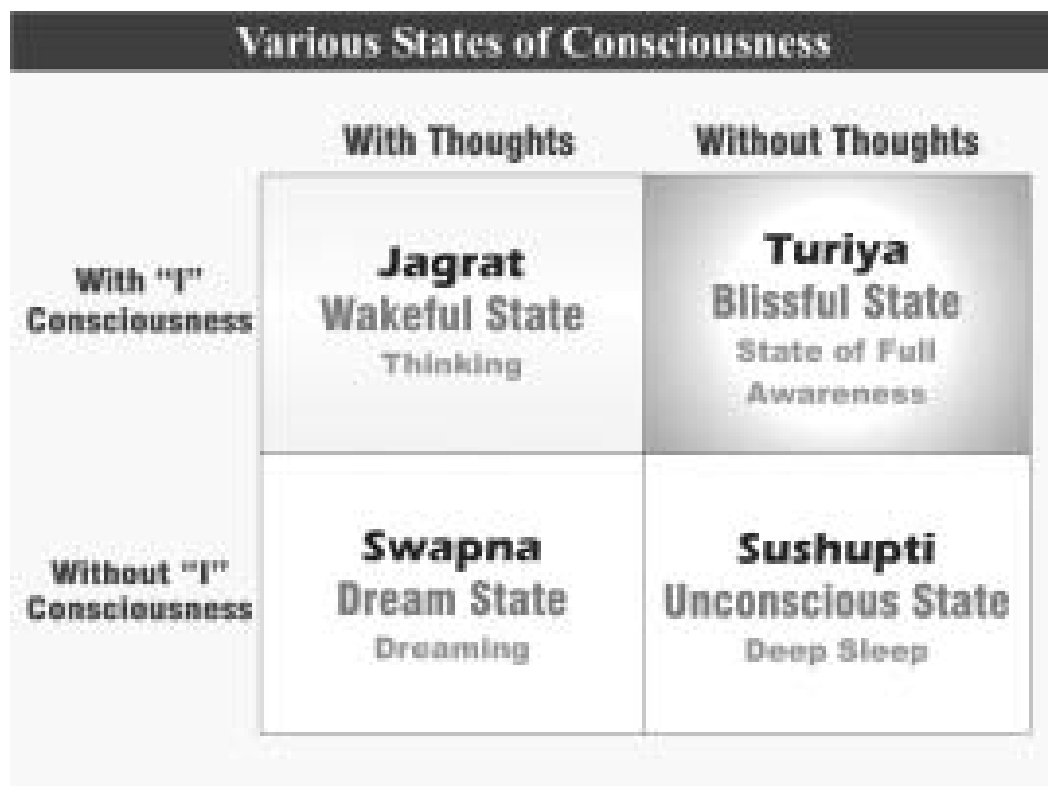
When we have thoughts in our mind, and we are aware of our identity, we are physically awake. This is the first state, the state in which you are listening to me now. When we are unaware of our identity but still have thoughts, we are dreaming. This is the second state. While dreaming, there is no ‘I’ identity right? This is why we are startled into wakefulness when a nightmare seems to threaten our life, our identity.
Third, when we are in deep sleep, we are neither with thoughts nor with our identity. For all practical purposes we are dead. The body-mind system is refreshing itself by dying and being reborn every day and night. This is why if you lose sleep continuously for a period of time, you will really die.
The fourth state, called by some the Fourth Way, is the state where we are fully aware but have no thoughts! At least there is no attachment to thought, no linking of thoughts. It is only witnessing. This is the state called samadhi. Samadhi means returning to one's natural state, or simply put, the realization of Self.
Enlightened beings are in the samadhi state all the time. This does not mean that they are withdrawn with closed eyes continuously, not at all. As Krishna says, they are awake when others are asleep and asleep when others are awake. This means that they are always in awareness and that their senses are controlled or asleep.
Let me give you a simple tip to evaluate how evolved a person is. Watch that person when he is asleep, when he is in really deep sleep and he does not know you are watching. If that person is like a flower when asleep, totally blissful, with no movements and no facial changes, that person is in turiya or samadhi state. The body is asleep but the mind while not in thought is fully aware. The mind-body is at rest and in bliss, nithyananda.
Thank you.
Thus ends the second chapter named ‘Transcendental Knowledge’ of the Upanishad of the Bhagavad Gita, the scripture of yoga, dealing with the science of the Absolute in the form of the dialogue between Sri Krishna and Arjuna.

Scientific Research on
Bhagavad Gita
Several institutions have conducted experiments using scientific and statistically supported techniques to verify the truth behind the Bhagavad Gita. Notable amongst them is the work carried out by Maharishi Mahesh Yogi, whose findings are published through Maharishi Ved Vigyan Vishwa Vidyapeetam.
Studies conducted using meditation techniques related to truths expressed in the verses of the Bhagavad Gita have shown that the quality of life is significantly improved through meditation. These studies have found that meditators experience a greater sense of peace resulting in a reduced tendency towards conflict.
Meditators gain greater respect for and appreciation of others. Their own inner fulfilment increases resulting in improved self-respect and self-reliance, leading to Self Actualization.
One's ability to focus along with brain function integration is enhanced. These have resulted in greater comprehension, creativity, faster response time in decision-making and superior psychomotor coordination.
Stress levels have been shown to decrease with enhanced sensory perception and overall health. The tendency towards depression has been clearly shown to decrease.
There is enough evidence to show that as a result of meditation, individuals gain a better ethical lifestyle that in turn improves their interaction with others in the community, resulting in less conflict and crime. Group meditation of 7000 people (square root of 1% of world population at the time of the study) was significantly correlated to a reduction in conflict worldwide.
Meditation leads to higher levels of consciousness. Through the research tools of Applied Kinesiology, Dr. David Hawkins (author of the book Power vs. Force) and others have shown that human consciousness has risen in the last few decades, crossing a critical milestone for the first time in human history. Dr. Hawkins’ research also documents that the Bhagavad Gita is at the very highest level of Truth conveyed to humanity.
We acknowledge with gratitude the work done by the Maharishi Mahesh Yogi institutions and Dr. David Hawkins in establishing the truth of this great scripture.