Verses Of Gita Chapter 6
This text was machine-transcribed from the printed book and may contain errors. Select the words and choose “Report a mistake”.
श्री भगवानुवाच
अनाश्रितः कर्मफलं कार्यं कर्म करोति यः।
स संन्यासी च योगी च न निरग्निर्न चाक्रियः।।६.१।।
Shri Bhagavan uvacha
anashritaha karma phalam karyam karma karoti yaha
sa sanyasi cha yogi cha na niragnir na chakriyaha 6.1
Shri bhagavan uvacha: the Lord said; anashritaha: without shelter; karma: action; phalam: fruit; karyam: obligated; karma: work; karoti: performs; yaha: who; sa: he; sanyasi: ascetic; cha: and; yogi: one engaged in yoga; cha: and; na: not; nih: without; agnih: fire; na: not; cha: and; akriyaha: without work
6.1 Bhagavan says:
One who performs actions without being attached to its outcome is an ascetic. He is a religious performer of purification of mind.
One who has stopped performing any actions, one who doesn't accept the sacred fire and doesn't perform his rituals is neither an ascetic nor a karma yogi, a sage immersed in action.
यं संन्यासमिति प्राहुर्योगं तं विद्धि पाण्डव।
न ह्यसंन्यस्तसङ्कल्पो योगी भवति कश्चन॥६.२॥
yam sanyasam iti prahur yogam tam viddhi pandava na hy asannyasta sankalpo yogi bhavati kashchana 6.2
yam: what; sanyasam: renunciation; iti: thus; prahuh: they say; yogam: linking with the Supreme; tam: that; viddhi: you should know; pandava: O son of Pandu; na: never; hi: certainly; asannyasta: without renouncing; sankalpah: self interest; yogi: one engaged in yoga; bhavati: becomes; kashchana: anyone
6.2 O Pandava, renunciation leads to the state of yoga where one is linking oneself with the Supreme. This union with the Divine can happen only when you renounce self interest.
आरुरुक्षोर्मुनेर्योगं कर्म कारणमुच्यते।
योगारूढस्य तस्यैव शमः कारणमुच्यते॥६.३॥
arurukshor muner yogam karma karanam uchyate yoga arudhasya tasyaiva shamaha karanam uchyate 6.3
aruruksoh: of one who has just begun yoga; muneh: of the sage; yogam: yoga system; karma: work; karanam: cause; uchyate: is said to be; yoga: yoga; arudhasya: of one who has attained; tasya: his; eva: certainly; shamaha: cessation of all activities; karanam: cause; uchyate: is said to be
6.3 A person who initially wants to start practicing the yoga system laid down by the sages should carry out all activities in line with that system. Activities for all other reasons will cease.
यदा हि नेन्द्रियार्थेषु न कर्मस्वनुषज्जते।
सर्वसङ्कल्पसंन्यासी योगारूढस्तदोच्यते।।६.४।।
yada hi nendriya artheshu na karmasv anushajjate sarva sankalpa sanyasi yoga arudhas tadochyate 6.4
yada: when; hi: certainly; na: not; indriya artheshu: in sense gratification; na: never; karmasu: in fruitive activities; anushajjate: does necessarily engage; sarva sankalpa: all material desires; sanyasi: renouncer; yoga arudhah: elevated in yoga; tada: at that time; uchyate: is said to be
6.4 Any one is said to have attained the state of yoga when, having renounced all material desires, he neither acts for sense gratification nor engages in result focused activities.
उद्धरेदात्मनाऽऽत्मानं नात्मानमवसादयेत्।
आत्मैव ह्यात्मनो बन्धुरात्मैव रिपुरात्मनः।।६.५।।
uddhared atmanatmanam natmanam avasadayet atmaiva hy atmano bandhur atmaiva ripur atmanaha 6.5
uddharet: one must deliver; atmana: by the mind; atmanam: the conditioned soul; na: never; atmanam: the conditioned soul; avasadayet: put into degradation; atma: mind; eva: certainly; hi: surely; atmanah: of the conditioned soul; bandhuh: friend; atma: mind; eva: certainly; ripuh: enemy; atmanaha: of the conditioned soul
6.5 You are your own friend; you are your own enemy. Evolve yourself through the Self and do not degrade yourself.
बन्धुरात्माऽऽत्मनस्तस्य येनात्मैवात्मना जितः।
अनात्मनस्तु शत्रुत्वे वर्तेतात्मैव शत्रुवत् ।।६.६।।
bandhur atma atmanas tasya yenatmaiva atmana jitaha anatmanas tu shatrutve varteta atmaiva shatruvat 6.6
bandhuh: friend; atma: the Self; atmanah: of the living entity; tasya: of him; yena: by whom; atma: the Self; eva: certainly; atmana: by the living entity; jitaha: conquered; anatmanah: of one who has failed to control the Self; tu: but; shatrutve: because of enmity; varteta: remains; atma eva: the very mind; shatruvat: as an enemy
6.6 For him who has conquered the self, the Self is the best of friends;
For one who has failed to do so, his self will remain the greatest enemy.
जितात्मनः प्रशान्तस्य परमात्मा समाहितः।
शीतोष्णसुखदुःखेषु तथा मानापमानयोः ।।६.७।।
jitatmanaha prashantasya paramatma samahitaha shitoshna sukkha dukkheshu tatha mana apmanayoha 6.7 jitatmanaha: of one who has conquered his self; prashantasya: who has attained tranquility; paramatma: Supreme; samahitaha: approached completely; shita: in cold; ushna: heat; sukkha: happiness; dukkheshu: and distress; tatha: also; mana: in honor; apmanayoha: dishonor
6.7 For one who has conquered the self, who has attained tranquility, the Supreme is already reached. Such a person remains in this state in happiness or distress, heat or cold, honor or dishonor.
ज्ञानविज्ञानतृप्तात्मा कूटस्थो विजितेन्द्रियः।
युक्त इत्युच्यते योगी समलोष्टाश्मकाञ्चनः॥६.८॥
jnana vijnana trupta atma kutastho vijitendriyaha yukta ityuchyate yogi sama loshta ashma kanchana 6.8
jnana: acquired knowledge; vijnana: realized knowledge; trupta: contented; atma: self; kuta sthah: established in Self-realization; vijita indriyaha: one who has subdued his senses; yukta: competent for self-realization; iti: thus; uchyate: is said; yogi: one established in yoga; sama: equipoised; loshta: lump of earth; ashma: stone; kanchana: gold
6.8 A person whose mind is contented because of spiritual knowledge, who has subdued his senses and to whom stone and gold are same and who is satisfied with what he is having, is said to be established in Self-Realization and is called an enlightened being.
सुहृन्मित्रार्युदासीन मध्यस्थद्वेष्यबन्धुषु।
साधुष्वपि च पापेषु समबुद्धिर्विशिष्यते।।६.९।।
suhrn mitra aryudasina madhyastha dveshya bandhushu sadhushv api cha papeshu sama buddhir vishishyate 6.9
suhrt: to well-wishers by nature; mitra: affectionate benefactors; ari: enemies; udasina: neutral; madhyastha: mediators; dveshya: envious; bandhushu: friends; sadhushu: pious; api: also ; cha: and; papeshu: sinners; sama: equal buddhih: with equal mind; vishishyate: is further advanced
6.9 A person is considered truly advanced when he regards honest well-wishers, affectionate benefactors, the neutral, mediators, the envious, friends and enemies, the pious and the sinners all with an equal mind.
योगी युञ्जीत सततमात्मानं रहसि स्थितः।
एकाकी यतचित्तात्मा निराशीरपरिग्रहः।।६.१०।।
yogi yunjita satatam atmanam rahasi sthitaha ekaki yata chitta atma nirashir aparigrahaha 6.10
yogi: yogi; yunjita: concentrate; satatam: always; atmanam: himself; rahasi: in a secluded place; sthitaha: situated; ekaki: alone; yata chitta atma: careful in mind; nirashih: without being attracted by anything else; aparigrahaha: free from the feeling of possessiveness
6.10 A yogi should always try to concentrate his mind on the Supreme Self; situated in a secluded place, he should carefully control his mind without being attracted by anything and should be free from the feeling of possessiveness.
शुचौ देशे प्रतिष्ठाप्य स्थिरमासनमात्मनः।
नात्युच्छ्रितं नातिनीचं चैलाजिनकुशोत्तरम्॥६.११॥
shuchau deshe pratishthapya sthiram asanam atmanaha nati ucchritam nati neecham chailajina kushottaram 6.11
shuchau: in a clean state; deshe: land; pratishthapya: placing; sthiram: stable; asanam: seat; atmanaha: own; na: not; iti: thus; ucchritam: high; na: not; neecham: low; chailajina: of soft cloth and deerskin; kusha: kusha grass; uttaram: covering
6.11 On a clean and pure place, one should establish his seat by laying kusha grass, a deer skin and a cloth, one over another, neither too high nor too low.
तत्रैकाग्रं मनः कृत्वा यतचित्तेन्द्रियक्रियः।
उपविश्यासने युञ्ज्याद्योगमात्मविशुद्धये॥६.१२॥
tatrai ekagram manaha krutva yat chittendriya kriyaha upavishya asane yunjyad yogam atma vishuddhaye 6.12
tatra: then; ekagram: with one focus; manaha: mind; krutva: making; yat: by chitta: mind; indriya: senses; kriyaha: activities; upavishya: sitting; asane: on the seat; yunjyat: should execute; yogam: yoga; atma: oneself; vishuddhaye: to purify
6.12 Sitting firmly on that pure seat, the yogi should practice the purification of the self by controlling the activities of mind and the senses.
समं कायशिरोग्रीवं धारयन्नचलं स्थिरः।
संप्रेक्ष्य नासिकाग्रं स्वं दिशश्चानवलोकयन् ।।६.१३।।
samam kaya shiro grivam dharayan achalam sthiraha samprekshya nasika agram svam dishashcha anavalokayan 6.13
samam: straight; kaya: body; shirah: head; grivam: neck; dharayan: holding; achalam: steady; sthiraha: still; samprekshya: looking; nasika: nose; agram: at the tip; svam: own; disha: directions; cha: and; anavalokayan: not looking
6.13 Holding the body, head and neck steady, look at the tip of your nose without looking in any other direction.
प्रशान्तात्मा विगतभीर्ब्रह्मचारिवृते स्थितः।
मनः संयम्य मच्चित्तो युक्त आसीत मत्परः।।६.१४।।
prashanta atma vigata bhir brahmachari vrate sthitaha manaha samyamya macchito yukta asita mat paraha 6.14
prashanta: unagitated; atma: mind; vigata bhih: free from fear; brahmachari vrate: in the vow of living with Existence; sthitaha: situated; manaha: mind; samyamya: controlling; mat: on Me; chittah: mind; yukta: yogi; asita: sit; mat: Me; paraha: supreme goal
6.14 Sit with an unagitated mind, free from fear and in tune with Existence, controlling the mind, focusing it on Me and make Me the supreme goal.
युञ्जन्नेवं सदाऽऽत्मानं योगी नियतमानसः।
शान्तिं निर्वाणपरमां मत्संस्थामधिगच्छति।।६.१५।।
yunjan evam sada atmanam yogi niyata manasaha shantim nirvana paramam mat samstham adhigachhati 6.15
yunjan: practicing; evam: thus; sada: always; atmanam: Self; yogi: yogi; niyata: controlled; manasaha: mind; shantim: peace; nirvana: liberation; paramam: supreme; mat samstham: My kingdom; adhigacchati: attain
6.15 Always practicing control over the mind and situated in the Self, the yogi attains peace, the supreme liberation and My kingdom.
नात्यश्नतस्तु योगोऽस्ति न चैकान्तमनश्नतः।
न चातिस्वप्नशीलस्य जाग्रतो नैव चार्जुन।।६.१६।।
natya ashnatastu yogo asti na cha ekantam anashnataha na cha ati swapna shilasya jagrato naiva cha arjuna 6.16
na: never; ati: too much; ashnatah: eats; tu: but; yoga: yoga; asti: is; na: not; cha: and; ekantam: on the one side; anashnataha: not eat; na: not; cha: and; ati: too much; swapna shilasya: sleep; jagrato: awake; na: not; eva: also; cha: and; arjuna: Oh Arjuna
6.16 Yoga is neither eating too much nor eating too little; it is neither sleeping too much nor sleeping too little, Oh Arjuna.
युक्ताहारविहारस्य युक्तचेष्टस्य कर्मसु।
युक्तस्वप्नावबोधस्य योगो भवति दुःखहा।।६.१७।।
yukta ahara viharasya yukta cheshtasya karmasu yukta swapna avabodhasya yogo bhavati dukkhaha 6.17
yukta: regulated; ahara: food; viharasya: rest; yukta: regulated; cheshtasya: exertion; karmasu: work; yukta: regulated; swapna avabodhasya: sleep and wakefulness; yogah: yoga; bhavati: becomes; dukkhaha: reduced misery
6.17 One who is regulated in food, rest, recreation and work, sleep and wakefulness can reduce misery.
यदा विनियतं चित्तमात्मन्येवावतिष्ठते।
निःस्पृहः सर्वकामेभ्यो युक्त इत्युच्यते तदा।।६.१८।।
yada viniyatam chittam atmany eva avatishthate nispruhaha sarva kamebhyo yukta iti uchyate tada 6.18
yada: when; viniyatam: disciplined; chittam: mind; atmani: situated in the Self; eva: certainly; avatishthate: situated; nispruhaha: free of desire; sarva: all; kamebhyah: material desires; yukta: situated; iti: thus; uchyate: said to be; tada: then
6.18 When the mind is disciplined and one is situated in the Self, free from all desires, then one is said to be situated in yoga.
यथा दीपो निवातस्थो नेङ्गते सोपमा स्मृता।
योगिनो यतचित्तस्य युञ्जतो योगमात्मनः॥६.१९॥
yatha deepo nivatastho nengate sopama smrita yogino yata chittasaya yunjato yogam atmanaha 6.19
yatha: as; deepah: lamp; nivatastho: in a place without wind; na: not; ingate: waver; sa: this; upama: comparison; smrita: is considered; yoginah: of the yogi; yata chittasya: whose mind is controlled; yunjatah: engaged; yogam: in yoga; atmanaha: in the Self
6.19 As a lamp in a place without wind does not waver, so also the yogi whose mind is controlled remains steady, engaged in yoga, in the Self.
यत्रोपरमते चित्तं निरुद्धं योगसेवया।
यत्र चैवात्मनाऽऽत्मानं पश्यन्नात्मनि तुष्यति॥६.२०॥
yatro uparamate chittam niruddham yoga sevaya yatra cha eva atmana atmanam pashyan atmani tushyati 6.20
yatra: there; uparamate: quietened; chittam: mind; niruddham: stop; yoga: yoga; sevaya: work; yatra: there; cha: and; eva: certainly; atmana: by the Self; atmanam: Self; pashyan: see; atmani: in the Self; tushyati: satisfied

6.20 In yoga, the mind becomes quiet and the Self is satisfied by the Self in the Self.
सुखमात्यन्तिकं यत्तद्बुद्धिग्राह्यमतीन्द्रियम्।
वेत्ति यत्र न चैवायं स्थितश्चलति तत्त्वतः॥६.२१॥
sukkham atyantikam yat tad buddhi grahyam atindriyam vetti yatra na cha eva ayam sthitash chalati tattvataha 6.21
sukkham: happiness; atyantikam: supreme; yat: which; tad: that; buddhi: intelligence; grahyam: grasped; atindriyam: beyond the senses; vetti: know; yatra: where; na: not; cha: and; eva: certainly; ayam: he; sthitah: situated; chalati: moves; tattvataha: from truth
6.21 Supreme bliss is grasped by intelligence transcending the senses. The person who knows this is based in reality.
यं लब्ध्वा चापरं लाभं मन्यते नाधिकं ततः।
यस्मिन्स्थितो न दुःखेन गुरुणापि विचाल्यते॥६.२२॥
yam labdhva cha aparam labham manyate na adhikam tataha yasmin sthito na dukkhen guruna api vichalyate 6.22
yam: that which; labdhva: by attaining; cha: and; aparam: any other; labham: gain; manyate: considers; na: not; adhikam: more; tataha: than that; yasmin: in which; sthitaha: situated; na: not; dukkhen: by misery; guruna api: though difficult; vichalyate: becomes shaken
6.22 By attaining that Supreme, one does not consider any other gain as being greater. By being situated in the Supreme, one is not shaken by the greatest of misery.
तं विद्याद् दुःखसंयोगवियोगं योगसंज्ञितम्।
स निश्चयेन योक्तव्यो योगोऽनिर्विण्णचेतसा।।६.२३।।
tam vidyad dukkha sanyoga viyogam yoga sanyitam sa nishchayen yoktavyo yogo anirvinna chetasa 6.23
tam: that; vidyad: know; dukkha: misery; samyoga: contact; viyogam: removal; yoga: yoga; sanyitam: situated; sa: he; nishchayen: with determination; yoktavyah: practiced; yogah; yoga; anirvinna chetasa: without deviating
6.23 When yoga is practiced with determination without deviating, the misery by contact with material senses is removed.
सङ्कल्पप्रभवान्कामांस्त्यक्त्वा सर्वानशेषतः।
मनसैवेन्द्रियग्रामं विनियम्य समन्ततः।।६.२४।।
sankalpa prabhavan kamams tyaktva sarvan ashetaha manas eva indriya gramam viniyamya samantataha 6.24
sankalpa: thought; prabhavan: born of; kama: desires; tvaktva: give up; sarvan: all; ashetaha: completely; manas: mind; eva: certainly; indriya gramam: all senses; viniyamya: regulating; samantataha: from all sides

6.24 Giving up completely all the fantasies born of the mind, one can regulate all the senses from all the sides by the mind.
शनैः शनैरुपरमेद् बुद्ध्या धृतिगृहीतया।
आत्मसंस्थं मनः कृत्वा न किञ्चिदपि चिन्तयेत्।।६.२५।।
shaniaha shanair uparamed buddhya dhriti grihitaya atma samstham manaha krutva na kinchid api chintayet 6.25
shanaiha: gradually; shanaih: step by step; uparamed: hold; buddhya: by intelligence; dhriti grihitaya: held by conviction; atma: Self; samstham: established; manaha: mind; krutva: doing; na: not; kinchit: other; api: also; chintayet: thinking of
6.25 Gradually, step by step, one should become established in the Self, held by the conviction of intelligence, with the mind not thinking of anything else.
यतो यतो निश्चरति मनश्चञ्चलमस्थिरम्।
ततस्ततो नियम्यैतदात्मन्येव वशं नयेत्।।६.२६।।
yato yato nischarati manash chanchalam asthiram tatastato niyamya etad atmanyeva vasham nayet 6.26
yatah yatah: wherever; nishcharati: becomes agitated; manah: mind; chanchalam: moving; asthiram: not steady; tatah tatah: there; niyamya: control; etad: this; atmani: in the Self; eva: certainly; vasham: under control; nayet: must bring under
6.26 From wherever the mind becomes agitated due to its wandering and unsteady nature, from there, one must certainly bring it under the control of the Self.
प्रशान्तमनसं ह्येनं योगिनं सुखमुत्तमम्।
उपैति शान्तरजसं ब्रह्मभूतमकल्मषम्॥६.२७॥
prashanta manasam hyonam yoginam sukkham uttamam upaiti shanta rajasam brahma bhutam akalmasham 6.27
prashanta: peaceful; manasam: mind; hi: certainly; enam: this; yoginam: yogi; sukkham: happiness; uttamam: highest; upaiti: attains; shanta rajasam: passion pacified; brahma bhutam: liberated by the Supreme; akalmasham: free from sins
6.27 The yogi whose mind is peaceful attains the highest happiness; his passion is pacified and he is free from sins as he is liberated by the Supreme.
युञ्जन्नेवं सदाऽऽत्मानं योगी विगतकल्मषः।
सुखेन ब्रह्मसंस्पर्शमत्यन्तं सुखमश्नुते॥६.२८॥
yunjan evam sada atmanam yogi vigata kalmashaha sukkhena brahma sansparsham atyantam sukkham ashnute 6.28
yunjan: being engaged; evam: and; sada: always; atmanam: Self; yogi: yogi; vigata: free from; kalmashaha: material contamination; sukkhena: in happiness; brahma samsparsham: in touch with the Supreme; atyantam: highest; sukkham: happiness; ashnute: attains
6.28 The yogi always engaged in the Self and free from material contamination, is in touch with the Supreme and attains the highest happiness.
सर्वभूतस्थमात्मानं सर्वभूतानि चात्मनि।
ईक्षते योगयुक्तात्मा सर्वत्र समदर्शनः।।६.२९।।
sarva bhutastham atmanam sarva bhutani cha atmani ikshate yoga yukta atma sarvatra sama darshanaha 6.29
sarva: all; bhuta: living beings; stham: situated; atmanam: Supreme; sarva: all; bhutani: living beings; cha: and; atmani: in the Supreme; ikshate: sees; yoga: yoga; yukta: engaged; atma: Self; sarvatra: everywhere; sama: equal; darshanaha: seeing
6.29 The yogi sees the Supreme situated in all beings and also all beings situated in the Supreme. One engaged in the Self sees the Supreme everywhere.
यो मां पश्यति सर्वत्र सर्वं च मयि पश्यति।
तस्याहं न प्रणश्यामि स च मे न प्रणश्यति।।६.३०।।
yo mam pashyati sarvatra sarvam cha mayi pashyati tasya aham na pranashyami sa cha me na pranashyati 6.30
yah: who; mam: Me; pashyati: sees; sarvatra: everywhere; sarvam: everything; cha: and; mayi: in Me; pashyati: sees; tasya: for him; aham: I; na: not; pranashyami: lost; sa: he; cha: and; me: Me; na: not; pranashyati: lost
6.30 For one who sees Me everywhere and who sees everything in Me, for him I am never lost nor is he lost to Me.
सर्वभूतस्थितं यो मां भजत्येकत्वमास्थितः।
सर्वथा वर्तमानोऽपि स योगी मयि वर्तते।।६.३१।।
sarva bhuta sthitam yo mam bhajatye ekatvam asthitaha sarvatha vartamano api sa yogi mayi vartate 6.31
sarva: all; bhuta: beings; sthitam: situated; yah: who; mam: Me; bhajati: worship; ekatvam: in oneness; asthitaha: situated; sarvatha: in all respects; vartamanah: present; api: though; sa: he; yogi: yogi; mayi: in Me; vartate: remains
6.31 He who is in oneness with Me in all respects, worships Me situated in all beings and remains present in Me.
आत्मौपम्येन सर्वत्र समं पश्यति योऽर्जुन।
सुखं वा यदि वा दुःखं सः योगी परमो मतः।।६.३२।।
atma aupamyena sarvatra samam pashyati yo arjuna sukkham va yadi va dukkham saha yogi paramo mataha 6.32
atma: self; aupamyena: by comparison; sarvatra: everywhere; samam: equal; pashyati: see; yah: who; arjuna: Oh Arjuna; sukkham: happiness; va: or yadi: if; va: or; dukkham: misery; saha: such; yogi: yogi; paramah: supreme; mataha: opinion
6.32 One who can feel the happiness or misery of others equally as he can feel his own happiness and misery is the supreme yogi in My opinion, Oh Arjuna.
अर्जुन उवाच
योऽयं योगस्त्वया प्रोक्तः साम्येन मधुसूदन।
एतस्याहं न पश्यामि चञ्चलत्वात् स्थितिं स्थिराम्॥६.३३॥
Arjuna uvacha
yo ayam yogas tvaya proktaha samyena madhusudana
etasya aham na pashyami chanchalatvat sthitim sthiram 6.33
Arjuna uvacha: Arjuna said; yah: this; ayam: system; yogah: yoga; tvaya: by You;. proktaha: said; samyena: generally; madhusudana: O killer of Madhu; etasya: of this; aham: I; na: not; pashyami: see; chanchalatvat: due to being restless; sthitim: situation; sthiram: steady
6.33 Arjuna said: O Madhusudhana, I am not able to see this system of yoga as told by You in the situation of the mind being restless and not steady.
चञ्चलं हि मनः कृष्ण प्रमाथि बालवद्द्रृढम्।
तस्याहं निग्रहं मन्ये वायोरिव सुदुष्करम्॥६.३४॥
chanchalam hi manaha krishna pramathi balavad drudham
tasya aham nigraham manye vayor iva sudushkaram 6.34
chanchalam: wavering; hi: certainly; manaha: mind; krishna: O Krishna; pramathi: agitating; balavad: strong; drudham: firm; tasya: is; aham: I; nigraham: controlling; manye: think; vayoh: of the wind; iva: like; sudushkaram: difficult
6.34 O Krishna, the wavering mind is agitating, strong and firm. I think it is difficult to control the mind like it is difficult to control the wind.
श्री भगवानुवाच
असंशयं महाबाहो मनो दुर्निग्रहं चलं ।
अभ्यासेन तु कौन्तेय वैराग्येण च गृह्यते ॥६.३५॥
Shri Bhagavan uvacha
asanshayam mahabaho mano durnigraham chalam
abhyasena tu kaunteya vairagyena cha guhyate 6.35
Shri Bhagavan uvacha: the Lord said; asanshayam: without doubt; mahabaho: O mighty-armed one; manah: mind; durnigraham: difficult to control; chalam: wavering; abhyasena: by practice; tu: but; kaunteya: O son of Kunti; vairagyena: by detachment; cha: and; guhyate: is controlled
6.35 The Lord said: O mighty-armed son of Kunti, it is undoubtedly difficult to control the wavering mind but by practice and detachment, it can be controlled.
असंयतात्मना योगो दुष्प्राप इति मे मतिः।
वश्यात्मना तु यतता शक्योऽवाप्तुमुपायतः।।६.३६।।
asamyata atmana yogo dushprapa iti me matiha vashya atmana tu yatata shakyo avaptum upayataha 6.36
asamyata: uncontrolled; atmana: by the mind; yogah: yoga; dushprapah: difficult to attain; iti: thus; me: My; matiha: opinion; vashya: controlled; atmana: by the mind; tu: but; yatata: while; shakyah: practical; avaptum: to achieve; upayataha: by appropriate means
6.36 For one whose mind is uncontrolled, it is difficult to attain yoga in My opinion. But, it is practical to achieve control over the mind by appropriate means.
अर्जुन उवाच
अयतिः श्रद्धयोपेतो योगाच्चलितमानसः।
अप्राप्य योगसंसिद्धिं कां गतिं कृष्ण गच्छति।।६.३७।।
Arjuna uvacha
ayatiha shraddhyo upeto yogoch chalita manasaha aprapya yoga samsiddhim kam gatim krishna gacchati 6.37
Arjuna uvacha: Arjuna said; ayatih: the uncontrolled person; shraddhyo: with faith; upetah: engaged; yogat: from yoga; chalita: wavered; manasaha: mind; aprapya: not getting; yoga: yoga; samsiddhim: achieve; kam: which; gatim: destination; krishna: O Krishna; gacchati: achieve
6.37 Arjuna said: O Krishna, if a person is engaged in yoga with faith but does not attain yoga because of the wavering mind, what destination does he achieve?
कच्चिन्नोभयविभ्रष्टश्छिन्नाभ्रमिव नश्यति।
अप्रतिष्ठो महाबाहो विमूढो ब्रह्मणः पथि।।६.३८।।
kacchin no ubhaya vibhrashtash chinna abhram iva nashyati pratishtho mahabaho vimudho brahmanaha pathi 6.38
kacchit: whether; na: not; ubhaya: both; vibhrashtaha: deviated from; chinna: torn; abhram: cloud; iva: like; nashyati: perish; apratishtho: without any position; mahabaho: O mighty-armed one; vimudhah: confused; brahmanaha: Supreme; pathi: on the path
6.38 O mighty-armed Krishna, does the person who deviated from the path perish, torn like a cloud without any position?
एतन्मे संशयं कृष्ण छेत्तुमर्हस्यशेषतः।
त्वदन्यः संशयस्यास्य छेत्ता न ह्युपपद्यते।।६.३९।।
etanme samshayam krishna chhetum arhasya asheshataha tvad anyaha samshayasya asya chheta na hy upapadyate 6.39
etad: this; me: My; samshayam: doubt; krishna: O Krishna; chhetum: dispel; arhasy: deserves; asheshataha: completely; tvad: than You; anyaha: without; samshayasya: of the doubt; asya: of this; chheta: remover; na: not; hi: certainly; upapadyate: to be found
6.39 This is my doubt, O Krishna and I request You to dispel it completely. Certainly, there is no one to be found other than You who can remove this doubt.
श्री भगवानुवाच
पार्थ नैवेह नामुत्र विनाशस्तस्य विद्यते।
नहि कल्याणकृत्कश्चिद्दुर्गतिं तात गच्छति।।६.४०।।
Shri Bhagavan uvacha
partha naiveha na amutra vinashas tasya vidyate na hi kalyana krut kashchid durgatim tat gacchati 6.40
Shri Bhagavan uvacha: the Lord said; partha: O son of Pritha; na: not; eva: thus; iha: in this; na: not; amutra: in the next life; vinashah: destruction; tasya: his; vidyate: exists; na: not; hi: certainly; kalyana krut: doing activities for the good; kashchit: anyone; durgatim: degradation; tat: then; gacchati: goes
6.40 The Lord said: O son of Pritha, the person engaged in activities for good does not meet with destruction either in this world or the next life; he never faces degradation.
प्राप्य पुण्यकृतां लोकानुषित्वा शाश्वतीः समाः।
शुचीनां श्रीमतां गेहे योगभ्रष्टोऽभिजायते।।६.४१।।
prapya punya krutam lokan ushitva shashvatiha samaha
shuchinam shrimatam gehe yoga bhrashto abhijayate 6.41
prapya: after achieving; punya krutam: one who has done virtuous deeds; lokan: worlds; ushitva: after living; shashvatih: many; samaha: years; shuchinam: of the virtuous; shrimatam: of the prosperous; gehe: in the house; yoga bhrashtah: one who has fallen from yoga; abhijayate: takes birth
6.41 The person who has fallen from yoga after many years of living in the world and doing virtuous deeds takes birth in the house of the virtuous and prosperous.
अथवा योगिनामेव कुले भवति धीमताम् ।
एतद्धि दुर्लभतरं लोके जन्म यदीदृशम् ॥६.४२॥
athva yoginam eva kule bhavati dhimatam
etad hi durlabhataram loke janma yad idrusham 6.42
athva: or; yoginam: yogi; eva: certainly; kule: in the family; bhavati: becomes; dhimatam: wise; etad: this; hi: certainly; durlabha taram: rare; loke: world; janma: birth; yad: which; idrusham: like this
6.42 Or the yogi certainly takes birth in a family of wise people. Certainly, such a birth is rare in this world.
तत्र तं बुद्धिसंयोगं लभते पौर्वदेहिकम् ।
यतते च ततो भूयः संसिद्धौ कुरुनन्दन ॥६.४३॥
tatra tam buddhi sanyogam labhate paurva dehikam
yatate cha tato bhuyaha samsiddhau kuru nandan 6.43
tatra: then; tam: that; buddhi: intelligence; sanyogam: united with; labhate: gains; paurva: previous; dehikam: body; yatate: try; cha: and; tatah: then; bhuyaha: again; samsiddhau: for attaining; kuru nandana: O son of Kuru
6.43 O son of Kuru, on taking such a birth, the person gains the intelligence of the previous body and tries again to attain yoga.
पूर्वाभ्यासेन तेनैव ह्रियते ह्यवशोऽपि सः।
जिज्ञासुरपि योगस्य शब्दब्रह्मातिवर्तते।।६.४४।।
purva abhyasena tenaiva hriyate hy avasho api saha
jijnasur api yogasya shabda brahma ativartate 6.44
purva: previous; abhyasena: by practice; tena: by that; eva: certainly; hriyate: is attracted; hi: certainly; avashah: automatically; api: also; saha: he; jijnasuh: inquisitive; api: also; yogasya: about yoga; shabda brahma: scriptures; ativartate: transcends
6.44 Due to the practice in his previous life, he certainly gets attracted automatically to yoga and he is inquisitive about yoga and transcends the scriptures.
प्रयत्नाद्यतमानस्तु योगी संशुद्धकिल्बिषः।
अनेकजन्मसंसिद्धस्ततो याति परां गतिम्।।६.४५।।
prayatnad yatamanastu yogi samshuddha kilbishaha
aneka janma samsiddhas tato yati param gatim 6.45
prayatnad: by trying; yatamanah: endeavor; tu: and; yogi: yogi; samshuddha: cleaned; kilbishaha: sins; aneka: many; janma: births; samsiddhah: achieved; tatah: then; yati: achieves; param: highest; gatim: state
6.45 A yogi by trying and practicing, after many births, is cleaned of all sins and achieves the highest state.
तपस्विभ्योऽधिको योगी ज्ञानिभ्योऽपि मतोऽधिकः।
कर्मिभ्यश्चाधिको योगी तस्माद्योगी भवार्जुन।।६.४६।।
tapasvibhyo adhiko yogi jnanibhyo api mato adhikaha
karmibhyash cha adhiko yogi tasmad yogi bhava arjuna 6.46
tapasvibhyah: than the ascetic; adhikah: greater; yogi: yogi; jnanibhyah: than the wise; api: also; matah: opinion; adhikaha: greater; karmibhyah: than person who works for the fruit of action; cha: and; adhikah: greater; yogi: yogi; tasmad: so; yogi: yogi; bhava: become; arjuna: O Arjuna
6.46 A yogi is greater than the ascetic, than the wise and the person who works for the fruit of the action. So, become a yogi, O Arjuna.
योगिनापि सर्वेषां मद्गतेनान्तरात्मना।
श्रद्धावान्भजते यो मां स मे युक्ततमो मतः।।६.४७।।
yoginam api sarvesham mad gatena antar atmana
sraddhavan bhajate yo mam sa me yuktatamo mataha 6.47
yoginam: yogis; api: also; sarvesham: all kinds of; mad gatena: living in Me; antar atmana: thinking of Me; sraddhavan: in full faith; bhajate: worship; yah: who; mam: Me; sah: he; me: Me; yuktatamah: engaged; mataha: opinion
6.47 Of all yogis, one who always lives in Me, thinking of Me, who worships Me in full faith, he is considered engaged in Me.
Bhagavad Gita
commentary by
Nithyananda
Look In - chapter 6
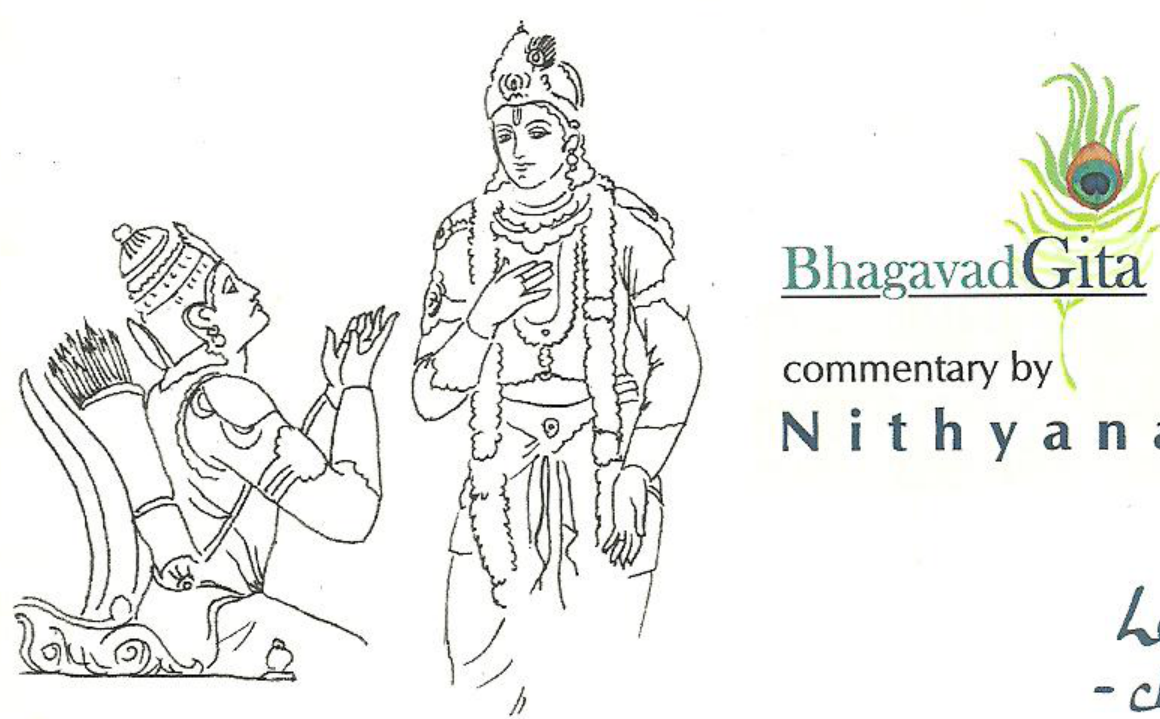
Lord Krishna instructs Arjuna in the Bhagavad Gita: You are your own friend; you are your own enemy. Evolve yourself through the Self and do not degrade yourself.'
The Vedic Masters repeatedly stress this same point. If you have fallen, if you have failed practicing these teachings or techniques, if you have forgotten, don't worry. Again and again, lift yourself. Don't feel depressed and don't have guilt.
In chapter 6 of the Gita, 'The Path of Meditation', Krishna outlines the steps of yoga to follow in order to experience our Divine Consciousness.
Nithyananda brings Krishna's instructions to life for us so that when we falter, we are able to pick ourselves up and continue on the path to blissful living.
This chapter includes Nithyananda's detailed account of his yoga training with Raghupati Yogi, a master of Patanjali's Ashtanga Yoga. He shares the enlightened truths and expressions of Patanjali's very body language.
® Ebook ISBN: 979-8-88572-062-5 PUBLISHED BY LIFE BLISS FOUNDATION