Are You Your Friend or
This text was machine-transcribed from the printed book and may contain errors. Select the words and choose “Report a mistake”.
Enemy?
6.5 You are your own friend; you are your own enemy.
Evolve yourself through the Self and do not degrade yourself.
6.6 For him who has conquered the Self, the Self is the best of friends.
For one who has failed to do so, his Self will remain the greatest enemy.
6.7 For one who has conquered the Self, who has attained tranquility, the Supreme is

already reached. Such a person remains in this state in happiness or distress, heat or cold, honor or dishonor.
6.8 A person whose mind is contented, because of spiritual knowledge, who has subdued his senses and to whom stone and gold are same and who is satisfied with what he is having, He is said to be established in Self-realization and is called an enlightened being.
6.9 A person is considered truly advanced when he regards honest well-wishers, affectionate benefactors, the neutral, the mediators, the envious, both friends and enemies, the pious and the sinners with an equality of mind.
'You are your own friend; you are your own enemy. Evolve yourself through the Self and do not degrade yourself.'
In my discourses, if I have quoted any Gita verse more than twice, it is this one. I can say this is the gist of the whole Gita. This single verse provides the essence of the whole Gita.
In the last session in the previous chapter, we saw how to move from doing and having to being. Usually we are stuck in having. We are constantly focused on our possessions. We are always conscious of our status. It is always 'I' and 'mine'. Loss of possessions affects our ego and identity deeply.
A slightly more intelligent person moves from having to doing, from passivity to activity. Then, from doing we are supposed to move to being, from activity to active-passivity. This shift to 'satva', active passivity, helps us evolve spiritually as we move deeper into awareness. In the last chapter we learned the technique from Krishna for moving from fear and greed into Divine Consciousness and bliss.
In this verse, Krishna says:
'One must deliver himself with the help of his own being and not degrade himself. The Being is the friend of the conditioned soul and his enemy as well.'
You are your own friend and you are your own enemy. If you know the technique of how to lift yourself by yourself, we will become a friend of your Self. If you let yourself down, you will become an enemy of yourself.
In our last session (Chapter 5) I asked all of you to practice the technique of centering yourselves in the third eye center, the ajna chakra, for ten days. How many of you were able to practice this? When you practice, naturally again and again you will fall. If you have not fallen, then please be very clear, you have not practiced it right. When you practice anything, naturally, you will fall. Suddenly, you will forget and then realize, 'Oh, I started working out of fear,' or 'I started working out of greed.' When you start working, naturally, there will be few problems.
A small story:
There was a big spiritual organization. A monk was sent to a remote tribal area to perform service.
Suddenly the headquarters received a lot of complaint letters about that monk.
After reading the complaint letters, the president said, ‘We have posted the right person. Don’t worry.’
The secretary was puzzled and asked him why he thought this despite all of the complaints received.
The president replied, ‘If we are getting complaints, it means that he has already started working. At least something is happening.’
When we start anything new, we will always have three phases: first is resistance. Second is avoidance. We just avoid, neither caring nor resisting. The third is acceptance. This is the way anything starts. Similarly, when we start doing anything inside our system, we start growing in the same way.
First, resistance: we will repeatedly fall. We will forget. Our system resists. We try to create complications and complaints and all possible arguments. Sometimes, if we can’t follow the teachings of Krishna, we start blaming Krishna. I have seen many people when they are unable to follow the teachings of Krishna they will go ahead and start blaming Krishna saying, ‘What Krishna are you talking about? He was always flirting. He was always running behind women. What type of a man was He?’ We can easily escape Krishna by criticizing Krishna.
When we can’t practice these teachings, we have to justify ourselves. Inside our being our conscience will naturally hurt us. So we have to make our conscience believe we are doing the right thing. We have to find some argument. Since we are unable to follow, we start criticizing Krishna. This is the best way to escape and avoid the teachings of Krishna.
When our being resists, if we allow the resistance to grow, we are our worst enemy. This is what Krishna means by saying, 'May you lift yourself by yourself.' If we don't, we will be our worst enemy. It is up to us to help ourselves as the best friend or to hurt ourselves as our worst enemy.
Please be very clear: nobody can hurt you unless you allow him or her to. Nobody can help you unless you allow him or her to. May you lift yourself by yourself. May you lift yourself to your Self. Again and again, these Masters stress the same point. If you have fallen, if you have failed practicing these words, the teachings or the meditation techniques, if you have forgotten, don't worry. Again and again, lift yourself. Don't feel depressed and don't have guilt. Don't get dejected thinking you will not be able to do it. Again and again, lift yourself.
The last teaching of Buddha was: atma deepo bhava, 'May your Self be the guiding light.' When Buddha was about to leave his body all of his disciples asked him, 'Master, please give us your ultimate message in one word.' Buddha said, 'Let you be the light, guide unto yourself. Let you be guided by yourself. Let your being guide you.' Here Krishna says the same thing. May you lift yourself by yourself. Nobody can do anything unless you lift yourself.
Just the other day, I came across an advertisement on the internet called ‘Super Deluxe Kundalini Yoga’ for $240. It says one doesn’t need to do anything. They sell a by-pass circuit by which your kundalini will be raised to the sahasrara automatically. All you need to do is to allow them to do the by-pass connection. Then your kundalini will stay in the sahasrara forever.
I was just shocked! How can someone else awaken your kundalini? Of course, enlightened Masters can awaken our latent energy but only we with our own effort can stay in that same state. They can give us a glimpse, satori, but staying in that consciousness and achieving samadhi can be done only by us. Only we can help ourselves.
Someone went to Buddha and asked, ‘Master, you know enlightenment is the ultimate thing. Why don’t you give that to all of us? Why don’t you make us all enlightened?’
Buddha said, ‘Oh, you want enlightenment? You think I should give enlightenment to everybody? Please go around and survey how many people really want enlightenment?’
By that evening the man returned after conducting an extensive survey in that city and said, ‘Master, only two people want enlightenment.’
Buddha said, ‘Please bring them here, and let me give it to them.’ The man said, ‘No, they are not ready to come all the way here from their houses. If you can send it to them, they are ready to receive it.’
Nobody really wants it! And, even if we do, we want it as one more item in our showcase. We are not ready to risk anything for enlightenment. We want it as one more item to showcase. Whenever people come to our houses, we can say, ‘This is from Delhi, this is from New York, this statue is from Japan.’
Just like that, we can say, ‘Oh, this enlightenment, you know that Master, Nithyananda? He gave me enlightenment. He was giving a Gita discourse that I attended and he just gave it to us. How does it look?’
Just as one more showpiece, we are ready to accept it but we are not ready to commit or risk anything for it. We are not ready to take the responsibility.
Buddha said, ‘Existence is so great that It gives you the freedom even to be in bondage. It is your choice whether to be in bondage or to be liberated. Even liberation should not be forced. If it is forced, even liberation is not liberation. So you have one hundred percent choice to be liberated or to be in bondage. It is completely up to you. God is so great that He gives you the freedom even to be in bondage or to be liberated.’
Here, Krishna says, ‘May you liberate yourself by yourself. Unless you liberate yourself, nobody else can liberate you. If you help yourself, you will be the greatest friend for yourself. If you don’t, you will be your worst enemy.’ This is an important verse. This has to be understood well. Let us see the next two verses to get the complete context and then we will enter into the meaning of the verses.
A small story:
Abdullah was a great enlightened Sufi Master. He was always in ecstasy, always in joy. One of his disciples asked him, 'Master, how are you so blissful? I have never seen you suffering. You are always joyful. How is this possible?'
Abdullah replied, 'Early morning when I get up from bed I ask myself, Abdullah, Abdullah, Abdullah, what do you want today? Do you want to be blissful or do you want suffering today? Naturally what will the mind choose? It will choose to be blissful. Then, immediately, I tell the mind: alright, be blissful. That's all!'
We may think, 'How can it be so simple, Master?' Be very clear, we know our twenty-four hour routine. We know what is going to happen in the next 24-hours. Just try this tomorrow morning. Accidents or lottery winnings are very rare. In a normal routine, we know exactly what is going to happen. Just decide whether you choose to face that routine with bliss or with suffering. Decide whether to face the routine with joy or with the usual long face. Decide for yourself. You have the choice. And whether you go with the long face or with a smiling face, the routine is going to be the same.
I always tell people, 'Pain is inevitable; suffering is a choice.'
We have one thing that we can choose - and that is our attitude. We can choose our inner space. We have complete freedom to do that. That is purely our own decision with no one to blame. Pain is independent of suffering. Pain is an external thing, suffering is an internal choice.
Abdullah says, ‘When my mind says in the morning I will choose to be happy, I tell the mind, just be blissful, that’s all.’ It is purely our choice. Hell or heaven is our conscious choice. People always have another question, ‘What do I do if my mind says, I want to suffer?’ Then suffer, that’s all. What is there in it? When our mind wants to enjoy suffering, then even suffering becomes an enjoyment for us. That is why we want to enjoy suffering. In a way, suffering becomes enjoyment for us.
So when you get up early in the morning, ask your mind, ‘What do you want today?’ If your mind chooses bliss, just tell your mind, ‘Be blissful. That’s all!’ This single conscious decision can change the quality of your life. But don’t make a commitment to do this for three days or one week. You will forget. Decide every day for just that 24 hours. People will immediately think, ‘Let me decide for my whole life today itself.’ No! You will forget. You will be back at the same point where you started; you will have the same face again tomorrow when you come back. No, don’t decide for your whole life. Decide only for one day. Only then will you be able to maintain it. Otherwise you will have the same old natural face.
A small story about this natural face:
The head of a monastery, a father, was teaching the young novices to preach. He was giving them tips on how to speak in public. He was taking classes about how to preach to the public.
He said, ‘When we speak, our whole body should express what we are saying. Our face should express the idea that we are talking about. When we speak about heaven our eyes should sparkle and our whole body should show the bliss, we should express the joys of heaven clearly. Our face should shine.’
The father continued, ‘When we speak about hell, we can just remain as we are. People will understand!’
At least in our life, let us not maintain the long face as our natural face.
Vivekananda said, ‘If you are depressed, don’t come out of your room. There is enough of suffering in the world. Don’t go around spreading a little more suffering.’
When we conquer the mind, happiness and distress are both one and the same and we are not touched by it. Throughout this chapter, Krishna speaks about the senses, how our senses function and what we are supposed to do. Let me give you a small diagram on how our mind functions and how our senses work. Then we will be able to understand the Gita in a much better way.
Now we will see how our mind works, how we perceive information, how we process it and how we make decisions.
First, as an example, let us say we are seeing something through our eyes. Here I am giving the example of the sense of sight through the eyes, but we can replace it with any of the other senses like taste, smell, etc. Let us take the example that you are seeing me at this moment. First your eyes will catch the picture or the scene. This will be taken to the chakshu. Actually, it is the sensory energy inside the eyes called indriya that does
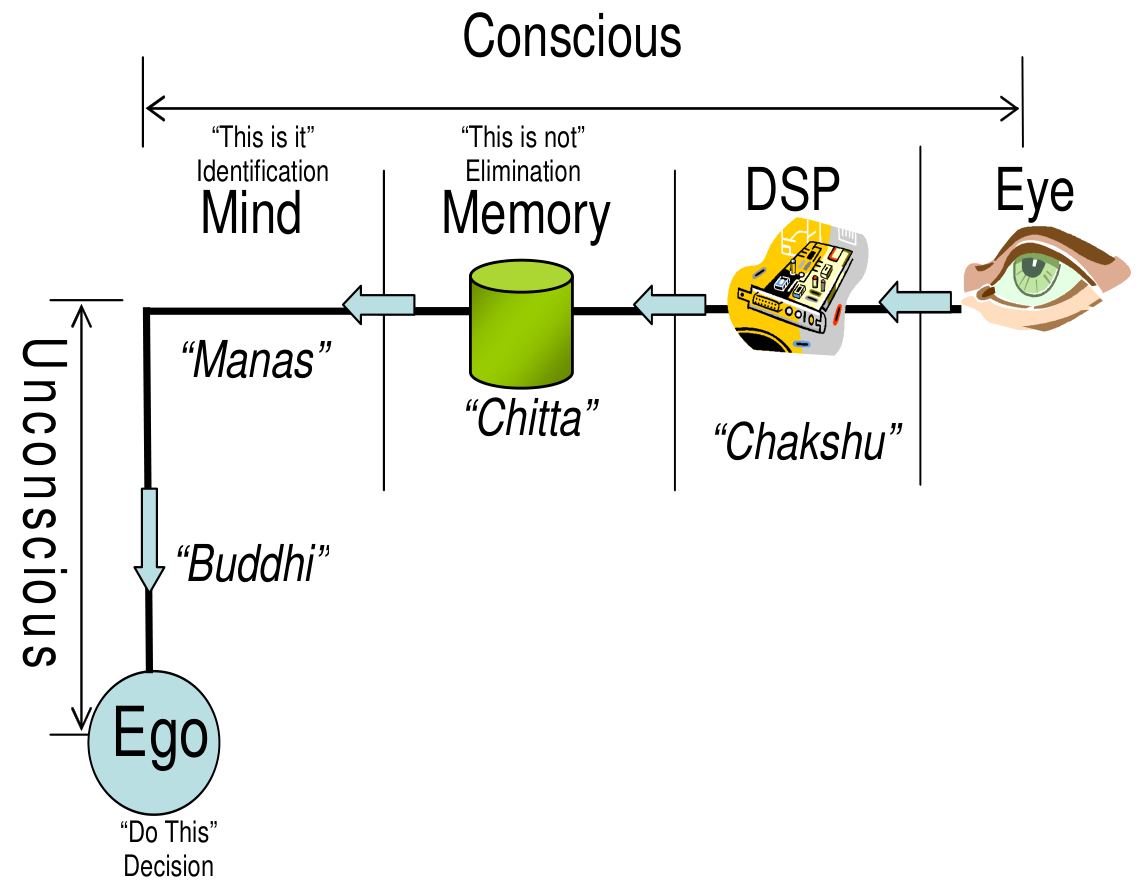
the job of seeing. Please understand, the eyes themselves do not see. Energy sees through the eyes. Sometimes, your eyes will be wide open and if you are listening to some music intensely, even if someone walks in front of you, you will not know. This is proof that you don't see with your physical eyes! You see through the sensory energy – indriya.
Let us say we are intensely reading something. At this time, we may not hear any of the ambient sound. This shows we are not hearing through the ears, something else is hearing through the ears or seeing through the eyes. That something else is called indriya, which is the energy behind the sensory organ. The whole file what you saw with your eyes goes to the chakshu.
The picture or the scene that we are seeing will go to the chakshu. In chakshu an important process happens. It is the conversion of the whole file into a digital file. It is almost like a Digital Signal Processor (DSP) in a computer. If we have to process any information inside a computer, it has to become digital. Whether it is a picture or whether it is sound, it has to be converted into a digital file.
Similarly, inside the mind, for any process to happen, the whole thing has to be converted into a bio-signal file or a digital file. The file processing happens in chakshu. Whatever scene we are seeing now, that picture will be converted into a digital file in chakshu.
That file will now go to chitta or memory. In memory the process of elimination starts happening. You will start analyzing and eliminating things and say, 'Na iti, na iti: not this, not this.' First, your mind will say, 'This is not a tree,' 'This is not an animal,' 'This is not a rock.' This process of elimination will happen in the chitta.
Once the 'This is not' process happens, the file goes to the manas, the mind. Here the mind starts identifying saying, 'This is it,' 'This is it'. This identification process happens in the mind. Our mind says, 'I am seeing a man standing with a kavi (saffron) cloth. He is teaching the Gita.’ This kind of identification of ‘This is it’ will happen in the mind.
Then the file goes to buddhi, intelligence. The process of analysis begins in the intelligence saying, ‘What is the relevance between me and this scene? What is the connection between this scene and me? In what way am I related to him or this scene?’ Our buddhi will start analyzing based on all of our earlier experiences. We may think, ‘The last four or five times that I attended these talks it was really useful.’ Or, we might think, ‘This is not worth it.’ Our buddhi makes some decision. Our buddhi will respond in some way whether it is right or wrong, whether we like it or not. Our buddhi will respond and will write ‘yes’ or ‘no’ on the file based on our past experiences.
The whole file will then go to the ego and the ego will give the command. If buddhi says, ‘Yes, I enjoyed yesterday,’ the ego will say, ‘Sit here and continue to listen intensely.’ If the buddhi says, ‘No, no, I wasted my time yesterday. It was boring. This is not for me.’ Then immediately the ego gives the command, ‘Come on and let’s move. There is so much work to do at home.’ The moment the ego gives the command, automatically, our whole being starts executing it. This is the way we receive information, process it and respond. The information comes through the senses, the processing is done and the response is given. This is the way our senses work.
Now, Krishna has an important point here. He says, ‘For one who has achieved the supreme bliss, for him happiness and distress, heat and cold, honor and dishonor are all the same.’ Throughout this chapter Krishna emphasizes this one idea, ‘Senses’. How can happiness and distress, how can heat and cold, how can honor and dishonor be the same for a man? How is it possible?
The first thing is that when these senses do this work, we decide ‘yes’ or ‘no’ only based on our past experiences, the experiences with which we have grown or the words with which we have conditioned our chitta and manas. Our buddhi decides based on the conditioning of our mind and memory. Please be very clear: Something that is so tasty for us may be like poison to our neighbour. Why our neighbour? Take our spouses for instance. We might like something, but the other might hate it.
There are three ways to do anything. First, hire someone to do it. Second, do it by yourself. Third, just tell your spouse NOT to do it. When you don’t want something to be done, just tell them to DO it and when we want something to be done, just tell them NOT to do it!
Anyway, whenever our mind is caught in dualities, again and again we fall back to our dilemma, to our nature, to our suffering, to our instinct level. Here Krishna says the person who has achieved bliss is not affected by heat or cold. How do we reach that state? Throughout this chapter He speaks about conquering the senses.
First, we need to understand that when I say conquering the senses, I don’t mean controlling the senses or destroying the senses. If we try to control or destroy the senses, we will only struggle more and more and suffer more and more.
Ramana Maharishi said beautifully, 'Instead of killing the person, you try to destroy the chair.' Destroying the chair will not kill the person. Here, our senses are just chairs. Our ego is the person who is sitting there. So if we try to control our senses, it is not going to work. If we try to control our body, that is not going to work.
Krishna says beautifully, 'For one who has conquered the self.' When he says self, he means the whole setup where the decision-making happens. Mind-Buddhi-Ego is the spot where the decision-making is happening. When we just try to conquer the senses, we will fail again and again. If we fail two or three times we will lose the confidence to try again. If we fail in a fight with our senses, we will automatically start thinking that it is impossible, and we will lose confidence. We need intelligence to progress in this path.
A small story:
A man wanted to go on a vacation to Juhu beach in Mumbai. He started to travel and kept going. After one week he came back.
His friend asked, 'Did you go to Juhu beach?'
He said, 'No, I was not able to find it.'
His friend asked, 'Did you not see any sign on the highway?' The man replied, ‘Yes, there was a board but it said Juhu Beach left,’ and I thought the beach had left so I came back.’
We need intelligence to traverse this path. If we try to work from the wrong side, from the side of the senses, we will never be able to succeed. If we try to create more pressure on the cooker we will not be able open the cooker lid. First, we need to put out the fire. First, we need to remove the energy supply. The ego or the buddhi, the place from where we make decisions, is continuously supplying energy to our senses. So all we need to do is to work at the level of mind and not at the level of the senses. If we try to work on the level of senses, we will create only more and more perverted desires.
For example, a man who tries to control his eating will dream about having a feast. If we fast for one day, it is enough. That day night, in our dreams we will be feasting! Our body has got its own balance. Our body has its own intelligence. If we avoid something, it has to supply and rejuvenate itself. If we are hungry, we can’t sleep. In order to continue to be in the state of sleep we should be made to believe that we are not hungry. So, the unconscious energy creates a dream as if we are feasting. Whenever we deprive ourselves, our unconscious energy will satisfy itself in the dream state. This is because in the dream state, there are no police or anyone else to control us. We just project our world and enjoy it. We can do whatever we want.
An important thing to note is that if we suppress something, be very clear, it will automatically express itself in our dreams. Dreams are nothing but expressions of our suppressed desires and fears. Our fear or desire when suppressed gets expressed in our dreams. Not only that, it expresses itself in a perverted way. If we enjoy with the senses, we will never become tired. But when we suppress our senses, our being suffers in our dreams. We can see very clearly, if we have a nightmare, even when we wake up, for hours we continue to be in that same mood and our whole being feels shaken.
Now they are coming up with a new concept called ‘fear stroke’. These are imaginary fears, such as seeing a rope in the dark and imagining it to be a snake, or imagining ghosts lurking in dark corners. Not only that, they are instant peaks of fear due to simple things such as the sudden ringing of the telephone etc. We also get these fear strokes in dreams. If we are suffering at the dream level, please be very clear that there is something seriously wrong with the mind-buddhi level. We are trying to control the senses instead of controlling the mind. Instead of removing the fire, we are trying to create more pressure in the cooker. All we need to do is to work on the mind to remove the fire, to stop the supply of fuel, to stop the supply of energy.
Here Krishna says, ‘For one who has conquered the mind,’ meaning that this applies to the one whose mind has learned the right processing. If our buddhi and chitta are filled with past memories, we cannot make correct decisions. Please be very clear, don’t think the mind makes decisions in a logical manner. Sometimes, it makes decisions in a very funny way, as I was explaining earlier about how we make the decision to sit here or not.
Sometimes our buddhi does not even think that much. In the example where you were seeing me with your eyes, if you have had any problems with any other swamis or any other person who was wearing this same color cloth in the past, suddenly that memory will be awakened. Then, the buddhi is not even ready to sit and listen. Our buddhi is not even ready to take a chance. It is not even ready to think. Immediately, our ego gives the order to leave. This is what we call prejudice.
Sometimes we hear an argument and pass judgment. Many times, our judgment is ready, and we collect arguments to support our judgment. We should look into our life. Whenever our judgment is ready, we collect arguments to support our judgment and we are caught in this network. This creates suffering. A man whose senses are clear, meaning one who is not driven by his sense organs, who is not suffering because of the senses, has the ability to make decisions with clarity. If our mind, especially the area of chitta, is clear, if that is intelligent enough, then automatically our senses work properly and we make the right decisions.
We can never achieve bliss by controlling the senses. We can only achieve bliss by controlling the mind. By changing the servants, we can't change the leader. But by changing the leader we can change the servants. The mind is the leader or the master that is making decisions
and leading the senses. So all we need to do is work on the mind, not on the senses.
Krishna says, ‘One who has conquered the mind achieves the Paramatman (Divine Self).’ We don’t need to achieve bliss. It is always there with us. If it has to be achieved, there is every possibility it can be lost. If it can be lost, what is the guarantee it will be there forever? Anything, if it has to be specially achieved, is not worth achieving. But if it is our very nature, then it becomes easy. If it has to be achieved, there is every possibility that after ten days it may be lost. Suddenly it may disappear. Krishna says that all we need to do is conquer our mind. We don’t need to achieve anything.
I always tell people that Ananda Spurana is continuously happening. The flowering of bliss is continuously happening. Spurana means flowering. Our very life energy is bliss. Unless we have the bliss energy in us, we cannot inhale and exhale. The inhaling and exhaling itself happens because of the bliss energy or the eternal consciousness in us. But we are stopping the bliss fountain again and again. All we need to do is stop the stopping process. That’s all. We don’t even need to create anything or achieve anything. We need to just stop the stopping process. Krishna says that we just have to conquer the mind because the Self has been already achieved. The Self has been already achieved and we are with it. There is nothing to strive for.
Here is a small story to explain how happiness and sorrow are in no way related to the outer world but to the inner world.
An old man went to a nearby city for some work. When he was coming back to his village, from a distance he suddenly noticed that his house was on fire. He started shouting, screaming and rolling on the ground and weeping.
His son came to him and said, ‘Dad, don’t worry. Don’t you remember, we sold that house just yesterday?’
Immediately, the old man sat up and wiped his tears. The sorrow just disappeared.
In ten minutes, his other son came to him and said, ‘Dad, yes, we have sold it, but we are yet to get the money.’
Again the man started rolling on the ground and weeping, ‘Oh, I don’t know what I will do now. I don’t know who will care for me. I don’t know how to save myself.’
Some ten minutes later, his wife came on the scene and said, ‘Don’t worry, just this morning I saw that the money was deposited in our bank account.’ Again he got up and wiped his tears and was perfectly back to normal!
If you notice, it is the same situation and the same person. But when he thinks the house is his, he is suffering and when he thinks it is not his, he is liberated. So what gives us suffering? It is just this single thing: thinking that something is mine. The habit of thinking ‘mine’, ‘mine’.
In the same way, there are people who can't enjoy something unless it is theirs. One day I was going for a walk on the beach. One of our devotees started saying, ‘Master, I think we should have a cottage here. It would be very nice. We can come out and enjoy the breeze.’
I asked him, ‘Are we not enjoying ourselves now? Why do you need a cottage here to enjoy? Just enjoy yourself now!’ But the mind never enjoys unless we are sure it is ours. Unless we possess something, we don't enjoy it.
Please be very clear that the man who possesses and tries to enjoy will never be able to enjoy. By the time we own the cottage we start worrying, ‘I think I should have this kind of furniture. I should have that type of arrangement.’ Or we have already started thinking about another cottage in some other place.
Ramana Maharishi was a great devotee of Arunachala. Someone who went to Ramana Maharishi, visiting him for the first time said, ‘Master, what a beautiful place this is! How nice it is to be here! The Arunachala hill is so beautiful!’ Ramana Maharishi said, ‘Just be here for three days, all these ideas will disappear!’ In three days, we take things for granted. Something will be beautiful only for three days. Not more than that. The person who enjoys only by possessing will never enjoy. The person who enjoys will not bother about possessing. It is just our mind. Sometimes, the mind will not allow us to enjoy something unless we know for sure that it is ours. And at other times when we know it is ours it creates suffering. Suffering or joy is created only by that one link, the mind. If that link is disconnected, the whole process will happen beautifully.
The only difference between an enlightened person and us is that one missing link! It’s not like an enlightened person will have two big distinguishing horns. There is no other difference between an enlightened person and us other than this one link, mind, which continuously decides, ‘What is in it for me? In what way am I connected?’ That ‘I’, ‘I’, ‘I’, ‘I’ - that link is missing. If we can cut this link, if we can cross that ‘I’, we will become Christ. Don’t start from the senses; start instead from the ego, the mind.
We always complain about the senses. Again and again, we say that our senses are spoiling us. No, we are spoiling them. Don’t put the responsibility on the senses. We are spoiling them. We destroy them. We abuse them. We must look into our life. It might be late at night even two am, but we will still watch our baseball or soccer game on television. Our eyes are begging for some rest. When the advertisements come on, our eyes close automatically by themselves. But we continue to sit and watch the rest of the game. We abuse our eyes because we want to enjoy ourselves.
It is the same story with the gongura chutney (extremely spicy side dish). Our tongue burns and our eyes pour tears but we continue to put large quantities of it into our mouth! Just the mention of it is enough; I can see how many mouths are salivating just now! We abuse and disrespect them. Please be very clear, our senses are not disturbing us. It is we who are disturbing them. It is this link: ‘What is there for me?’ that destroys the whole thing. This is where the whole trouble starts. This ‘I’, ‘I’, ‘I’, ‘I’ is where we start abusing the senses. All we need to do is control the mind, not the senses.
Another simple thing: hot and sweet tastes are just one and the same. Today just try this simple experiment: stretch out your tongue and concentrate on the tongue. Visualize your tongue as a highway and that you are walking on your tongue. Then take a chili and a sugar candy. Touch one corner of your tongue with the chili and the other corner with sugar candy. Deeply witness what happens. You will see that when you touch with the chili and when you touch with the sugar candy, both feel one and the same! When we do this experiment, we understand that if we go a little deeper into our system, the experience of hot and sweet both are one and the same.
Only when we put a rubber stamp on it saying, ‘This is hot, this is not good for me,’ or ‘This is sweet, I like this,’ the trouble starts. Only when we label it, the trouble starts. As a process in nature, both are one and the same. We label these experiences based on our belief. Based on our earlier belief system, we pigeonhole our experiences. Based on our recorded memory, we start thinking that this is not good for me. As a result of which we really begin to feel that it is not good for us.
We need to understand one more thing: our thoughts create our senses. Our mind creates our senses. Don't think we are living with what we have. We create what we want to have. Our thoughts are so powerful and our mind is so powerful, it can just change the whole body. For example, just think of one thought that creates disturbance inside. Or just think of an enemy. Or think of a person who took money from you and has not returned it. Consider a person who loaned you money and now asks for it. Immediately, we experience the change happening in our system. The body chemistry changes. Our blood is boils, our blood pressure rises, our heart rate and pulse rate rise. Just one thought and our whole system changes. A single thought can change the whole chemistry. Or one thought that creates lust, one advertisement, and immediately our body chemistry changes. Our whole body becomes ready to respond.
Please be very clear that a single thought can change the chemistry of our body. Our body is created only by our thoughts. It is our thoughts that create the body. In India there is a great science called samudrika lakshana. Just by seeing the face, the body, the way of standing, sitting and walking, the trained sage can tell the quality of the mind. They can tell everything about the person's mind. This is because the sage knows the secret that the mind creates the body. The body is the outer expression of the mind. The mind is the inner experience of the body. If our mind changes, our body can be changed and our whole system can be changed.
A man whose mind is clearly reprogrammed according to spiritual ideas can completely change his senses. As of now, our mind is programmed for misery. It is looking outward. If we can reprogram our mind to look inward, towards bliss, our entire sense experience can be changed.
Please be very clear, all we need to do is to reprogram our mind to look in. This is the gist of this whole chapter.
And Krishna says one more important thing about heat and cold. I don't know how you can believe this, but I have seen people living in the Himalayas with just two pieces of cloth. Let me tell you very clearly, I lived in the Himalayas and I used to sleep on the snow with this same cotton dress. It may be very difficult to believe but it was done. All we need to do is stop resisting, that's all.
Just try this experiment: the moment you feel the cool breeze, don't create the idea, 'It is cold, I may catch a cold, I may have wheezing. I may develop sinus problems. I may get asthma.' Just don't create such words. Especially in the west, you learned all of these big negative words. The more words you know about diseases, the greater is the possibility of getting those diseases in you. Whenever we repeat something, we create that quality in us.
Here is a simple experiment you can do:
Close your eyes and repeat ten times: 'Shanti, Shanti, Shanti', you will have peace inside (shanti means peace in Sanskrit). The only thing is your wife's name should not be Shanti! If you just repeat the word 'shanti', you will start experiencing the word 'shanti' in you. The quality of peace will start happening in you. In the same way, if you repeat the names of diseases, you will start creating those diseases in you.
I encountered some research recently that I want to share you. I went to the AAPI (Association of American Physicians of Indian Origin) convention. There they showed me a book containing their research works. One such study shows that in medical colleges, if lessons are being taught about a particular disease, more than forty percent of the students start showing symptoms of that disease. I know this is difficult to accept but the reason for this phenomenon is that the students are continuously thinking about those symptoms. Another big problem is that whenever we hear about a disease, the first thing we tend to do is to check and see if we have those symptoms. ‘Do I have it?’ We check to see if we have the symptoms.
Since the students are constantly meditating on the symptoms, forty percent of them express the same symptoms in their life. Whatever we think, we express. If we are constantly thinking about the wrong thing, our senses will be created in the same way. We need to do only one thing, work on the mind. Just liberate the mind. Then our whole system will be purified. Our senses will be reconstructed. Krishna gives us a beautiful technique to work on the mind.
He says one more important thing, ‘Honor and dishonor will be the same.’ This is very difficult to believe. Cold and heat can be the same. Hot and sweet can be the same. We can even accept that. But honor and dishonor, how can the two be the same? One word is enough to anger us. A single word thrown at us is enough to anger us and hurt our honor.
Someone asked me the other day, 'Master, why do we bother so much about others' opinions?'
We bother about others' opinions because we don't have an opinion about ourselves. We know about ourselves only through others' words and their opinions. We understand ourselves through others. If everybody says, 'You are beautiful,' we get that certificate. If everybody says, 'You are intelligent,' we get that certificate. If everybody says, 'You are great,' we get that certificate. We collect all these certificates and we build our personality with these certificates.
In our Life Bliss Program, the first session is about this. The first session is about why we get depressed, why we repeatedly fall into a low energy state. It is because our energy source is others' certificates. We don't have any self-respect. We respect ourselves based on other's opinions. If others' opinions about us are good, we think we are great. If others' opinions about us are not good, we immediately lose self-esteem.
Have you seen children build castles with playing cards? We too build castles with others' certificates. Our personality is nothing but a castle built with others' certificates. If one card is removed from that castle, what will happen to that castle? It just collapses. Similarly if a single person takes away his certificate, what happens to our personality? It just collapses. We fall into depression repeatedly.
Please be very clear, whenever we fall into depression, either somebody would have just taken away our certificate, or we would be afraid that somebody may take away our certificate. We know about ourselves only based on others' opinions and we build our personality only based on that. That is why we care so much for others' opinions. We have made them our lifeline.
Christ says, 'Love thy neighbor as you love thyself.' But we don't even love ourselves. That is why there is so much of hatred. We don't love ourselves. We don't have any self-respect. That is the reason for the wars all around us. The first session of the Life Bliss Program is about this. I tell people, if we want to live, we must learn how to stand on our own two feet, learn how to be with ourselves. As of now, our source of energy is others' opinions. If somebody tells us, 'You are really great', we may act humble and try our best to say, 'No, no, I am not,' but what happens inside us? 'Please tell me a little more!' Outside we feel shy but inside our mind we want them to go on and on.
We are constantly fuelled by others' opinions and we work to get others' opinions. Just meditate on this one thought. This is a great technique that can liberate us. Don't worry about others' opinions. Don't worry about what others are thinking about you. Because they are also busy worrying about what we think of them! If we meditate on this one statement, it will completely liberate us from this problem of honour or dishonour.
We must look into our life. Whoever stands in our consciousness, whose opinions we are bothered about, realize that all of these people are also bothered about our opinion. Be very clear, if we are bothered about somebody's opinion, directly or indirectly, he is also bothered about our opinion. It is just a give and take game. Don't bother about others' opinions, because they are also bothered about our opinions. Meditate on this one statement and you will be liberated.
Krishna says, 'A person whose mind is content because of spiritual knowledge, who has subdued his senses and to whom stone and gold are the same and who is satisfied with what he has, is said to be established in Self-realization and is called an enlightened being.'
First we should understand why Krishna is speaking of all these qualities of a Master. Why is he explaining all of these qualities? These qualities are techniques. If we practice them we will reach the same enlightened state.
Please be very clear that an enlightened man's words are mantra, words that will transform us. His life is tantra, a technique that will transform us and his form is a yantra, a sacred image to be meditated upon. His actions, if replicated in our life will create the same quality of consciousness in our being. For example, if we listen to music that comes from the heart, like traditional Carnatic music, we will have that same experience. If we listen to music that comes from the muladhara (sex center) it will create the same lustful mood in us. If we meditate on some expression, we will have that same experience behind that expression. Experience leads to expression and expression leads to experience.
There are research reports on art therapy. Once, several mad people were asked to paint. They were given canvas and paint. We can imagine how they paint! They just did whatever they wanted. But the surprising thing is, when asked to paint everyday, they experienced a complete recovery within a six-month period. This is because the catharsis happened. They threw everything out. When catharsis happens, naturally people get healed.
And the next amazing thing is that the doctor who was doing research on this art therapy saw a pattern. He found that those who became mad because of money all painted and drew in the same manner. People who had become mad because of relationships, all painted in the same way and people who had become mad because of name and fame, painted in the same way.
A small story:
A man went to a mental hospital, just to see what was happening in there. The doctor took him on a tour around the hospital. In the first room, he saw that one person had written a name all over the walls in blood: 'Latha,' 'Latha,' 'Latha.' He was sitting and chanting the words, 'Latha, Latha, Latha.'
The man asked the doctor what had happened to this patient. The doctor replied that he had wanted to marry some girl called Latha, but was not able to. That is why he became mad. That is why he constantly repeated her name. The tour continued and the man was shown many different kinds of people in different rooms.
One patient was attempting to swim on the floor, another was hanging from the ceiling, and another was walking on all fours.
In the end, he came to the last room, where another person was sitting and chanting, 'Latha, Latha, Latha.' In this room, the walls were covered with the word 'Latha'. The visitor enquired what had happened to this patient and whether he was also in love with some Latha.
The doctor replied, 'No, he actually married the woman named Latha! That is how he went mad.'
So, there are so many reasons why someone can become mad.
All men who become mad because of an obsession with money, paint and draw in the same way. The reason is that only what is inside comes out. In the process of painting, which is really a form of catharsis, they throw on to the canvas what is inside their unconsciousness. And the last and most important part of this story: the doctor who was researching all this and reviewing all the paintings apparently became mad.
There are three things we need to understand here: First, experience comes out as expression.
Second, the quality of experience and the quality of expression, both are very closely related or associated. And third, a very important thing is that if you concentrate on the expression, you will reach the experience. Here, again and again, Krishna speaks about how an enlightened person lives and how the qualities that an enlightened person expresses so that we can meditate on it. When we begin imbibing these ideas in our lives we can reach the consciousness of an enlightened being. When we contemplate upon these ideas, we start expressing them naturally and they sink into our being.
Krishna says repeatedly, ‘Vijitendriyaha’ (one who has subdued his senses). This whole chapter is just about the senses. If we can understand this one diagram (chakshu- chitta-manas diagram) and understand where the problem lies, Krishna gives us a beautiful technique to heal the problem.
He gives us a method to solve the problem and go beyond. All we have to do is understand the problem - where we are caught and where our problems lie. Our whole trouble is in the mind, buddhi and ego.
Look at the modified diagram :
In this diagram, beyond the ego we have the atman, the Self. Just the presence of the atman or the light of the
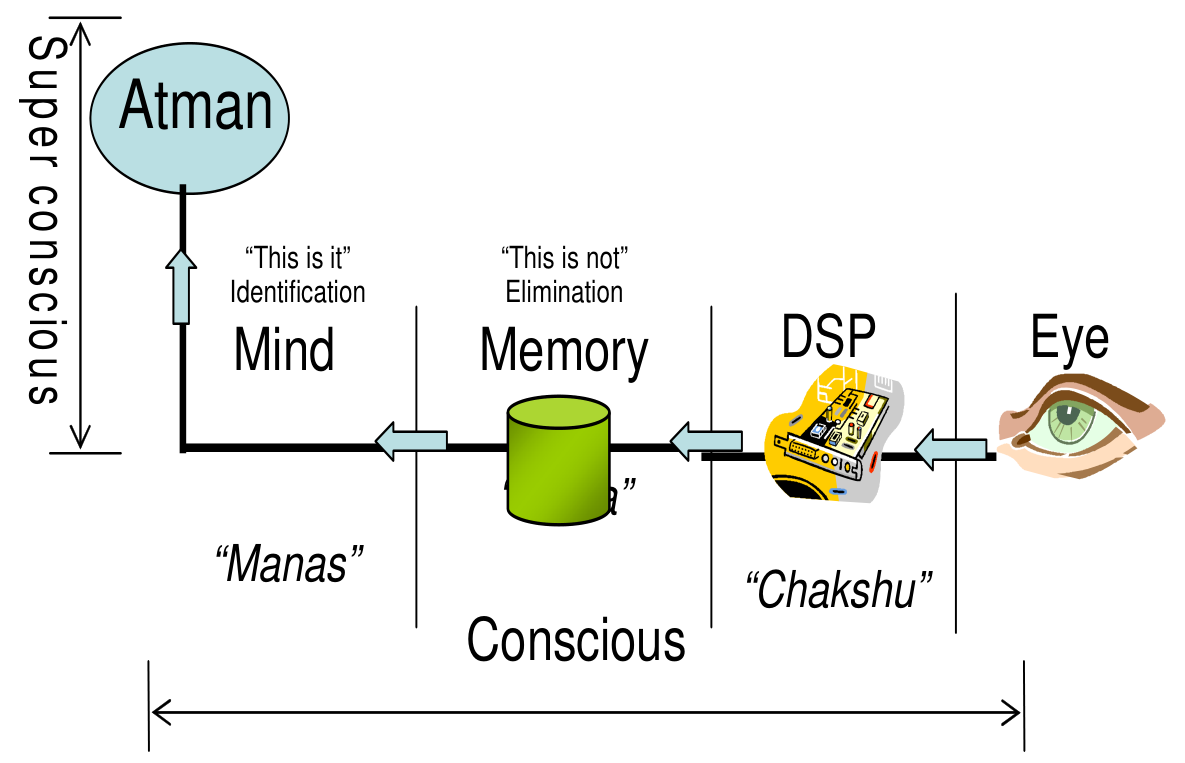
atman radiates and makes our ego work. The whole trouble is when we identify for ourselves and start thinking, 'What is there for me? How am I related to this situation? How am I going to gain from this?' or 'What am I going to lose?' Here is where the problem starts.
If the ego and buddhi are removed from the system, the atman starts radiating its energy directly through the senses. That is why enlightened people have sharp senses. Their senses are not contaminated. Whether it is their vision or their hearing, it will be sharp and deep because it is not corrupted by buddhi and ego. They have not lost their sensitivity. Please be very clear that only a person whose being is clear will have pure senses. His senses will be sharp and alive. A man who continuously uses his senses abuses them. He will not have energy or tejas in his senses.
The first thing that happens to a man who has used and abused his senses is the loss of his sense of smell. If we have lost our sense of smell, please be very clear that we need immediate emergency treatment. We need to be admitted into the ICU of spirituality. We need meditation immediately. Meditation is a basic need for us. When our mind is under our control we develop equanimity. We look at everyone the same way. This really happens when we reach enlightenment. When we become enlightened there is nothing to be achieved. There is nothing to be gained. Our being will start respecting everyone automatically.
Here the word ‘equal’ is used, but the exact translation should be ‘unique’. We do not treat everyone as an equal. Instead we respect everyone as a unique being. Treating others as equals is one thing. Treating them as unique is another. When we understand everyone is unique, we respect him or her. Sometimes when we say we treat everyone equally, we start disrespecting everybody equally. Instead of raising others to a higher level, we bring ourselves down.
Ramakrishna Paramahamsa was such a humble soul. If anybody came to see him, he would first do the namaskar (bowing down with hands folded to show respect for the other person) even before they paid their respects to him. Once, an egoistic man came to see Ramakrishna. Education, especially spiritual education without experience, is a problem. A man who has read all the scriptures and not become enlightened, is the person who is already in hell. Such a man has a lot of ego. He knows the tricks of the trade, but he does not have the capital or courage to do business.
Ramakrishna as usual, bowed down before this well-read pundit who came to meet him. The pundit said, 'After all, he is younger than me. He can bow down to me.' Then Ramakrishna said, 'By doing namaskar, I try to bring you to my level. But by accepting it in an egoistic way, you try to bring me down to your level.' So be very clear, when we treat people equally we may bring them to our level. Let us not do that. Understand that every being is unique. There is no equality. When we understand every being is unique, we will begin respecting every being. We will understand every being has its own unique place.
We are not the same. We are all unique. God is an artist. That is why He painted each one of us so differently, so uniquely. He is not an engineer. If He was an engineer, He would have just ordered ten thousand pieces of Mr. India or one million pieces of Miss Universe so all of us would look the same. He is not a mass-producing engineer. He is an artist. When we understand that each one of us is unique, we will start respecting every being.
One more thing we need to understand is that even our enemy is necessary for our life. We have possibly learned thousands of things from our enemies. Without enemies we wouldn't have achieved what we have achieved. Even enemies contribute to our lives. When we are depressed we can remember our enemies. Then we can come out of our depression and start fighting again. We don't know in what ways people contribute to our life.
There was a great sanyasi, a very famous sanyasi, who was highly respected all over the world. Suddenly one day, his close disciple found out an important secret about him. The disciple happened to be in the sanyasi's private quarter and saw that he had his divorced wife's photograph in his room.
The disciple asked the sanyasi, 'Master, I thought you were such a great person. I never expected that you will be harbourng such family attachments in your life. Why do you still have her picture in your room?'
The sanyasi just laughed and replied, 'Whenever I want to leave this life of sanyas, I just look at her photograph and I get my courage back immediately!'
So we don't know who is playing what role in our life!
Even our enemy might be playing an important and helpful role in our being, in our personality, and in our growth. We can't say how somebody is necessary in our life and how somebody is not necessary. Just like our friends, our enemies also may be playing a role in our life. When we understand that each and every being is unique, we will see everybody with the same mind or in the same way. One more thing that Krishna says here is about 'the pious and the sinners'. Please be very clear, there is no such thing as sin, except calling human beings 'sinners'. There is no other sin on planet Earth. Krishna rightly states that the enlightened being sees only divine consciousness in everyone and so can never label anyone as being pious or a sinner.
A small story:
Once a monk was sitting and meditating in a forest. He had a small hut. One night, a man came to the hut and begged, 'Swami, can you give me a little food and can you allow me to stay here until tomorrow morning?'
The monk said, 'Why not?' So, he gave the man food and shelter for the night. The next morning, when the man was about to leave, the monk asked, 'Who are you?'
The man replied, 'I am a thief. Just last night I robbed the palace. I tried to escape from the police and came here. You gave me food and shelter. I thank you.' So saying, he went away.
Immediately, this monk started weeping, 'Oh God! What a big sin I have committed! I gave a thief food and shelter. Save me from this sin!'
Within a few minutes, he heard a voice from heaven weeping loudly. The monk was startled and asked, 'Oh God, why are you weeping?' God said, 'You gave food and shelter for one day and you are weeping. I give him food and shelter 365 days a year. Where will I go and wash my sins?'
Be very clear that God accepts each and every one of us as we are. The people who created society created the idea of sin and merit. Immediately, the next question will be, 'Then can we do whatever we want?' A man who understands this spiritual science will never disturb others. Again and again, I tell people, our sin and merit should not be based on fear or greed. If it is just based on heaven or hell, I don't think we can claim to be matured beings. Our sin or merit should be out of our understanding, not out of greed for heaven or fear of hell. Don't live a disciplined life out of motivation for heaven or hell. Let discipline happen to you as an understanding, a natural flowering. If we are afraid of the police and follow the rules for speed limits, then whenever we don't see a police car, there is a small temptation, 'Why not press the accelerator a little bit more?' Especially in Los Angeles, when there is hardly any traffic, we always try to speed for at least a few miles!
Actually stepping the wrong way is a deep temptation. Breaking rules can be exciting, especially when something is forbidden. It becomes really attractive. The forbidden fruit is always tasty. I don't think Adam would have eaten the fruit if God had not forbidden it. He ate it just because God said, 'Don't eat it.' He lived in that garden for how many years we don't know, but he didn't taste a single fruit. He was living happily. It was actually God who tempted Adam to eat the fruit by saying, 'Don't eat it.’ It was not the snake that tempted him! The story is wrong! The story says that God said, ‘Don’t eat the fruit’ and the snake tempted Adam. But it is actually God who tempted Adam by saying ‘Don’t eat the fruit.’
So, whenever we listen to a rule, automatically we try to go beyond it, we try to break it. Let our morality be not based on fear and greed. That is why in Patanjali’s Yoga Sutras, or aphorisms, there is a beautiful word yama. Yama means discipline. It also means death. If we understand that our life is going to end in death and if we understand that death is the result of our life, if our consciousness imbibes this truth we start thinking and meditating upon death. We will automatically be disciplined. If we start thinking about death, we will completely restructure our whole thinking and our life. Our whole life will be restructured. If we start thinking about yama (death), then yama (discipline) will happen in our life. In Sanskrit, for both discipline and death, we use the same word. If we imbibe that death is going to happen to us, automatically we will imbibe discipline in our life. Discipline happens to us when we realize death comes to everyone and we realize that life is going to end. Let our discipline happen only out of understanding of death and not out of fear or greed.
Q: What Krishna says about equanimity, treating everything the same way, and not getting affected by whether something is stone or gold, may be fine for an enlightened Master, but how is it possible for an ordinary person living in this material world?
Before we talk about stone and gold, let us analyze our emotions. Let us take someone who gets angry very quickly. The more he gets angry, the more he seems addicted to being angry. Biologists tell us that repeated behavior actually rewires the brain. Neural networks get established with repeated behaviour patterns. The brain releases neuro-peptide proteins specific to each emotion. These neuro-peptides cause new receptors to grow in our cellular system in order to accommodate repeated emotions. Anger literally breeds anger.
Emotions not only rewire the brain, but they also rewire the body. In their efforts to accommodate these repetitive emotions, cells lose the capacity to absorb nutrients. They grow less and they rejuvenate less. These changes affect us and more importantly affect our progeny as well, as our entire cellular and DNA structure can be changed by our behavior. Biology tells us that our emotions are chemicals and that the brain releases these chemicals. We control these chemicals. However, over time, these chemicals can change and control us.
We should watch when we get angry the next time. What are we angry at? Are we angry at someone or are we angry about something? If we say that we are angry at some thing, at some behaviour, we should watch ourselves as someone else repeats that behaviour. Do we get equally angry? Do we allow some people to get away with such behaviour, or even humor such behaviour from some people that would make us blow up at another person? Are we angry with a person because we have made up our mind to be angry with that person?
We will find that ninety percent of the time we are angry at a person not at a behavior or an issue. If we are angry with an issue we can learn to use that anger as energy and do something with that energy. If it is behaviour, we can learn to laugh at it. However, if it is a person, we have a deeper problem. We have already made a judgment about that person and all that we do is collect evidence to support our judgment. Nothing that person does can be right for us.
With awareness we can drop these judgments. Awareness makes us realize the truth that everyone else and us are the same at a deeper level. If we are getting angry with someone, we are in fact getting angry with ourselves. It is our own negativities that make us see others negatively. It is possible to drop these negativities through meditation.
In our second level course, LBP 2, the Nithyananda Spurana Program, we take participants through techniques that educate them and cleanse their systems. Engraved memories are eliminated. These memories are in the unconscious mind and are responsible for our decisions and actions. The mind body system reverts to its pristine state. They are, in fact, reborn.
Look back in time to when you were a child and at how carefree, curious, adventurous and happy you were. Did you care whether your toy was made of stone or gold? It made no difference. You still enjoyed playing with
it. As you grew in years, and grew down in awareness, you learned to differentiate between gold and stone. Did that make you happier? All it does is bring suffering.
Krishna is talking here about reverting to that state of childlike equanimity, but now with awareness so that our suffering can be eliminated. What would we rather have? Would we prefer the ability to see the difference between gold and stone and be miserable. Or do we want the awareness to treat both the same and be in bliss?