No Sin, No Virtue
This text was machine-transcribed from the printed book and may contain errors. Select the words and choose “Report a mistake”.
7.28 Persons who have acted virtuously, whose sinful actions are completely eradicated and who are freed from the duality of reality and unreality,
Engage themselves in My worship with firm resolve.
7.29 Persons who are striving for
liberation from the cycle of birth,
old age and death, take refuge in
Me.
They are actually Brahman because
they comprehend everything about
activities that transcend these.

Those who know Me as the Supreme Lord, as the
governing principle of the material manifestation, who
know Me as the one underlying all the demigods and as
the one sustaining all sacrifices,
Can, with steadfast mind, understand and know Me,
even at the time of death.
Krishna talks here about papa and punya, sinful and meritorious acts.
The concept of sin and merit itself is a delusion, one of duality. At the level of Krishna Consciousness there is no papa or punya, no sin and no act of merit. All are the same.
Your immediate question is, 'Can I do anything I want? Can I kill, maim, annihilate, and be a Hitler?'
When you reach Krishna Consciousness you will not be a Hitler. It is impossible. At the level where you are now, it is necessary to follow some regulations because you still operate in duality. You operate from attachment and aversion. You act out of fear and greed.
Unfortunately, instead of these statements being guidelines for self-awareness as they were intended to be, they have become tools to control us by institutions, whether religious, political or societal.
Thousands of years ago, great Masters like Patanjali outlined prescriptions for Self-realization. In his ashtanga yoga, Patanjali established practices of yama and niyama. These are internal and external regulations for your guidance, not for others to manipulate you with. These are milestones to guide your way. Once you reach the destination, you do not need milestones anymore; you do not need regulations either.
Every year, when I take my disciples to the Himalaya mountains on a pilgrimage, the first stop is Rishikesh, where the river Ganga is about to enter the plains. Here I make them take the sannyas vows prescribed in yama. It is for their protection and guidance. It is not to instil notions of sin and virtue.
These five vows are satya, ahimsa, asteya, aparigraha and brahmacharya. Satya is truth in thoughts, word and action; ahimsa is not harming anyone in thought, word and action; asteya is not coveting, not stealing what belongs to another; aparigraha is living with minimal needs; brahmacharya is living without fantasies. They take these vows at the end of a dip in Ganga and participate in a vraja homa, a fire ritual of purification; for the next two weeks they wear kavi, the saffron cloth that I give them.
These vows are for self-discipline and they lead to awareness. No one needs to control us. As long as we need to look over our shoulder to see whether Big Brother is watching, whatever we do is fake; it is sheer hypocrisy.
Krishna addresses mortal beings here, in the form of Arjuna. So He talks about doing virtuous acts and avoiding sinful acts. What follows is more important. He says to go beyond duality, the duality of sin and virtue.
This is only possible when we become aware. It is only when we become aware that we can reach Him.
In Bhaja Govindam, Shankara says hauntingly,
punarapi jananam punarapi maranam
purnarapi janani jathare shayanam
iha samsare bahu dustaare
kripaya paare paahi muraare
Birth and death again and again; lying in a mother's womb again and again. This [ocean of] repeated birth and death is so difficult to cross. Please save me, O Krishna!
The greatest philosopher that Hinduism has known, prays to the greatest Master that the universe has known, ‘Save me from this endless cycle of samsara, the cycle of birth and death.’
To know that one needs to be saved from this cycle needs great wisdom. To seek the feet of the Master who can lead you to that liberation needs wisdom and awareness.
You can be born again and again and still think that you are being born for the first time, and that this is the only life that you have. This knowledge requires no wisdom. In fact, it requires ignorance to believe this. Much of the Western world operates on this premise. So you focus on this life and want to extract the maximum juice out of it. You run after wine, women and song, as if there is no tomorrow. You live in a fantasy world. You enact a psychodrama.
Please understand that this is not your only life. This body is not who you are. All this is temporary. What you chase is a dream. One day you will wake up and discover that this life is nothing but a dream. But as long as you are in the dream, you salivate and chase.
You are more than this body and mind; you are above this body-mind. What you are endures after death. What you are returns after death. When you understand this cosmic truth, you are liberated. You do not wish to be part of this psychodrama anymore. You are bored. You ask, 'What for?,' just as Shankara plaintively asks Krishna. 'Again and again, without end, I come and I go, please save me from this useless journey; let me be with You,' Shankara says.
Buddha calls this cycle of birth and death a bondage; the cycle of sorrow. It is sorrow because it is not real. It is not the real you that dies and is reborn. The real you changes bodies as you change clothes. How many times do you want to change clothes?
There is no meaning to the psychodrama that you play, the games that you play. Understand that these have no purpose at all. Shed your attachment and aversion to these activities and become a witness. You then become Brahman, one with the Master, and become Krishna Consciousness.
Krishna ends this chapter with the prescription for how to know and understand Him and reach Him.
Even at the time of death, He says, even if all your life you lived a dissolute life, if at the point of departure you realize your folly, the futility of the psychodrama that you have enacted, that is enough to redeem you. The mere recognition of that saves you.
His compassion is unlimited. He promises: Knowing me at the time of death, even at the time of death, will lead you to Me.
Please understand, this is not easy, not so easy as it seems. If you have been ruled by greed, greed for power, wealth, women, possessions and all such material objects throughout your life, nothing can change suddenly at the point of death. You will be full of the same fantasies that you were obsessed with throughout your life. Your last thoughts will be on them, that dollar bill, car, club dancer or whoever you fancied till the day before.
A small story:
A recently bereaved widow went to a medium to contact her husband's spirit.
All she wanted to know was to whom he had lent money. She knew that he was a miser. He had died suddenly without leaving a record of what people owed him, and she knew he would suffer wherever he was if she did not do something about the collection.
Sure enough the medium responded, 'Our neighbor owes me a hundred dollars. The guy living opposite our house borrowed five hundred dollars...' The list was long and went on for a while.
When the medium stopped, the widow asked, 'Is that all?'
'Oh, I forgot. I owe Bill a thousand dollars.'
The widow told the medium, 'You have the wrong spirit this time. For sure that is not my husband.'
We cannot change our nature at the last minute. Gandhi died with the name 'Hey Ram' on his lips when he was assassinated because Lord Rama's name permeated his whole being all his life. It could never have been otherwise.
If we want to die with the thought of the Divine uppermost in our mind, we must cultivate the habit of remembering Him now. We should know Him today. We should understand Him today. Then, and only then, will we know and understand Him at death.
Some may ask, 'What is the need to understand and know Krishna, whether at the point of death or before? If I do the right things in the right manner, why should it make any difference whether I understand and know Krishna?'
Please understand that Krishna is not talking about the physical Krishna, or even about the Cosmic Consciousness that He is. He speaks about our understanding and knowing ourselves. Krishna talks about the need for us to understand who we are.
The ultimate Master resides within us, not anywhere else. The external Master, be He Krishna or Nithyananda, is a guide to make us understand, know and accept that Master within us. Yes, it may be possible in rare cases for that wisdom to dawn on us at the point of death, but it is not common. Someone who constantly seeks that truth will continuously search for that Master within, and has a better chance of making that connection, making that discovery earlier.
Krishna in His deep compassion says, ‘Even if that happens at the point of death, I shall redeem you.’ He does not want us to miss that chance, even if we have not thought about Him all our lives. He does not rule out the possibility, even if we have not been seeking all our lives. He wants us to discover that Master within. Even if we do that at the point of our last breath, that is ok with Him.
So, let us pray to the Ultimate Parabrahma Krishna to give us the intelligence and awareness to realize the truth about ourselves, to give us this experience of eternal bliss, Nithya Ananda.
Q: Does being wealthy negate self-realization? Most religions preach that we need to give up all that is material before we can become spiritual.
It is not necessary to be poor to become spiritual. One can be wealthy and spiritual but the attachment to wealth and the expectations of wealth need to be dropped.
In almost all cultures, a god or goddess is portrayed as the symbol of wealth, fortune and prosperity. These cultures believe that wealth is important not only in this realm where we live, but also in the spiritual realm. In Hindu mythology, Vishnu, the Sustainer, and his consort Lakshmi represent wealth and fortune. It is believed that when Shankara sang the praises of the goddess Lakshmi in his Kanakadhara Stotram, gold coins fell through the roof of the hut of a poor brahmana who had fed him selflessly. Shankara had no need for wealth, yet he had no reservations about making a poor man wealthy.
Wealth and money are energy. Not only you, but many others can also benefit from your wealth. It is not the mere possession of wealth that causes problems, but your attitude to your wealth that matters. As long as you enjoy the wealth that you have and also allow others to benefit, you do a great spiritual service. You are of far greater value to the universe than someone who is poor.
However, when greed drives us into acquisition and more acquisition without the desire to enjoy that wealth, wealth becomes an addiction. Wealth consumes us, rather than our consuming wealth. We are no longer in control.
There have been great kings and wealthy men who were spiritually advanced. They did not allow the fantasy of wealth to touch them. They used wealth intelligently, and the very use of wealth without attachment brought them more wealth. That is the way the universe works.
The universe is abundance. Any amount of wealth is possible from the universe. However, the universe does not respond to begging, arising from a mentality of emptiness. The universe responds to a call that arises from fulfilment. That is why wealth begets wealth.
Masters and religions have advocated giving up wealth. Please understand that they do not tell you to stay poor. That makes no sense. When you are wealthy, when the wealth does not touch you, you can give up wealth and still be wealthy. Money will come to you and you can give it away. You can live with minimal needs. What you then do is to renounce the pleasures associated with wealth. You renounce fantasies associated with wealth. Only one who is used to wealth can do this and succeed.
For someone who has nothing, to pretend that he is renouncing wealth is foolish. His fantasies remain with him and haunt him, because his basic desires about wealth have not been fulfilled.
Wealth or lack of wealth by itself does not make one spiritual. It is one’s attitude to wealth and the renunciation of fantasies about what one does not have that determine spirituality.
Q: Throughout this chapter and other chapters, Krishna talks about reaching Him for salvation. He suggests many methods. But none seem practical. Is He referring to a mere intellectual understanding of what He says or is
there more to it? How does the mere acceptance of the truth that He is Supreme and beyond the demigods liberate me?
This is a brilliant question.
Some years ago I told a group of early disciples that they should only stick around me if they were serious about enlightenment. I told them to leave otherwise. I told them not to block the threshold. Either come in or get out. Some were older and experienced meditators. I said jokingly that it brings me a bad reputation when they say they have been long-time meditators, when nothing has happened to them. People would wonder of what use I am!
Fortunately, Krishna is not in the physical body to suffer the same abuse, when people find that millions read Gita word by word, verse by verse, and yet remain no better in consciousness than when they started.
Many read Gita and claim that they understand what Krishna says. What they mean perhaps is that they understand that language into which the Gita they are reading has been translated. That is all.
A small story.
A businessman placed an advertisement for an executive fluent in French. A girl responded saying she was fluent in writing French, but could not read French. Intrigued, the businessman called her and gave her a test. He played a French tape for half an hour as she industriously transcribed. He asked her what it was about. She gave him her note pad. He could not understand a word she had written.
Exasperated, he asked her, 'Please read what you have written.'
She said angrily, 'I already told you that I could only write French, I can't read it!'
So you think you understand, but you cannot read.
How can we even intellectually understand that Krishna is Supreme? Forget the demigods, how can we even accept that He is greater than us? We are so full of our identity and ego, that even if a thousand Krishnas were to descend in front of us, we would ask them for their identification cards! We will recognize Krishna only if He comes in front of us in the mold and image of Him that we have stored in our minds!
Krishna must come to us in our image of Him. Then we will accept Him. Then we will accept Him as the Supreme and hang His picture on the wall. If He comes to us in flesh and blood, we would rather see Him dead, hanging on the wall as a picture. Everyday, Krishna comes to us in many forms. He comes to us in the form of every person we meet. We have no idea. We decide whom we will accept and whom we will reject.
We cannot accept Krishna in parts and reject Him in parts. Either we accept Him totally or reject Him. We
have to surrender to Him. We have to surrender our identity to Him. We have to surrender to Him that foolish image that we have in our minds of Him.
When I told my disciples that they should either get enlightened or leave, they chorused, ‘Of course we want to get enlightened. That is why we are here. But how? We need your help.’
So I said, ‘All you have to do is to surrender to me as your Master. It is that simple.’
They said, ‘We have surrendered. We have accepted everything you say. What else do we need to do?’
I explained to them. ‘Surrender has three components. The first is intellectual surrender, which is the mental acceptance of what I say. You may have done that partially. Even that I am not sure of. When I say something that pleases you, you accept what I say. The moment I say something that displeases you, you argue.
Ok, even if I assume that you have intellectually surrendered as some of you may have, the next step is total emotional acceptance. It is emotional surrender and your heart must accept me. People often ask me how they can tell if I am their true Master. I say, ‘If I am your Master, you can never forget me even for a moment.’ Your heart will tell you that I am your Master. You do not have to tie a knot in your handkerchief to remember me.
Even this acceptance is partial. The final surrender is the surrender of the senses.
This is the surrender that happens when the mind is extinguished. This is the state when we drop our identity. We assume the identity of the Master. We see what he sees; we see what he says he sees.
I told them, ‘If I tell you that the white wall in front of you is black, and your eyes see a black wall, then and only then have you surrendered to me. Only then have you surrendered your identity.’
Meditation is a technique for surrendering one’s identity. Throughout Gita, Krishna suggests to Arjuna techniques or sutras that lead to liberation. Combined with understanding at the intellectual level, as a shaastra, as well as through devotional acceptance of His glories through stotra, Gita leads you through the path of surrender into liberation.
Dropping one’s identity requires a deep understanding, acceptance and internalization of the merger of Self, World and God. This is what we call the merger of the elements of Jiva (Self), Jagat (World) and Ishwara (Creator). Simply put, we accept our divinity and become one with the Divine. This is what enlightenment is about.
In the various Life Bliss Programs we teach techniques that lead you through this process of dropping your identity. In the first level course, LBP 1 or Ananda Spurana Program, we teach techniques that activate and unblock your energy centers or chakras. The sixth chakra (the third eye or ajna chakra) that lies between your eyebrows is the center that needs to be unblocked to drop one's ego. Over a two-day program we take you through a journey of energizing the seven chakras in your body-mind energy system.
Once you unblock and energize the ajna chakra and move on to the final gateway of the crown center, the sahasrara chakra, you drop all your discontent and surrender in gratitude to the universe. You accept your inner divinity and have a glimpse of that final integration.
The next level course, LBP 2 or Nithyananda Spurana Program, is a different journey through the energy layers that are part of your body-mind system. At each level you re-experience the emotion-laden memories that have conditioned your life. This reliving relieves you and liberates you. At the end of the program you are reborn in a sense, liberated from the bondage of your emotions and conditioned memories that have imprisoned you.
At the end of these courses, if you are ready to accept me as a Master, I initiate you into a meditation technique that helps you reach your innermost core. This meditation technique, called the ananda gandha or 'fragrance of bliss' meditation, helps you constantly discard embedded memories as they surface. This is a meditation technique that you can use any time or all the time, along with any activity you are engaged in. It anchors you in the present moment, and in the awareness of the present moment, no embedded memories, samskaras, can form. No karmic baggage is acquired and your vasanas, the mindset of unfulfilled desires, is extinguished. You are liberated. The simple truth is that the present moment is Krishna Consciousness. When we reach this state of being in the present moment, we reach Him and we are liberated. So it is not the mere intellectual understanding of what we read in the verses, but the internalization of what Krishna says, that can liberate us.
May you reach Krishna Consciousness and realize eternal bliss, nithyanandam!
Thus ends the seventh chapter named ‘Self Knowledge and Enlightenment’ of the Upanishad of Bhagavad Gita, the scripture of yoga dealing with the science of the Absolute in the form of the dialogue between Sri Krishna and Arjuna.
Scientific Research on
Bhagavad Gita
Several institutions have conducted experiments using scientific and statistically supported techniques to verify the truth behind the Bhagavad Gita. Notable amongst them is the work carried out by Maharishi Mahesh Yogi, whose findings are published through Maharishi Ved Vigyan Vishwa Vidyapeetam.
Studies conducted using meditation techniques related to truths expressed in the verses of the Bhagavad Gita have shown that the quality of life is significantly improved through meditation. These studies have found that meditators experience a greater sense of peace resulting in a reduced tendency towards conflict.
Meditators gain greater respect for and appreciation of others. Their own inner fulfilment increases resulting in improved self-respect and self-reliance, leading to Self Actualization.
One’s ability to focus along with brain function integration is enhanced. These have resulted in greater comprehension, creativity, faster response time in decision-making and superior psychomotor coordination.
Stress levels have been shown to decrease with enhanced sensory perception and overall health. The tendency towards depression has been clearly shown to decrease.
There is enough evidence to show that as a result of meditation, individuals gain a better ethical lifestyle that in turn improves their interaction with others in the community, resulting in less conflict and crime. Group meditation of 7000 people (square root of 1% of world population at the time of the study) was significantly correlated to a reduction in conflict worldwide.
Meditation leads to higher levels of consciousness. Through the research tools of Applied Kinesiology, Dr. David Hawkins (author of the book Power vs. Force) and others have shown that human consciousness has risen in the last few decades, crossing a critical milestone for the first time in human history. Dr. Hawkins’ research also documents that the Bhagavad Gita is at the very highest level of Truth conveyed to humanity.
We acknowledge with gratitude the work done by the Maharishi Mahesh Yogi institutions and Dr. David Hawkins in establishing the truth of this great scripture.
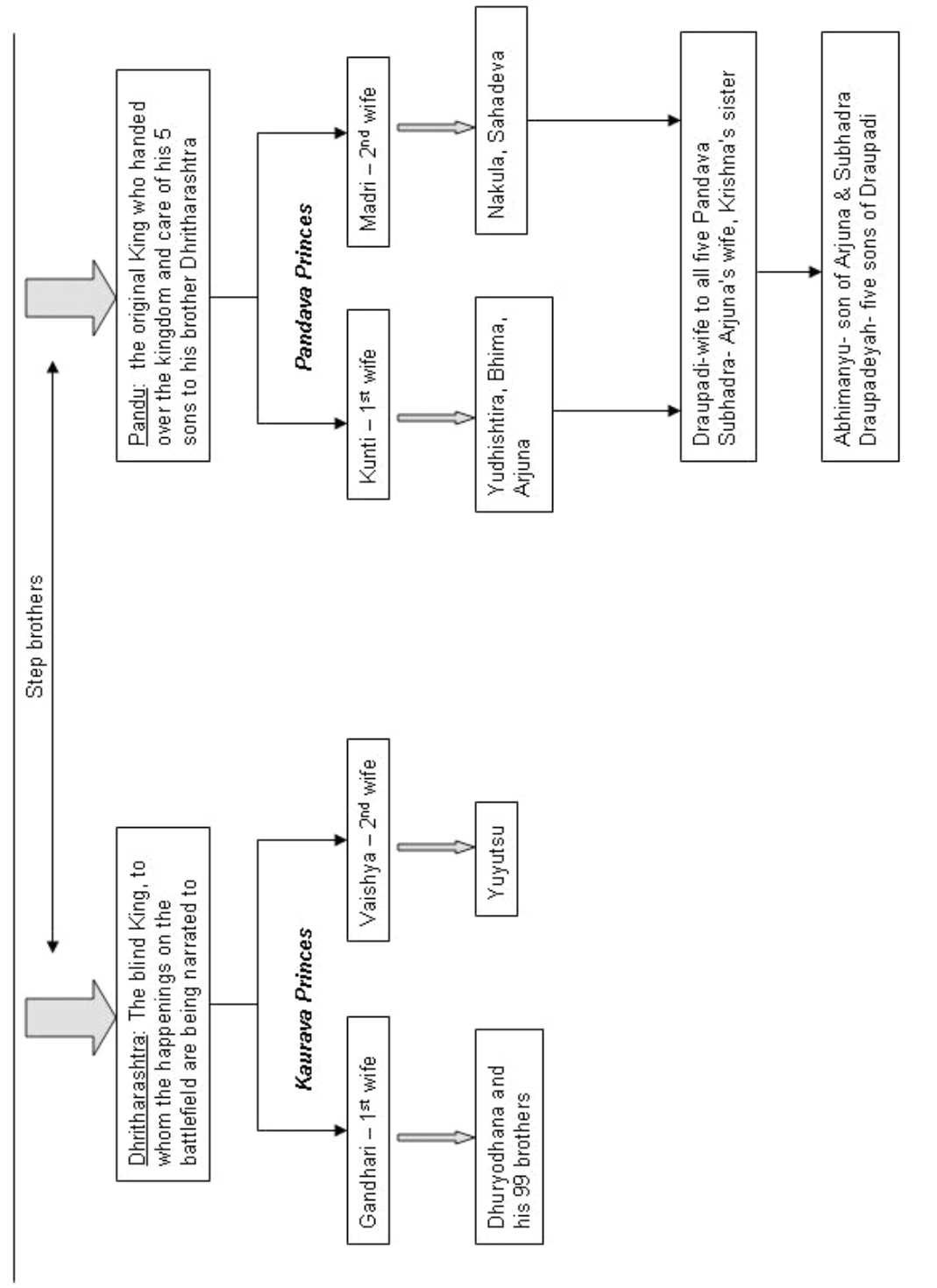
Kuru Family Tree