Verses Of Gita Chapter 5
This text was machine-transcribed from the printed book and may contain errors. Select the words and choose “Report a mistake”.
अर्जुन उवाच
संन्यासं कर्मणां कृष्ण पुनर्योगं च शंससि।
यच्छ्रेय तयोरेकं तन्मे ब्रूहि सुनिश्चितम्।।५.१।।
Arjuna uvacha
Sanyasm karmanam Krishna punaryogam cha shamsasi Yacchreya etayorekam tanme bruhi sunishchitam 5.1
Arjuna uvacha: Arjuna said; sanyasm: renunciation; karmanam: of all actions; Krishna: O Krishna; punah: again; yogam: devotion; cha: also; shamsasi: praising; yat: which; shreya: beneficial; etayoh: of the two; ekam: one; tat: that; me: to me; bruhi: please tell; sunishchitam: definitely
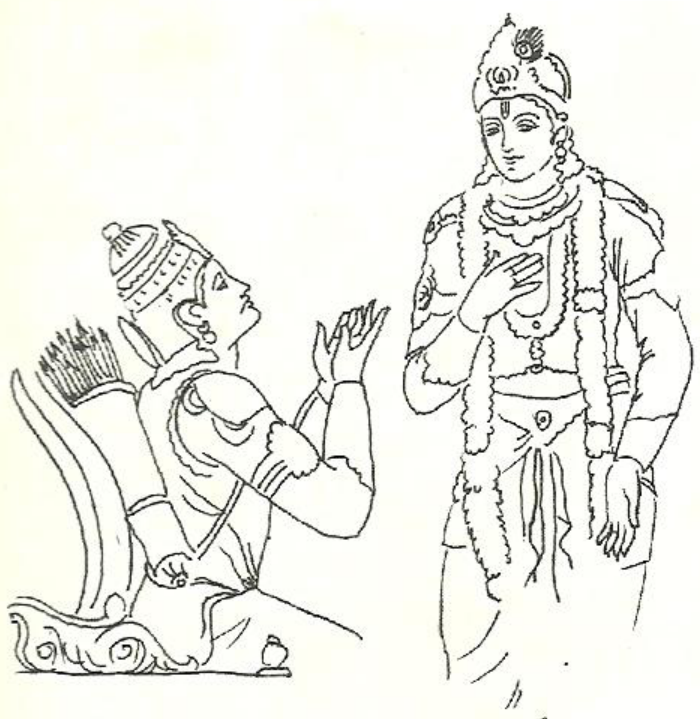
5.1 Arjuna said:
Oh Krishna, you asked me to renounce work first and then you ask me to work with devotion.
Will you now please tell me, one way or the other, which of the two will work for me?
श्री भगवानुवाच
संन्यासः कर्मयोगश्च निःश्रेयसकरावुभौ।
तयोस्तु कर्मसंन्यासात्कर्मयोगो विशिष्यते॥५.२॥
Shri bhagavan uvacha
Sanyasha karmayogashcha nihshreyaskaravubhau
Tayostu karma sanyast karmayogo vishishyate 5.2
Shri bhagavan uvacha: Lord Krishna said; sanyasha: renunciation; karmayoga: work in devotion; cha: also; nihshreyasakarau: for liberation; ubhau: both; tayoh: of the two; tu: but; karma sanyast: between work and renunciation; karmayoga: work in devotion; vishishyate: better
5.2 Krishna says:
The renunciation of work and work in devotion are both good for liberation.
But, of the two, work in devotional service is better than renunciation of work.
ज्ञेयः स नित्यसंन्यासी यो न द्वेष्टि न काङ्क्षति।
निर्द्वन्द्वो हि महाबाहो सुखं बन्धात्प्रमुच्यते॥५.३॥
Nyeyaha sa nityasanyasi yo na dveshti na kankshati
Nirdvandvo hi mahabaho sukham bandhat pramuchyate 5.3
nyeyaha: should be known; sah: he; nitya: always; sanyasi: renouncer; yah: who; na: never; dveshti: hates; na: never; kankshati: desires; nirdvandva: free from all dualities; hi: certainly; mahabaho: mighty-armed one; sukham: easily; bandhat: from bondage; pramuchyate: completely liberated
5.3 He who neither hates nor desires the fruits of his activities has renounced.
Such a person, free from all dualities, easily overcomes material bondage and is completely liberated, Oh Arjuna!
सांख्ययोगौ पृथग्बालाः प्रवदन्ति न पण्डिताः।
एकमप्यास्थितः सम्यगुभयोर्विन्दते फलम् ।।५.४।।
Sankhya yogou prithagbalaha pravadanti na panditaha Ekamapya asthitaha samyag ubharyo vindate phalam 5.4
Sankhya: sankhya system; yoga: work; prithak: different; balaha: less intelligent; pravadanti: say; na: not; panditaha: learned; ekam: one; api: even; asthitaha: situated; samyak: complete; ubhayoh: of both; vindate: enjoys; phalam: result
5.4 Only the ignorant speaks of the path of action to be different from the path of renunciation.
Those who are actually learned say that both action and renunciation lead to the same truth.
यत्सांख्यैः प्राप्यते स्थानं तद्योगैरपि गम्यते।
एकं सांख्यं च योगं च यः पश्यति स पश्यति।।५.५।।
Yat sankhyaiha prapyate sthanam tadyogairapi gamyate Ekam sankhyam cha yogam cha yaha pashyati sa pashyati 5.5
Yat: what; sankhyaiha: by Sankhya system; prapyate: get; sthanam: position; tat: that; yogai: by work in devotion; api: also; gamyate: can reach; ekam: one; sankhyam: sankhya system; cha: and; yogam: work in devotion; cha: and; yaha: who; pashyati: sees; sa: he; pashyati: sees
5.5 He who knows, knows that the state reached by renunciation and action are one and the same.
State reached by renunciation can also be achieved by action, know them to be at same level and see them as they are.
संन्यासस्तु महाबाहो दुःखमाप्तुमयोगतः।
योगयुक्तो मुनिर्ब्रह्म नचिरेणाधिगच्छति।।५.६।।
sanyass tu mahabaho dukkham aptum ayogataha yogayukto munir brahma na chirena adhigachhati 5.6
sanyash: renunciation; tu: but; mahabaho: mighty-armed one; dukkham: misery; aptum: afflicts with; ayogataha: without devotion; yogayukta: engaged in devotion; muni: wise; brahma: supreme; na chirena: without delay; adhigachhati: attains
5.6 Renunciation without devotional service afflicts one with misery, Oh mighty-armed one.
The wise person engaged in devotional service attains the Supreme without delay.
योगयुक्तो विशुद्धात्मा विजितात्मा जितेन्द्रियः।
सर्वभूतात्मभूतात्मा कुर्वन्नपि न लिप्यते।।५.७।।
yogayukto vishuddha atma vijita atma jitendriyaha sarva bhuta atma bhutatma kurvan api na lipyate 5.7
yogayukta: engaged in work with devotio; vishuddha: a man of purified mind; atma: soul; vijita: self-controlled; atma: soul; jitendriyaha: conquered the senses; sarva bhuta: to all living beings; atma bhuta atma: compassionate; kurvan api: though engaged in work, na: never; lipyate: entangled
5.7 The person engaged in devoted service, beyond concepts pure and impure, self-controlled and who has conquered the senses is compassionate and loves everyone.
Although engaged in work, he is never entangled.
नैव किंचित्करोमीति युक्तो मन्येत तत्त्ववित्।
पश्यन् शृण्वन्स्पृशञ्जिघ्रन्नश्नन्गच्छन्स्वपन् श्वसन्।।५.८।।
Naiva kinchit karomi iti yukto manyet tattvavit
Pashyan shrunvan sprshan jighran ashnan gacchan svapan
shvasan 5.8
Na: never; eva: certainly; kinchit: anything; karomi: I do; iti: thus; yukto: engaged; manyet: thinks; tattvavit: one who knows the truth; pashyan: seeing; shrunvan: hearing; sprshan: touching; jighran: smelling; ashnan: eating; gacchan: going; svapan: dreaming; shvasan: breathing
5.8 One who knows the truth, though engaged in seeing, hearing, touching, smelling, eating, going, dreaming, and breathing knows that he never does anything.
प्रलपन्विसृजन्गृह्णन्नुन्मिषन्निमिषन्नपि ।
इन्द्रियाणीन्द्रियार्थेषु वर्तन्त इति धारयन् ॥५.९॥
Pralapan visrajan grihanan unmishan nimishan api
Indriyani indriyartheshu vartant iti dharayan 5.9
pralapan: talking; visrajan: giving up; grihanan: accepting; unmishan: opening; nimishan: closing; api: though; indriyani: the senses; indriyartheshu: in gratifying senses; vartanta: are engaged; iti: thus; dharayan: considering
5.9 While talking, letting go, receiving, opening, closing, he considers that the senses are engaged in gratification.
ब्रह्मण्याधाय कर्माणि सङ्गं त्यक्त्वा करोति यः।
लिप्यते न स पापेन पद्मपत्रमिवाम्भसा।।५.१०।।
Brahmanya adhaya karmani sangam tyaktva karoti yaha Lipyate na sa papen padma patram iva ambhasa 5.10
Brahmani: Eternal Consciousness; adhaya: surrendering to; karmani: actions; sangam: attachment; tyaktva: giving up; karoti: does; yaha: who; lipyate: affected; na: never; sa: he; papena: by sin; padma: lotus; patram: leaf; iva: like; ambhasa: water
5.10 He, who acts without attachment, giving up and surrendering to the Eternal Consciousness,
He is never affected by sin, in the same way that the lotus leaf is not affected by water.
कायेन मनसा बुद्धया केवलैरिन्द्रियैरपि।
योगिनः कर्म कुर्वन्ति सङ्गं त्यक्त्वात्मशुद्धये।।५.१२।।
Kaayena manasaa buddhyaa kevalaih indriyaih api Yoginah karma kurvanti sangam tyaktvaa tmasuddhaye 5.11
Kaayena: by the body; manasa: by the mind; buddhyaa: by the intellect; kevalaih: only; indriyaih: by the senses; api also: yoginah: yogis; karma: action; kurvanti: perform; sangam: attachment; tyaktvaa; having abandoned; aatmasuddhaye: for the purification of the self
5.11 The yogis, giving up attachment, act with the body, mind, intelligence, even with the senses for the purpose of self-purification.
युक्तः कर्मफलं त्यक्त्वा शान्तिमाप्नोति नैष्ठिकीम्।
अयुक्तः कामकारेण फले सक्तो निबध्यते।।५.१२।।
Yuktaha karma phalam tyaktva shantim apnoti naishthikim Ayuktaha kamakarena phale sakto nibadhyate 5.12
Yuktaha: one steadfast in devotion; karma: action; phalam: fruit; tyaktva: giving up; shantim: peace; apnoti: achieves; naishthikim: established; ayuktaha: one not steadfast in devotion; kamakarena: for enjoying the fruits of the action; phale: fruit; sakto: attached; nibadhyate: becomes entangled
5.12 One who is engaged in devotion, gives up attachment to outcome of one's actions and is centered, is at peace.
One who is not engaged in devotion, attached to the outcome of one's action becomes entangled.
सर्वकर्माणि मनसा संन्यस्यास्ते सुखं वशी।
नवद्वारे पुरे देही नैव कुर्वन्न कारयन्।।५.१३।।
sarva karmani manasa sannyasya aste sukham vashi navadvare pure dehi naiva kurvan na karayan 5.13
sarva: all; karmani: activities; manasa: by the mind; sannyasya: giving up; aste: remains; sukham: in happiness; vashi: who is controlled; navadvare: of nine gates; pure: in the city; dehi: body; na: never; eva: surely; kurvan: doing; na: never: karayan: causing to be done
5.13 One who is controlled, giving up all the activities of the mind, surely remains in happiness in the city of nine gates (body), neither doing anything nor causing anything to be done.
न कर्तृत्वं न कर्माणि लोकस्य सृजति प्रभुः।
न कर्मफलसंयोगं स्वभावस्तु प्रवर्तते ।।५.१४।।
na kartrutvam na karmani lokasya srujati prabhuha na karma phala sanyogam svabhavastu pravartate 5.14
na: never; kartrutvam: of doing; na: not; karmani: activities; lokasya: of the people; srujati: creates; prabhuh: master; na: not; karma: activities; phala: fruit; sanyogam: connection; svabhava: nature; tu: but; pravartate: act
5.14 The master does not create activities nor makes people do nor connects with the outcome of the actions. All this is enacted by the material nature.
नादत्ते कस्यचित्पापं न चैव सुकृतं विभुः।
अज्ञानेनावृतं ज्ञानं तेन मुह्यन्ति जन्तवः ।।५.१५।।
Nadatte kasyachit papam na cha eva sukrutam vibhuha Ajnanena avrutam jnanam tena muhyanti jantavaha 5.15 Na: never; adatte: accepts; kasyachit: anyone's; papam: sins; na: not; cha: and; eva: surely; sukrutam: good deeds; vibhuha: lord; ajnanena: by ignorance; avrutam: covered; jnanam: knowledge; tena: by that; muhyanti: are confused; jantavaha: living beings
5.15 The Lord, surely, neither accepts anyone's sins nor good deeds.
Living beings are confused by the ignorance that covers the knowledge.
ज्ञानेन तु तदज्ञानं येषां नाशितमात्मनः।
तेषामादित्यवज्ज्ञानं प्रकाशयति तत्परम्।।५.१६।।
jnanena tu tad ajnanam yesham nashitam atmanaha tesham adityavaj jnanam prakashayati tat param 5.16
jnanena: by knowledge; tu: but; tad: that; ajnanam: ignorance; yesham: whose; nashitam: destroyed; atmanaha: of the self; tesham: their; adityavaj: like the rising sun; jnanam: knowledge; prakashayati: throws light on; tat param: that supreme consciousness
5.16 Whose ignorance is destroyed by the knowledge, their knowledge, like the rising sun, throws light on the Supreme Consciousness.
तद्बुद्धयस्तदात्मानस्तन्निष्ठास्तत्परायणाः।
गच्छन्त्यपुनरावृत्तिं ज्ञाननिर्धूतकल्मषाः॥५.१७॥
Tad buddhyas tad atmanas tannishthas tat parayanaha Gachhantya apunara avrittim jnana nirdhuta kalmashaha 5.17
Tad buddhyas: one whose intelligence is in the supreme; tad atmanas: whose mind is in the supreme; tannishthas: whose faith is in the supreme; tat parayanaha: who has surrendered to the supreme; gacchanti: go; apunara avrittim: liberation; jnana: knowledge; nirdhuta: cleanses; kalmashaha: misunderstandings
5.17 One whose intelligence, mind, faith are in the Supreme and one who has surrendered to the Supreme, his misunderstandings are cleansed through knowledge and he goes towards liberation.
विद्याविनयसंपन्ने ब्राह्मणे गवि हस्तिनि।
शुनि चैव श्वपाके च पण्डिताः समदर्शिनः॥५.१८॥
Vidya vinaya sampanne brahmane gavi hastini Shuni chaiva shvapake cha panditaha sama darshinaha 5.18
Vidya: knowledge; vinaya: compassion; sampanne: full with; brahmane: in the brahmana; gavi: in the cow; hastini: in the elephant; shuni: in the dog; cha: and; eva: surely; shvapake: in the dog-eater; cha: and; panditaha: learned; sama: equal; darshinaha: see
5.18 One who is full of knowledge and compassion sees equally the learned brahmana, the cow, the elephant, the dog and the dog-eater.
इहैव तैर्जितः सर्गो येषां साम्ये स्थितं मनः।
निर्दोषं हि समं ब्रह्म तस्माद्ब्रह्मणि ते स्थिताः॥५.१९॥
Ihaiva tair jitaha sargo yesham samye sthitam manaha Nirdosham hi samam brahma tasmad brahmani te sthitaha 5.19
Iha: in this life; eva: surely; taih: by them; jitaha: conquered; sarga: birth and death; yesham: of whose; samye: in equanimity; sthitam: situated; manaha: mind; nirdosham: flawless; hi: surely; samam: in equanimity; brahma: supreme; tasmad: therefore; brahmani: in the supreme; te: they; sthitaha: situated
5.19 In this life, surely, those whose minds are situated in equanimity have conquered birth and death.
They are flawless like the Supreme and therefore, are situated in the Supreme.
न प्रहृष्येत्प्रियं प्राप्य नोद्विजेत्प्राप्य चाप्रियम्।
स्थिरबुद्धिरसम्मूढो ब्रह्मविद्ब्रह्मणि स्थितः॥५.२०॥
Na praharshyet priyam prapya nodvijet prapya cha apriyam Sthir buddhir asammudho brahmavid brahmani sthitaha 5.20
Na: never; praharshyet: rejoice; priyam: like; prapya: achieving; no: not; advijet: agitated; prapya: achieving; cha: and; apriyam: the unpleasant; sthir: steady; buddhir: intelligence; asammudho: undeluded; brahmavid: one who knows the Supreme; brahmani: in the Supreme; sthitaha: situated
5.20 One who does not rejoice at achieving something he likes nor gets agitated on getting something he does not like, who is of steady intelligence, who is not deluded, one who knows the Supreme, is situated in the Supreme.
बाह्यस्पर्शेष्वसक्तात्मा विन्दत्यात्मनि यत्सुखम्।
स ब्रह्मयोगयुक्तात्मा सुखमक्षयमश्नुते।।५.२१।।
bahya sparsheshva asaktatma vindatya atmani yat sukham sa brahmayoga yukta atma sukham akshayam ashnute 5.21
bahya: outer; sparsheshva: sense pleasures; asakta atma: not attached; vindati: enjoys; atmani: in the Self; yat: that; sukham: happiness; sa: he; brahmayoga: engaged in the Supreme; yukta atma: self-connected; sukham: happiness; akshayam: unlimited; ashnute: enjoys
5.21 One who is not attached to the outer world sense pleasures, who enjoys in the Self, in that happiness, he is self-connected and engaged in the Supreme and enjoys unlimited happiness.
ये हि संस्पर्शजा भोगा दुःखयोनय व ते।
आद्यन्तवन्तः कौन्तेय न तेषु रमते बुधः।।५.२२।।
Ye hi sansparshaja bhoga dukkha yonaya va te Adhya anta vantaha kaunteya na teshu ramate budhaha 5.22
Ye: those; hi: surely; sansparshaja: by contact with the senses; bhoga: enjoyments; dukkha: misery; yonaya: sources of; eva: surely; te: they are; adhya: beginning; anta: end; vantaha: subject to; kaunteya: son of Kunti; na: not; teshu: in those; ramate: enjoys; budhaha: intelligent person
5.22 The intelligent person surely does not enjoy the sense pleasures, enjoyments which are sources of misery and which are subject to beginning and end.
शक्नोतीहैव यः सोढुं प्राक्शरीरविमोक्षणात्।
कामक्रोधोद्भवं वेगं स युक्तः स सुखी नरः॥५.२३॥
Shaknoti ihaiva yaha sodhum prak shareera vimokshanat Kama krodhodbhavam vegam sa yuktaha sa sukhi naraha 5.23
Shaknoti: able to do; iha eva: in this body; yaha: one who; sodhum: tolerate; prak: before; shareera: body; vimokshanat: give up; kama: desire; krodha: anger; udbhavam: generated from; vegam: urge; sa: he; yuktaha: well-situated; sa: he; sukhi: happy; naraha: man
5.23 Before leaving this present body, if one is able to tolerate the urges of material senses and check the force of desire and anger, he is well situated and he is happy in this world.
योऽन्तःसुखोऽन्तरारामस्तथान्तर्ज्योतिरेव यः।
स योगी ब्रह्मनिर्वाणं ब्रह्मभूतोऽधिगच्छति।।५.२४।।
yo antaha sukho antararamastatha antarjyotireva yaha sa yogi brahmanirvanam brahmabhuto adhigacchati 5.24
ya: who; antaha sukha: happy from within; antararamaha: active within; tatha: as well as; antarjyotih: illumined within; eva: surely; yaha: who; sa: he; yogi: mystic; brahma nirvanam: liberated in the Supreme; brahma bhuta: self realized; adhigacchati: attains
5.24 One who is happy from within, active within as well as illumined within, surely, is a yogi (united in mind body and spirit) and he is liberated in the Supreme, is self-realized and attains the Supreme.
लभन्ते ब्रह्मनिर्वाणमृषयः क्षीणकल्मषाः।
छिन्नद्वैधा यतात्मानः सर्वभूतहिते रताः।।५.२५।।
Labhante brahmanirvanam rushayaha ksheena kalmashaha Chinna dvaidha yatatmanaha sarva bhuta hite rataha 5.25
Labhante: achieve; brahma nirvana: liberation in the Supreme; rushayaha: who are active within; ksheena kalmashaha: devoid of sins; chinna: torn off; dvaidha: duality; yatatmanaha: engaged in self-realization; sarva: all; bhuta: living beings; hite: for the welfare; rataha: engaged
5.25 The holy men whose sins have been destroyed are working for the welfare of other beings, those who are self-restrained and have cleared all their doubts and dualities attain the eternal happiness of God, Nithya Ananda, of Divine.
कामक्रोधवियुक्तानां यतीनां यतचेतसाम्।
अभितो ब्रह्मनिर्वाणं वर्तते विदितात्मनाम्।।५.२६।।
kamakrodha viyukthamaam yatheenaam yathachethasaam abhitho brahmanirvaanam vartate viditaatmanaam 5.26
Kaama: desire; krodha: anger; viyuktaanaam; one freed from; yateenaam; of the ascetics; yatacetasaam: with the thoughts controlled; abhitah: on all sides; brahma nirvaanam: absolute freedom; vartate: exists; viditaatmanaam: of those who have realized the Self
5.26 They who are free from lust and anger, who have subdued the mind and senses, and who have known the Self, easily attain Brahma-nirvana.
स्पर्शान्कृत्वा बहिर्बाह्यांश्चक्षुश्चैवान्तरे भ्रुवोः।
प्राणापानौ समौ कृत्वा नासाभ्यन्तरचारिणौ।।५.२७।।
Sparshan krutva bahirbahyansh chakshush chayva antare bhruhvoha Pranapanou samou krutva nasabhyantara charinou 5.27
Sparshan: external sense objects; krutva: keeping; bahi: external; bahyan: external; chakshu: eyes; cha: and; eva: surely; antare: within; bhruvoha: eyebrows; prana apanou: inward and outward breath; samou: suspending; krutva: doing; nasa abhyantara: within the nostrils; charinou: moving;
यतेन्द्रियमनोबुद्धिर्मुनिर्मोक्षपरायणः।
विगतेच्छाभयक्रोधो यः सदा मुक्त एव सः।।५.२८।।
Yatendriya mano buddhir munir moksha parayanaha Vigateccha bhaya krodho yaha sada mukta eva saha 5.28
yata: controlled; indriya: senses; mano: mind; buddhi: intelligence; muni: the sage; moksha: liberation; parayanaha: aiming; vigata: free from; iccha: desires; bhaya: fear; krodha: anger; yaha: one who; sada: always; mukta: liberated; eva: certainly; saha: he is
5.27, 5.28 Shutting out all external sense objects, keeping the eyes and vision concentrated between the two eyebrows, suspending the inward and outward breaths within the nostrils and thus controlling the mind, senses and intelligence, the transcendental who is aiming at liberation, becomes free from desire, fear and the by- product of desire and fear, anger all three. One who is always in this state is certainly liberated.
भोक्तारं यज्ञतपसां सर्वलोकमहेश्वरम्।
सुहृदं सर्वभूतानां ज्ञात्वा मां शान्तिमृच्छति।।५.२९।।
bhoktaram yajna tapasam sarva loka maheshwaram
sahrudam sarva bhutanam jnatva mam shantim ruchhati 5.29
bhoktaram: one who enjoys; yajna: sacrifice; tapas: penance; sarva: all; loka: worlds; maheshwaram: lord; sahrudam: benefactor; sarva: all; bhutanam: living beings; jnatva: knowing; mam: me; shantim: peace; ruchhati: achieves
5.29 One who knowing Me as the purpose of sacrifice and penance, as the lord of all the worlds and the benefactor of all the living beings, achieves peace.
Bhagavad Gita
commentary by Nithyananda
Live all your Dimensions
- chapter 5
We are caught in the conditioning of the unconscious mind, believing that we can do only one thing at a time. We have sold ourselves to the bondage of believing we are one-dimensional.
From an early age we are taught certain beliefs and habits that have cut deep grooves in our mind. The rest of our lives we follow these furrows and tracks of thinking.
In chapter 5 of the Bhagavad Gita, traditionally called 'Path of Renunciation', the great Master, Krishna tells us how to break away from our conditioning and become multi-dimensional. He teaches us how to reach our true state, samadhi.
Like how Krishna addresses Arjuna's questions, Nithyananda addresses our own, so we can transform ourselves and live like Gods on the earth.
Ebook ISBN : 979-8-88572-020-5 PUBLISHED BY LIFE BLISS FOUNDATION