You Are Not
This text was machine-transcribed from the printed book and may contain errors. Select the words and choose “Report a mistake”.
The Doer
Authored by
THE SPH NITHYANANDA PARAMASHIVAM

3.26
न बुद्धिभेदं जनयेदज्ञानां कर्मसङ्गिनाम् ।
जोषयेत्सर्वकर्माणि विद्वान्युक्तः समाचरन्
॥३-२६॥
na buddhi bhedaṁ janayed
ajñānāṁ karmasagināṁ
joṣayetsarvakarmāṇi vidvānyuktaḥ
samācaran
Let not the wise disturb the
minds of the ignorant who are
attached to the results of work.
They should encourage them to
act without attachment
POWERFUL COGNITION
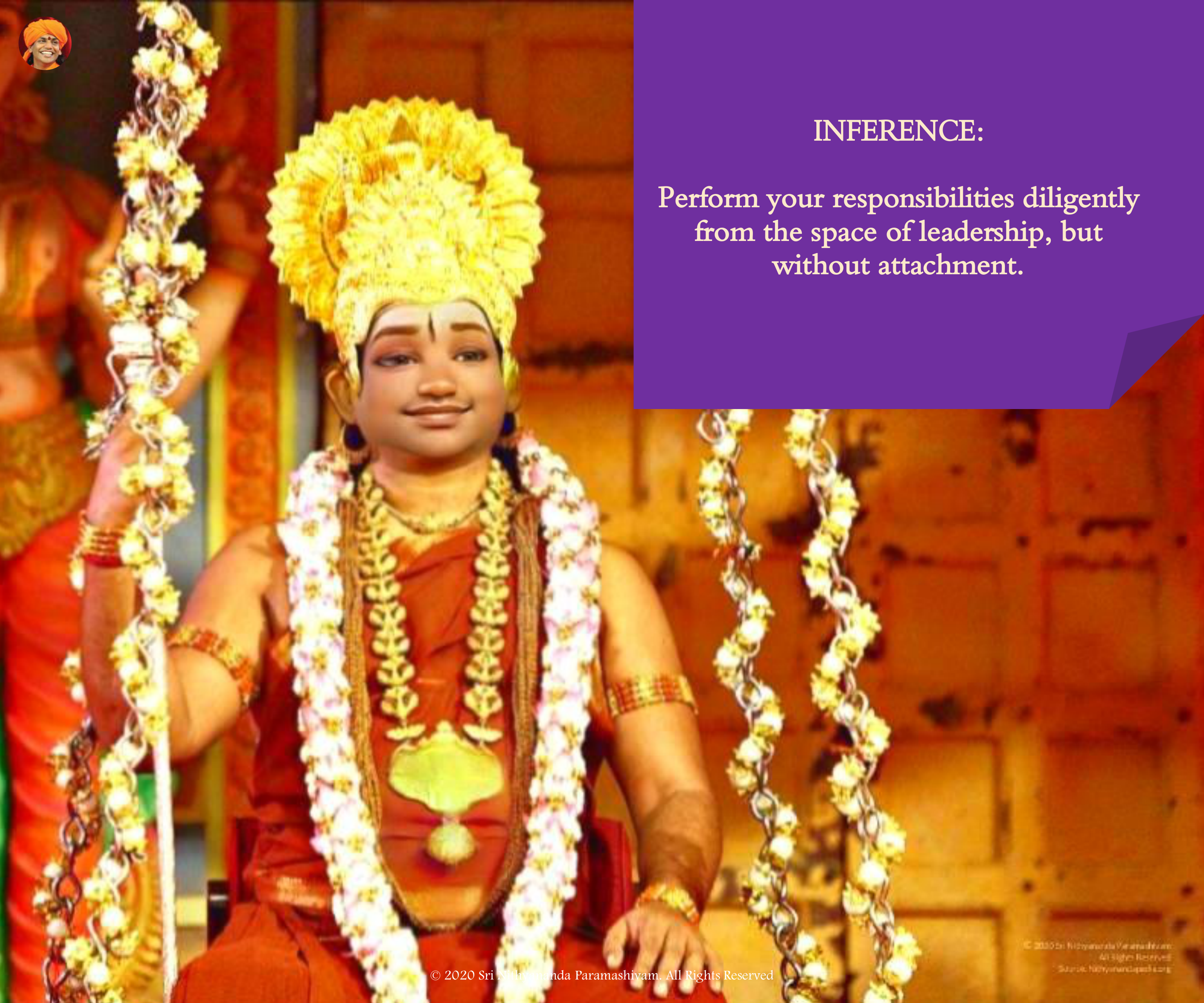
A wise man should set an example by performing his responsibilities diligently from the space of leadership, but without attachment.
3.27
प्रकृतेः क्रियमाणानि गुणैः कर्माणि सर्वशः ।
अहङ्कारविमूढात्मा कर्ताहमिति मन्यते
॥ ३=२७॥
prakṛteḥ kriyamāṇāni guṇaiḥ
karmāṇi sarvaśaḥ
ahakāravimūḍhātmā kartāhamiti
manyate
People, confused by ego, think
they are the doers of all kinds of
work while it is being done by the
energy of nature
POWERFUL COGNITION
The wise person goes through all activities without the inadequate cognition that he is the doer of them.
तत्त्ववित्Paramashivamतु महाबाहो गुणकर्मविभागयोः ।
गुणा गुणेषु वर्तन्त इति मत्वा न सज्जते
॥ ३=२८॥
tattvavittu mahābāho
guṇakarmavibhāgayoḥ guṇā guṇeṣu
vartanta iti matvā na sajjate
One who knows the Truth, O
mighty-armed one, knows the
differences between the attributes of
nature and work. Knowing well
about the attributes and sense
gratification, he never becomes
attached
POWERFUL COGNITION
When you understand that it is the mind and the senses doing what is in their nature, you become detached from your body-mind and do things with the clear understanding that just the mind, body and senses are doing their job.
3.29
प्रकृतेर्गुणसम्मूढाः सज्जन्ते गुणकर्मसु ।
तानकृत्स्नविदो मन्दान्कृत्स्नविन्न विचालयेत्
॥३-२९॥
prakṛterguṇasammūḍhāḥ sajjante
guṇa karmasu tānakṛtsnavido
mandān kṛtsnavinna vicālayet
Fooled by the attributes of nature,
those people with less wisdom or
who are lazy become engaged in
actions driven by these attributes.
But, the wise should not unsettle
them
POWERFUL COGNITION
Upon seeing the wise person being unaffected by his own actions and being always blissful, naturally, the ignorant one will get curious to know the secret behind happiness.
INTRODUCTION
An ignorant man says to himself, ‘I shall do this action and thereby enjoy its result.’ A wise man should not unsettle this belief. Instead, he himself should set an example by performing his responsibilities diligently from the space of leadership, but without attachment. If the wise man condemns the actions performed with attachment, the ignorant person may simply decide to neglect his responsibilities.
It is like this. Can you explain to a child that his toys are not precious? No! The child will never be able to understand that. It has to grow and automatically its attachment to toys will drop when maturity happens. Similarly, the ignorant person can first do the action only with attachment. But upon seeing the wise person being unaffected by his own actions and being always blissful, naturally, the ignorant one will get curious to know the secret behind happiness.
The example of the wise man will automatically pull him towards work with detachment.


Take the example of relating to God. Most of us pray to God to get something. All our prayers to God are asking Him to fulfill some desire or to protect us from something.
It is perfectly all right to start a relationship with God like this. When you get what you asked for, your trust towards him grows. This is important.
We are all governed by our basic nature, attributes, or guṇa. The mental set-up, patterns from previous births, called vāsana determines what we are, what we do in this birth, and also what happens to us in our future births.

The desires born out of vāsana carry
their own energy for fulfillment. If
you are conscious, you will be able to
fulfill them.
Once fulfilled, these vāsana and
karma get dissolved. One who
reaches this state of completion with
desires also realizes that he is not the
doer.
The potter’s wheel goes on turning
around even after the potter has ceased
to turn it.
The vāsana or desires with which you took this body and mind will make the body-mind go through whatever activities it was made for. But the wise person goes through all these activities without the inadequate cognition that he is the doer of them. Actually, your desire to lead life in a particular way is what creates the corresponding mental set-up or pattern. Once you choose to live life in a particular way, your body supports this decision and acts accordingly.
You create a vāsana or seed of karma to aid you in living life the way you desire.

KARMA IS NOTHING BUT THE
UNFULFILLED OR INCOMPLETE
PATTERNS AND DESIRES, WHICH
ARE INSIDE YOUR BEING, THAT
CONSTANTLY MAKE YOU TRAVEL IN
THE SAME PATH AGAIN AND AGAIN,
TRYING TO GIVE THE EXPERIENCE
OF COMPLETION IN YOUR INNER
SPACE
You are the one who chooses and acts, but any choice comes with effects and side effects. On seeing the side effects, you feel powerless and blame your fate or destiny. Actually, you are the one who chose it in the first place. You are responsible for the cause and effect, as you are source of everything!

A SMALL STORY
Once a man went to a restaurant
and ordered various items: pasta,
drinks, sweets, and so on. He
had a hearty meal and relaxed.
The waiter brought the bill. The
man took a look at the long bill
and exclaimed, 'But I didn't
order this bill!'
When you eat, you don't think
about the bill, but the bill comes
only as a result of all that you
ate. Similarly, in life, all that you
undergo are the effects of your
own incomplete actions.
Then when you do not take
responsibility for these actions,
the very actions and their effects
bind you into further incomplete
actions or desires.

YOU ARE NOT THE DOER
We think, when the sense of 'I' happens, the sense of 'mine' happens. But if you look deeply, our idea of what we think of as 'ours' is what defines what we think of as ourselves.
When you get attached to anything, you start creating suffering for yourself. When you understand that it is the mind and the senses doing what is in their nature, you become detached from your body-mind and do things with the clear understanding that just the mind, body and senses are doing their job. When you don't understand this, you get caught in what you are doing, you get emotionally attached to incidents and people, and you start living without awareness.
GOALS:
let children understand to set an
example by performing their
responsibilities diligently from
the space of leadership, but
without attachment.
And to not condemn the actions
done with attachment.
To understand actions
out of incompletion.
Get children to understand they
are the ones who choose and
act.
ASSESSMENTS
1. How should we show or tell
someone to perform their
responsibilities without attachment?
2. What are gunas?
3. What does vāsana mean?
4. What is karma?
5. What does the turning potter's wheel describe?
6. What do we feel about the effects and side effects of our actions?
ART OF THE DAY


ART OF THE DAY:
SUN AND THE MOON
MATERIALS NEEDED:
- Paper
- Sketch pens
PROCEDURE
Draw a small poster with the title: My prayer for today. Decorate the border. The children can write a prayer on the poster, or they can take it home and stick new prayers on every day
INFERENCE
Start a relationship with God. Start building your trust towards Him. This is important.
ACTIVITY OF THE DAY
ACTIVITY OF THE DAY:
DRESS UP
MATERIALS NEEDED: A few dress-up props showing professions, for example: a doctor, a teacher, a driver, a fireman Alternative is to have papers with the professions written on them and attached with safety-pins
PROCEDURE: Some children act as the professional people and the remainder interact with them according to their profession. For example, they pretend they have a broken finger and go to the doctor, or pretend they need to get to the airport and call the driver. If there is time, switch the roles. Finish by asking the children how it felt for them to be in a role. Did they identify with the role or with the action required? Can they see how these are two separate things, the title and the actions required?

INFERENCE:
Perform your responsibilities diligently
from the space of leadership, but
without attachment.
WORKSHOP OF THE DAY



WORKSHOP OF THE DAY:
VAAKYARTHA SADHAS
Hold Vaakyartha sadhas on the difference between • First the sense of ‘I’ happens, then the sense of ‘mine’ happens • First the sense of ‘mine’ happens, then the sense of ‘I’ happens Discuss why the second statement is the correct statement.
Conclusion: Take responsibility for your actions.
- BHAGAVAD GITA -
BOOK III, VOLUME VIII