Unattached Work Liberates You
This text was machine-transcribed from the printed book and may contain errors. Select the words and choose “Report a mistake”.
Authored by
THE SPH NITHYANANDA PARAMASHIVAM
३.३३
सदृशं चेष्टते स्वस्याः प्रकृतेर्ज्ञानवानपि ।
प्रकृतिं यान्ति भूतानि निग्रहः किं करिष्यति
॥ ३-३३॥
sadṛśaṁ ceṣṭate svasyāḥ
prakṛterjñānavānapi । prakṛtiṁ
yānti bhūtāni nigrahaḥ kiṁ
kariṣyati
Even the wise person tries to act
according to the modes of his
own nature, for all living beings
go through their nature. What
can restraint of the senses do?
POWERFUL COGNITION
When we use our energies with authenticity for our peak growth without comparing ourselves with others, we do our responsibility according to our nature.

3.34
इन्द्रियस्येन्द्रियस्यार्थे रागद्वेषौ व्यवस्थितौ ।
तयोर्न वशमागच्छेत्तौ ह्यस्य परिपन्थिनौ
॥ ३=३४॥
ndriyasyendriyasyārthe rāgadveṣau
vyavasthitau tayorna vaśamāgacchet
tau hyasya paripanthinau
Attachment and repulsion of the
senses for sense objects should be put
under control. One should never
come under their control as they
certainly are the stumbling blocks on
the path of self-realization
POWERFUL COGNITION
A human being is endowed with Consciousness that rises above base emotions and instincts.

श्रेयान्स्वधर्मो विगुणः परधर्मात्स्वनुष्ठितात् ।
स्वधर्मे निधनं श्रेयः परधर्मो भयावहः
॥ ३=३५॥
śreyānsvadharmo viguṇaḥ
paradharmātsvanuṣṭhitāt svadharme
nidhanaṁ śreyaḥ paradharmo
bhayāvahaḥ
Attachment and repulsion of the
senses for sense objects 2nd line:
should be put under control. One
should never come under 3rd line:
their control as they certainly are the
stumbling blocks on the 4th line:
path of self-realization
POWERFUL COGNITION
Each of us is unique in our capabilities and interests. Accordingly, our responsibilities are different.

3.37
श्रीभगवानुवाच ।
काम एष क्रोध एष रजोगुणसमुद्भवः ।
महाशनो महापाप्मा विद्ध्येनमिह वैरिणम्
॥३=३७॥
śrībhagavānuvāca
kāma eṣa krodha eṣa
rajoguṇasamudbhavaḥ mahāśano
mahāpāpmā viddhyenamiha vairiṇam
The Lord says, ‘It is lust and anger
born of the attribute of passion, all-
devouring and sinful, which is one’s
greatest enemy in this world
POWERFUL COGNITION
When you take responsibility, the higher energies start expressing through you.


INTRODUCTION
Here, it is important to understand what duty means. If I have to do my duty, I need to know how to identify my duty.
The idea of duty is different for different people, different countries, different cultures, and different religions. Hence the term 'duty' is impossible to clearly define. We have always been trained by society to consider certain acts as duty; some as good and others as bad. Duty and responsibility are totally different.
For example, it is our duty to help elderly people, to follow principles of truth, non-violence, non-stealing and such tenets. We are brought up with these concepts of morality, but have we experienced the beauty of implementing them?
What Kṛṣṇa talks about here is not socially defined duty or conscience.
He is talking about responsibility, the
leadership consciousness, the law of the
cosmos. The Cosmos functions on
responsibilism.
When you take responsibility, the higher energies start expressing through you. When you actually take responsibility, Indra enters your hand; it becomes vajrāyudha. Yama enters your lungs; it means 'not-stopping'. Lakṣmi enters your heart; it means 'continuously sharing'.
Kubera enters your liver and kidney, keeping the whole thing alive;
Mārut, Agnī, Mārīci, all of them enter your intestine, burning anything that is offered and keeping the whole system active and alive.

UNATTACHED WORDS LiBERATES YOU
Just like the wonders of the world, if you analyse the linguistic wonders of the world, Saṁskṛtaṁ, the devabhāśā— language of Divine, will be the first and only linguistic wonder of the world.
The word Saṁskrit means well done, refined, perfect. Anything created out of the space of completion stands forever, stands eternally. Completion is eternal, Nitya.
A SMALL STORY
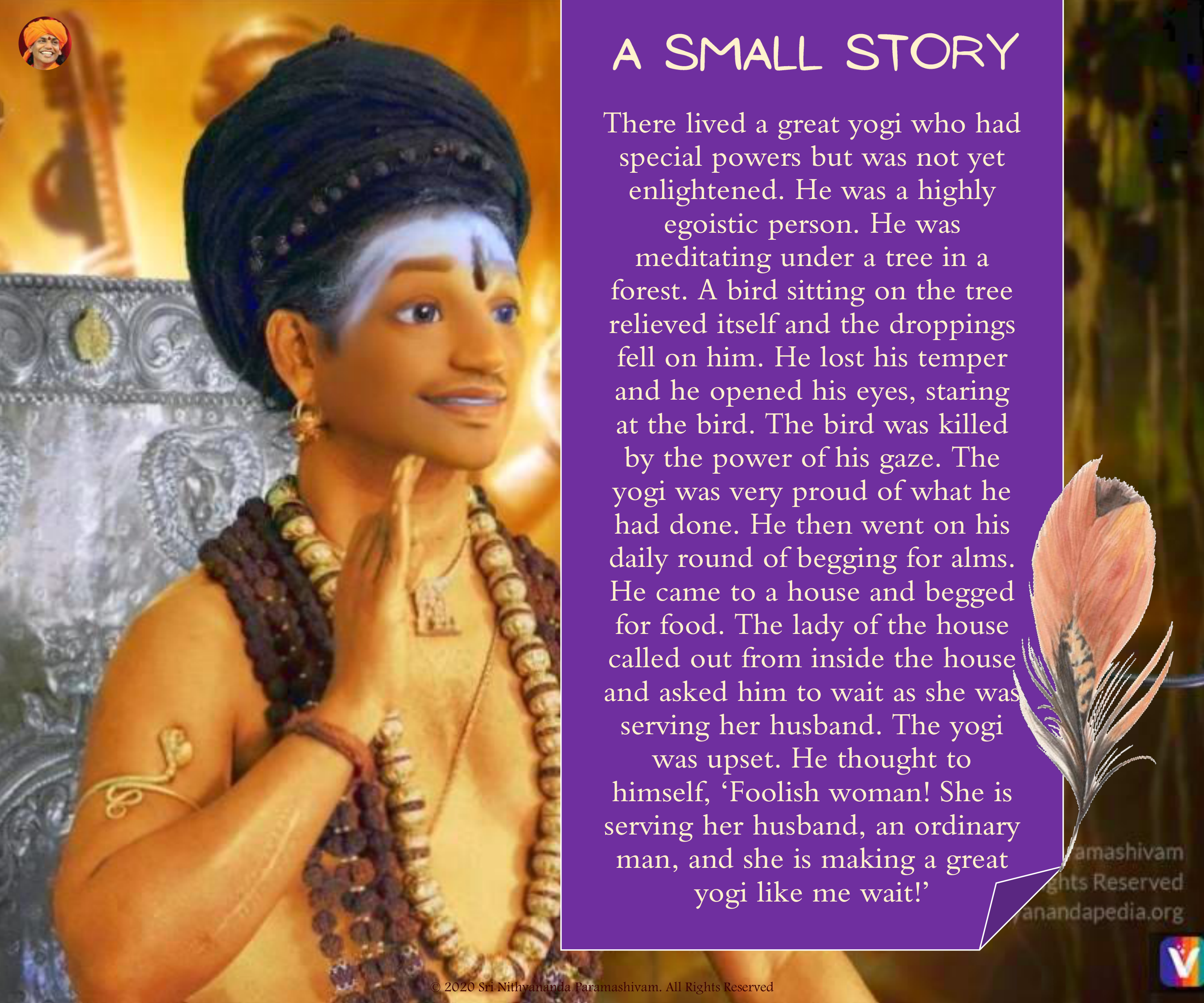
There lived a great yogi who had
special powers but was not yet
enlightened. He was a highly
egoistic person. He was
meditating under a tree in a
forest. A bird sitting on the tree
relieved itself and the droppings
fell on him. He lost his temper
and he opened his eyes, staring
at the bird. The bird was killed
by the power of his gaze. The
yogi was very proud of what he
had done. He then went on his
daily round of begging for alms.
He came to a house and begged
for food. The lady of the house
called out from inside the house
and asked him to wait as she was
serving her husband. The yogi
was upset. He thought to
himself, 'Foolish woman! She is
serving her husband, an ordinary
man, and she is making a great
yogi like me wait!'
Suddenly he heard the lady’s voice again as if in answer, ‘I am not like the bird in the forest to be killed so easily.
Your powers may be used against birds but not against me, so relax!’The yogi was shocked! The lady actually knew not only what he was thinking, but even what had happened in the forest!
The yogi apologized to the lady when she came out to give him food. He asked her, ‘Mother, how did you know what I was thinking? And how did you know what happened in the forest?
Please teach me how I can achieve this.’ She replied, 'You have attained śakti (power) but not buddhi (intelligence).
Go to the butcher who is down the road and he will teach you.' Now the yogi was even more surprised. He thought, 'How can ordinary butchers teach me anything about buddhi?' But what the lady had done was too much for him.
So he quietly took the lady's counsel and went down the road to the butcher's shop. When he reached the butcher's shop, he saw that the butcher was busy cutting up the meat of the animal he had just slaughtered. He could not imagine learning from a butcher. But he wanted intelligence, so he approached the butcher and asked, 'I was told by a lady living nearby to ask you about intelligence.
Can you explain to me how to attain intelligence?'



The butcher explained how he
himself had achieved
intelligence, the ultimate
experience.
All he did to achieve it was do
his job with complete awareness
and total authenticity.
He did his job with complete
integrity and used the money
that he earned to take care of
his aged parents, which he did
with equal devotion.
Just the very doing of his
responsibility had liberated him.
The nature of his work, the act
of slaughtering animals,
was not important.
The attitude, space from which
he did it was what mattered.

CAUSING RESPONSIBILITY OUT OF COMPLETION
In the Mahābhārat, Karṇa is a great
warrior and close friend of
Duryodhana; his acts of charity and
generosity are much admired.
He is the immaculate son of Surya,
the Sun energy and the eldest son of
Kuntī, the mother of Pāṇḍavas. Being
born before Kuntī's marriage to King
Pāṇḍu, the unwed
Kuntī abandoned him at birth.
Karṇa lived as the adopted son of the
royal charioteer of the Kurus, and
struggled with misfortune throughout
his life.

Karṇa's famous charity was out of a
deep incompletion and a feeling
that he is not respected. What was
Karṇa's inner image, mamakāra? 'I
am a failure; I am not respected
anywhere I go.'
This is because he did not know his
parents' names, his origins.
So, his inner image, mamakāra at a
young age was 'I am not respected!'
So he was exploding with the outer
image, ahaṁkāra — 'I have to be
respected, I am respectable!'
And the best way to be respected
was to do charity work.
Even the great acts like charity,
when done out of incompletion,
only lead to the wrong effect.
If you cause anything out of
completion, what you get back will
be miraculous.
If you cause even a great charitable
act out of incompletion,
what you get back will be hell.
Even the so-called moral, good
deeds will only have bad effects.

THE NATURAL DHARMA

Each of us is unique in our capabilities and interests.
Accordingly, our responsibilities
are different. If you try to imitate
others, thinking their responsibility
appears more attractive, you will be
making the mistake of following
somebody else's pathIn the vedic
culture, a child was taken to a
Gurukul, the ancient system of
living, learning at the feet of
Master, before the age of seven.
The Guru taught the child based on
his or her abilities. If the child had
the aptitude to become a scholar he
was trained in scriptures, and
became a brāhmaṇa. If the child
was aggressive and courageous, he
was trained in martial arts, and
became a kṣatriya, meaning warrior,
and so on. Varṇa or caste
classification was based on one's
natural abilities, not on birth

THE ALCHEMY OF POSSIBILITY INTO REALITY
These four principles of integrity, authenticity, responsibility and enriching exist in our very DNA. A seed becomes a tree or man realizes his potential only when these four principles are lived. A human has everything needed in him to become the ultimate reality, the divine reality. As of now, man is only a possibility. Only when these four principles become reality do you experience your actuality.
Anger is a tremendous energy we misuse because we do not understand and respect it. Greed, anger are all rajasic qualities that arise from passion and aggression from the blocked mūlādhāra cakra, the root center. These are instinctive emotions that we inherit from our animal ancestors. Indulging in these base emotions keeps one in bondage to his instinctive nature. This is the reason Kṛṣṇa classifies these as the root causes of sin. A human being is endowed with Consciousness that rises above these instincts. The meaning of a human life is not mere survival; it is the realization of one's Superconscious nature, one's highest reality. Anything that stands in the way of Self-realization is a sin.


GOALS:
Help children understand
responsibilism, and being
responsible out of completion.
ASSESSMENTS
- What does duty mean?
- What does responsibilism mean?
- What is the difference between responsibilism and duty?
- What happens when you take responsibility?
- What does egoistic mean?
- In the story about the yogi meditating under a tree, why was he egoistic?
- What did the woman tell the yogi that shocked him?
- Why did the yogi doubt that a butcher could teach him?
- What had liberated the butcher?
ASSESSMENTS
• In the Mahābhārat, why did Karṇa have a low inner image, mamakāra? And because of his inner image, mamakāra, what was Karna's outer image, ahaṁkāra?
• What is the problem with acts done out of incompletion?
• In the Vedic culture, how does the Varṇa or caste classification work?
• What four principles exist in our very DNA for us to realize our potential?
• Why do we need to go beyond the instinctive emotions that we inherit from our animal ancestors?

ART OF THE DAY

ART OF THE DAY:
CARTOON STORYLINE
MATERIALS NEEDED:
- Paper Pens
- Coloring pens
PROCEDURE Draw the story of the yogi who was told to learn buddhi as a cartoon series. Split the story between the children with each child being given one scene to draw. If there are many children, split into groups of about 4 children with each group splitting the full story between themselves. When they are done, place the drawings in the sequence of the story and let each child tell what is happening in their drawing (in the correct order), thus bringing the story to life.
INFERENCE Let children intranalize concepts like egoistic and doing work with awareness and authenticity.


ACTIVITY OF THE DAY
ACTIVITY OF THE DAY:
UNLEASH YOUR NATURAL ABILITIES
PROCEDURE: Split the children into two groups. Each group takes a turn to try an activity from • Training in the scriptures to become a scholar, brāhmaṇa. For example, learn a short Sanskrit mantra. • Training in the martial arts to become a warrior, kṣatriya. For example, learn a short sequence of martial arts movements. Note: remind the children that these are only two of the four Varna
INFERENCE: Learn how one's natural abilities influence our Varna, and that the abilities require training.

WORKSHOP OF THE DAY
WORKSHOP OF THE DAY:
VAAKYARTHA SADHAS
Hold Vaakyartha sadhas on the duties that the children are learning, such as their duties at home and among the wider family, their duties at school, duties in public places such as obeying traffic lights, and duties in any other situations such as sport
Conclusion: Each of us is a unique possibility. The very doing of responsibility liberates
- BHAGAVAD GITA -
BOOK III, VOLUME X