INTRODUCTION
This text was machine-transcribed from the printed book and may contain errors. Select the words and choose “Report a mistake”.
In His concluding words in this chapter, Kṛṣṇa clarifies to Arjuna once again, how to reach liberation, how to become one with Brahman which is one's true and natural state. We have seen that a person not centered in self-completion cannot be peaceful or happy or wise. A person who is led by his senses cannot be complete. A person who is in control of his senses is firmly in control of his mind and emotions. Only such a person is truly awake.
We all think we are awake; are we really? We live in daydreams even if we are awake. The only occasion when we are truly awake is when we are in the space of completion.

A person in such a space of completion is whom Kṛṣṇa calls a ‘Muni,’ a realized being living in the present. Such a person is always awake, having experienced his inner awakening, whether physically awake or asleep. Kṛṣṇa says that such a person is in sleep when others are awake, yasyāṁ jāgrati bhūtāni sā niśā paśyato muneḥ (2.69). The realized person, although he may appear to be living and actively participating in the activities of the same world that we live in, is in reality, in a state of passive alertness or restful awareness.
This means that his senses are not immersed in worldliness and he is centered and complete in his Self. He is dead and asleep to this world because he has moved beyond his senses. A truly realized person is also awake when others are asleep. Even in his sleep he is aware, in what is called the state of supta chittam.
A person who is in the space of
completion is still as the waters in the
bed of the ocean. Though there are
waves in the surface, they do not
disturb the bed of the ocean. Even
when desires assail him, they are mere
waves in the periphery of his
consciousness, and do not disturb him
at all. He has abandoned all attachment
to 'I' and 'mine.' He is without
thoughts and desires and when
thoughts and desires come to him, they
merge into him without disturbing
him.

How this is possible? The ‘Muni,’ one who is still, in silence, is one who is in tot al control of his senses. When the senses are controlled, when the ego is out of action, all thoughts and desires are just witnessed.
The ‘Muni’ does not get involved in
these thoughts and desires. He does not
even try to stop or suppress them, as he
knows it is impossible. He just lets
them be watching them go past, just
like the ocean watches impassively as
other waters merge into it.
We are all enlightened because we
are all a hologramic part of the
reality of the Universe, Brahman. All
that we lack is the awareness of the
truth of our Enlightenment.
I TELL MY DISCIPLES TIME
AND AGAIN, 'I AM NOT HERE
TO PROVE MY DIVINITY. I AM
HERE TO PROVE YOUR
DIVINITY.' THIS IS THE
TIMELESS MESSAGE OF
KRISHNA, THE MESSAGE OF
BHAGAVAD GĪTĀ.
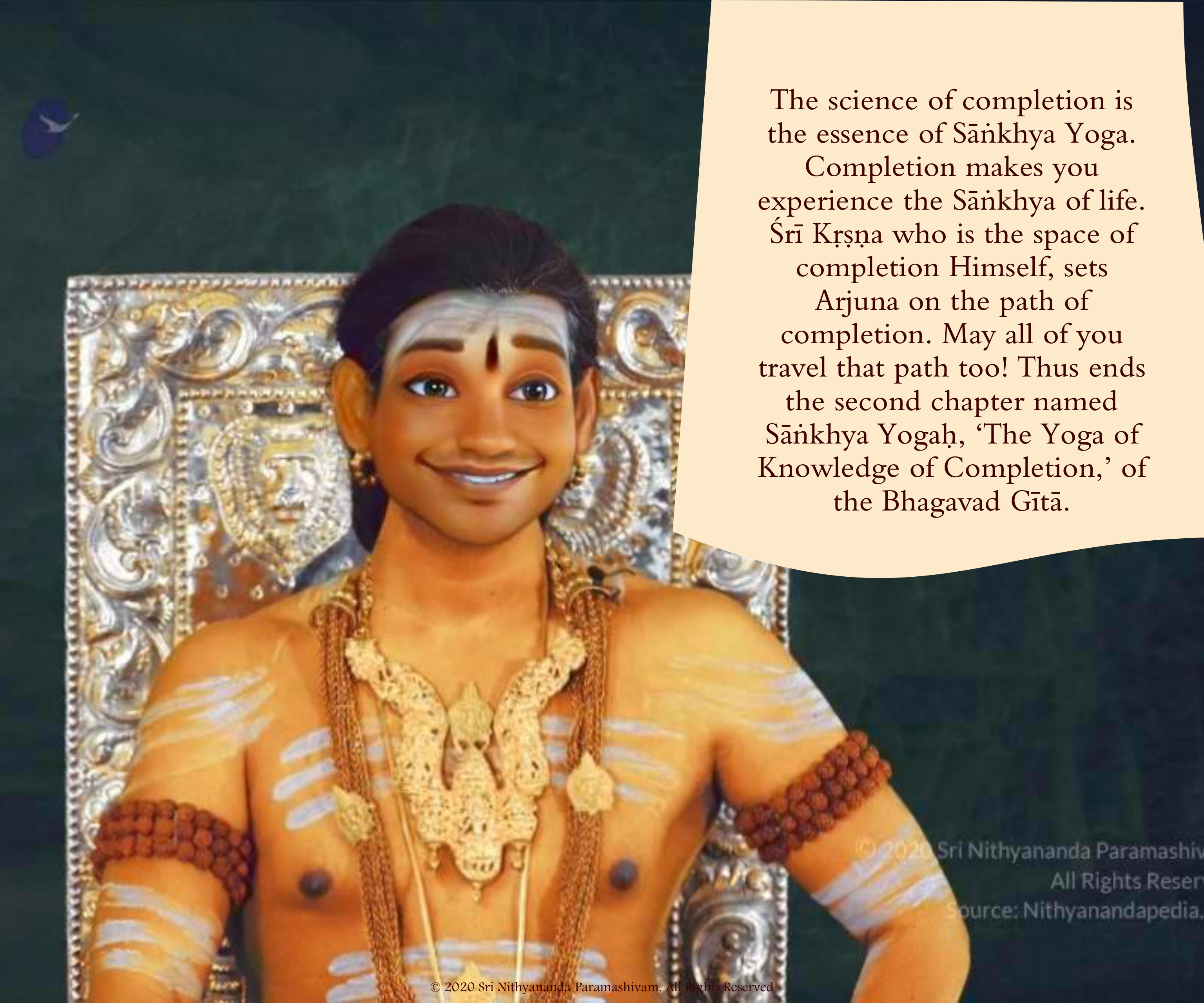
The science of completion is
the essence of Sāṅkhya Yoga.
Completion makes you
experience the Sāṅkhya of life.
Śrī Kṛṣṇa who is the space of
completion Himself, sets
Arjuna on the path of
completion. May all of you
travel that path too! Thus ends
the second chapter named
Sāṅkhya Yogaḥ, ‘The Yoga of
Knowledge of Completion,’ of
the Bhagavad Gītā.