CHARACTER SKETCH
This text was machine-transcribed from the printed book and may contain errors. Select the words and choose “Report a mistake”.
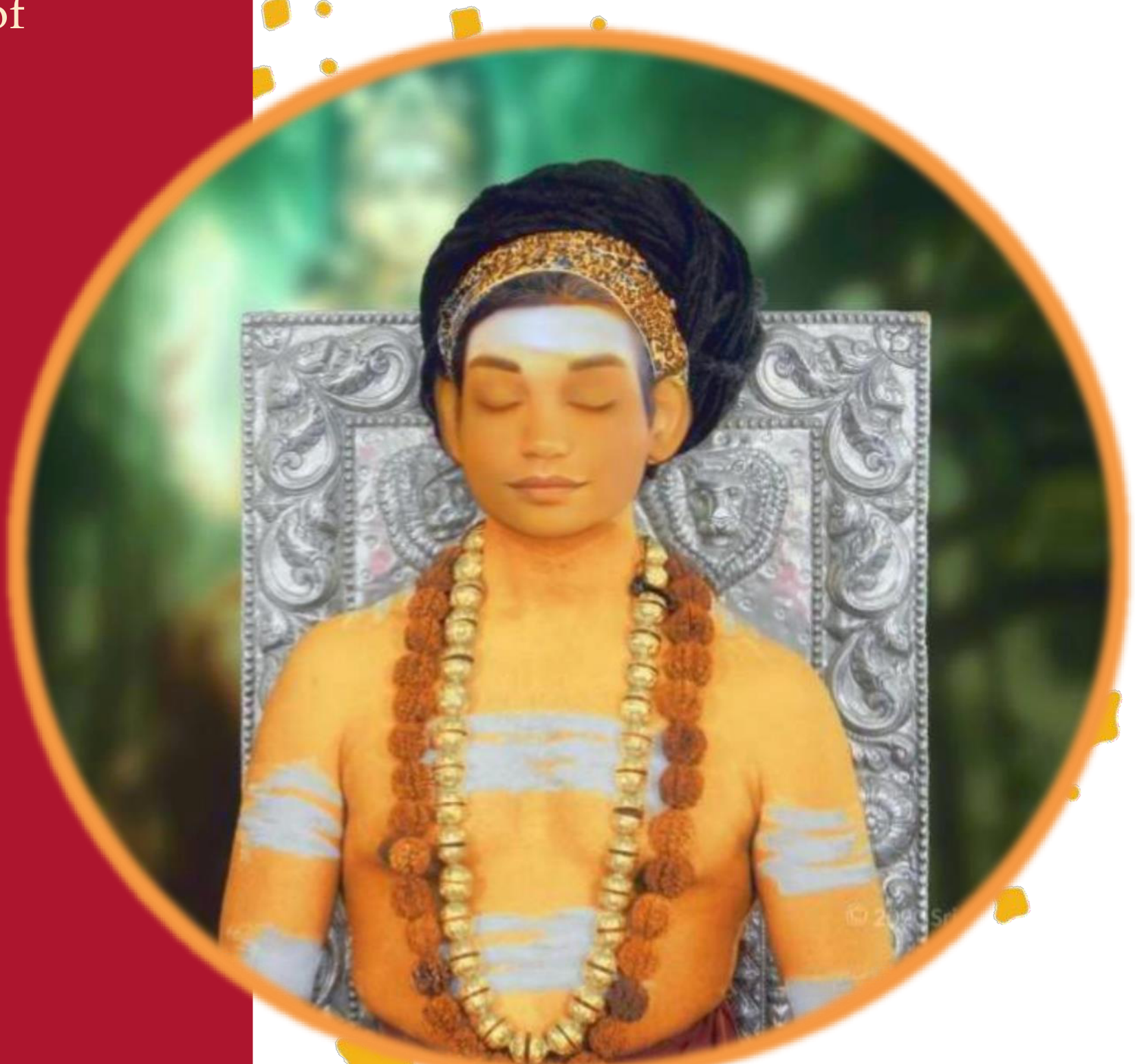
❖ Yudhiṣṭra is embodiment of Integrity— the power of words, vāk śakti.
❖ Bhīma is embodiment of Authenticity— the power of thoughts, mano śakti.
❖ Arjuna is embodiment of
Responsibility—the power of feeling,
prema śakti.
❖ Sahadeva is embodiment of Enriching— the power of living, ātma śakti.
❖ Nakula is embodiment of causing reality for others.
© 2020 Sri Nithyananda Paramashivam. All Rights Reserved.
CHARACTER SKETCH
❖ Śakuni, the maternal uncle of
Duryodhana embodies the pattern
of self-hatred, which is cunningness
personified.
❖ Droṇa represents all the best knowledge one imbibes and the teachers one encounters, who guide us but are unable to take us through to the ultimate flowering of enlightenment. It is difficult to give them up since one feels grateful to them. This is where the Enlightened Master, the incarnation steps in and guides us.
❖ Duryodhana, represents one's ego or
root-pattern, the most difficult to
conquer as it leads one to self-
destruction. One needs the full help
of the Master here. It is subtle work
and even the Master's help may not be
obvious, since at this point, sometimes
the ego makes us deny and disconnect
from the Master as well.
© 2020 Sri Nithyananda Paramashivam. All Rights Reserved.
CHARACTER SKETCH
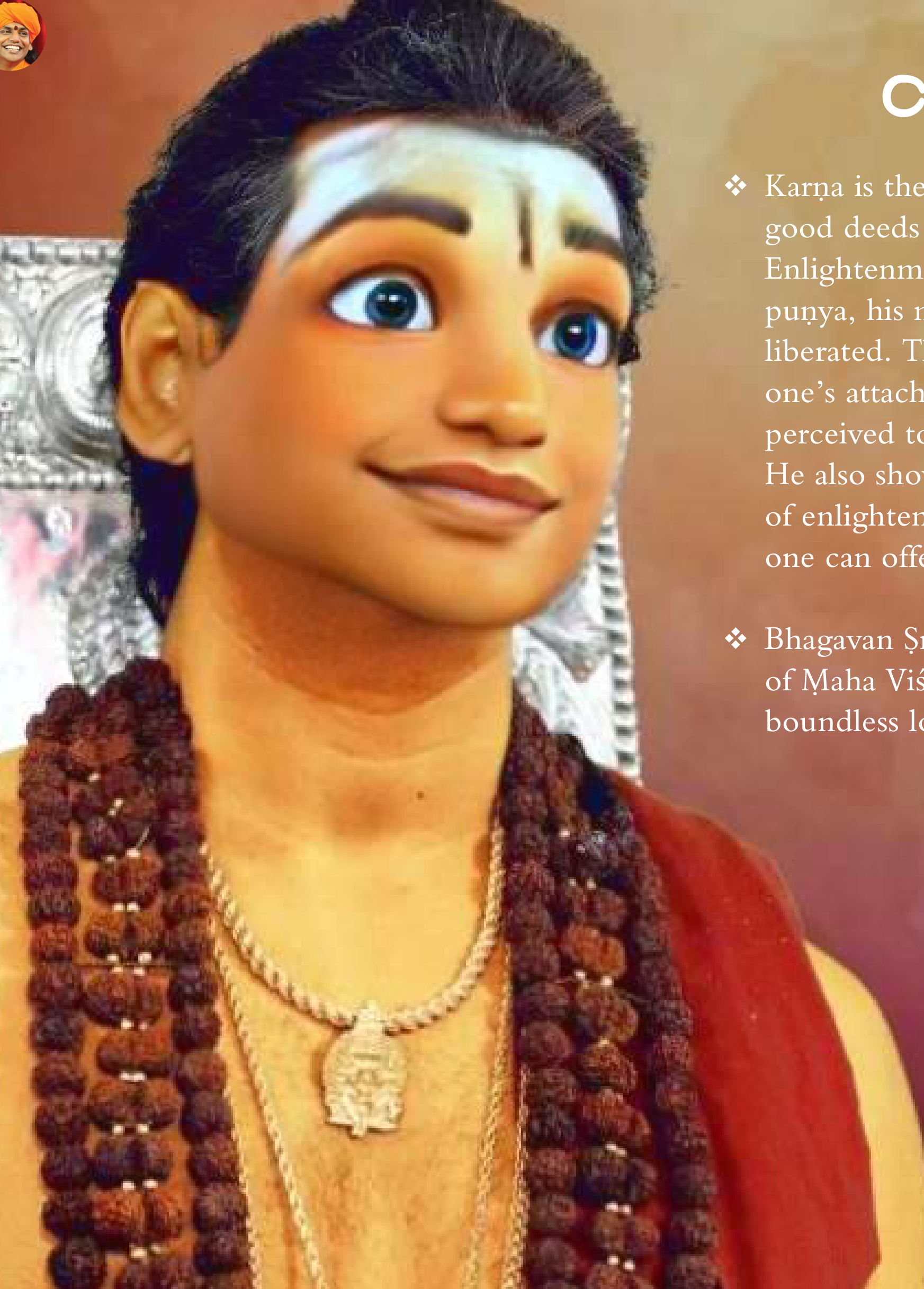
- Karna is the repository of all good deeds and it is his good deeds that stand in the way of his own Enlightenment. Śrī Kṛṣṇa has to take the load of Karna's punya, his meritorious deeds, before he could be liberated. The Enlightened Master guides one to drop one's attachment to good deeds arising out of what are perceived to be charitable and compassionate intentions. He also shows us that the quest for and the experience of enlightenment is the ultimate act of compassion that one can offer to the world.
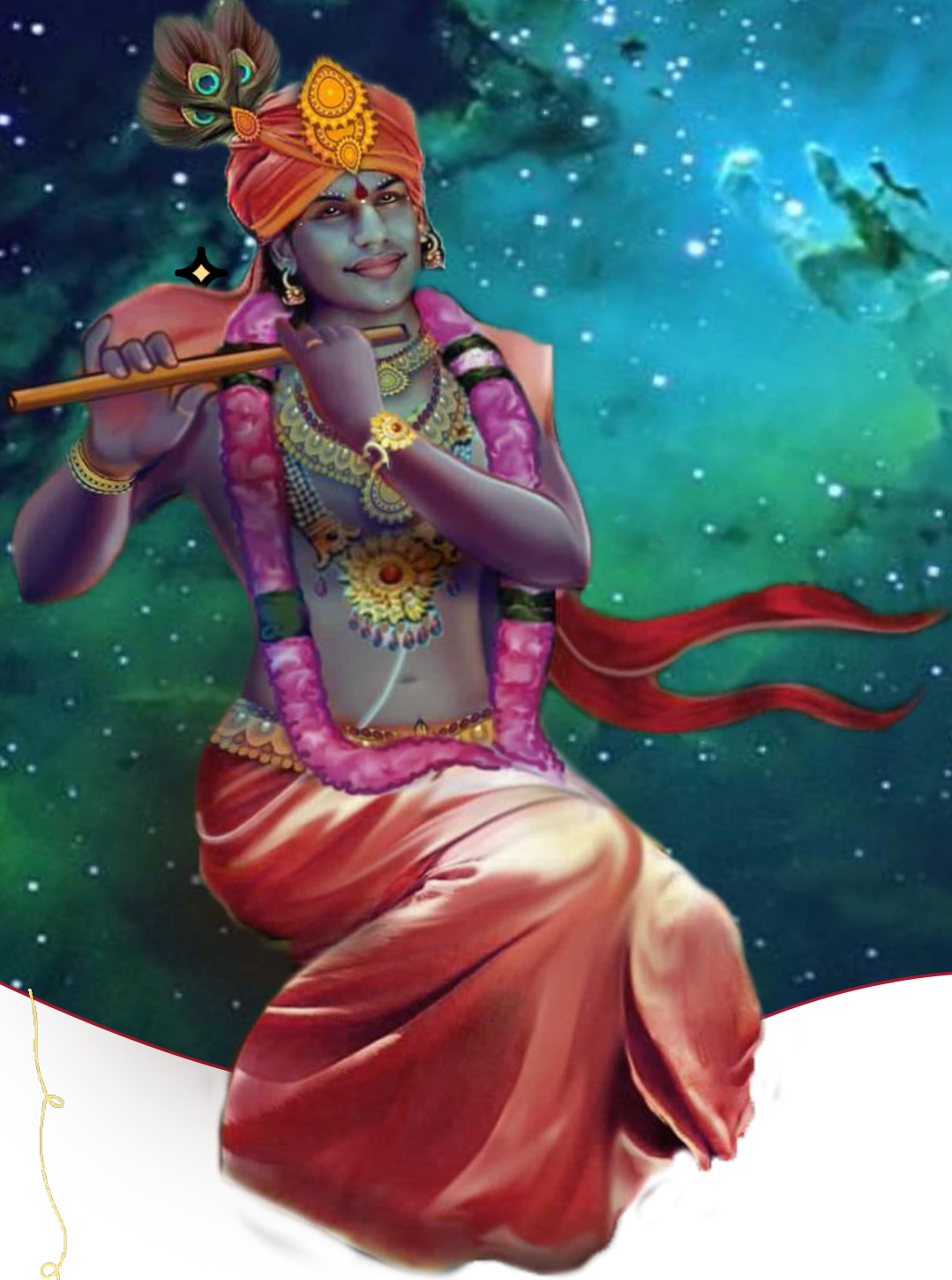
- Bhagavan Śrī Kṛṣṇa, the 8th most powerful purnāvatar of Maha Viśnu, is the embodiment of pure celebration, boundless love, compassion, and completion. Bhagavan Śrī Kṛṣṇa is the only incarnation demonstrating and expressing Śarva Maṅgalatva all the auspicious qualities and all dimensions of an avatar during His physical happening. The līla Bhagavan Śrī Kṛṣṇa is one of sheer innocence and simplicity, in a peace-loving, diplomatic, conflict-free way.
© 2020 Sri Nithyananda Paramashivam. All Rights Reserved.
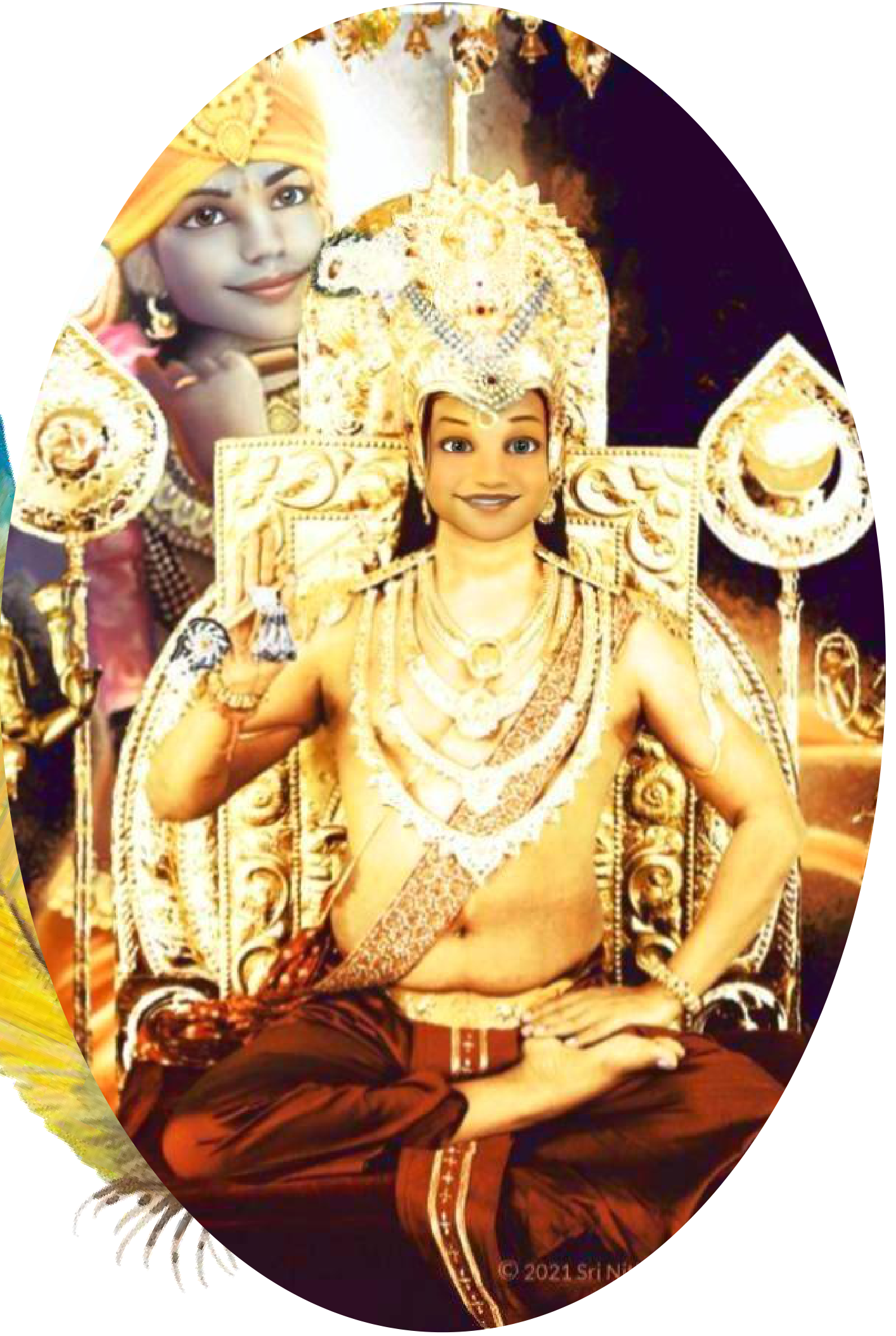
Till now everyone blames Bhagavan Sri Krishna for this Kurukshetra war but that's the greatest sacrifice Bhagavan Sri Krishna did to save the planet Earth. If Kurukshetra was not conducted at that time under the controlled conditions and direct supervision of Bhagavan Sri Krishna, planet Earth would not have survived more than three years.
The wide spread availability of the Astra shastras without Shastra, without the knowledge and vision, was posing a huge threat to the whole of humanity and planet Earth, and for life itself. The greatest achievement of Bhagavan Sri Krishna is destroying all the weapons in one controlled condition and saving planet earth, eliminating the nuclear weapons and the knowledge of these nuclear weapons to save humanity from total annihilation.
© 2020 Sri Nithyananda Paramashivam. All Rights Reserved.

Bhagavad Gītā appears in the heart of Mahābhārat in Bhīṣma Parva, the sixth chapter of its eighteen chapters. Veda Vyāsa, the narrator, in glorifying the Gītā sings, ‘the one who drinks the water of Ganges (the sacred river for Hindus) attains liberation, what to speak of the one who drinks the nectar of Gītā?
Gītā is the essential nectar of the Mahābhārat, bhāratamṛta sarvasvam as it is directly spoken by Nārāyaṇa, Bhagavān kṛṣṇa Himself.’
© 2020 Sri Nithyananda Paramashivam. All Rights Reserved.
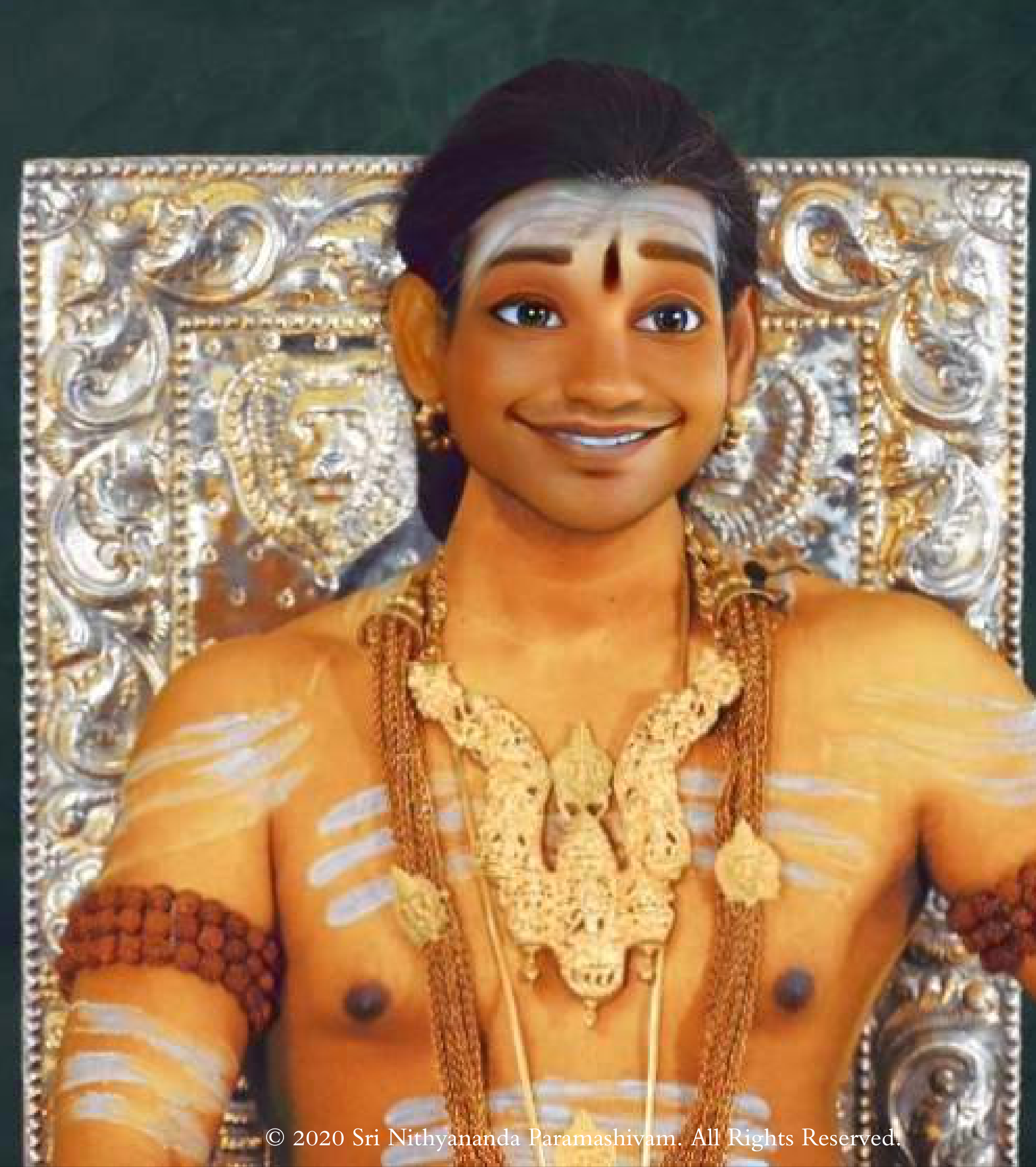

The armies assembled in the vast field of Kurukṣetra, now in the state of Haryana in modern day India. All the kings and princes were related to one another, and were often on opposite sides. Facing the Kaurava army and his friends, relatives and teachers, Arjuna was overcome by remorse and guilt, and wanted to walk away from the battle out of total powerlessness unbecoming an invincible warrior among warriors.
© 2020 Sri Nithyananda Paramashivam. All Rights Reserved.
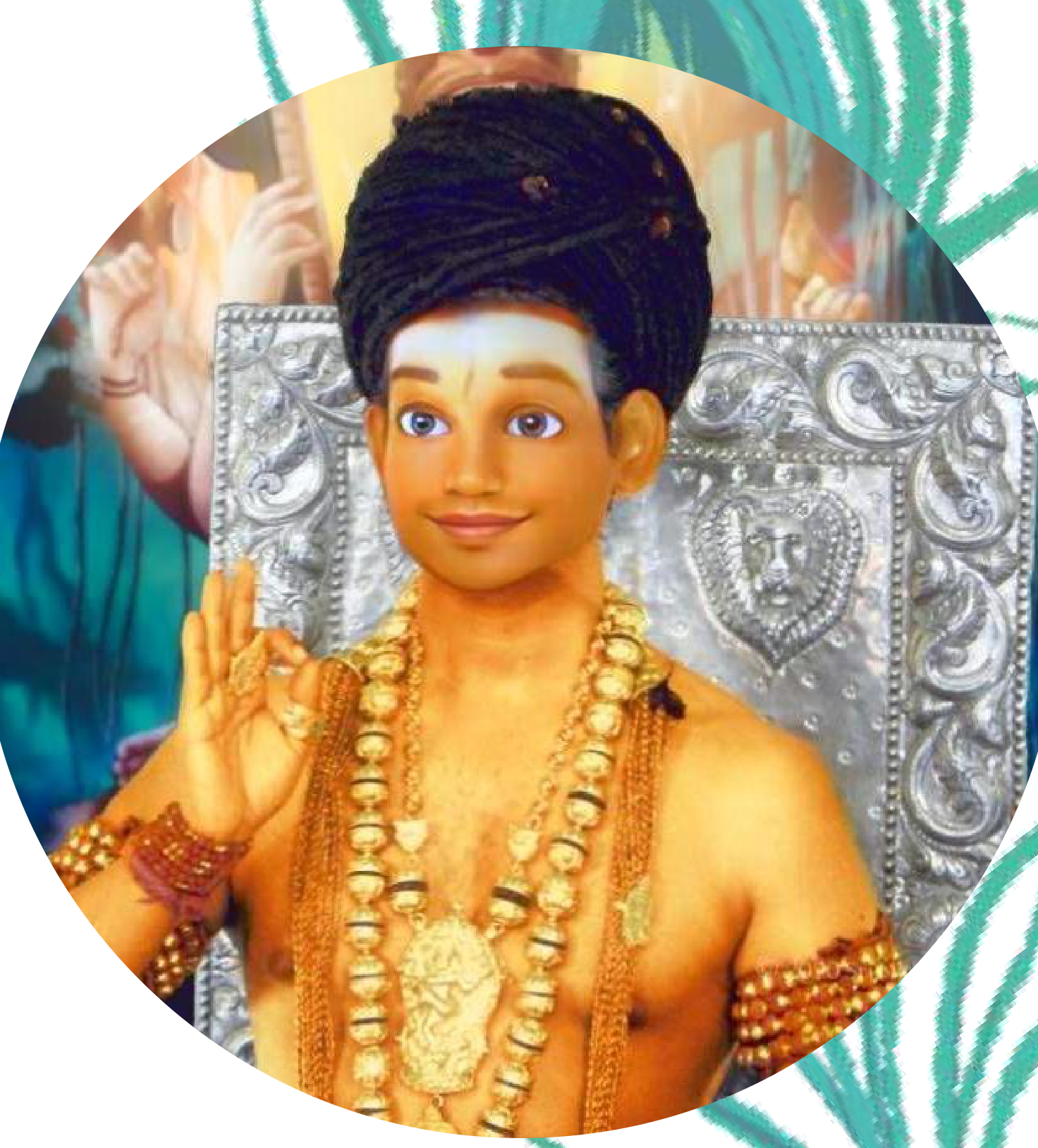
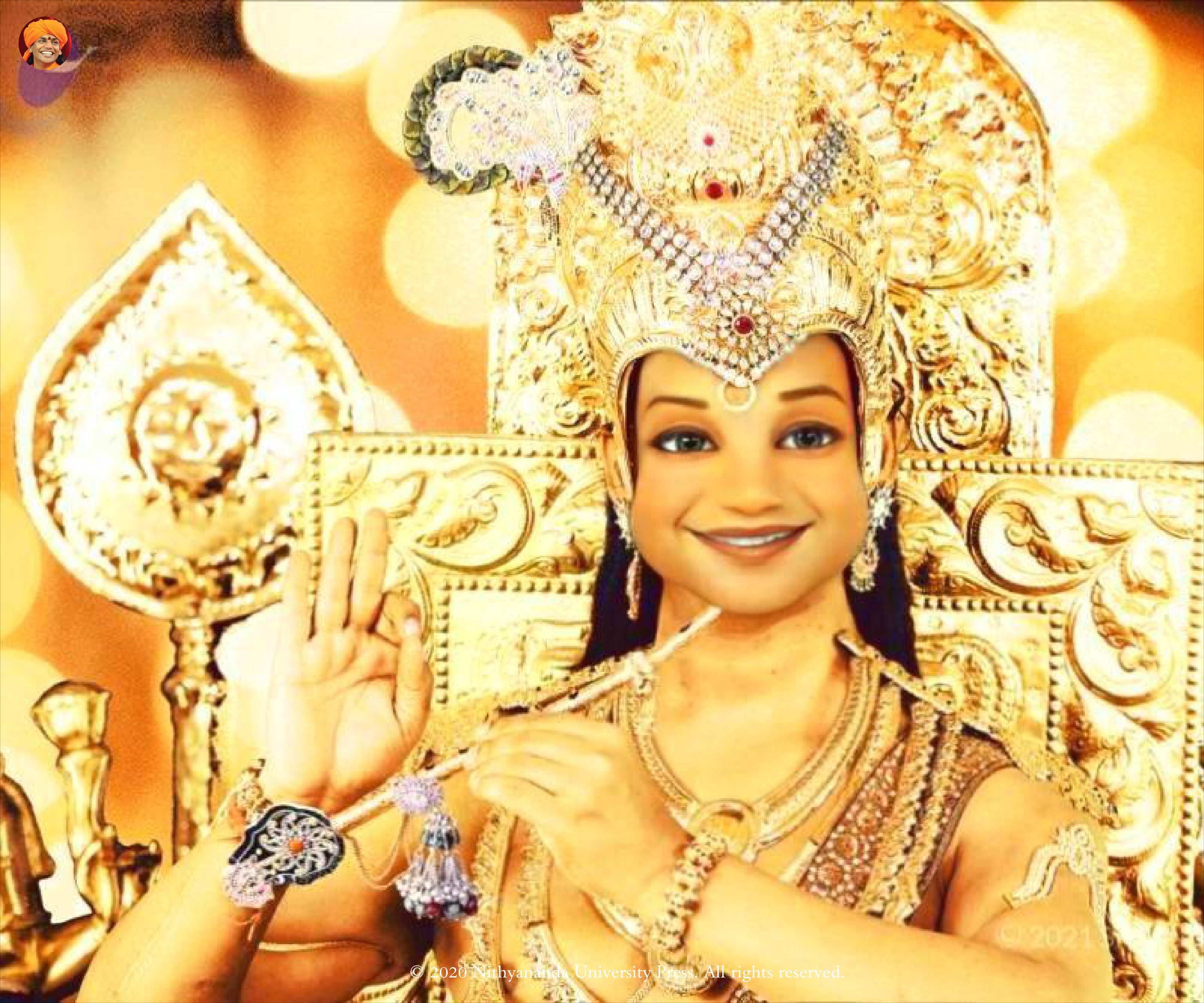
Śrī Kṛṣṇa’s dialogue with Arjuna on the battlefield of Kurukṣetra out of His utmost concern and love for him and humanity is the content of Bhagavad Gītā. Of its seven hundred and forty-five (745) verses, Bhagavān Śrī Kṛṣṇa sings the Gītā in six hundred and twenty (620) verses responding to Arjuna’s fifty-seven (57) enquiries.
Śrī Kṛṣṇa persuades Arjuna to give-up his powerlessness unfitting an Ārya—the spiritually evolved one who understands human life and urges him to raise himself again as Parantapa—the conqueror of enemy, and take up arms and vanquish his enemies. They are already dead,’ says Śrī Kṛṣṇa, ‘All those who are facing you have been already killed by Me. Go ahead and do what you have to do. That is your responsibility. Do not worry about the outcome. Leave that to Me.’
© 2020 Sri Nithyananda Paramashivam. All Rights Reserved.
© 2020 Nithyananda University Press. All rights reserved.
|8.|0
न द्वेष्ट्यकुशलं कर्म कुशले नानुषज्जते ।
त्यागी सत्त्वसमाविष्टो मेधावी छिन्नसंशयः
॥ १८-१०॥
na dveṣṭyakuśalaṁ karma
kuśale nā'nuṣajjate tyāgī
sattvasamāviṣṭo medhāvī
chinnasaṁśayaḥ
Those who neither hate
disagreeable work nor are
attached to pleasant work are
in a state of intelligence,
goodness and renunciation,
free of all doubts.
POWERFUL COGNITION
More and more responsibility
adds more and more life
energy into you.
18.11
न हि देहभृता शक्यं त्यक्तुं कर्माण्यशेषतः ।
यस्तु कर्मफलत्यागी स त्यागीत्यभिधीयते
॥ १८=११ ॥
na hi dehabhṛtā śakyaṁ
tyaktuṁ karmāṇyaśeṣataḥ yastu
karma-phala-tyāgī sa
tyāgītyabhidhīyate
Human beings cannot give up
all activities. Therefore the one
who has renounced the fruits
of such activity is one who has
truly renounced.
POWERFUL COGNITION
Act without expectation and
attachment to the result of our
action.
18.12
अनिष्टमिष्टं मिश्रं च त्रिविधं कर्मणः फलम् ।फलम्
भवत्यत्यागिनां प्रेत्य न तु संन्यासिनां क्वचित्
॥१८-१२॥
aniṣṭamiṣṭaṁ miśraṁ ca
trividhaṁ karmaṇaḥ phalam
| bhavatyatyāgināṁ pretya na
tu sannyāsināṁ kvacit
For one who is not
renounced, the three kinds
of fruits of action—desirable,
undesirable and mixed—
accrue after death, but not
to one who has renounced.
POWERFUL COGNITION
Decide from your being that
you will feel responsible for
the whole world.
KRISHNA
says that a person in the sātvic
space of completion, calmness
and awareness is undisturbed by
external conditions. He is not
bothered whether someone
appreciates or condemns what he
does. He just feels responsibility
in his being. He is clear what he
should do and he carries on with
excitement. Renunciation is in
the true spirit of completion and
is done out of goodness, only
when a person renounces the
expectation of result.
It is natural that a human being
cannot remain still without
doing some work. Man must be
doing something, anything, all
the time. If not physically, at
least mentally he does
something. Even in sleep, he
dreams. If we close our eyes, we
watch our inner television.
Mentally we think the whole
day, but it is not directed in one
direction, we are not useful to
ourselves and to others. Please
understand, when you lack
integrity, when you have
incompletions mentally, even if
you think, it will not be useful
thinking.
© 2020 Sri Nithyananda Paramashivam. All Rights Reserved
Only an Enlightened person truly
keeps his body and mind still. So the
normal man is never without activity.
This being the case, the only way
man can be comfortable and at peace
with himself is by not having any
expectation of the result of his
thoughts or words or actions. This
can be achieved by every one of us.
Kṛṣṇa says that one who is not
concerned about the fruits of his
action has truly renounced.
ATTACHMENT TO ACTION AND
TO THE RESULTS OF ACTION
CREATES MORE DESIRES.
Even when an action has been
completed and the expected result
achieved, as long as one is attached to
that action and its result, another
desire crops up. Even when one desire
is fulfilled, another unfulfilled desire
rises. This is a constant, consistent
sequence of incompletions. This is
what I call karma.
© 2020 Sri Nithyananda Paramashivam. All Rights Reserved
Karma is nothing but unfulfilled, incomplete desires. As long as we have attachment to the action as ‘doer’, which in turns creates an expectation of reward or punishment, we are caught in the cycle of karma and saṃsāra. Our concern about whether an action or the result is good, bad or a mix of both, follows us as our mental patterns or vāsanā after death.
© 2020 Sri Nithyananda Paramashivam. All Rights Reserved
No one is ‘up there’ keeping an account of our deeds and misdeeds. Our own spirit does that job. So we can never escape! No amount of propitiation or contribution to ‘noble’ causes will erase the knowledge from our inner Self of what we have done. When we die, the body perishes but the spirit moves on to another body. That spirit carries its earlier mental patterns, its vāsanā. There is no exception to this rule. Saṃskāras or root patterns are the carried-over incomplete desires and they cause the cycle of saṃsāra, birth, death and rebirth.
We have no unfulfilled desires, karma, saṁskāra or vāsanā left when we renounce attachment to ‘doership’ and become a mere witness to both the action and the result. This means we act without expectation and attachment to the result of our action. Such a person breaks out of this cycle of saṁsāra.
© 2020 Sri Nithyananda Paramashivam. All Rights Reserved
GOALS:
Helping students
understand what is karma
and how to break out of
the cycle of samsara.