INTRODUCTION
This text was machine-transcribed from the printed book and may contain errors. Select the words and choose “Report a mistake”.
Kṛṣṇa says that He is seated in everyone's heart. He is memory, He is knowledge, He is forgetfulness. What does this mean? How does our mind work? How does it invent beliefs? We don't even know where our mind is. If I ask you where your mind is, you will point to your head. That's not your mind. Every cell in our body has inbuilt intelligence. These cells constantly regenerate themselves. These cells present everywhere make up our body-mind system. Therefore, there is no one place where our mind is definitely located; certainly it is not in our head!
INTELLECT AND INTELLECTUAL
This unconscious area or the root where the mind is born is powerful enough to make you feel powerless or powerful. It can be used in three ways: at the instinct level, intellect level or intuition level.
As long as the unconscious is
overloaded with negative memories and
restlessness, it works at the instinct
level. We decide instinctively,
unconsciously, just like an animal does
© 2020 Sri Nithyananda Paramashivam. All Rights Reserved
Next is the intellect level. Here, we are conscious; we make decisions logically, but we don’t have extra enthusiasm or energy. We are not creative or innovative; we don’t take big steps; we don’t grow.
We don’t experience the space of possibility and expansion. We make decisions in a logical and conscious way, that’s all. When we are at the intellect level, we are not tired; yet we are not energetic either.
We are in a break-even state. At this level, we do not use our potential to the maximum.
Constant completion without root thought patterns, and bringing integrity in our words, authenticity in our actions melts the intellect layer. The level where we can actualize our entire potential with power of thinking, power of words, power of feeling and power of living is the intuition level. This is the space of completion and creation. If we can infuse deep silence and completion into the unconscious zone and replace root thought patterns, then we are at the intuition level.
If you come to a decision after multiple thoughts, it is ignorance. If you come to a decision after one clear flow of thoughts, it is called intelligence. If you come to a decision without any thought, it is called intuition.
Completion is equivalent to inner
cleansing. All your muscle-memories come
to peace and rest in peace.
The greatest wealth lies within, not outside. The greatest joy lies within, not outside. In the outside world, every experience of joy is followed by sorrow. Joy creates expectations and when expectations are not fulfilled, they lead to sorrow. When the search begins inside, expectations drop, attachments drop and a new joy of completion happens. That joy is eternal, never ending.
It is Ānanda, Nityānanda, eternal bliss. Because we are unaware of this, we search outside for happiness, because that is the only way we know.
Perishable and Imperishable
Puruṣa Kṛṣṇa takes Arjuna into a
deeper understanding. Kṛṣṇa talks
about puruṣa, the principle of
energy that underlies our
existence. Sāṅkhya philosophy
talks about puruṣa and prakṛti.
Puruṣa, in one sense is energy, and
prakṛti is matter. Puruṣa is the
unmoving, passive energy
principle, whereas prakṛti is the
active material principle. Puruṣa is
the male principle; prakṛti is the
female principle. Puruṣa is Śiva and
prakṛti is Śakti. Kṛṣṇa goes beyond
that philosophy. He says Puruṣa is
twofold, one imperishable and the
other perishable. He says all living
beings are the perishable puruṣa
and they are situated in the
imperishable energy. In earlier
chapters, Kṛṣṇa has covered in
depth, these aspects of prakṛti,
which operate through the mind,
senses and the attributes, the three
types of guṇa. Here, He expands
upon puruṣa.
Puruṣa is the Ultimate Energy from which all emanates. When Einstein read this verse from the Upaniṣads, written possibly tens of thousands of years ago, he said,
'I felt proud that I had discovered that matter is energy. Many thousand years ago, these Sages knew this, and also knew that matter arises from energy. The last step in science is the first step in spirituality.'
More and more, scientists are beginning to sound like the Eastern Mystics. They no longer have the attitude of scientists of a hundred years ago who felt that they were rewriting the laws of Nature. Our Vedic scriptures said this over thousands of years ago. Śaṅkara has said again and again that the Seer influences what is seen. That was over a thousand years ago. The primal energy principle, puruṣa is like potential energy. It is energy, but passive. It is the operating principle behind the entire Universe. Without this energy, nothing will exist. Nothing will live.

© 2020 Sri Nithyananda Paramashivam. All Rights Reserved
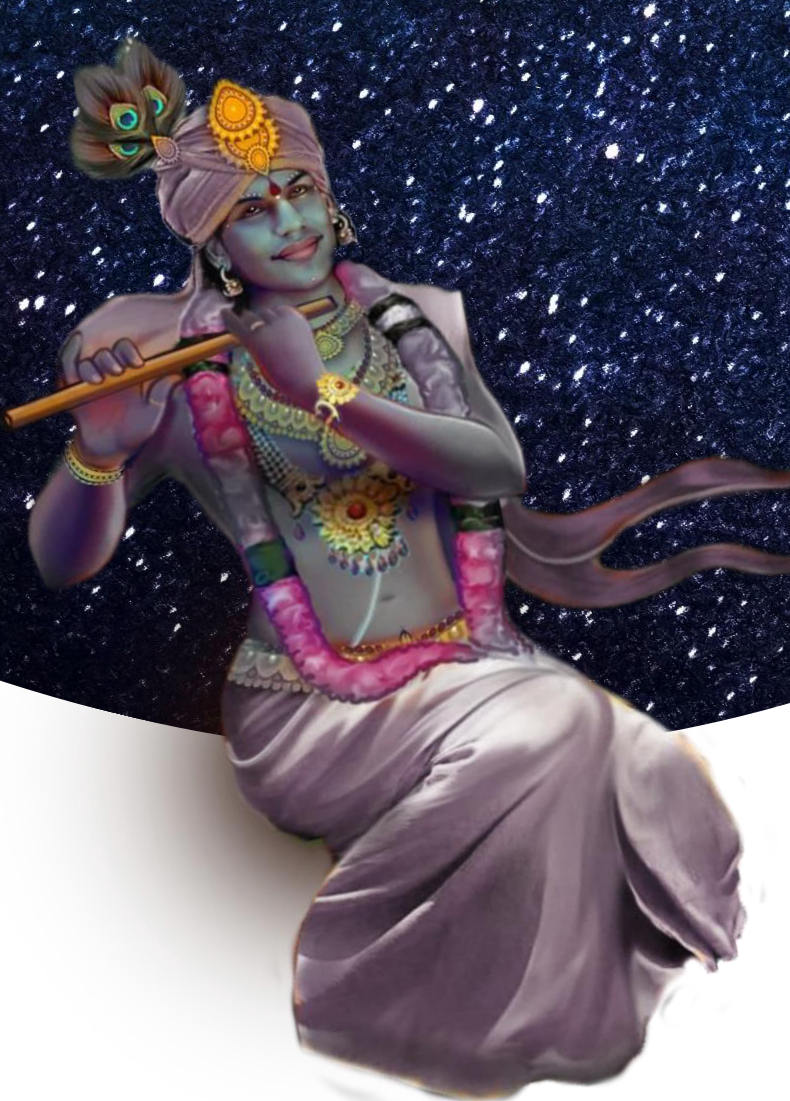
Kṛṣṇa says that there are two kinds of puruṣa: one is eternal, akṣara and one perishes, kṣara. The puruṣa that perishes is the body-mind energy embedded in all beings, including humans. This energy has a definite, limited lifetime. It is always changing. There is nothing permanent about it. It is programmed for deterioration and destruction. The puruṣa that is kūṭastha is the imperishable aspect of this energy. It is the energy of the spirit that is indestructible, akṣara. It is the Soul that is forever, that which cannot be destroyed. Kṛṣṇa points out that primal energy manifests in different ways, as perishable and imperishable. Both are aspects of primal energy. One is destroyed and the other lives. One who realizes this difference and understands the true nature of puruṣa is liberated.
Rāmakṛṣṇa Paramahamsa beautifully narrates:
An arrogant scholar was very proud of his learning. He was a great Advaitic (non-dualitistic) scholar and did not believe in the various forms of God. Then, God came to him one day. The mother goddess appeared before him in all Her splendor. She came as the primal energy, Parāśakti. The scholar was in a swoon for a long time. When he woke up, he shouted, ‘Ka, Ka, Ka.’ He could not fully pronounce ‘Kālī,’ the name of the goddess whom he had seen. Words cannot describe the Divine! Scholars argue endlessly about the nature of puruṣa, the various aspects of puruṣa, the difference between prakṛti and puruṣa. It strengthens their ego. When the Divine presents itself before them, they cannot recognize or cognize what they see.
© 2020 Sri Nithyananda Paramashivam. All Rights Reserved
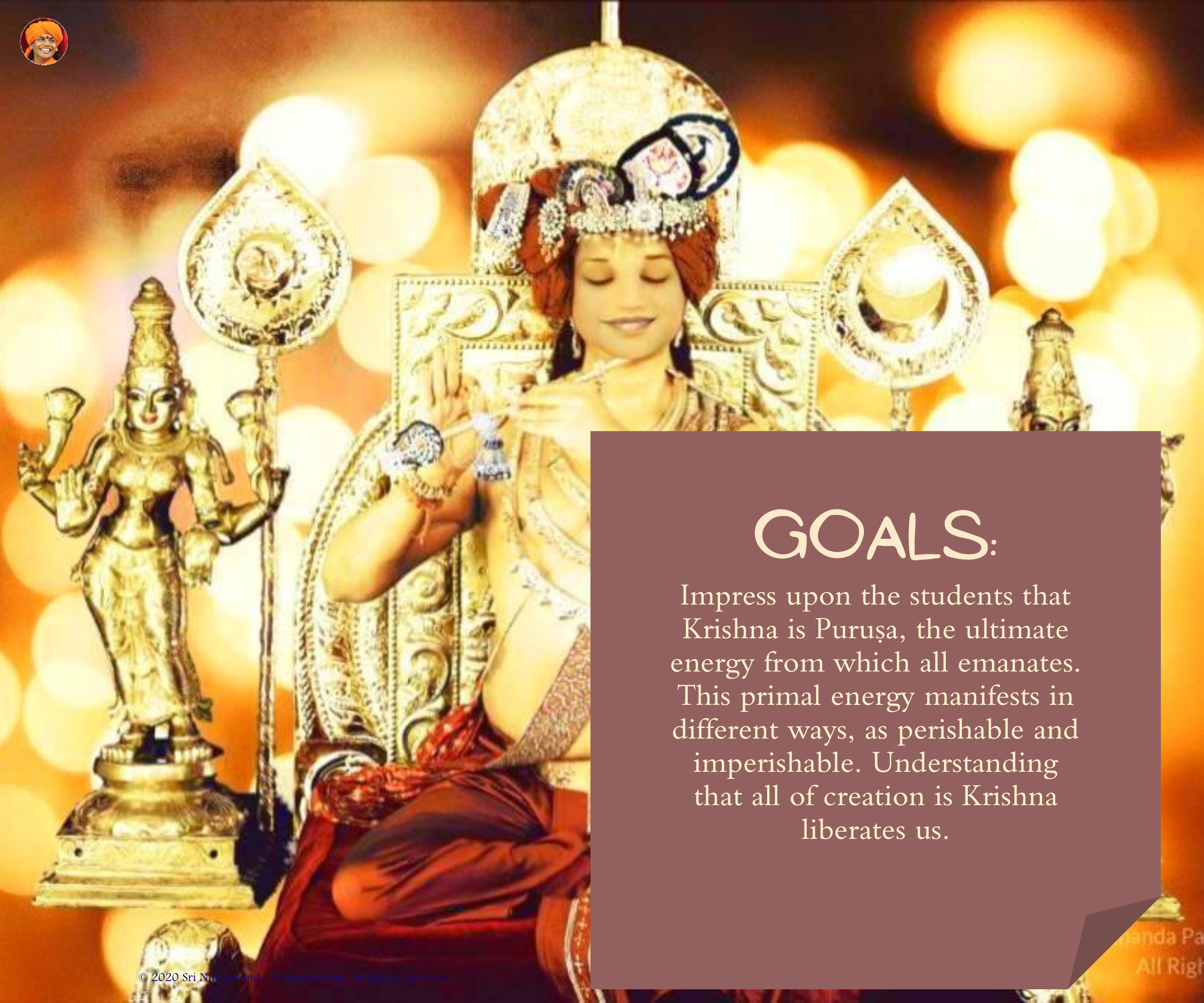
GOALS:
Impress upon the students that
Krishna is Puruṣa, the ultimate
energy from which all emanates.
This primal energy manifests in
different ways, as perishable and
imperishable. Understanding
that all of creation is Krishna
liberates us.
ASSESSMENTS

- What is the difference between instinct, intellect and intuition?
- The greatest joy lies within, not outside. True or False?
- Explain the attributes of primal energy, according to Krishna?
- What is the Sāṅkhya philosophy on purusha?
- What are the two aspects of primal energy?
ART OF THE DAY
© 2020 Sri Nithyananda Paramashivam. All Rights Reserved
ART OF THE DAY:
THE LAMP OF KNOWLADGE
MATERIALS NEEDED:
Clay deeyas Acrylic paint Paint brush
PROCEDURE:
We must light the lamp of knowledge in our hearts and come to the self realization that we are one with the Divine, and that Kṛṣṇa is seated in our hearts.
INFERENCE:
We must light the lamp of knowledge in our hearts and come to the self realization that we are one with the Divine, and that Kṛṣṇa is seated in our hearts.
ACTIVITY OF THE
DAY
© 2020 Sri Nithyananda Paramashivam. All Rights Reserved
ACTIVITY OF THE DAY:
NITHYANANDA - ETERNAL BLISS

Materials needed
- Notebook
- Pen
Procedure
- Think back into your life and remember incidents when your expectations were not fulfilled, and it leads you to sorrow.
- Share your experience with the Group. The group moderator will help the group contemplate on the distinct pattern that can be seen in all incidents and experiences.
- We will observe that in the outside world, every experience of joy is followed by sorrow. Joy creates expectations and when expectations are not fulfilled, they lead to sorrow.

INFERENCE:
The greatest wealth lies within, not outside. The greatest joy lies within, not outside. When the search begins inside, expectations drop, attachments drop and a new joy of completion happens. That joy is eternal, never ending. It is Nityānanda, eternal bliss.
WORKSHOP OF THE DAY
© 2020 Sri Nithyananda Paramashivam. All Rights Reserved
[Figure: A portrait of a serene face with traditional markings]
WORKSHOP OF THE DAY:
VAAKYARTHA SADHAS-
SCIENCE AND SPIRITUALITY
PROCEDURE:
1. Albert Einstein, famously said “The last step in science is the first step in spirituality”. Do you agree and why?

CONCLUSION:
Modern science is based on logic. Scholars argue endlessly about the nature of energy, the various aspects of energy, the difference between matter and energy. It strengthens their ego. However, the ego becomes an obstacle in their path to realize the ultimate truth that God is the ultimate energy from which all emanates.
© 2020 Sri Nithyananda Paramashivam. All Rights Reserved