THE SCIENCE OF COMPLETION
This text was machine-transcribed from the printed book and may contain errors. Select the words and choose “Report a mistake”.
The science of completing with these roots thought patterns is the owner's manual for life. This is the basic life science!
Kṛṣṇa calls it Guṇatraya Vibhāga Yoga. Mūla vāsanas are living bio-memories and muscle-memories, not dead memories. Another important point is that because these memories are living energies, they can be used for creating powerlessness, the space of incompletion or powerfulness, the space of completion.
Understand, how the science of completion and incompletion work, how powerfulness and powerlessness work, how the space of satsaṅga and nissaṅga work. When you associate yourself with powerfulness, you are in satsaṅga. When you associate yourself with powerlessness, the wrong association, you are in nissaṅga.
If we entertain
powerfulness, if we
complete, the same way
completion will raise us so
quickly! Once the
cognitive shift takes place,
we receive data, process it
and go inside instead of
outside.
We respond from the
complete cognition we
carry inside and create
more and more
completion outside also.
As long as we operate from
incomplete cognition, we react
externally and we work towards
depression, powerlessness.
However, once we go in and
complete with our root patterns,
and associate ourselves with
powerfulness, we move into bliss.
Cognition is the process of
receiving information through our
five senses, processing that
information internally, relating
with it based on our root patterns,
and responding to life based on
our patterns. There are five
jñānendriya and five karmendriya
(senses of action) that are the
means of communication between
the external world and us.


Jñānendriya are the senses of perception, the five senses of smell, taste, sight, touch and hearing. The karmendriya are five actions of elimination, procreation, locomotion, grasping and speaking. Each sense is related to one of the energy centers (cakras) in our body-mind system.
Let us say in a scene of a discourse happening. You see Swamiji talking to you. First your eye captures this whole scene like a picture and this picture goes to the cakṣu (the energy behind the eyes).



Understand, we don't see with the eye, we see through the eye. There is an energy that is inside or behind the eye that actually sees. There is an energy inside or behind the ears that hears. The ears by themselves cannot hear. That is why when we are engrossed in a book, we may not hear the alarm or doorbell ring. So, there is an energy inside the eyes that sees. We call this energy cakṣu
The whole scene is converted into a file like in a digital signal processor in a computer so that our mind can process the data. The cakṣu is almost like the digital signal processor or DSP in electronics. In a computer, whether it is an audio or visual file, it must be converted into a digital file. In the same way in our inner space whatever we see or hear is converted into a bio-signal file like a digital file. Then the file starts moving up, step-by-step.

The file goes to citta, the place where past bio-memories are collected. Citta means mind, inner space. This area is where the work of excluding happens as — ‘Na iti, Na iti’ — this is not, this is not. Upon seeing this file, our citta starts eliminating whatever the object is not. Take the example of this scene: First you see me, the whole scene is photographed. It goes to cakṣu and becomes a bio- signal file. The file is then taken to citta, bio-memory. Citta says, ‘This is not a tree. This is not an animal. This is not a plant. This is not this. This is not that.’
Next, the file goes to manas, another part of the mind. The manas tries to positively identify, ‘This is a human being. He is wearing a saffron robe. He is standing on a stage.’ The identification process, ‘iti, iti’ (this is it, this is it) identification process happens in manas.
Once this positive identification happens, the file goes to a third part of the mind called buddhi or intelligence. buddhi is where the trouble starts. Here the analysis starts, ‘How am I related to this file? How am I connected to this scene? How is it relevant to me? How should I respond to this scene?’

If past bio-memories about me have been good or pleasant according to your intelligence, you cognize and respond in a positive way. You immediately refer to those past memories and review, ‘It was so good at yesterday’s discourse.’ Your intelligence refers to the past bio-memory and muscle-memory and makes a decision based upon your cognition of these experiences. If your cognition about the past experiences with me has been positive, your intelligence tells you to stay and listen. If your cognition of the past experiences has been inadequate, unpleasant and you felt bored, your intelligence tells you that this is not the place for you and that you should leave.
These are logical decisions based on conscious memories retained by your mind. Up to this point, your cognition, the transmission of what is perceived by the senses and what is the response based on that pattern is relatively straightforward. It is a conscious process.

From the conscious mind, the information is passed to the unconscious space of the mind, the ego.
This unconscious space of the mind as the ego, not because it is arrogant, but because it provides you the identity of who you are. Your identity stems from your unconscious incompletions which are your root patterns. You project who you wish to be, never who you are. You do not even know who you are. Who you are is deeply buried in your unconscious. All the major decisions that shape your life are consigned to

This unconscious space. This is
the repository of all those
emotionally-filled memories, the
root thought patterns and beliefs
about yourself; which constitute
what you believe as you, what
you project as you, what others
expect you to be, and what you
expect others or life to be for you
and therefore, create your
identity.
Identify your root pattern! Root
pattern means the first time in
your life when your cognitions
were imbalanced, disturbed by
some external force; and your
terrorized being started defining
yourself with a disempowering
word and started defining the
world in that disempowering
powerless state; and to
compensate from this death, the
disempowering inner identity —
the inner image, you create a
pseudo alternative compensating
cognition — the outer image.

Completion takes away the agitated
confusion and the alternative
compensating image we create in our
life. Because we have a very
disempowering cognition about
ourselves, we go on creating an
alternative compensating cognition to
compensate with our inadequate
cognition. To compensate the
inadequate cognition which got
created unconsciously inside you,
which is your inner image,
mamakāra, you create an alternative
compensating cognition which is
your outer image, ahaṁkāra. Till the
end you never feel satisfied, because
you feel the guilt you showed, which
is not true, without realizing your
true identity is much more than what
you can imagine and show.



The conscious mind does not make
important decisions. It makes a few
decisions that can be reached by its
limited intellect. Anything important
moves to the unconscious ego or root
patterns. Our unconscious handles all
life-threatening situations with the
disempowering cognitions, the so-
called fight-or-flight decisions.
The effects of your root pattern are
your conflicting patterns Conflicting
patterns are the branches which sprout
from the root pattern. When the file
reaches the ego, the ego comes to a
conclusion based on all the 'yes'
responses and all the 'no' responses
based out of your conflicting patterns.
Yes or no is not a problem; however,
we have wasted so much time and
energy on this small decision. Not only
that, any decision you take out of
powerlessness, restlessness, will lead
you to more and more powerless space.
Powerless moments in life create more
and more powerless moments in life.
All restlessness is powerlessness.
The first truth you need to know about completion—do completion just to be in the space of completion. All other reasons lead to more and more incompletions. Completion done in the space of completion transforms your personality, transforms your being; the intense, constant agitated violence you carry towards you and others due to rajas patterns. Continuously completing for the sake of completion leads you to the experience of Enlightenment.
When you try to push your incompletions into your unconscious mind, unfortunately, it reaches deeper and goes closer to your consciousness. Anything closer to consciousness becomes powerful. That is why a small incompletion that happened in your life when you are young or a small incompletion which you are suppressing without completing it, it explodes in you as a dangerous imbalance of your rājasic guṇa patterns.

Many times, your imbalance is such that you do not care about your destruction. You go on waiting in anger and expecting the other person's destruction. Once we do completion with the rajas patterns, we can make one thousand decisions without any stress, violence or suffering.
That is why Kṛṣṇa says that when we don't expect the result, when we don't think of karma phala (result of the work done). we can do the work intensely. When we don't expect or worry about the result, we work beautifully because there are fewer patterns. We will not suffer or be tortured by root thought patterns. We will be in the space of completion, which will lead to more and more completion.
If there are more vāsanas or patterns, the file does not reach the ego easily or even fully. A powerful pattern may make the decision on the way.
This unconscious space is filled with negative bio-memories, and powerlessness, restlessness. All our past bio-memory or root thought patterns are stored in your inner space as files without any logical connection between them. When the file takes a quantum leap to this space, it does not reach the ego properly for a decision. Like that, when your unconscious is loaded with past root thought patterns and memories, it becomes inadequate, inefficient, and incomplete and makes superficial, illogical decisions..

When there are no patterns,
there will be no need for the file
to drop into the unconscious
inner space for a decision. It
straightaway meets the buddhi
and ego after the mind.
In satva, our mind works
continuously and we make
decisions, yet we do not
become tired. We can be active
for twenty-four hours and yet
remain peaceful. This is what is
call action in inaction and
inaction in action. Kṛṣṇa says we
will be centered when we are in
satva. If we are caught in tamas,
we need to move towards rajas.
If we are caught in rajas, make
the move towards satva. If we
are caught in satva, it will
automatically lead us to
enlightenment.
Work does not need to make you tired. It is the wrong idea taught to you by the society. The only two enemies human beings have are boredom and tiredness. When you entertain them, you build wrong patterns.
Be integrated to your Soul. The Soul can never have tiredness, consciousness can never have tiredness. That is the truth. Whether you realize or not, you are Soul and Consciousness.
GOALS:
Impress upon the
students that it is
essential to identify our
root patterns and
complete with them. It
is equally essential to
make a conscious effort
to move from tamas and
rajas towards satva, by
giving up powerlessness
and creating a powerful
inner space.
ASSESSMENTS
- Differentiate between Satvik, Rajasic, and Tamasic root patterns?
- Why is Powerlessness more dangerous than Alcohol or Poison?
- What is Cognition?
- Name the five karmendriya (sense of actions) ?
- Name the five Jñānendriya (senses of perception)?

ART OF THE DAY

ART OF THE DAY:
RANGOLI
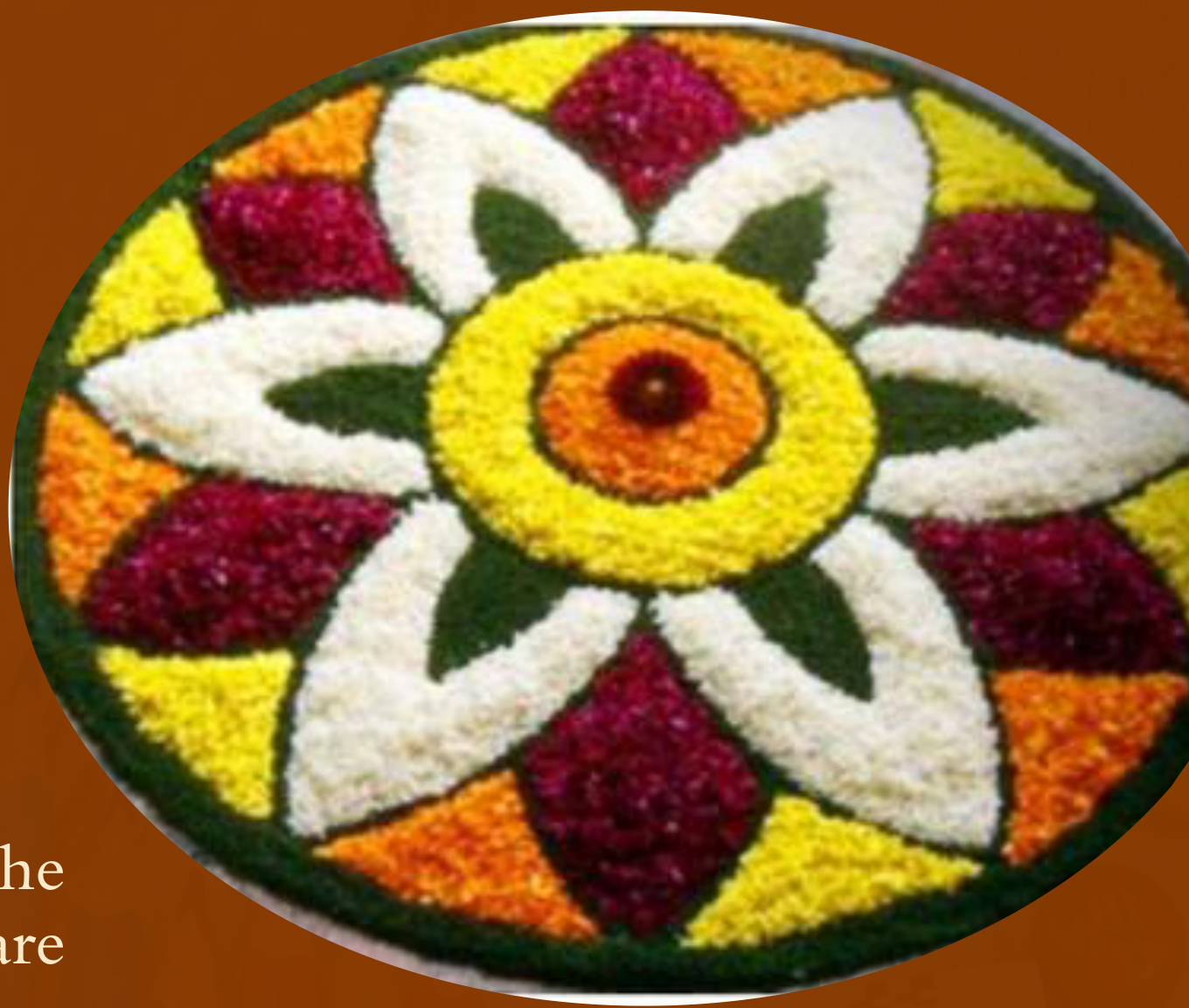
MATERIALS NEEDED:
- Colored rice
- Colored sand
- Quartz powder
- Flower petal
PROCEDURE
Rangoli is an art form, originating in the Indian subcontinent, in which patterns are created on the floor or the ground using materials such as coloured rice, coloured sand, quartz powder or flower petals. Rangoli is considered auspicious and forms an integral part of festival decor.
INFERENCE If we make satva inducing devotional activities our lifestyle, our pastimes and hobbies, it will automatically lead us to enlightenment.

ACTIVITY OF THE DAY
ACTIVITY OF THE DAY:
USE YOUR SENSE ORGAN
MATERIALS NEEDED:
• Chart paper
• Color pens
• Pencil colors.

PROCEDURE: Divide the class into five groups. Each group is asked to choose any one sense organ. For example, eyes, ears etc.
Each group will draw a flowchart or diagram on a chart paper to show our decision making process, graphically explaining how the chosen Jñānendriya (sense of perception) receives a certain input from the external world, (for example, seeing a person, hearing a song, deciding whether or not to smoke etc) and transmits that input to the part of the mind called chitta (inner space of stored bio-memories where elimination process happens), then to the manas (inner space of stored bio-memories where identification process happens), then to the Buddhi (inner space of stored bio- memories where analysis by reference to old experiences happens), to the unconscious mind (repository of negative bio-memories); and finally to our Ego (unconscious mind where our identity stems from root patterns), in order to form our decisions.

INFERENCE
Cognition is the process of receiving information through our five senses, processing that information internally, relating with it based on our root patterns, and responding to life based on our patterns. Upon understanding the way our mind works, we will now cognize how we make decisions, opinions, likes and dislikes based upon our flawed root thought patterns, and consequently suffer.

WORKSHOP OF THE DAY

WORKSHOP OF THE DAY:
VAAKYARTHA SADHAS
PROCEDURE The topic of discussion is "All restlessness is powerlessness"
CONCLUSION Our unconscious space is filled with negative bio-memories, and powerlessness, restlessness. When your unconscious is loaded with past root thought patterns and memories, it becomes inadequate, inefficient, and incomplete and makes superficial, illogical decisions.
When there are no patterns, there will be no need for the file to drop into the unconscious inner space for a decision. It straightaway meets the buddhi and ego after the mind.