Work For
This text was machine-transcribed from the printed book and may contain errors. Select the words and choose “Report a mistake”.
God
Authored by
THE SPH NITHYANANDA PARAMASHIVAM
अथैतदप्यशक्तोऽसि कर्तुं मद्योगमाश्रितः ।
सर्वकर्मफलत्यागं ततः कुरु यतात्मवान्
॥ १२-११ ॥
athaitad apy aśakto'si kartum
madyogamāśritaḥ । sarva-
karma-phalatyāgaṁ tataḥ kuru
yatātmavān
If you are not able to work
even this way, surrendering
unto Me, give up all the results
of your actions to Me without
ego.
POWERFUL COGNITION
You must fix your mind upon Me alone.
If you are not able to work even this way, surrendering unto Me, give up all the results of your actions to Me without ego.
Kṛṣṇa gives various possibilities to Arjuna, one after another. His compassion for Arjuna's spiritual evolution knows no limits. He never gives up on Arjuna. 'If you cannot do this, do that. And if you cannot do that, at least do this,' Kṛṣṇa continues. In the last four verses, He continuously gives options to Arjuna. Kṛṣṇa says, 'Fix your mind upon Me alone.
Live in Me.' Then He felt that He had to give Arjuna an option, in case Arjuna could not succeed. 'If you cannot fix your mind upon Me, steadily practice and practice again,' He advised. He relented further, 'If you cannot do this repetitive practice, if this is too much for you, then work on My mission. Whatever you do, do it for Me.' Kṛṣṇa now says, 'If you are unable to do even this, which is work for My sake, then just abandon your ego and turn over the results of your actions to Me, sarva-karma-phala tyāgaṁ tataḥ kuru yatātmavān (12.11).'
Kṛṣṇa relents from His standpoint that Arjuna should work only on those activities that are Kṛṣṇa's. He feels that there may be conditions that may prevent Arjuna from devoting all his time only to those activities that are Kṛṣṇa's. See how relevant Kṛṣṇa's advice is, even by today's standards. None of us can hope to sit idle and be taken care of. We must do something to occupy ourselves. In our day-to-day reality of life, not all may be able to work on God's mission alone, all the time.
We may be able to spend only some time on activities that are selfless activities that benefit humanity overall, and activities that are spiritual.
we need to spend a lot of time on
activities that are of material benefit
to us and to others related to us.
Nothing is lost, assures
Kṛṣṇa, and He provides the bridge
between material pursuits and
spiritual pursuits. Kṛṣṇa brings in the
core concept of the Gītā, that of
‘renunciation’.
He says, ‘Do what you must do with
an attitude of surrender to Me and
sacrifice the results of your actions to
Me, with complete control over
yourself, your ego.’ We feel
responsible for the results of our
actions. Whether we succeed or fail in
what we do, either proud and happy,
or guilty and sad, our ego makes us
feel responsible.
We identify ourselves with what
we do and the results of what
we do. Kṛṣṇa says, 'If you cannot
do whatever else I have told you
to do, do this. Drop your ego.
Drop the fruits of your actions
and renounce them to Me.' The
freedom that results from what
Kṛṣṇa advises is true liberation.
Once we realize that we no
longer are the masters of our
destiny, decision makers of the
results of our actions, we feel a
weight lifting off our shoulders.
It is He who is now responsible
for the results of our action. We
still are the 'doers', but no
longer the 'owners.' One may
wonder, how can I succeed in
this rat race? Remember that
even if you are the winner in
this rat race, you are still
only a rat!
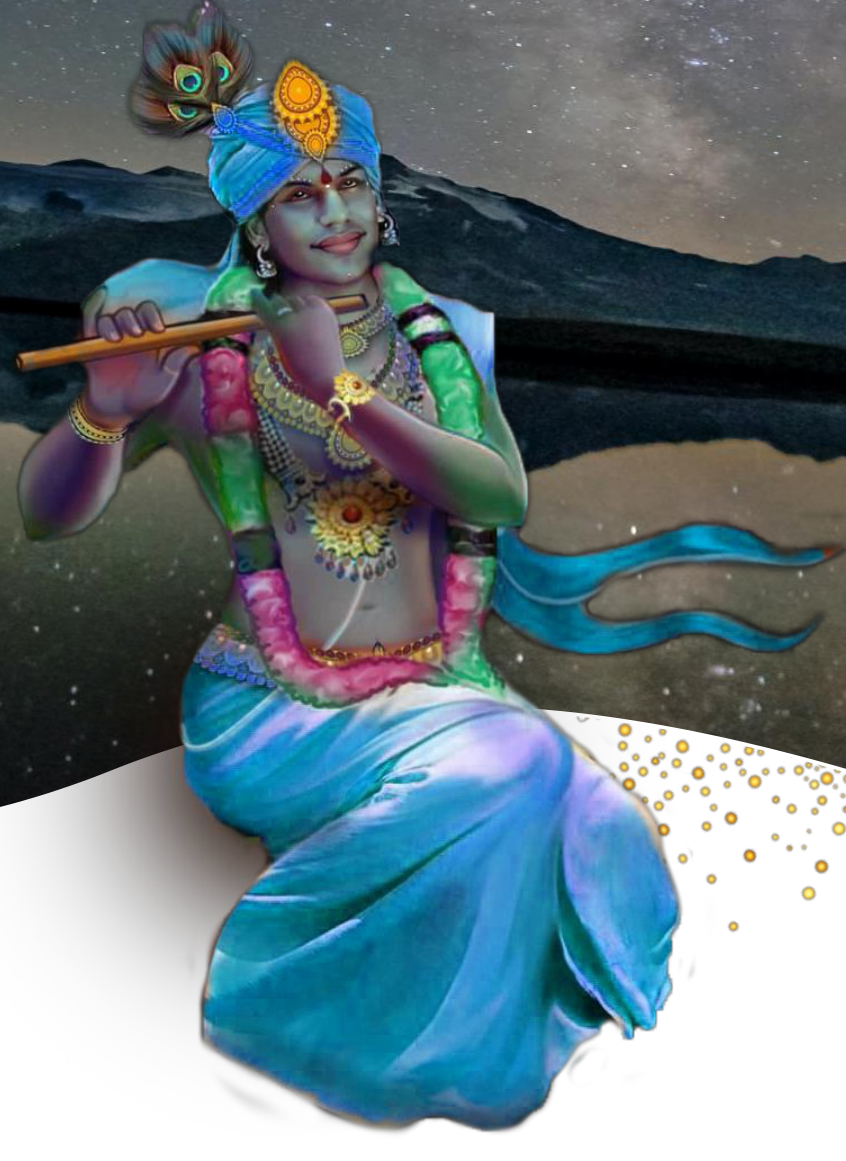
It is an illusion of our minds that we decide the results of our actions. It is pure fantasy to believe that we decide the result of our actions. We cannot even guarantee that we will survive our next breath. Our life is not in our hands. What arrogance, therefore, to imagine that activities in the outer world are subject to our control! There is a power higher than us that decides the results of our actions. Once we realize this and start believing in the wisdom of that higher power, strange and mystical things happen to us.
We just need to let the Universe, Kṛṣṇa, the Divine, decide what is best for the rest of humanity and us.

Let us surrender the results of
all that we do to this sacred
power. Whatever then happens
to us is for the good, for our
good and the good of everyone
in this Universe. We are
surrendering to the cosmic
power that surrounds us.
Without Its grace we cannot live
or take our next breath. Say,
‘Do what you think is best for
me’ with deep completion and
see what happens. Not merely
does the end goal materialize,
but an immense spiritual relief
will overtake you. ‘Renounce
unto Me,’ says Kṛṣṇa, ‘surrender
yourself to Me, and I shall
liberate you.’

GOALS:
Impress upon the
students that we can
bridge the gap between
our material pursuits and
our spiritual pursuits by
adopting an attitude of
renunciation and
surrender of the results of
all our actions to God.
ASSESSMENTS
❖ Is it possible to devote
all of one's time on
spiritual activities?
❖ Is it possible to give up
material pursuits
altogether?
❖ How will we sustain
ourselves if we do not
engage in worldly
activities?
❖ How can we engage in
worldly activities with
surrender to Krishna?
❖ What does it mean to be
detached from the
results of our actions?

ART OF THE DAY
ART OF THE DAY:
SPIRITUAL VS WORLDLY
MATERIALS REQUIRED
Mobile phone with camera
PROCEDURE
Discuss with the children the difference between spiritual activities and worldly activities. Get the children to act these activities. Click two photographs depicting contrasting themes: first picture to capture them doing a spiritual activity and second picture captures them doing a worldly activity. Share the images with the group.
INFERENCE
We must engage in spiritual activities as much as possible, as such actions raise the level of our consciousness and that of all others around us.
ACTIVITY OF THE DAY
ACTIVITY OF THE DAY:
PROCEDURE:
Let us discuss the following scenario to understand how we can apply Krishna's teaching about surrendering the results of our action in real life.
Let us imagine a hypothetical situation.
An important exam is coming up for
your friend Rugwed. This will require
Rugwed to study a big book for several
hours each day for the next one month.
Which of the following three approaches
do you recommend for your friend:
Approach 1: Every now and then Rugwed looks at the large number of unread pages in his book and counts the few days left to go for his Exam. He feels so overwhelmed that Rugwed finds it difficult to focus on what he is reading.
ACTIVITY OF THE DAY:
PROCEDURE:
Approach 2: Rugwed sets daily milestones to cover the syllabus in the available time and focus only on meeting his daily targets. He says to God “Let the result be what you think is best for me”.
Approach 3: Rugwed often visualizes what will happen if he fails the exam. He thinks of all the direct and indirect consequences of not passing the exam. In order to motivate himself, Rugwed tries to imagine the appreciation he will receive if he gets good grades and the humiliation he will have to face if he fails. Fear and greed push Rugwed to keep reading.
INFERENCE:
The freedom and immense relief that
results from surrendering the results of
one's action to God, is liberation.
WORKSHOP OF THE DAY

WORKSHOP OF THE DAY:
VAAKYARTHA SADHAS
Topic of discussion:
“Who decides the results of our
actions?”
Conclusion:
Kṛṣṇa provides the bridge between
material pursuits and spiritual
pursuits. Kṛṣṇa brings in the core
concept of the Gītā, that of
‘renunciation’.
- BHAGAVAD GITA -
BOOK XII, VOLUME IX