Who Is Perfect ?
This text was machine-transcribed from the printed book and may contain errors. Select the words and choose “Report a mistake”.
Authored by
THE SPH NITHYANANDA PARAMASHIVAM

अर्जुन उवाच ।
एवं सततयुक्ता ये भक्तास्त्वां पर्युपासते ।
ये चाप्यक्षरमव्यक्तं तेषां के योगवित्तमाः
॥ १२=१ ॥
arjuna uvāca
evaṁ satata-yuktā ye bhaktāstvāṁ
paryupāsate I ye cā’py akṣaraṁ
avyaktaṁ teṣāṁ ke yoga-vittamāḥ
Arjuna asked: Who are considered
perfect, those who are always
engaged sincerely in Your worship in
form, or those who worship the
imperishable, the unmanifest
formless You?
POWERFUL COGNITION
Through devotion and gratitude, a person has divine experiences and enjoys bliss, which in turn leads to feelings of great love and gratitude towards the whole world and every living being.
INTRODUCTION

Arjuna asks, ‘Which of these two types of people are considered to be better: those who are always engaged in your bhakti, devotional love towards you or those who merge in the Brahman, the unmanifest, formless, Cosmic consciousness?’ Please be clear, Arjuna is not asking for himself. From here, the discourse becomes a simple discussion. It is more like trying to record the truth for future generations. The questions from here onward are neither doubts nor enquiries. Arjuna tries to put the whole thing down in the expression form, so that it will be a useful reference for future generations. A flow of Arjuna’s love for humanity, an expression of his divine experience, prompts him to seek answers to these vexing questions and record the answers from the godhead Himself. Arjuna asks, ‘Who will be established in You totally? Will it be a devotee or a person who is enlightened?’ Religious people or so-called religious people, confuse others with this verse about Arjuna’s question as to whether worshipping the form or worshipping the formless is right. These people are so confused that they do not know right from wrong. They use their intellectual arrogance and misunderstanding to confuse others. Let me tell you, this is not what Arjuna meant by asking this question. If we look at Kṛṣṇa’s answers, we will understand. Experience Or Expression? Completion Or Enriching?
Arjuna asks, ‘Is it good to be established in the experience of the Divine consciousness, just to stay in it and enjoy the eternal bliss that flows from that experience? Or is it better to express that love and gratitude created by the conscious experience towards the whole world and every living being? Which is correct? Which one is preferred?’
EXPERIENCE OF GOD
See, when we have a spiritual experience, some people stay in that experience with closed eyes, that's all. Only with eyes closed can they see God. They do not seek to use their senses, since the bliss within is so great and beautiful that absolutely no sensory input remotely matches that bliss. However, there are others who are impelled to open their eyes, by the Universe to communicate that blissful experience through their expression to enrich others. The so-called scholars enter into endless debates on savikalpa samādhi and nirvikalpa samādhi.
SAMADHi STATE
Savikalpa samādhi is the
state where the experience
of samādhi continues.
Nirvikalpa samādhi is when
the expression of samādhi
starts. Savikalpa samādhi is
supposed to be a lower
state, and one is supposed
to work towards the second
and higher state of
nirvikalpa samādhi.
But it is not an ironclad
rule.
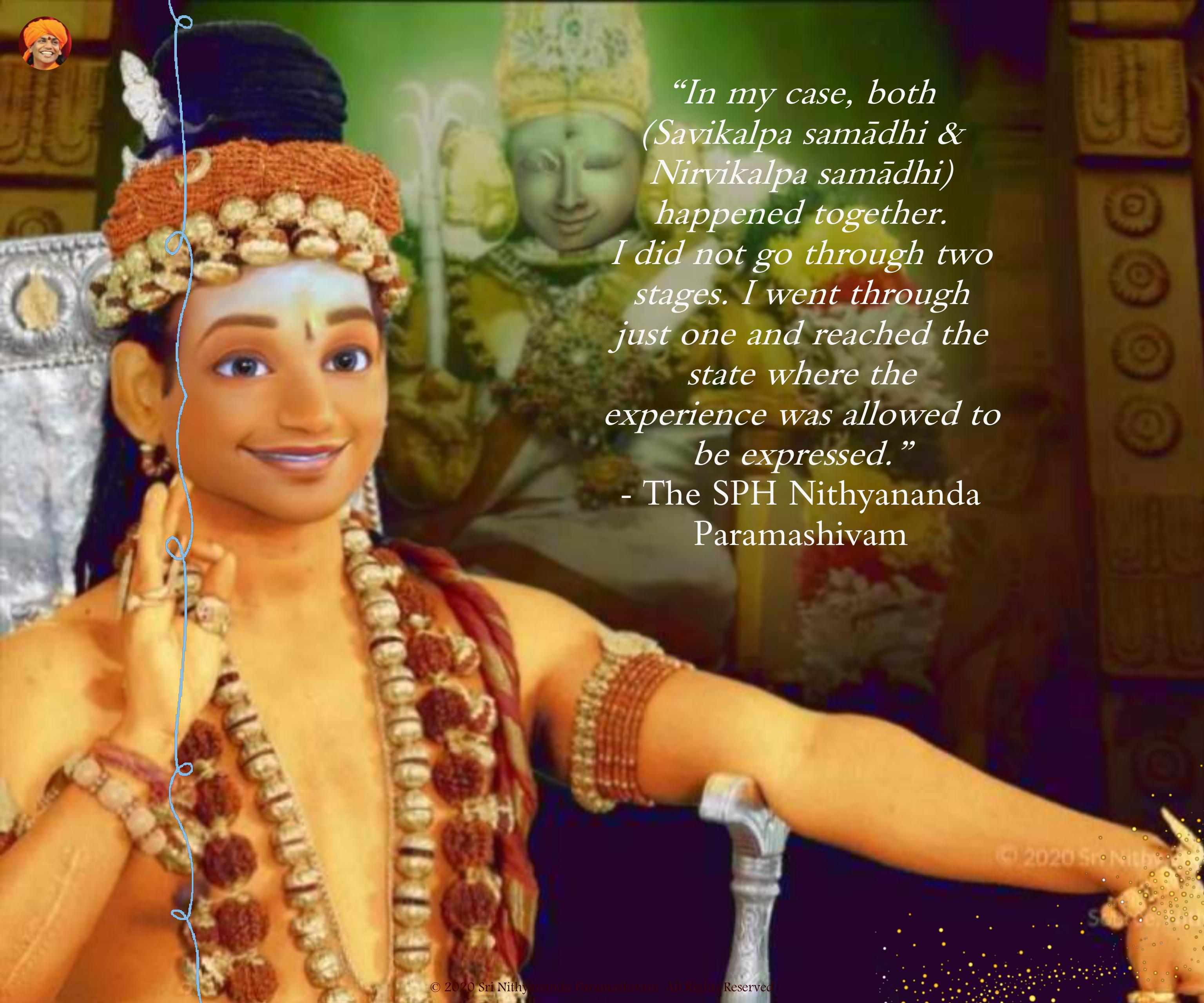
“In my case, both
(Savikalpa samādhi &
Nirvikalpa samādhi)
happened together.
I did not go through two
stages. I went through
just one and reached the
state where the
experience was allowed to
be expressed.”
- The SPH Nithyananda Paramashivam
It was the will of the Divine, Parāśakti. Please understand that this is not a choice that people make. An option is not presented to those who have such experiences. Those who experience the Divine transcend that point of freewill. They are driven wholly, in each step that they take, by Parāśakti, the Universal energy; by Kṛṣṇa, the Superconscious Divine.
Arjuna understands that he and others who have had an experience of the Divine, face the choicelessness. He knows that Kṛṣṇa decides what he should do. Yet, he asks because he wants everyone to understand. Arjuna asks, ‘What type of a person is greater? Is it a person who closes his eyes and sees God within himself or a person who opens his eyes and sees God in every being? Who is greater?’
He is not asking whether
worshiping the form or
worshiping the formless is
greater. Yet so-called religious
people have interpreted it that
way, and created problems
between the teachings of the
great masters, Ādī Śaṅkarācārya
and Rāmānuja. Śaṅkara followed
jñāna, the path of knowledge,
and Rāmānuja followed bhakti,
the path of devotion. Jñāna,
focuses on the formless through
intellectual queries. Bhakti
focuses on the form, sheer
devotion, as if the Divine were
alive as It indeed is! However,
those who have studied Śaṅkara
and Rāmānuja in depth know
that there was much devotion in
Śaṅkara's approach and much
knowledge in Rāmānuja's
approach!
Both approaches converge. One
without the other never works.
Expressing the gratitude that
happens because of the
experience is devotion. Having
that experience and rejoicing,
staying in that experience is
knowledge; that's all.
Kṛṣṇa's answer is that both paths
are the same.
The paths are intertwined.
The first one leads to the second
one and the second one leads
back to the first one. We have
heard the term vicious circle.
First one leads to the second and
the second one leads back to the
first one.
Vicious circle leads to low energy or lower level of consciousness. Virtuous circle leads to high energy, a higher level of consciousness! Bliss leading to devotion and gratitude, devotion and gratitude leading to bliss: these two form the virtuous circle that lead us to higher consciousness. Bliss means the experience of completion that leads us to the expression of gratitude and enriching. Again, the expression, the gratitude of enriching, leads us to bliss, and bliss leads us to deeper completion. One leads to the other and therefore it is a virtuous circle.

Usually we are caught in the
vicious circle. Fear leads to
greed and greed leads to fear.
More fear leads to more greed,
and more greed leads to more
fear. This is the vicious circle.
Here Kṛṣṇa introduces the
virtuous circle. Virtuous circle
is what He calls dharma,
righteousness, that which must
be followed in the path of
truth. Dharma means virtuous
circle, that which leads us to
live and express higher and
higher levels of Consciousness.
That in turn leads us to higher
and higher levels of blissful
experience. Consciousness and
bliss lead to expression of that
consciousness and bliss, which
in turn lead to higher level
experiences.
GOALS:
Impress upon the
students that it is
liberating to encourage
feelings of devotion
and gratitude towards
god for our lives and
to be in completion.
ASSESSMENTS
❖ What is Savikalpa samādhi ?
❖ What is Nirvikalpa samādhi?
❖ What is best: to close one's
eyes and see God within or to
open one's eyes and see God
in every being?

❖ What is the difference
between the jñāna, the path
of knowledge and bhakti, the
path of devotion as a means
to seek the ultimate truth?
❖ What is the vicious cycle and
how does it differ from the
virtuous cycle?
ART OF THE DAY

ART OF THE DAY:
FEEL OF BLISS
MATERIALS NEEDED
- paper,
- pencil and watercolors,
- brush, water.
PROCEDURE
Draw a painting that according to you could best depicting the feeling of "Bliss"
INFERENCE
Bliss means the experience of completion that leads us to the expression of gratitude and enriching.
ACTIVITY OF THE DAY
ACTIVITY OF THE DAY:
PROCEDURE:
Create a flow chart to depict a
Virtuous Circle i.e. draw a
continuing sequence of stages of
enlightenment: bliss, completion,
gratitude and enriching, in a circular
non-directional flow. Each stage
should have the same level of
importance. Now write a few
sentences in your notebook,
describing your very own personal
experience of bliss, completion,
gratitude and enriching.
INFERENCE:
Bliss can lead to completion, which
leads to devotion and gratitude, or
devotion and gratitude can lead to
completion and bliss.

WORKSHOP OF THE DAY
WORKSHOP OF THE DAY:
VAAKYARTHA SADHAS
Topic of discussion: “Is it good to be established in the experience of the Divine consciousness, just to stay in it and enjoy divine bliss within oneself; or is it better to express that love and gratitude created by the conscious experience towards the whole world and every living being by encouraging others to seek the divine within?”
Conclusion: Arjuna understands that he and others who have had an experience of the Divine, face the choicelessness. He knows that Kṛṣṇa decides what he should do.
- BHAGAVAD GITA -
BOOK XII, VOLUME II