WHAT HAPPENED DURING THE MAHABHARATA?
This text was machine-transcribed from the printed book and may contain errors. Select the words and choose “Report a mistake”.
Since Dhṛtarāṣṭra was blind, Pāṇḍu was made the king of Hastināpura. Pāṇḍu was cursed by a sage that he would die if he ever entered into a physical relationship with his wives.
He therefore had no children. Vyāsa says that all the five Pāṇḍava children were born to their mothers Kuntī and Mādri through the blessing of divine beings. Pāṇḍu handed over the kingdom and his children to his blind brother.

© 2020 Sri Nithyananda Paramashivam. All Rights Reserved.
WHAT HAPPENED DURING THE MAHABHARATA?
Kuntī, who is the embodiment of tapas,
spiritual penance, had received a boon
when she was still a young unmarried
adolescent, that she could summon any
divine power at will to father a child.
Before she married, she tested her boon.
The Sun god, Sūrya appeared before her.
Karṇa was born to her as a result. In fear of social reprisals, she cast the newborn away in a river. Yudhiṣṭra, Bhīma and Arjuna were born to Kuntī after her marriage by invocation of her powers, and the twins Nakula and Sahadeva were born to Mādri, the second wife of Pāṇḍu.
© 2020 Sri Nithyananda Paramashivam. All Rights Reserved.
WHAT HAPPENED DURING THE MAHABHARATA?
Yudhiṣṭra was born to Kuntī as a result of her being blessed by Yama, the god of death, dharma and justice, Bhīma by Vāyu, the god of wind, and Arjuna by Indra, god of all the divine beings. Nakula and Sahadeva, the youngest Pāṇḍava twins, were born to Mādri, through the Divine Aśvini twins.
Dhṛtarāṣṭra had a hundred sons through his wife Gāndhārī. The eldest of these Kaurava princes was Duryodhana. Duryodhana felt no love for his five Pāṇḍava cousins. He made many unsuccessful attempts, along with his brother Duśśāsana, to kill the Pāṇḍava brothers. Kuntī’s eldest son Karṇa, whom she had cast away at birth, was found and brought up by a chariot driver in the palace, and by a strange twist of fate, joined hands with Duryodhana.
© 2020 Sri Nithyananda Paramashivam. All Rights Reserved.
WHAT HAPPENED DURING THE MAHABHARATA?
Dhṛtarāṣṭra gave Yudhiṣṭra one half of the Kuru kingdom on his coming of age, since the Pāṇḍava prince was the rightful heir to the throne that his father Pāṇḍu had vacated.
Yudhiṣṭra ruled from his new capital Indraprastha, along with his brothers Bhīma, Arjuna, Nakula and Sahadeva.
Arjuna won the hand of princess Draupadī, daughter of the king of Pāñcāla, in a svayaṃvara, a marital contest in which princes fought for the hand of a fair damsel.
© 2020 Sri Nithyananda Paramashivam. All Rights Reserved.
WHAT HAPPENED DURING THE MAHABHARATA?
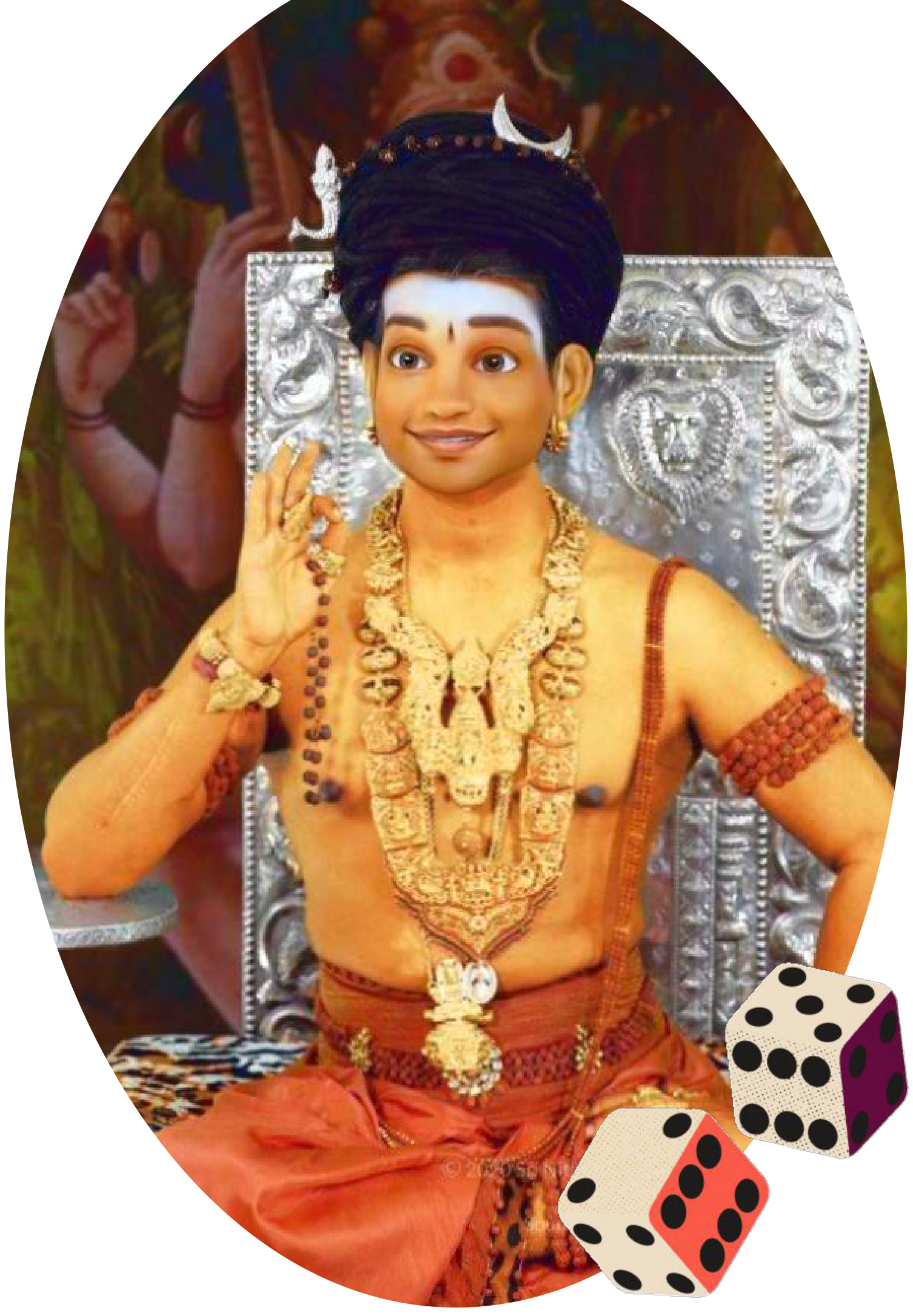
In fulfillment of their mother Kuntī’s desire that the brothers share everything equally, Draupadī became the wife of all five Pāṇḍava brothers. Duryodhana persuaded Yudhiṣṭra to join a gambling session, where his cunning uncle Śakunī defeated the Pāṇḍava king.
Yudhiṣṭra lost all that he owned—his kingdom, his brothers, his wife and himself, to Duryodhana. Duśśāsana shamed Draupadī in public by trying to disrobe her. The Pāṇḍava brothers and Draupadī were forced to go into exile for fourteen years, with the condition that in the last year they should live incognito or ajyāta vāsa.
© 2020 Sri Nithyananda Paramashivam. All Rights Reserved.
WHAT HAPPENED DURING THE
MAHABHARATA?
At the end of the fourteen
years, the Pāṇḍava
brothers tried to reclaim
their kingdom. In this
effort they were helped by
Śrī Kṛṣṇa, the king of the
Yādava clan, who is the
eighth divine incarnation
of Bhagavān Viṣṇu.
However, Duryodhana
refused to yield even a
needlepoint of land, and
as a result, the Great War,
the War of Mahābhārat
ensued. In this war,
various rulers of the entire
nation that is modern
India aligned with one or
the other of these two
clans, the Kauravas or the
Pāṇḍavas.
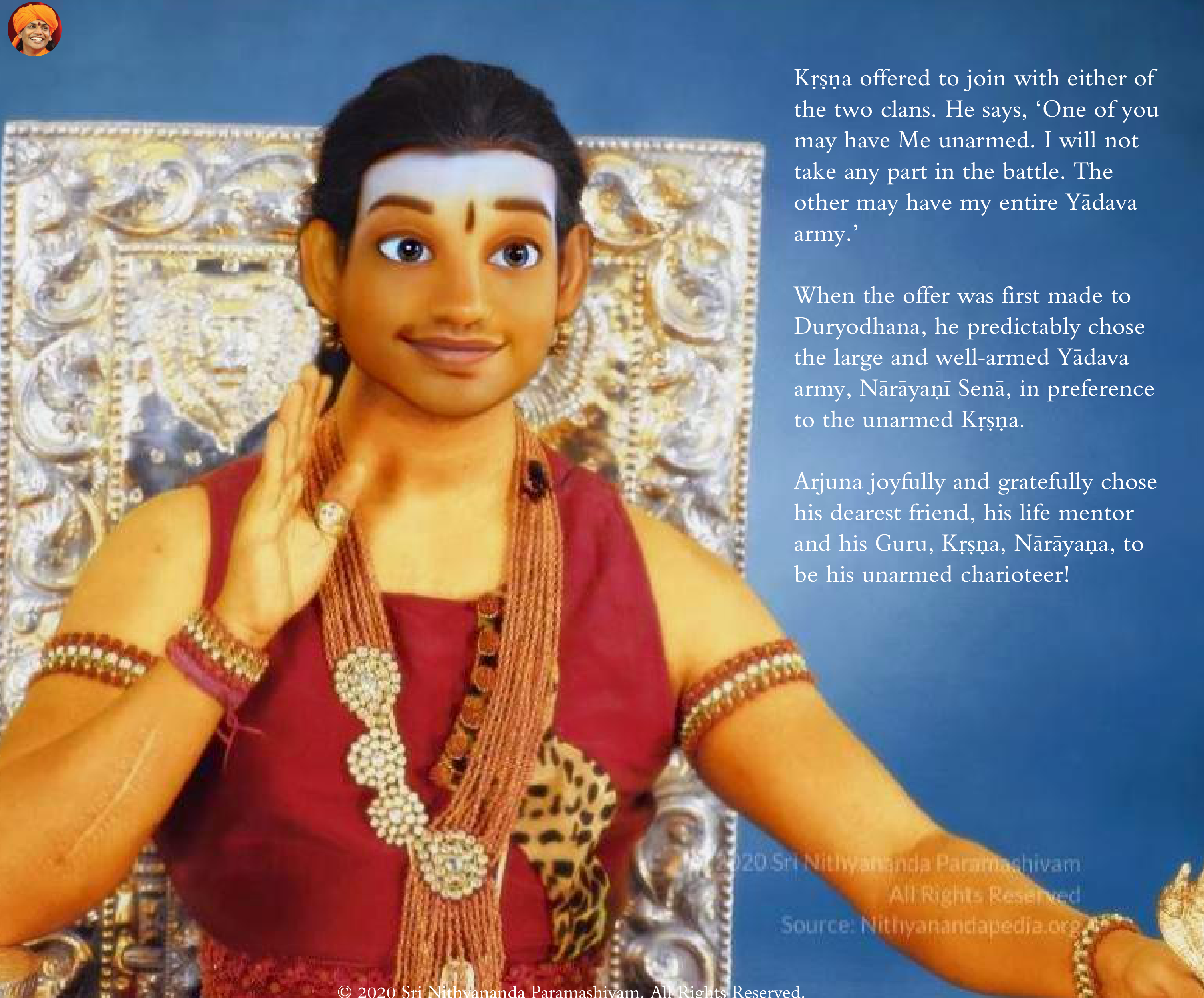
Kṛṣṇa offered to join with either of
the two clans. He says, ‘One of you
may have Me unarmed. I will not
take any part in the battle. The
other may have my entire Yādava
army.’
When the offer was first made to
Duryodhana, he predictably chose
the large and well-armed Yādava
army, Nārāyaṇī Senā, in preference
to the unarmed Kṛṣṇa.
Arjuna joyfully and gratefully chose
his dearest friend, his life mentor
and his Guru, Kṛṣṇa, Nārāyaṇa, to
be his unarmed charioteer!
© 2020 Sri Nithyananda Paramashivam. All Rights Reserved.
THE SIGNIFICANCE
OF MAHABHARAT
This whole history is such a beautiful
happening. Mahābhārat is actually your
life! Every character in the Mahābhārat
teaches so much! We don't need to go
anywhere for our life success or
fulfillment or for anything else that we
may desire. We don't need to study any
other book to learn the human
psychology or the science of living and
leaving. Whether we seek righteous
living—dharma; or we want to learn
business or administration, economy or
abundance—artha; or we want to create
the best rich lifestyle—kāma; or we
want to be a leader and want the
enriching life of being enlightened—
mokṣa, for all these purposes,
we don't need anything other than the
Mahābhārāt!
© 2020 Sri Nithyananda Paramashivam. All Rights Reserved.
Study each character. We will not find any more characters in our life than the characters described in the Mahābhārāt!
Any character we see in our life is mapped to Mahābhārāt’s one character. They are either half or full representation of some character.
To know how to handle them and even handle yourself, just see how Śrī Kṛṣṇa handles them and handle them the same way. The Mahābhārāt war is a representation of life as it was lived in that age.
Vyāsa, its author is an unbiased historian who recorded the whole history as it happened without trying to apply any makeup. People ask whether the Mahābhārāt war happened at all!