SAMADHi
This text was machine-transcribed from the printed book and may contain errors. Select the words and choose “Report a mistake”.
STATE
Savikalpa samādhi is the
state where the experience
of samādhi continues.
Nirvikalpa samādhi is when
the expression of samādhi
starts. Savikalpa samādhi is
supposed to be a lower
state, and one is supposed
to work towards the second
and higher state of
nirvikalpa samādhi.
But it is not an ironclad
rule.
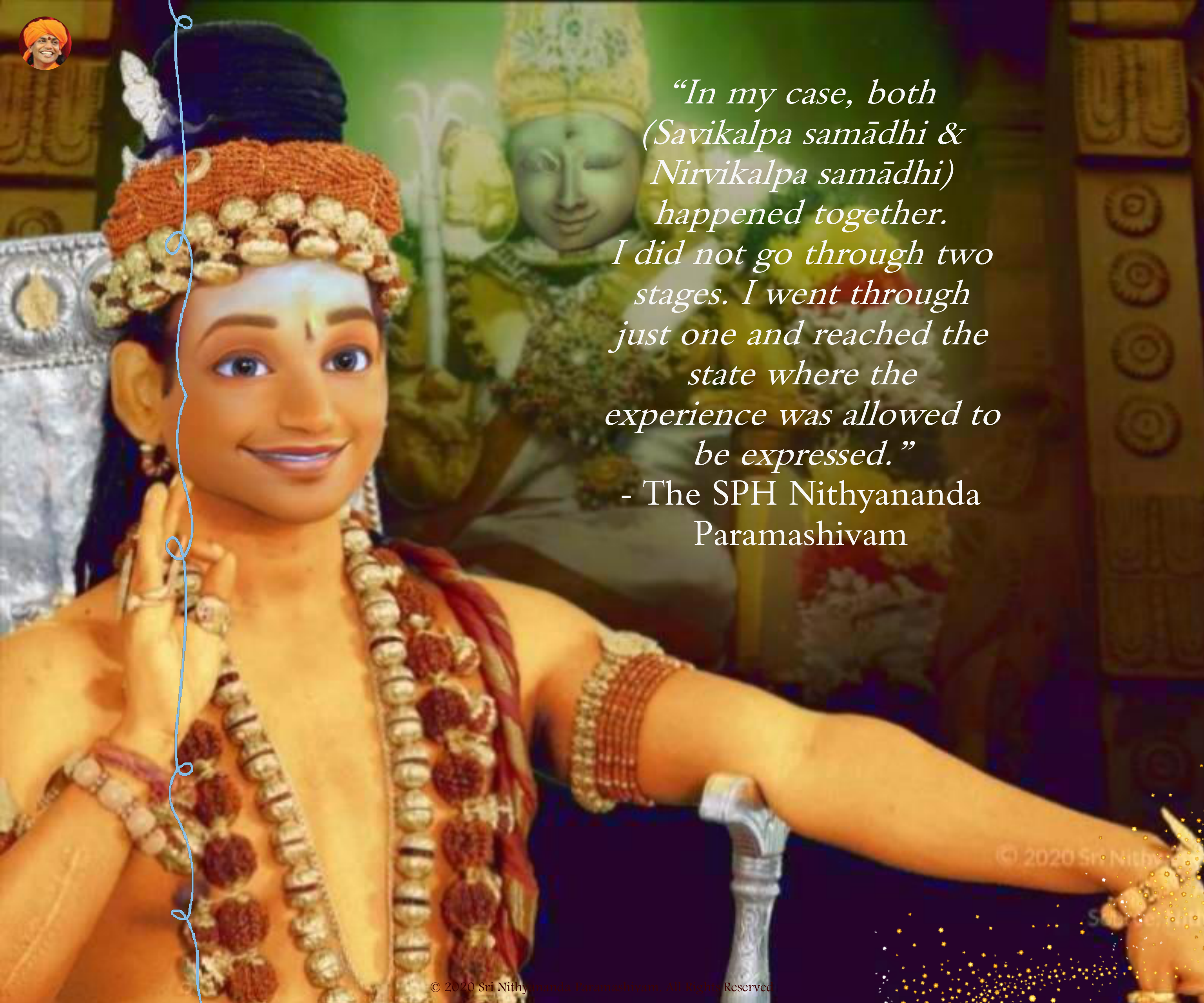
“In my case, both
(Savikalpa samādhi &
Nirvikalpa samādhi)
happened together.
I did not go through two
stages. I went through
just one and reached the
state where the
experience was allowed to
be expressed.”
- The SPH Nithyananda Paramashivam
© 2020 Sri Nithyananda Paramashivam. All Rights Reserved.
It was the will of the Divine, Parāśakti. Please understand that this is not a choice that people make. An option is not presented to those who have such experiences. Those who experience the Divine transcend that point of freewill. They are driven wholly, in each step that they take, by Parāśakti, the Universal energy; by Kṛṣṇa, the Superconscious Divine.
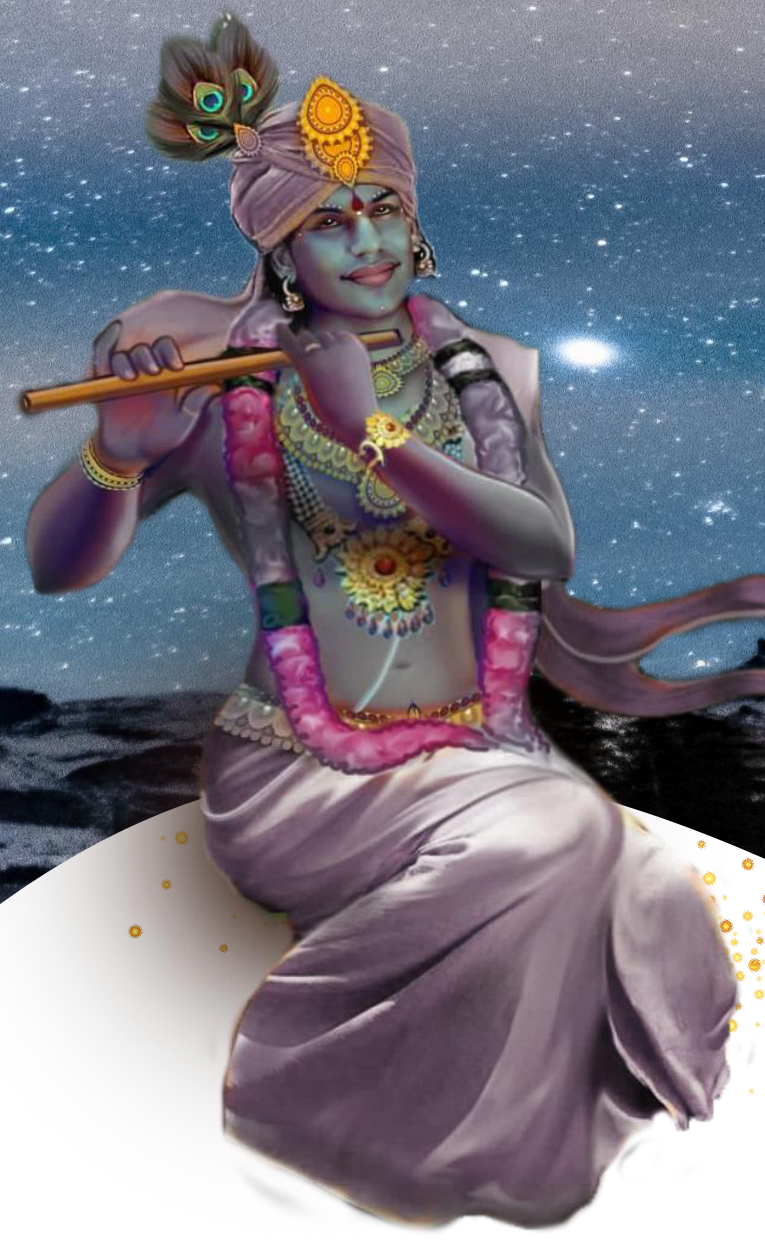
Arjuna understands that he and others who have had an experience of the Divine, face the choicelessness. He knows that Kṛṣṇa decides what he should do. Yet, he asks because he wants everyone to understand. Arjuna asks, 'What type of a person is greater? Is it a person who closes his eyes and sees God within himself or a person who opens his eyes and sees God in every being? Who is greater?'
He is not asking whether
worshiping the form or
worshiping the formless is
greater. Yet so-called religious
people have interpreted it that
way, and created problems
between the teachings of the
great masters, Ādi Śaṅkarācārya
and Rāmānuja. Śaṅkara followed
jñāna, the path of knowledge,
and Rāmānuja followed bhakti,
the path of devotion. Jñāna,
focuses on the formless through
intellectual queries. Bhakti
focuses on the form, sheer
devotion, as if the Divine were
alive as It indeed is! However,
those who have studied Śaṅkara
and Rāmānuja in depth know
that there was much devotion in
Śaṅkara’s approach and much
knowledge in Rāmānuja’s
approach!
Both approaches converge. One
without the other never works.
Expressing the gratitude that
happens because of the
experience is devotion. Having
that experience and rejoicing,
staying in that experience is
knowledge; that’s all.
Kṛṣṇa’s answer is that both paths
are the same.
The paths are intertwined.
The first one leads to the second
one and the second one leads
back to the first one. We have
heard the term vicious circle.
First one leads to the second and
the second one leads back to the
first one.
Vicious circle leads to low energy or lower level of consciousness. Virtuous circle leads to high energy, a higher level of consciousness! Bliss leading to devotion and gratitude, devotion and gratitude leading to bliss: these two form the virtuous circle that lead us to higher consciousness. Bliss means the experience of completion that leads us to the expression of gratitude and enriching. Again, the expression, the gratitude of enriching, leads us to bliss, and bliss leads us to deeper completion. One leads to the other and therefore it is a virtuous circle.
Usually we are caught in the
vicious circle. Fear leads to
greed and greed leads to fear.
More fear leads to more greed,
and more greed leads to more
fear. This is the vicious circle.
Here Kṛṣṇa introduces the
virtuous circle. Virtuous circle
is what He calls dharma,
righteousness, that which must
be followed in the path of
truth. Dharma means virtuous
circle, that which leads us to
live and express higher and
higher levels of Consciousness.
That in turn leads us to higher
and higher levels of blissful
experience. Consciousness and
bliss lead to expression of that
consciousness and bliss, which
in turn lead to higher level
experiences.
© 2020 Sri Nithyananda Paramashivam. All Rights Reserved
© 2020 Nithyananda Paramashivam. All Rights Reserved. www.nithyanandapedia.org